Could Wero wean Europe off dependence on Visa and Mastercard?
Every time a resident of the EU pays for a coffee, buys a train ticket or signs up for an online subscription, the transaction is almost…
Could Wero wean Europe off dependence on Visa and Mastercard?
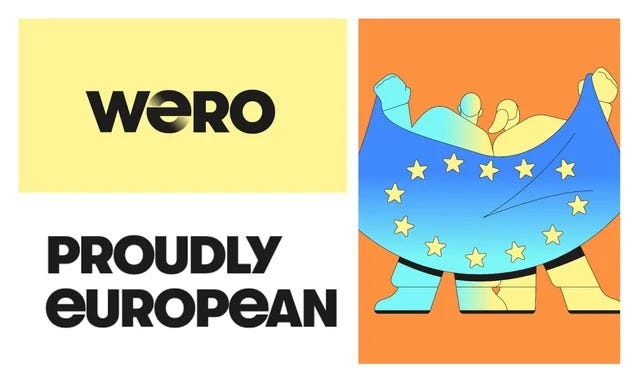
Every time a resident of the EU pays for a coffee, buys a train ticket or signs up for an online subscription, the transaction is almost always carried out by American companies. Visa, Mastercard, American Express, PayPal, Apple Pay or Google Pay are so embedded in our lives that we rarely think about them. Which raises the question as to why an economy the size of the European Union relies on payment systems it does not control?
The issue is especially striking because Europe has been talking about digital sovereignty for years: AI, cloud computing, semiconductors or cybersecurity; while ignoring one of the most critical layers of any modern economy: payments. In practice, we have built a single market, a common currency, and a complex regulatory framework, but we continue to leave an essential part of our financial infrastructure dependent on companies subject to another jurisdiction.
The data from the European Central Bank is revealing. Around 61% of card payments in the eurozone are processed by Visa and Mastercard, with 13 European countries lacking a relevant domestic alternative. In many cases, every payment made by European citizens and companies ends up going through US networks.
In response, the EU’s European Payments Initiative launched Wero a year ago, backed by a consortium of some of Europe’s main banks. During its first year of operation, the platform has reached 48.5 million users and processed more than €7.5 billion in transactions. These figures are still modest compared to the gigantic volume of Visa or Mastercard, but enough to show that there is a real demand for European alternatives.
At this stage Wero’s true value is not in its numbers, it’s that it provides a potential alternative to Visa or Mastercard. The important thing is that it exists. That there is a functional, interoperable and European alternative. Retailers, consumers, regulators, and governments now know they have another option.
Because the existence of an alternative radically changes the playing field. Today, Visa and Mastercard can impose conditions from an extraordinarily comfortable position. Retailers have practically no other option but to accept its conditions. But if Europe manages to deploy its own infrastructure capable of operating payments between individuals, e-commerce and point-of-sale payments, the conversation changes completely and we can prevent a few actors from having the capacity to unilaterally dictate their rules. If we also add that these actors are subject to the will of an unpredictable US government that can demand the data it deems appropriate at any time, the problem — and the solution — is obvious.
What makes Wero even more interesting is that it does not intend to start from scratch. The aim is to connect and coordinate already consolidated national systems such as Spain’s heavily implanted Bizum, Italy’s Bancomat, Portugal’s MB Way, the Netherlands’ iDEAL and MobilePay in Notrthern European countries. The idea is to build a true pan-European network that allows instant payments between citizens and businesses without relying on external infrastructure.
Obviously, payment habits are difficult to change. Apple Pay and Google Pay offer a great user experience. Visa and Mastercard have decades of advantage, universal acceptance, and enormous economies of scale. Even in Germany, one of the first markets where Wero was deployed, adoption is still relatively limited.
But reducing the discussion to a simple trade battle would be a mistake. Payment systems are also geopolitical instruments. When Visa and Mastercard decided to suspend their operations in Russia following the invasion of Ukraine, they demonstrated something obvious: whoever controls financial infrastructures has a powerful tool to apply political pressure. In that specific case, many considered the measure justified. But the lesson is still valid. Technological dependence always implies vulnerability.
That is why it is significant that the ECB has been insisting for years on the need to strengthen European autonomy in payments, or that the debate on the digital euro is moving forward in parallel. They are not identical initiatives, but they respond to a common concern: the need to ensure that Europe retains decision-making power over infrastructures that are essential for its economy.
The issue, moreover, transcends the financial sphere. Payments generate data, business relationships, bargaining power and innovation. They determine who captures value and who sets the standards. In an increasingly digitalized economy, controlling these infrastructures is equivalent to controlling a significant part of the future.
Europe has delayed too long in building digital platforms. It was late to social media, the cloud, mobile operating systems, and many other strategic areas. But in payments there is still a real opportunity to shake up the competition.
And that should be the real goal. Not because of economic patriotism or industrial nostalgia, but because no market works properly when it depends on such a small number of actors. Sovereignty is not about closing borders or expelling competitors: it is about having options.
Because, in the end, the question is not whether Wero will defeat Visa or Mastercard. The question is much simpler: do we want the infrastructure that moves our money to depend exclusively on decisions made outside Europe? If the answer is no, then initiatives like Wero cease to look like mere financial experiments and become something much more important: an essential piece of European strategic autonomy.
(En español, aquí)
메타데이터
- post_id
- 2f550a678042
- slug
- could-wero-wean-europe-off-dependence-on-visa-and-mastercard-2f550a678042
- url
- https://medium.com/enrique-dans/could-wero-wean-europe-off-dependence-on-visa-and-mastercard-2f550a678042
- canonical_url
- https://medium.com/enrique-dans/could-wero-wean-europe-off-dependence-on-visa-and-mastercard-2f550a678042
- author_url
- https://medium.com/@edans
- status
- ok
- fetched_at
- 2026-06-09 15:37:30