Crypto Primary Market Weekly Report: VC Heat Hits Monthly Peak at 27x, MegaETH Ignites Ethereum…
SYNBO Primary Market Investment & Trend Insight Report | Issue №15
Crypto Primary Market Weekly Report: VC Heat Hits Monthly Peak at 27x, MegaETH Ignites Ethereum Ecosystem
SYNBO Primary Market Investment & Trend Insight Report | Issue №15
Report Date: May 6, 2026
Cycle: April 27, 2026 — May 3, 2026
Type: Crypto Primary Market Data Statistics & Trend Analysis

Abstract
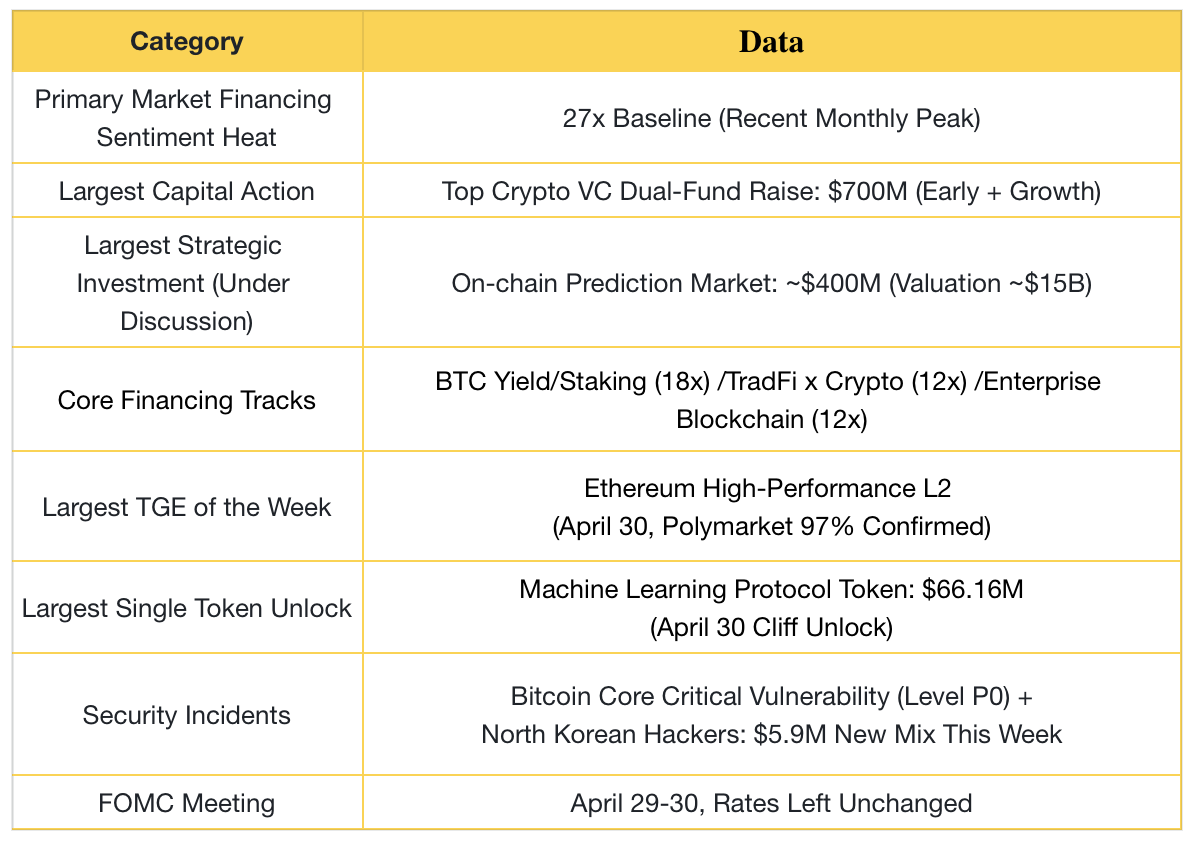
From April 27 to May 3, 2026, the capital landscape of the crypto primary market shifted from “Project-led Financing” to a stage of “Institutional Capital Formation.”
Two representative capital signals emerged this week:
- A top-tier crypto VC announced one of the largest dual-fund raises in history ($700 million total, split between early-stage and growth), marking the largest capital action of 2026 so far.
- A leading on-chain prediction market platform is advancing a ~$400 million strategic round (at a ~$15 billion valuation), backed by a traditional mainstream financial exchange group. If confirmed, this will be the largest single funding in the prediction market sector and the first time core TradFi infrastructure has taken a sovereign-level stake in an on-chain betting market.
Financing sentiment reached 27x the benchmark, making it the strongest week in recent months. BTC Yield/Staking Infrastructure (18x heat) became the dominant track; having completed “Step 1: BTC Allocation,” institutions are accelerating “Step 2: Deployment of Yield Tools.” Overall, the market is upgrading from “narrative-driven” to “institutional ecosystem construction.” Capital is no longer chasing individual projects but systematically laying the groundwork for the next cycle’s infrastructure layer.
Core Data Overview
This week’s financing landscape presents two distinct characteristics:
- First, the level of capital formation has shifted upward from the “project level” to the “fund level.” The dual-fund raise by a top-tier crypto VC signifies that institutional LPs in 2026 are assigning a high degree of certainty to the crypto cycle over the next 3 to 5 years. This is a far stronger signal of confidence than any single project financing. The specific tracks they choose to allocate to will serve as the most critical forward-looking indicator for primary market heat in the second half of the year.
- Second, the penetration of TradFi × Crypto has pivoted from “passive allocation” to “active equity participation.” The strategic investment intent shown by core traditional financial infrastructure institutions toward on-chain price discovery mechanisms marks a new structural milestone in institutionalization. They are no longer simply seeking indirect exposure to crypto assets through ETFs, but are instead taking direct equity stakes in the on-chain prediction and betting markets.
I. Primary Market Scale & Growth Trends
1.1 Key Financing Highlights

1.2 Sector Deep Dive
Bitcoin Yield/Staking Infrastructure: The BTC Version of Ethereum’s Institutional LRT Path is Launching
Financing signals for BTC-yield and bitcoin-staking surged simultaneously this week (reaching 12 to 18 times the baseline), driven by clear underlying logic: with spot BTC ETFs in the US seeing consecutive net inflows totaling over $2.12 billion since April 8, institutions have completed the first step of “Allocating to BTC.” In the next phase, institutions will seek to enhance the yield on their BTC holdings — pointing directly to the Bitcoin staking/yield infrastructure layer.
This closely mirrors the institutionalization path of the Ethereum LST/LRT sector in 2024–2025. Due to the time-compression effect, the speed of capital migration is expected to outpace the Ethereum precedent. However, the systemic risk lessons from the KelpDAO incident hold equally true for the BTC yield track: the triple overlap of high LTV configurations, cross-chain messaging layers, and non-isolated exposure remains the most dangerous combination. Given that the maturity of cross-chain security infrastructure in the BTC ecosystem is far lower than that of the Ethereum EVM, risk parameters must be set far more conservatively.
TradFi × Crypto Integration: From Strategic Exploration to Core Infrastructure Equity Participation
The Intercontinental Exchange (ICE, parent company of the NYSE and one of the world’s largest financial infrastructure operators) discussing a ~$400 million strategic investment in an on-chain prediction market represents a qualitative shift in the strategic logic of traditional financial infrastructure. It is no longer just about indirectly allocating to crypto assets via ETFs; it is about taking a direct equity stake in a core platform for on-chain price discovery.
A $15 billion valuation indicates that ICE/NYSE is treating the on-chain prediction market as a core financial infrastructure on par with traditional derivatives exchanges. This serves as an order-of-magnitude valuation repricing signal for the entire on-chain betting and prediction sector, with the stablecoin settlement layer and the oracle data layer being the most direct infrastructural beneficiaries.
Blockchain Capital’s $700M Dual-Fund: Decoding Institutional LPs’ Outlook on the 2026–2030 Cycle
The dual-track structure (early-stage Fund VII + growth-stage Fund VIII) signifies that Blockchain Capital is placing bets across two time horizons simultaneously: the early-stage fund captures narrative directions and seed-stage opportunities, while the growth-stage fund locks in leading projects within proven sectors.
The $700 million scale makes this the largest crypto VC fundraising action of 2026 to date. The specific tracks they allocate this capital to will be gradually revealed through project announcements over the next 3 to 6 months — this will serve as the most crucial forward-looking indicator for assessing primary market heat in the second half of 2026, and warrants continuous tracking.
II. Launchpad Ecosystem & TGE Trends
2.1 MegaETH (MEGA) — The Largest TGE Signal of 2026
MegaETH completed its Token Generation Event (TGE) on April 30, 2026. Market expectations were sky-high, with Polymarket giving it a 97% confirmation probability.
- Why it Matters:
MegaETH is positioned as a “Real-Time EVM.” Its core technical proposition is to increase the Ethereum execution layer’s TPS to 100,000, bringing the on-chain transaction experience closer to the real-time response of Web2 applications — this poses a fundamental challenge to the “delayed confirmation” experience of existing L2s. The project has received a personal endorsement from Vitalik Buterin, along with participation from top-tier institutions such as Dragonfly Capital and Figment Capital, giving it a highly solid financing background.
The structural significance of the MegaETH TGE for the crypto market is reflected in three dimensions:
First, the Ethereum L2 competitive narrative is shifting from “security/decentralization” to “execution layer experience.” The competitive focus of Arbitrum, Optimism, and Base lies in their security architectures and ecosystem compatibility. MegaETH, however, uses “real-time capability” as its core differentiator. If its technical metrics are realized, it will directly compete with Solana’s “high-speed public chain” narrative while simultaneously redefining the expected “speed ceiling” for Ethereum L2s.
Second, the 97% prediction probability represents a risk rather than a certainty. Ultra-high certainty expectations typically lead to a “sell the news” effect when the TGE actually occurs. When market participants collectively believe an asset is “bound to rise,” the probability of market makers narrowing their quoting ranges and the market experiencing insufficient day-one depth increases significantly. This is the most critical short-term price risk for the MegaETH TGE. It is recommended to strictly separate the “success of the TGE event itself” from the “post-TGE price trajectory” as two entirely independent dimensions.
Third, the liquidity interference from the simultaneous FLOCK cliff unlock. The $66.16 million FLOCK cliff unlock occurs on the exact same day as the MegaETH TGE, forcing market liquidity to face two directional forces. While buyer enthusiasm for MegaETH might absorb a portion of the FLOCK selling pressure, if market sentiment reverses on MegaETH’s first day, these two forces will align to create extreme downward pressure.
The next observation node: The 30-day TVL growth rate and the migration speed of mainstream DEXs after MegaETH goes live. These two indicators will reflect the actual market adoption willingness of the “Real-Time EVM” narrative much more accurately than the day-one price.
III. Post-Token Unlock Performance Data
3.1 OpenGradient (OPG) — First Tracking One Week After Binance’s 46th TGE

The subsequent effects of the proactive burn of $24 million worth of tokens in the previous period (April 16, near ATH price) continued to be validated this week: post-burn, the price has maintained a high level in the $0.57 — $0.65 range, with no significant selling pressure observed, indicating a relatively healthy holding structure.
Core Lesson: For tokens in the AI infrastructure track like OPG, the developer adoption rate and mainnet transaction volume are the core variables determining the valuation anchor. It is recommended to track the number of active developers and cumulative AI computation tasks on a monthly basis, rather than relying solely on price appreciation to judge holding logic. The 65% unvested tokens represent an overarching structural dilution pressure; the schedule for each unlock phase must be systematically integrated into your position management framework.
IV. Upcoming Token Unlocks in the Next Two Weeks
This section provides a forward-looking view for the next two weeks to help token holders position themselves in advance and discover investment windows.
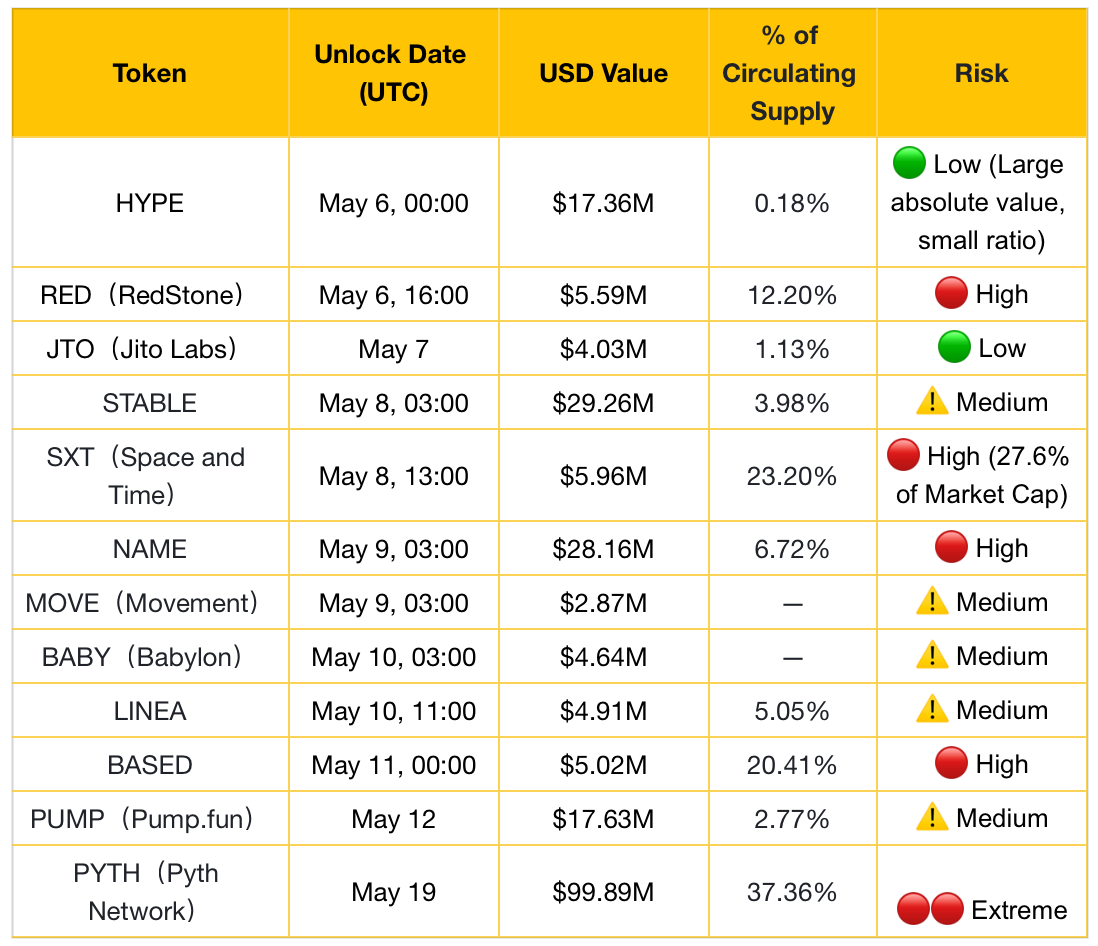
It is recommended to closely monitor large on-chain transfers and exchange inflows 2–3 days prior to the unlock date. The 24–72 hours following the unlock is considered a high-risk window.
- Pyth Network is scheduled to unlock 2.13 billion $PYTH tokens on May 19, valued at approximately $99.89 million, accounting for 37.36% of the current circulating supply and 21.30% of the total supply.
- Pump.fun plans to unlock 10 billion $PUMP tokens on May 12, valued at approximately $17.63 million, accounting for 2.77% of the circulating supply and 1% of the total supply. Notably, this token launchpad recently burned 123 billion previously repurchased $PUMP tokens, with a burn value exceeding $370 million, representing over 36% of the circulating supply.
Operational Framework
- Around May 19 is the highest-risk single day within the two weeks: PYTH has a $99.89M cliff unlock representing 37.36% of its circulating supply. Holders are advised to complete position assessments by May 16 (Saturday). The 24–72 hours post-unlock will be a high-risk window.
- May 8 “Double-Hit” Day (STABLE + SXT): Two unlocks occur on the same day. STABLE has the largest scale, while SXT has the highest market cap ratio. If market sentiment is weak that day, the dual selling pressures will create a resonance effect. Avoid making large position entries on this day.
- Linear Unlocks Cannot Be Ignored: RAIN’s linear release scale for the entire month tops the monthly list ($397.5M). Among the top seven token unlocks in May, $RAIN leads with $397.5M, followed by $PYTH at $100.16M, and $ZRO at $36.78M. While linear unlocks do not have the single-day peak of cliff unlocks, the continuous daily release creates a long-term price ceiling, and holders must factor this into their mid-term valuation frameworks.
V. Security Incidents
5.1 Bitcoin Core Critical Vulnerability — The Highest-Level Protocol Impact of 2026 Crypto Security Incidents
This week’s highest-level alert in the crypto security space came from the foundational protocol layer of the Bitcoin network: a critical vulnerability was disclosed in Bitcoin Core. Miners could exploit this vulnerability to remotely crash other network nodes and execute arbitrary code without needing administrative privileges over the target nodes.
- Technical Mechanism: The vulnerability pathway is triggered through the Bitcoin P2P network messaging layer and exists in specific versions of the Bitcoin Core client. Theoretically, if the vulnerability were coordinated and exploited on a massive scale, it could lead to a restructuring of the network’s hash rate distribution, give a minority of miners asymmetric control over the network, and potentially trigger temporary blockchain fork risks.
- Market Significance: This is one of the most severe disclosed remote execution vulnerabilities in Bitcoin’s history, directly shaking the core narrative of BTC’s “underlying protocol security.” Institutional investors currently allocating massively to BTC via ETFs (with cumulative net inflows exceeding $2.12 billion) are facing a confidence shock, which could trigger short-term selling pressure. However, historically, patches for similar vulnerabilities in the Bitcoin ecosystem are typically released within 48–96 hours, and the market shock is usually digested within 2–4 weeks. The long-term significance of this event is that it brings “the responsiveness and transparency of the Bitcoin protocol maintenance team” into the due diligence frameworks of mainstream institutional investors for the first time, serving as a critical stress test for the maturity of the Bitcoin ecosystem.
5.2 North Korea-Linked Hackers Continuing to Launder Money — Structural Evolution in Cross-Chain Mixing Efficiency
- Timeline Progression: On 4/20, attribution was confirmed to the Lazarus Group (TraderTraitor operation); identity remains locked.
- 4/20–4/26: Multi-party collaboration resulted in the freezing of 30,766 ETH (approx. $71 million), the largest on-chain collaborative freeze in history.
- New This Week: Wasabi Perps tracking revealed attackers newly deposited $5.9 million into Tornado Cash.
- Overall Path: Cross-chain messaging layer attack to steal ETH → THORChain.
- Deep Insight: The laundering efficiency of the Lazarus Group is systematically improving. After the 2022 Ronin Bridge incident, moving a similar scale of funds took over 6 months; in this recent KelpDAO incident, the primary funds essentially completed their mixing paths within 3–4 weeks, reflecting a significant evolution in their toolchain. This poses a structural challenge to the on-chain enforcement capabilities of global crypto regulators. The traditional dual-track model of “on-chain tracking + exchange KYC blocking” is systematically failing against real-time cross-chain mixing. Proactive compliance interception at the protocol layer (such as THORChain’s optional OFAC compliance mode) will become the core topic of enforcement discussions in the next phase.
5.3 Drift Protocol — The “Proactive Compensation” Paradigm Sets a New Standard for DeFi Credit
Drift Protocol officially announced a $295 million user compensation plan for its hacking incident this week, marking one of the largest proactive compensation commitments by a protocol in DeFi history.
- Historical Significance of the Compensation Mechanism: Drift choosing to bear the compensation obligation rather than shutting down the protocol indicates a fundamental shift in the survival paradigm of DeFi protocols following extreme risk events — moving from “losses borne by users / protocol shutdown” to “protocol credit backing / proactive remediation.” This echoes the narrative of last week’s “DeFi United” joint mechanism: the anti-fragility of the DeFi ecosystem is expanding from the “technical layer” to the “social coordination layer” and the “protocol credit layer.”
- Unresolved Issues: The source of the compensation funds (the specific ratio between protocol treasury / DAO proposal / insurance fund) and the timeline have not yet been fully disclosed. The progress of Drift DAO governance proposals requires continuous monitoring. The execution quality of this compensation will become a key qualitative indicator for future investors when assessing the risk premiums of DeFi protocols.
5.4 Other Security Incidents This Week
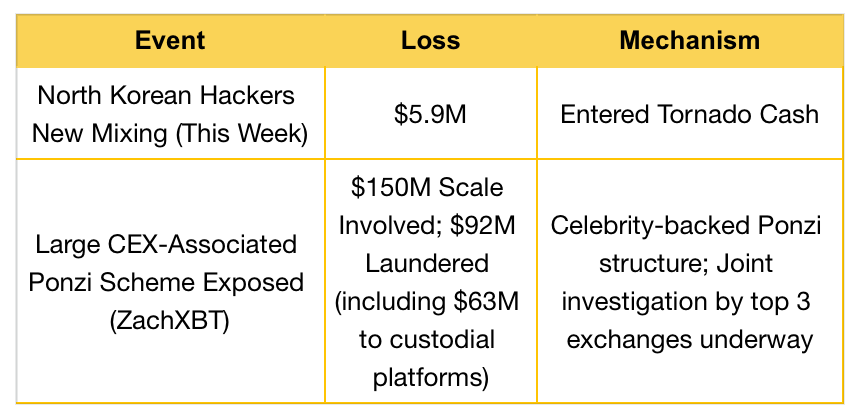
The second-largest social security incident this week was the massive Ponzi scheme exposed by ZachXBT: $150 million was laundered through complex on-chain pathways, with $63 million flowing into top crypto custodial platforms. This event proves once again: on-chain Ponzi schemes have evolved complex operational structures rivaling traditional financial fraud. Verifying Top 10 holding ratios + analyzing associated address graphs must become a standard operating procedure before participating in any small-cap token, rather than an optional step.
VI. Data-Driven Investment Summary
For Investors
- Bitcoin Core Vulnerability: Separate Short-Term Volatility from Long-Term Impact. The vulnerability exposure period (the 48–96 hour patch release window) is the most unstable timeframe; node operators should immediately review their versions and upgrade. Spot BTC holders do not need to panic trade; historical data shows that the market typically digests the shock within 2–4 weeks after the Bitcoin ecosystem repairs similar vulnerabilities. The long-term significance is that the transparency and response speed of the Bitcoin core development team will be included in institutional investors’ due diligence frameworks for the first time.
- BTC Yield Infrastructure: 18x Heat Signal is a Leading Indicator, but the LRT Risk Framework Must Be Applied. Institutional capital is looking for the “Step 2” tools to “make BTC generate yield.” This closely mirrors the institutionalization path of the Ethereum LRT track in 2024–2025 and is expected to form a primary financing narrative in the second half of 2026. However, KelpDAO’s risk lessons apply equally to the BTC yield track: independent audits of the cross-chain messaging configuration layer, strict high LTV limits, and non-isolated lending risk isolation are prerequisites that must be evaluated before taking positions.
- FLOCK + MegaETH Same-Day Dual Pressure: April 30 is the Highest-Risk Trading Day This Week. The collision of cliff unlock selling pressure and TGE buyer enthusiasm on the same day creates an extreme dual-directional liquidity state. It is recommended to complete position adjustments 48 hours in advance to avoid being forced into passive trades during extreme price quoting when these two forces intersect. The MegaETH “sell the news” effect must be included in your contingency plans as a baseline scenario.
- FOMC Left Rates Unchanged: Short-Term Macro Uncertainty Removed, but Beware of May Expectation Gaming. The Federal Reserve leaving interest rates unchanged on April 29–30 removes the greatest macro pressure for the crypto market in the short term. Historically, crypto markets generally see liquidity improvements 1–2 weeks after an “unchanged” FOMC resolution. However, during the May FOMC expectation speculation period, the correlation between BTC and interest-rate-sensitive assets will systematically rise. It is recommended to maintain weekly tracking of macro data.
For Project Teams
- Entering the BTC Ecosystem Requires Adopting the Post-KelpDAO Checklist. Project teams currently in or planning to enter the BTC yield/staking track must complete the following checks in advance: independent auditing of the cross-chain messaging configuration layer (distinct from traditional smart contract audits), E-Mode LTV cap evaluation, and non-isolated lending risk isolation plans. Do not simply copy the successful path of Ethereum’s LRT directly to the BTC ecosystem — the cross-chain infrastructures of the two underlying networks differ significantly, and the BTC ecosystem lacks the mature configuration audit toolchains of the Ethereum EVM.
- Large TGEs: Ultra-High Certainty Expectations Are the Greatest Liquidity Design Risk. The case of MegaETH’s 97% prediction probability demonstrates that when the market universally believes an asset is “bound to rise,” the likelihood of market makers narrowing their quote ranges and day-one depth being insufficient increases significantly. It is advised that highly anticipated TGE projects negotiate day-one liquidity plans with market makers in advance and design progressive price discovery mechanisms (such as batch-unlocking the initial circulation), making “expectation management” a core module of TGE design.
- ZachXBT On-Chain Transparency Framework: The Strongest Anti-Fraud Backing for Compliant Projects. This week’s large-scale Ponzi scheme case proved once again that ZachXBT’s on-chain forensic capabilities are sufficient to dismantle fraud structures of any size within weeks. For compliant project teams, this is a positive signal: proactively and regularly disclosing fund flows, making multi-sig addresses public, and ensuring transparent on-chain treasury operations are becoming the strongest compliance endorsements distinguishing them from fraudulent projects, serving as a major bonus point for attracting institutional investors.
For Market Observers
- “Bitcoin Protocol Security” Enters Mainstream Investment Discussions: A Shift in the Crypto Security Narrative. This week’s Bitcoin Core vulnerability is one of the most important narrative shift signals of 2026 — the focus of crypto asset security issues is moving upward from the DeFi application layer to the L1 foundational protocol layer. Even the Bitcoin network itself must undergo a “re-examination of security assumptions.” It is expected that the governance efficiency and patch quality of the Bitcoin core development team will become a monitoring dimension that institutional investors will continuously track in the second half of the year.
- Drift Compensation + DeFi United: Two New Standards for the DeFi Credit System Are Being Established Simultaneously. Last week’s DeFi United joint response mechanism and this week’s proactive compensation by Drift are jointly shaping the behavioral code for how the DeFi ecosystem handles black swan events. In the future, when investors evaluate DeFi protocols, the “historical crisis management record” will become a qualitative dimension as important as technical audits. Top-tier protocols capable of participating in joint responses or executing proactive compensations will command a sustained “systemic importance premium.”
- CLARITY Act May Window: The Most Critical Legislative Node Coexists with Maximum Uncertainty. Polymarket’s 56% passage probability implies that the legislative outcome has entered a zone of genuine uncertainty. The most important signal sources this month are: whether Senator Tillis’s revised text on the stablecoin provisions is officially published (the critical node for the integration path of the CLARITY Act and the GENIUS Act); and the final revision direction of the GENIUS Act AML rules following public commentary (deadline 6/9). If the CLARITY Act does not enter the Senate floor for a full vote by May, its probability of passing in 2026 will rapidly downgrade to below 50%, at which point the repricing of the compliance narrative will impact the valuation of blue-chip DeFi tokens.
FAQ: Frequently Asked Questions for This Report
Q1: What was the most important financing signal in the crypto primary market this week? The most important signal this week was not a specific single funding round, but the overall sentiment heat reaching the 27x baseline. Three tracks — Bitcoin yield infrastructure (18x), TradFi × Crypto integration (12x), and Enterprise Blockchain (12x) — were activated simultaneously, marking that institutional capital deployment has entered a “multi-track parallel” phase.
Q2: What is MegaETH? Why is it worth watching? MegaETH is an Ethereum L2 positioned as a “Real-Time EVM,” claiming to achieve 100,000 TPS. It completed its TGE on April 30. Its core significance is that it marks the first time “execution layer real-time capability” is used as the core differentiator for an L2. Backed by top ecosystem supporters like Vitalik Buterin, Polymarket gave it a 97% certainty prediction. This is the largest single liquidity event in the Ethereum ecosystem in 2026 and marks a critical turning point where the Ethereum L2 narrative shifts from a “competition for security” to a “competition for user experience.”
Q3: How severe is the Bitcoin Core vulnerability? What should ordinary holders do? The vulnerability is classified as Level P0 (the highest), allowing miners to remotely crash nodes and execute code. Node operators should immediately verify their running version and install the latest patch (typically released within 48–96 hours of vulnerability disclosure). Ordinary BTC holders do not need to panic. Historically, the market typically digests the impact within 2–4 weeks after the Bitcoin ecosystem repairs similar vulnerabilities. It does not affect BTC’s long-term value storage properties, but short-term price volatility should be factored into risk contingency plans.
Q4: What are the risks of the FLOCK unlock and MegaETH TGE happening on the same day? This is the most rare overlapping liquidity event of the week: the collision of a $66.16M cliff unlock sell pressure with MegaETH TGE buyer enthusiasm on the same day creates a dual-directional, extreme liquidity state. The optimal window for position adjustment is 48 hours before the unlock date. The MegaETH “sell the news” effect must be included as a baseline scenario in your plans to avoid forced, passive trades during the period when these two forces intersect.
Q5: What does Drift’s compensation plan signify? Drift’s decision to proactively compensate users for the $295 million hacking loss is one of the largest proactive compensation commitments in DeFi history. Its significance lies in shifting the survival paradigm of DeFi protocols from “loss/shutdown” to “compensation/rebuilding,” establishing a new behavioral standard for the DeFi credit system. In the long run, a protocol’s “historical crisis management record” will become a new dimension for investors evaluating DeFi protocol risk premiums.
Q6: Why is the money laundering efficiency of North Korean hackers increasing? The Lazarus Group’s toolchain has continuously evolved since 2022. Following the 2022 Ronin Bridge incident, laundering a similar scale of funds took over 6 months; in the recent KelpDAO incident, the primary funds essentially completed their mixing paths within 3–4 weeks. Their three-stage combination of Cross-Chain Bridges + Privacy Protocols + the Bitcoin Network poses a systemic challenge to the traditional dual-track enforcement model of “on-chain tracking + exchange KYC blocking.”
Q7: What are the expected developments for the CLARITY Act in May? May is the final critical legislative window for the CLARITY Act in 2026. The 56% passage probability on Polymarket places it in a zone of true uncertainty. If the Senate calendar does not schedule it for a floor vote in May, the full-year passage probability will rapidly drop below 50%. The most important observation signals are: whether Senator Tillis’s revised text on the stablecoin provisions is officially published, and the final revision direction of the GENIUS Act AML rules (public comment deadline 6/9).
Disclaimer
This report is based on public data and statistical information. It aims to verify market opportunities and innovative value through data-driven logic and does not constitute any investment advice. Cryptocurrency investments involve high risks, and investors should make decisions cautiously based on their own risk tolerance. This report makes no guarantees regarding the accuracy, completeness, or timeliness of the data, and assumes no responsibility for any direct or indirect losses arising from the use of this report’s contents.
Officially Produced by Synbo.io | Data as of May 6, 2026
메타데이터
- post_id
- 2f5a3d0e156e
- slug
- crypto-primary-market-weekly-report-vc-heat-hits-monthly-peak-at-27x-megaeth-ignites-ethereum-2f5a3d0e156e
- url
- https://medium.com/@synbo001/crypto-primary-market-weekly-report-vc-heat-hits-monthly-peak-at-27x-megaeth-ignites-ethereum-2f5a3d0e156e
- canonical_url
- https://medium.com/@synbo001/crypto-primary-market-weekly-report-vc-heat-hits-monthly-peak-at-27x-megaeth-ignites-ethereum-2f5a3d0e156e
- author_url
- https://medium.com/@synbo001
- status
- ok
- fetched_at
- 2026-07-10 19:15:58