Java 8 Explained: The ABCs of Functional Interfaces
Functional Interfaces are a core feature introduced in Java 8 to facilitate functional programming. They are single abstract method…
Java 8 Explained: The ABCs of Functional Interfaces
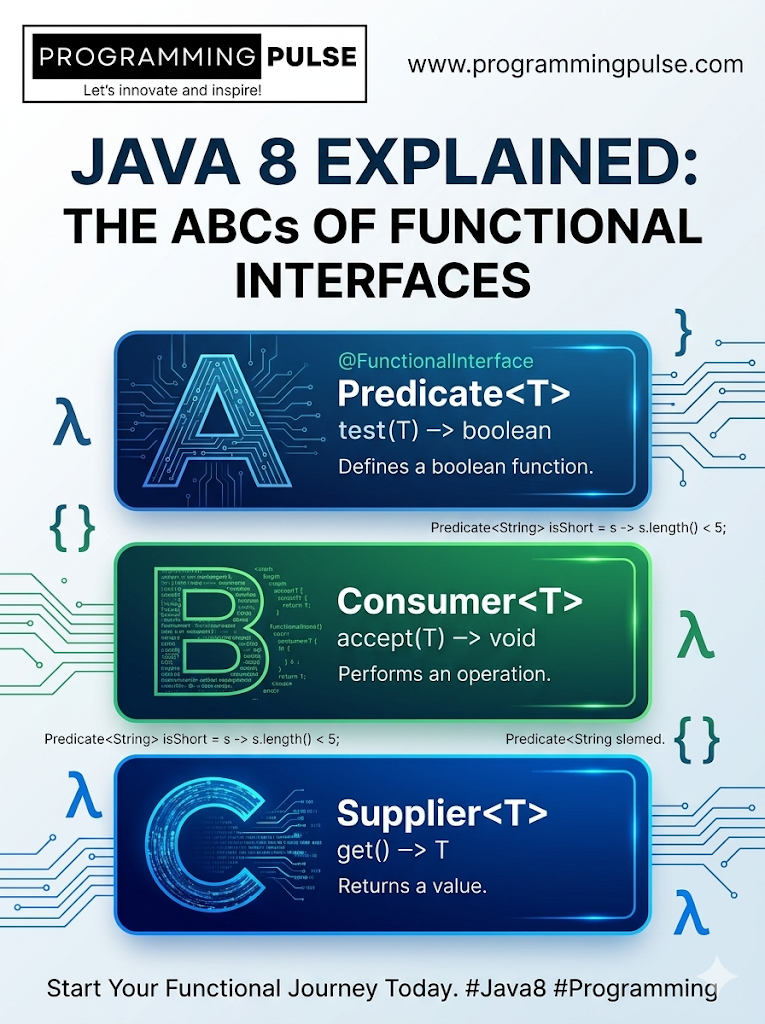
Functional Interfaces are a core feature introduced in Java 8 to facilitate functional programming. They are single abstract method interfaces, designed to work seamlessly with lambda expressions and method references, promoting cleaner and more readable code.
Key Characteristics of Functional Interfaces:
- Single Abstract Method (SAM): A functional interface must contain exactly one abstract method. This characteristic allows lambda expressions to provide an implementation for the method.
- Default and Static Methods: Functional interfaces can include default and static methods without affecting their functional nature, as these methods are not abstract.
- Annotation for Clarity:
The
@FunctionalInterfaceannotation is used to explicitly declare a functional interface. While optional, it ensures the interface adheres to the SAM rule by triggering a compilation error if more than one abstract method is present.
Common Functional Interfaces in Java 8:
Java 8 includes several built-in functional interfaces in the java.util.function package:
- Predicate: Accepts an argument and returns a boolean (
testmethod). - Consumer: Accepts an argument and operates without returning a result (
acceptmethod). - Function<T, R>: Accepts an argument and returns a result (
applymethod). - Supplier: Provides a result without accepting any input (
getmethod).
Example of a Functional Interface:
@FunctionalInterface
interface Greeting {
    void sayHello(String name);
}
public class FunctionalInterfaceExample {
public static void main(String[] args) {
// Using a lambda expression
Greeting greeting = name -> System.out.println("Hello, " + name + "!");
greeting.sayHello("Programming Pulse");
}
}Why Use Functional Interfaces?
- Simplifies the codebase with concise lambda expressions.
- Encourages the use of functional programming paradigms.
- Improves readability and maintainability of code.
By leveraging functional interfaces, Java 8 enables developers to write modern, efficient, and cleaner code while maintaining compatibility with existing object-oriented designs.
Happy Coding! 🚀
____
Follow my Instagram page — Programming_Pulse for daily programming tips and insights!
메타데이터
- post_id
- 2f6c4fd40e8e
- slug
- java-8-explained-the-abcs-of-functional-interfaces-2f6c4fd40e8e
- url
- https://medium.com/@Programming_Pulse/java-8-explained-the-abcs-of-functional-interfaces-2f6c4fd40e8e
- canonical_url
- https://medium.com/@Programming_Pulse/java-8-explained-the-abcs-of-functional-interfaces-2f6c4fd40e8e
- author_url
- https://medium.com/@Programming_Pulse
- status
- ok
- fetched_at
- 2026-06-09 15:37:30