A Comprehensive Market Insight into 800G Switches
As the scale of AI large-scale model training continues to expand, data center networks are rapidly entering the 800G era. Compared to 400G…
A Comprehensive Market Insight into 800G Switches
As the scale of AI large-scale model training continues to expand, data center networks are rapidly entering the 800G era. Compared to 400G architecture, 800G switches not only significantly improve single-port bandwidth density but also provide lower latency and higher throughput interconnect capabilities for ultra-large-scale GPU clusters. With the continuous upgrades of AI computing platforms represented by NVIDIA, and driven by the mass production of Broadcom’s 51.2Tbps and 102.4Tbps switching chips, 800G has moved from the technology research stage to a window of opportunity for large-scale deployment. This article will provide a systematic insight into the 800G switch market from the perspectives of market drivers, technological evolution, and development trends.
800G Switch Market Drivers
In the past, data centers primarily relied on north-south traffic (also known as frontend networks). However, with the rise of generative AI and large-scale model training, the traffic structure has shifted to an east-west (also known as backend networks) model centered on communication within GPU clusters. Operations such as All-Reduce in AI training bring high-bandwidth, high-concurrency, and low-latency-sensitive communication characteristics, upgrading the network from a basic connection channel to a key system component that determines computing efficiency.
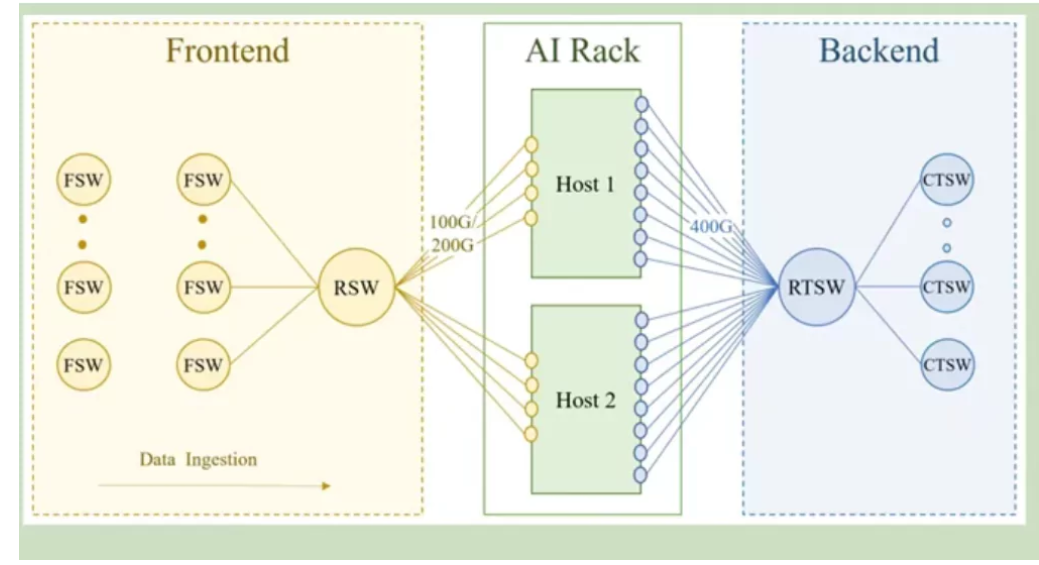
It is precisely under this structural shift — marked by continuously increasing computing power density and a rising proportion of communication traffic — that data center networks are transitioning from a supporting role to a performance-defining factor, making bandwidth generational upgrades inevitable. The rise of 800G switches is not merely a single-point technological evolution but the result of multiple industry variables converging. The core market drivers are primarily reflected in the following aspects:
- Large-scale model training continues to expand: The exponential growth in model parameters leads to a communication bandwidth demand that far exceeds Moore’s Law. To maintain parallel computing efficiency, higher bandwidth interconnect architectures are necessary to reduce cross-node communication overhead.
- GPU server bandwidth upgrades: Represented by NVIDIA’s new generation platform, single-node computing power has significantly improved, and server interface speeds to external networks have simultaneously increased to the 800G level, driving switch port upgrades.
- Switch chip capacity leap: Data center core switching capacity is moving from 51.2Tbps to 102.4Tbps. Leading vendors such as Broadcom have launched new-generation high-capacity ASICs, providing the underlying hardware foundation for high-density 800G port deployments.
- A transition window from 400G to 800G has formed: With the accelerated deployment of AI clusters, 400G is no longer sufficient to meet the bandwidth and port density requirements of large-scale training. 800G not only doubles the bandwidth but also delivers better TCO performance in terms of cost per bit, energy efficiency, and fiber resource utilization.
800G Switch Technology Evolution Path and Architecture Trends
SerDes Architecture Breakthrough
SerDes (Serializer/Deserializer) is the core of the physical layer of a switching chip. Its speed and signal integrity limits directly determine the overall switching capacity and port density. Current mainstream 51.2Tbps switching chips — such as the Broadcom Tomahawk 5 and NVIDIA Spectrum-4 — use 112G PAM4 SerDes to achieve 64×800G level port deployment.
However, 112G is approaching the physical limit of traditional PCB copper interconnects. Insertion loss and crosstalk of high-speed signals increase significantly in the traces, forcing the system to use ultra-low loss materials or shorten channel lengths. This means that the traditional architecture of “switching chip + pluggable optical module + long PCB traces” is gradually failing to meet current demands.

Different vendors are clearly pursuing different paths:
- Broadcom emphasizes high integration and expanded switching capacity;
- Marvell Technology emphasizes programmability and decoupled MAC-SerDes design;
- Cisco Systems balances switching and routing capabilities through a unified architecture.
The next stage will usher in the 224G SerDes era. With the advancement of the IEEE 802.3dj standard, 102.4Tbps chips are gradually being implemented. Copper interconnect distances will be further shortened, and new optoelectronic interconnect technologies such as AEC, LPO, and even CPO will accelerate their adoption.
Switch ASIC
The core engine of an 800G switch is a 51.2Tbps-class application-specific integrated circuit (ASIC), which not only provides bandwidth upgrades but also marks a key milestone in network architecture. The market is dominated by three major vendors: Broadcom, NVIDIA, and Marvell Technology, and the differences in their respective chip design strategies directly impact downstream system architecture and performance.
Broadcom Tomahawk 5
Designed for Spine/Leaf layer deployments in hyperscale data centers, this chip delivers 51.2Tbps and supports 64 x 800G ports or 256 x 200G ports. Based on a 5nm process, it integrates 512 x 100G PAM4 SerDes. Architectural features include scalable Ethernet, cognitive routing, dynamic load balancing, and global congestion control, significantly reducing AI traffic tail latency to approximately 250ns.

NVIDIA Spectrum-4
Spectrum-4 is the core of NVIDIA’s AI interconnect strategy, employing a custom 4N process and boasting 51.2Tbps bandwidth. Its advantage lies in its single-chip shared cache, enabling all ports to dynamically share a packet buffer, significantly improving the ability to absorb micro-burst traffic. Combined with the BlueField-3 DPU for end-to-end RoCE congestion control, it can improve effective bandwidth utilization by approximately 1.6 times in AI training scenarios.

Marvell Teralynx 10
Focusing on the cloud service provider market, this single-chip solution offers 51.2Tbps speeds, supports 64 x 800G ports, and features 512 logical channels for a flatter network topology. It boasts low latency (approximately 500ns) and programmable forwarding pipes, allowing support for new protocols or telemetry standards without hardware replacement, thus enhancing investment protection.

Cisco Silicon One G100
Designed for a unified routing and switching architecture, it supports 32 x 800G ports, is built on a 7nm process, emphasizes energy efficiency and P4 programmability, and is suitable for diverse network scenarios.

Overall, the evolution of 800G switches is not just about doubling port speeds, but also about a comprehensive upgrade of switching chips in terms of bandwidth, latency, programmability, and system architecture flexibility, providing fundamental support for AI and high-performance computing data centers.
CPO Technology
With the increasing port density of 800G switches, the power consumption of traditional pluggable optical modules has become a system bottleneck. A typical QSFP-DD 800G module consumes 16–18W, and the total power consumption of an optical module in a 64-port 51.2Tbps switch exceeds 1kW. Adding the 300–400W of the switching chip itself, the overall thermal design power (TDP) approaches 2kW, pushing air cooling to its limits.
Co-Packaged Optics (CPO) integrates the switching chip and optical engine into the same slot, achieving co-packaging of the chip and optical module, significantly reducing system power consumption. The CPO architecture mainly consists of an ASIC, an OE optical engine (including a PIC), an external light source (ELS), a flexible optical backplane, and an MPO connector. Advantages include:
- Low power consumption: Eliminating high-power DSPs within the optical module and using low-power SerDes on the ASIC reduces power consumption from the ASIC to the optical module by approximately 50%, resulting in a 25%–30% reduction in overall power consumption.
- Low latency and high bandwidth: Shorter optical-to-electrical distance significantly reduces signal latency and improves bandwidth utilization efficiency.
- Cost optimization: Reduced heat dissipation and fiber optic cabling costs.
In industry practice, Broadcom has launched Tomahawk chip CPO switches, supporting high-density ports and low-power computing. NVIDIA, on the other hand, has launched the Spectrum-X series of CPO switches, which, combined with the BlueField DPU, enable end-to-end AI cluster interconnection, improving bandwidth utilization and reducing system TCO. Overall, CPO is a key technology path for the evolution of 800G switch architecture, not only solving power consumption and heat dissipation bottlenecks, but also providing a feasible solution for the future deployment of 1.6T switches and 224G SerDes.

800G Switch Market Landscape
The 800G switch market is in the early stages of rapid growth. According to data from Dell’Oro Group and Dataintelo, the global 800G switch market was worth approximately $1.62 billion in 2024 and is projected to grow to $17.45 billion by 2033, representing a compound annual growth rate (CAGR) of 32.7%. 2025 is considered the “Year Zero” for 800G, with port shipments expected to reach a record high, particularly in AI training and inference backend networks, where 800G ports are rapidly replacing 400G and 200G ports.
In terms of the global market landscape, Arista Networks, NVIDIA, and Cisco Systems dominate. Arista leads in the hyperscale cloud service provider market with its high-performance, low-latency Spine/Leaf switch solutions; NVIDIA holds a near-monopoly in turnkey AI network architectures, achieving efficient end-to-end interconnectivity through Spectrum-X and BlueField DPUs; and Cisco continues to maintain its advantage in the traditional enterprise and carrier markets, with its Silicon One series addressing both routing and switching needs.
Overall, the 800G market is still in a phase of rapid expansion, and competition in the next few years will revolve around new architectural capabilities such as port density, energy efficiency, AI interconnect optimization, and CPO.
Challenges in the Development of 800G Switches
While 800G switches represent a significant stage in the evolution of data center network bandwidth, their practical implementation still faces several constraints.
High Initial Capital Investment
800G switches are typically based on the latest generation of high-performance switching ASICs (such as 51.2Tbps or higher capacity chips), coupled with 800G optical modules (OSFP/QSFP-DD) and high-specification cabling systems. The overall CAPEX is significantly higher than that of 400G architectures. Not only is the equipment itself expensive, but the costs of supporting optical modules, AOC/DAC cables, and rack power consumption and thermal management upgrades are also considerable. Therefore, for small and medium-sized enterprises or non-high-density AI/cloud scenarios, the return on investment cycle is relatively long, constituting a real barrier to entry.
Increased Network Integration and Architectural Complexity
800G switches are often deployed in Spine-Leaf or AI-dedicated Fabric architectures, placing higher demands on network design. This includes the rational planning of high-speed port breakouts, compatibility strategies with 400G/200G nodes, optimization of low-latency protocols such as RDMA and RoCEv2, and high-density cabling and airflow management. Upgrading existing data centers may involve network topology reconstruction and equipment replacement, making implementation significantly more complex than traditional speed upgrades.
Shortage of Professional Technical Personnel
800G Ethernet networks typically serve AI training clusters, high-performance computing, or ultra-large-scale cloud environments, involving advanced network optimization capabilities, such as ECMP and load balancing optimization, congestion control parameter tuning (e.g., PFC, ECN), and large-scale fabric automated operation and maintenance. Currently, engineers with experience in high-speed Ethernet fabric design and operation and maintenance are relatively scarce, making talent costs a hidden challenge.
Interoperability and Ecosystem Compatibility Issues
Although the 800G interface standard has gradually matured, differences still exist between different vendors in terms of optical module compatibility, operating system characteristics, and hardware platform optimization. Especially in hybrid deployment environments (multi-vendor switches, different brand optical modules), additional compatibility verification and testing are required to avoid link stability and performance issues. This is particularly critical for companies sourcing from multiple brands.
Emerging Trends in 800G Switches
While challenges exist, the 800G switch ecosystem is rapidly maturing, exhibiting the following major development trends:
Accelerated Deployment of Silicon Photonics Technology
The large-scale application of silicon photonics technology is reducing the cost of high-speed optical modules and improving power efficiency and port integration. By combining optics with CMOS processes, the power consumption and size of 800G optical modules are continuously optimized, which helps alleviate the heat dissipation and energy consumption pressure of high-density switches, while improving overall system reliability.
Energy Efficiency Optimization Becomes a Core Indicator
With rising electricity costs in data centers and increasingly stringent carbon emission regulations, Power Usage Effectiveness (PUE) and Power Consumption Ratio (PCR) have become key indicators. The new generation of 800G switches continues to improve in chip manufacturing processes, port power management, and dynamic energy-saving mechanisms, constantly optimizing power consumption per bit (W/Gbps), making them more competitive in the long-term Total Cost of Ownership (TCO).
Deep Integration with AI-Driven Network Management
With the continuous expansion of AI clusters, traditional manual operation and maintenance (O&M) is insufficient to meet the real-time optimization needs of complex fabrics. More and more 800G platforms are integrating with AI-driven network management tools, enabling real-time traffic analysis, automatic congestion prediction, anomaly detection and root cause analysis, and adaptive load optimization. This shifts the network from “passive response” to “proactive optimization.”
The Rise of Decoupled Network Architecture
Decoupled networking is gaining wider attention. This model separates the hardware platform from the network operating system, allowing enterprises to flexibly choose white-box switches and deploy open-source or commercial NOS, thereby reducing vendor lock-in risk. In the 800G era, this model is particularly suitable for large-scale data centers and AI infrastructure environments because it can improve architectural flexibility while ensuring performance.
Overall, 800G switches are transitioning from “high-end experimental deployments” to “mainstream large-scale applications.” In the short term, cost and complexity remain the main limiting factors; in the medium to long term, with the maturation of silicon photonics, energy efficiency optimization, and the improvement of the decoupled ecosystem, 800G will become the standard configuration for high-performance data center networks.
NADDOD 800G Switch Introduction
NADDOD offers high-performance 800G Ethernet switches for AI/ML and HPC scenarios, covering the 51.2T platform based on the Broadcom Tomahawk 5 (TH5) ASIC. These switches feature high port density and large-scale switching capacity, significantly improving throughput and scalability under the Leaf-Spine architecture.
In addition, NADDOD also offers 800G switch solutions based on NVIDIA Spectrum-4, meeting the need for consistency with the NVIDIA network ecosystem and software stack. Through deep integration with mainstream chips and the ecosystem, NADDOD achieves a balance between performance, compatibility, and deployment efficiency, optimizing overall data center network design and TCO. For further information on how to select the appropriate 400G or 800G switch for your network environment, please refer to our blog post: How to Choose the Right 400G/800G Ethernet Switch?

Conclusion
With the rapid development of large-scale AI models and hyperscale GPU clusters, the demand for high bandwidth, low latency, and high-density ports in data centers continues to rise, driving 800G switches from experimental applications to large-scale deployment. Compared to 400G architecture, 800G not only provides double the bandwidth but also significantly improves port density, energy efficiency, and interconnect efficiency, becoming a key infrastructure for AI training, inference, and high-performance computing scenarios. The implementation of CPO, silicon photonics technology, and next-generation switching chips provides practical solutions to address power consumption, heat dissipation, and interconnect complexity, transforming the network from a supportive role to a performance determinant.
Although high initial capital investment, increased network architecture complexity, and a shortage of professional operation and maintenance personnel remain short-term challenges, with the scaling up of silicon photonics modules, the maturation of energy efficiency optimization strategies, and the improvement of the decoupled network ecosystem, 800G switches will gradually become the mainstream choice. Market competition will focus more on port density, power management, AI interconnect optimization, and new architectural innovations, driving high-performance data center networks to achieve efficient, scalable, and sustainable development.
메타데이터
- post_id
- 2f71f9ae9dc4
- slug
- a-comprehensive-market-insight-into-800g-switches-2f71f9ae9dc4
- url
- https://medium.com/@naddod/a-comprehensive-market-insight-into-800g-switches-2f71f9ae9dc4
- canonical_url
- https://medium.com/@naddod/a-comprehensive-market-insight-into-800g-switches-2f71f9ae9dc4
- author_url
- https://medium.com/@naddod
- status
- ok
- fetched_at
- 2026-06-14 11:28:49