CSR vs SSR vs SSG: Understanding Modern Web Rendering (With Real Production Examples)
When building modern web applications — especially with frameworks like Next.js — you’ll often hear three terms:
CSR vs SSR vs SSG: Understanding Modern Web Rendering (With Real Production Examples)
When building modern web applications — especially with frameworks like Next.js — you’ll often hear three terms:
- CSR (Client-Side Rendering)
- SSR (Server-Side Rendering)
- SSG (Static Site Generation)
At first they sound like complicated architectural choices. In reality, they simply describe where and when your HTML is generated.
Understanding this difference is critical for:
- SEO
- Performance
- Scalability
- User experience
Let’s break it down clearly with real production scenarios.
The Core Question: Where Is HTML Generated?
Every webpage eventually becomes HTML rendered in the browser.
The real question is:
Who generates that HTML and when?
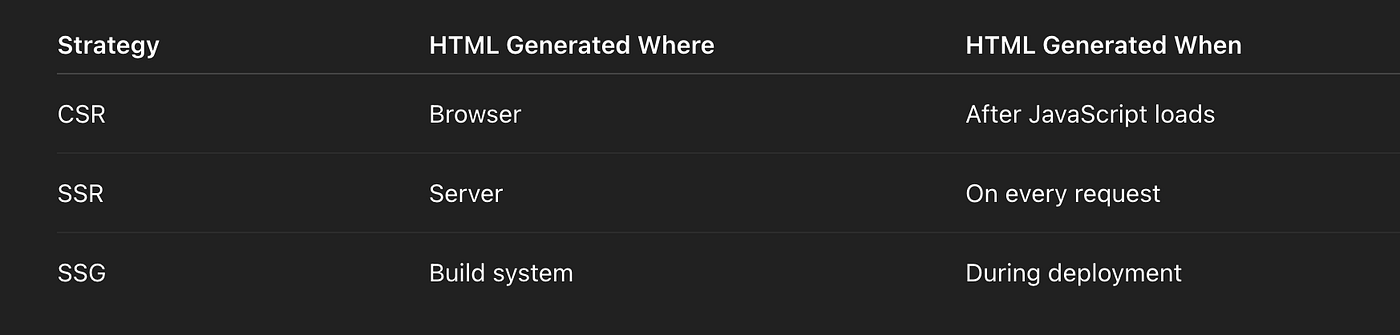
That’s the fundamental difference.
1. Client-Side Rendering (CSR)
What Happens in CSR
With CSR, the server sends a nearly empty HTML page.
Then JavaScript loads and builds the UI inside the browser.
Process:
Browser requests page
↓
Server sends minimal HTML
↓
JavaScript downloads
↓
React builds the UI
↓
User finally sees content
Example response:
<div id="root"></div>
<script src="app.js"></script>
React then renders everything.
Real Production Examples of CSR
CSR works best for highly interactive apps:
- Admin dashboards
- Analytics platforms
- Internal tools
- SaaS control panels
Examples:
- Notion dashboard
- Figma editor
- Jira boards
These apps prioritize interactivity over SEO.
Advantages of CSR
Rich interactivity Smooth client navigation Less server load Great for dynamic apps
Problems with CSR
Slow first load Bad SEO Blank page before JavaScript loads Poor performance on slow devices
This is why CSR alone is rarely used for marketing pages.
2. Server-Side Rendering (SSR)

SSR solves the biggest problem with CSR.
Instead of letting the browser generate HTML, the server generates it first.
Process:
Browser requests page
↓
Server generates HTML
↓
HTML sent to browser
↓
React hydrates the page
The user immediately sees content.
Real Production Examples of SSR
SSR is ideal when content changes frequently.
Examples:
- E-commerce product pages
- Social media feeds
- News websites
- Personalized dashboards
Companies using SSR heavily:
- Amazon
- Shopify
These sites must deliver fast, SEO-friendly pages with dynamic content.
Advantages of SSR
Excellent SEO Fast first paint Always fresh data Better performance on slow devices
Problems with SSR
Higher server cost Slower server response Increased infrastructure complexity
If traffic spikes, servers must render pages repeatedly.
3. Static Site Generation (SSG)

SSG generates pages at build time, not when users visit.
Process:
Build step runs
↓
HTML pages generated
↓
Stored on CDN
↓
Users receive static files instantly
No server computation needed.
Example generated file:
/blog/how-to-scale-startups.htmlIt’s already built before the user arrives.
Real Production Examples of SSG
SSG works best when content changes rarely.
Examples:
- Blogs
- Documentation sites
- Marketing pages
- Landing pages
Companies using SSG heavily:
- Stripe docs
- Vercel documentation
- Many tech blogs
Advantages of SSG
Extremely fast Cheap hosting (CDN) Great SEO Scales easily
Problems with SSG
Content updates require rebuilds Not suitable for personalized content Large sites may have long build times
CSR vs SSR vs SSG

How Modern Frameworks Combine Them

Frameworks like Next.js use hybrid rendering.
Example production setup:
PageRenderingLanding pageSSGBlogSSGProduct pageSSRDashboardCSR
This hybrid approach gives the best of all worlds.
Final Thoughts
There’s no “best” rendering strategy.
The best approach is choosing the right tool for each page.
Modern applications mix:
- SSG for speed
- SSR for dynamic content
- CSR for interactivity
Understanding these trade-offs helps you design scalable and performant applications.
메타데이터
- post_id
- 2f78949bb54f
- slug
- csr-vs-ssr-vs-ssg-understanding-modern-web-rendering-with-real-production-examples-2f78949bb54f
- url
- https://medium.com/@rohitarya18/csr-vs-ssr-vs-ssg-understanding-modern-web-rendering-with-real-production-examples-2f78949bb54f
- canonical_url
- https://medium.com/@rohitarya18/csr-vs-ssr-vs-ssg-understanding-modern-web-rendering-with-real-production-examples-2f78949bb54f
- author_url
- https://medium.com/@rohitarya18
- status
- ok
- fetched_at
- 2026-06-13 12:55:53




