The Five Eyes Issued Three AI Security Warnings in Six Weeks. Read Them as One Story.
Intelligence agencies don’t issue joint statements to make news. They issue them when the internal threat picture has shifted enough that…
The Five Eyes Issued Three AI Security Warnings in Six Weeks. Read Them as One Story.

Intelligence agencies don’t issue joint statements to make news. They issue them when the internal threat picture has shifted enough that they believe the public needs to be told — and when the gap between what organizations are prepared for and what is actually coming has grown large enough to warrant the unusual step of saying so out loud.
On June 22, 2026, the cybersecurity agencies of five nations did exactly that. The heads of six cybersecurity agencies across five nations — CISA and the NSA from the US, the UK’s NCSC, the Australian Signals Directorate, Canada’s Cyber Centre and New Zealand’s NCSC — signed a joint statement titled “The AI Shift in Cyber Risk: Why Leaders Must Act Now.” The Five Eyes alliance issues coordinated public statements rarely. A unanimous one, signed by the heads of all six participating agencies, is unprecedented.
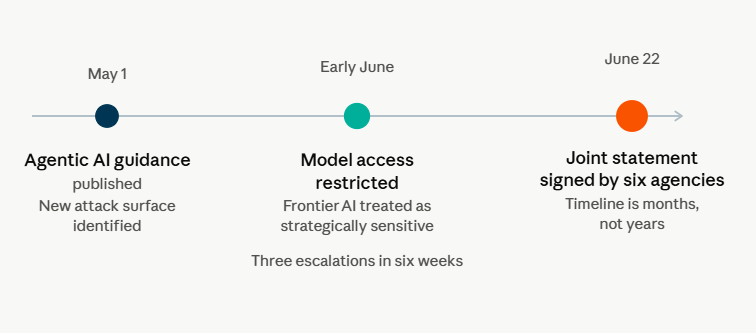
But the June 22 statement didn’t emerge in isolation. It was the third escalation in roughly six weeks. Reading them separately misses the point. Read together, they tell a story about how quickly the agencies’ assessment of AI-driven risk has sharpened, and what that means for any enterprise that hasn’t moved yet.
The First Warning: Agentic AI Has Its Own Attack Surface
On May 1, the same alliance published a 30-page joint guidance document titled “Careful Adoption of Agentic AI Services.” It was the first time all five nations had issued coordinated policy on a single AI attack surface, and the framing was pointed: agentic AI systems — those capable of independently planning tasks, calling APIs, taking real-world actions and operating across tool chains without human review — were already running inside critical infrastructure. And in most cases, nobody had governance frameworks designed to manage them.
The document organized its findings into five risk categories — privilege risks, design and configuration risks, behavior risks, structural risks and accountability risks — each with multiple specific failure modes described in detail. A few stood out.
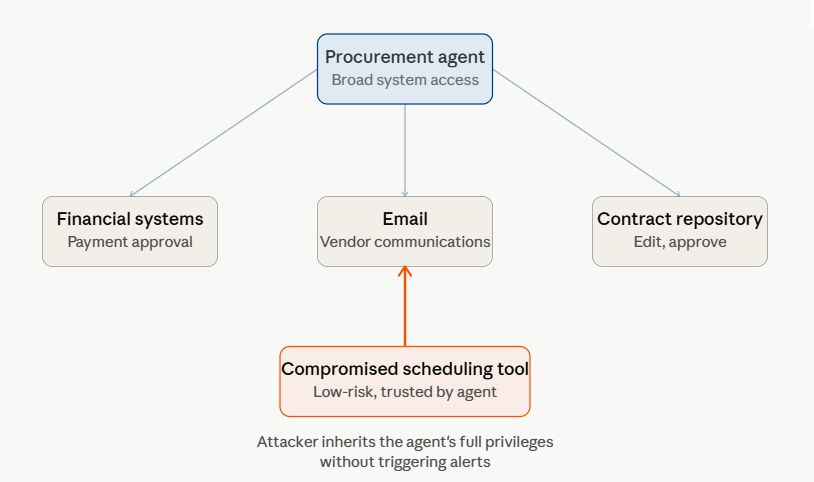
Agents tend to inherit over-permissioned access. The document illustrated this with a specific scenario: a procurement agent granted broad access to financial systems, email and contract repositories at deployment, with other agents over time coming to implicitly trust its outputs. When a malicious actor compromises a low-risk tool integrated into that agent’s workflow, they inherit the agent’s excessive privileges, modifying contracts and approving payments without triggering alerts. The document called this a “confused deputy” pattern, where a trusted agent is misused to perform unauthorized actions under what appear to be legitimate audit logs.
The guidance was also direct about how unprepared existing security frameworks are for this. “Governance mechanisms designed for human actors do not always translate effectively to autonomous AI agents,” the document stated. Threat intelligence for agentic systems is still evolving, it noted, and existing frameworks like OWASP and MITRE ATLAS focus on LLM vulnerabilities — meaning some attack vectors unique to agentic AI may not yet be fully captured. The recommendation was unambiguous: approach adoption with security in mind and never grant broad or unrestricted access, especially to sensitive data or critical systems.
The Second Escalation: Frontier Models Enter Export Control Territory
In early June, the US government issued restrictions on foreign national access to some of the most advanced available AI models — a move that landed without extensive public explanation but carried a clear signal. Western governments were beginning to treat frontier AI capabilities as strategically sensitive assets, in the same category as defense technology and semiconductor IP.
This is worth noting not because of what it means for any specific organization’s tooling choices, but because of what it signals about how governments now view the risk calculus around frontier AI. When capabilities are restricted at the access level, it means the assessment of what those models can do in the wrong hands has cleared some internal threshold. The restrictions don’t name a specific threat. They don’t need to. The act of imposing them is itself the statement.
The Third Warning: The Timeline Is Months, Not Years
The June 22 joint statement is where the escalation became impossible to miss.
The agencies were direct: “Frontier AI models are anticipated to exceed current industry expectations, fundamentally transforming both offensive and defensive cyber capabilities. The timeline is not years, it is months.”
The statement also laid out what that transformation looks like in practice: AI lowers barriers for malicious actors, increases the speed and complexity of attacks and shrinks the window between vulnerability discovery and exploitation ever more quickly.
The old model of cyber risk assumed that when a vulnerability was discovered, organizations had weeks or months to patch before exploitation became widespread. AI is compressing that window on both ends — accelerating how quickly adversaries find vulnerabilities and how quickly they can chain exploits together, automate reconnaissance and scale attacks beyond what any human team could replicate manually.
But the statement did not frame AI solely as an offensive tool. Organizations that integrate AI into their security operations can detect vulnerabilities earlier, improve software quality, monitor unusual behavior and respond faster to incidents, the agencies noted. The same capabilities that make AI dangerous in adversarial hands make it powerful in defensive ones. The difference, as the statement makes clear, is deliberateness. AI used for defense requires intentional architecture, governance and accountability. AI adopted without those structures simply expands the attack surface.
The statement was explicit that cyber risk can no longer be treated as a purely technical issue. It is a core business risk and leadership responsibility, central to operational continuity and market trust. Boards and executives, not just security teams, are responsible for ensuring resilience holds under pressure during a real incident — not just on paper. The statement went further: “It is not enough to have controls. Leaders must be confident those controls will perform during a real incident.”
What the Pattern Means
Three escalations in six weeks from the world’s most consequential intelligence-sharing alliance is not a sequence that happens by accident. It reflects a rapidly evolving internal threat picture. Each document builds on the one before it: first, a specific new attack surface (agentic AI); then, a signal that frontier capabilities are sensitive enough to restrict; then, a public declaration that the timeline for transformative offensive AI capabilities is measured in months.
The throughline across all three is the same problem stated at different levels of abstraction: AI adoption has outrun the governance frameworks that exist to manage it.
The Five Eyes warning is not a call to halt AI adoption. It is a call to adopt it deliberately. Organizations that use AI defensively while strengthening foundational controls may improve resilience. But the corollary is equally true: organizations that continue to deploy AI tools, agents and workflows without extending governance to cover them are accumulating risk that existing controls were never designed to contain.
The statement cautions that cyber risk assumptions can become outdated in months, not years. That is the most operationally significant sentence in the entire sequence. Most enterprise security programs operate on annual review cycles, periodic policy updates and risk assessments tied to known threat models. Those cycles are now mismatched to the pace at which the threat is evolving.
The Five Eyes aren’t saying the sky is falling. They’re saying the sky has already started moving, and the organizations that treat this as a future problem will find they’ve run out of lead time before they realized it was gone.
The Practical Implication for Enterprise Security Leaders
The June 22 statement closes with a line that deserves to be printed and put on a wall: “Leaders who act now will reduce exposure, strengthen resilience, and build confidence with customers, partners, and investors. Those who delay will face growing and avoidable risk.”
The specific actions the agencies recommend are not novel: reduce your attack surface, accelerate patching, fix legacy systems, strengthen identity and access controls, prepare for incidents before they happen. What is new is the urgency attached to each one, and the explicit demand that boards own the outcome, not just delegate it.
For security leaders, the immediate question is not whether to act. The statement makes that answer obvious. The question is whether the existing security stack was built to govern the specific surface area the agencies are warning about — AI interactions, agent activity, non-human identities and autonomous processes operating across enterprise systems with no human in the loop.
Most weren’t. They were built for SaaS, web, email and endpoint — channels that assume a person is making the decision at each step. The governance gap the Five Eyes are warning about is not theoretical and it is not future-dated. It is in production right now, in enterprises that believe they are adequately protected because their perimeter controls are solid.
The escalation from May to June is the intelligence community’s way of saying: look more carefully at what your controls can actually see.
Follow Force Multiplier for ongoing research and perspective on AI data security.
메타데이터
- post_id
- 2f7cb26a7412
- slug
- the-five-eyes-issued-three-ai-security-warnings-in-six-weeks-read-them-as-one-story-2f7cb26a7412
- url
- https://medium.com/forcepoint-security/the-five-eyes-issued-three-ai-security-warnings-in-six-weeks-read-them-as-one-story-2f7cb26a7412
- canonical_url
- https://medium.com/forcepoint-security/the-five-eyes-issued-three-ai-security-warnings-in-six-weeks-read-them-as-one-story-2f7cb26a7412
- author_url
- https://medium.com/@forcepoint-security
- status
- ok
- fetched_at
- 2026-07-09 08:02:55