The Murder Case That Exposed a Hidden Side of Jehovah’s Witness Life
Why the Pierina Paganelli case also concerns Jehovah’s Witnesses: a reflection by a psychology undergraduate and former member
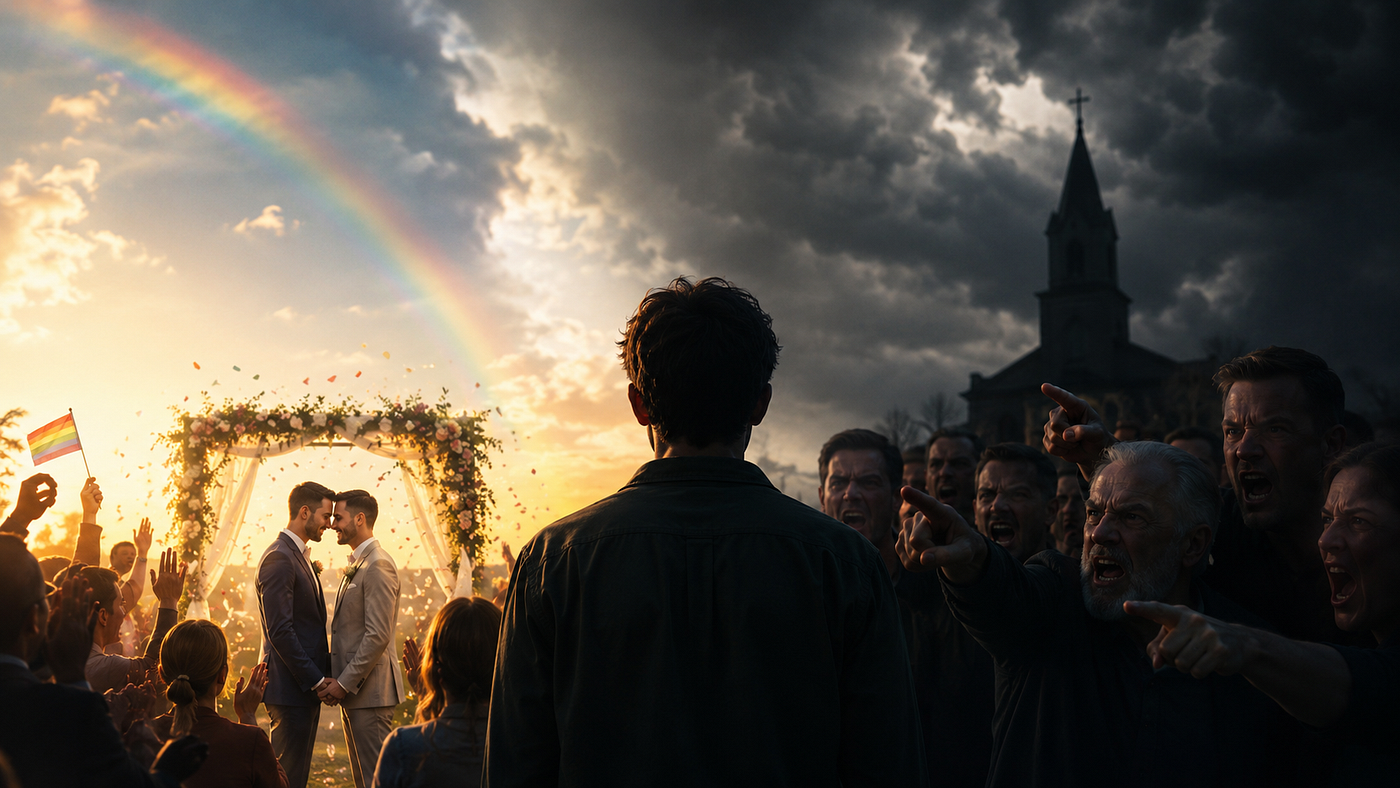
Photo by Roel Dierckens on Unsplash
The Murder Case That Exposed a Hidden Side of Jehovah’s Witness Life
Why the Pierina Paganelli case also concerns Jehovah’s Witnesses: a reflection by a psychology undergraduate and former member
I will say what I think straight away, so we can save both of us some time.
This murder, which took place in the Italian city of Rimini, has not given us many clear elements to understand who the killer was. Reading the Italian press, one gets the impression of a case made even murkier by investigative mistakes and procedural confusion.
However, it can tell us a great deal about how a closed religious community works when the sin of one of its members becomes a judicial file.
Newspapers have told the story of the bloodshed, apparently soaked in betrayals and jealousy. I would like to tell the other half of the story, the one that was unfolding in a Kingdom Hall, or church, in Rimini, a small Italian seaside town where Germans go for their summer holidays and where a marital betrayal was already a trial before the prosecutor’s office even opened its own.
I am a former Jehovah’s Witness. I know that world from the inside, and I know how to distinguish between what can be said and what would be dishonest to insinuate. Let us proceed in order and with caution.
The case, in brief
I understand that summaries are a pain in the ass, but they have to be done, especially if you do not live in Italy and do not know this story.
Let us start with the most recent and important point. On 10 June 2026, a court in Rimini found Louis Dassilva not guilty of murdering Pierina Paganelli. After almost two years in prison while awaiting trial, he was released (ANSA, 2026).
The prosecution has already said it will appeal the decision, but only after the judges publish their full written reasons, which are expected within ninety days.
So, for now, two things must be kept in mind. Legally speaking, Dassilva is an innocent man. At the same time, the question of who killed Pierina Paganelli has not been finally answered. I intend to respect both facts.
Here are the basic facts, for anyone hearing about this case for the first time.
Pierina Paganelli was 78 years old. On the evening of 3 October 2023, she was killed with 29 stab wounds in the garage of the apartment building where she lived, in Rimini, a city on Italy’s Adriatic coast.
Her body was found the next morning by her daughter-in-law, Manuela Bianchi.
The investigation later focused on Louis Dassilva, a neighbour who was having an extramarital relationship with Manuela. According to the prosecution, Pierina may have known about that relationship and could have exposed it. That, they argued, was the possible motive.
The prosecution asked for a life sentence. The court, however, decided that the evidence was not strong enough and acquitted Dassilva.
That is the basic summary. It is also the part of the story that most newspapers have already covered. What interests me begins here.
Why Jehovah’s Witnesses are part of this story, in my view
The point is simple. Pierina Paganelli was a devoted Jehovah’s Witness. So was Manuela Bianchi, so was the family, and the entire family affair was immersed in the local congregation.
When an extramarital relationship emerges in that environment, the matter stops being private. To understand this, it is enough to look at the timeline of those days, as emerged in court.
On 2 October 2023, the day before the murder, Manuela Bianchi sent voice messages to one of the congregation elders, roughly the closest equivalent to a pastor within Jehovah’s Witnesses, although the role works very differently. According to the prosecution’s reconstruction, on the very evening of the murder, the woman wrote to Dassilva, worried about the meeting of the judicial committee that was supposed to examine her the following day. And in January 2024, overwhelmed by the media exposure of her private life, Manuela wrote a letter of disassociation to the elders and left the community, describing the choice as “painful but necessary.” I am explaining this in the next chapter, so do not worry if you are a bit lost in this JW jargon.
And I will stop for a moment, because honesty is needed here.
This timeline proves an atmosphere and an entanglement between religious life and private life. It certainly does not prove a murder. Anyone who uses Jehovah’s Witnesses as the scapegoat for this crime is doing propaganda, and propaganda is the opposite of journalism. But anyone who pretends that the religious dimension is irrelevant, in a story where the victim, the daughter-in-law and half the family belonged to the same congregation, and where a judicial committee was scheduled for the day after the murder, is closing their eyes out of politeness.
I prefer to keep mine open.
The knot of the elders
Who are the elders, for readers who live outside that world? As mentioned before, they are men, always and only men, appointed to oversee the congregation. They act as shepherds, teachers and, when necessary, judges. When a member commits a “serious sin,” and adultery is the textbook example, the elders form a judicial committee. Three brothers, a room, detailed questions about the sinner’s intimate life, and a final decision about their spiritual and social fate. I used the word “judges” deliberately, because the internal vocabulary is exactly that. Committee, disciplinary action, reproof, disassociation.
In the Dassilva trial, two elders from the Rimini congregation were called to testify. And this is where the story becomes interesting.
Regarding the contents of Manuela’s voice messages and the family situation, one of them almost always invoked confessional secrecy, which Italian law recognises for ministers of religion. The other confirmed in court that adultery, within the congregation, is considered a serious sin. In essence, they said what they were required to say and remained silent about what they were allowed to keep silent.
I want to be precise, because this is slippery ground.
The elders exercised a right. Ministerial confidentiality exists, it is legitimate, and God forbid a country should force confessors to become informants. The question I ask is another one, and I put it to the reader.
What happens when the only people who knew the state of mind, fears and pressures weighing on one of the main figures in the case, in the hours immediately before a murder, are also the people institutionally bound to silence? What happens is that a piece of truth remains inside the Kingdom Hall. Legally, everything is in order. Humanly, and civilly, a knot remains. And knots, sooner or later, must at least be looked at.
Adultery, for a Witness, is something else
For the average reader, an affair is a relationship crisis. Painful, perhaps devastating, but still confined between two people and a divorce lawyer.
For a Jehovah’s Witness, it belongs to a different category of existence. It is a sin that sets the internal judicial machine in motion, and that machine has two main outcomes. If the sinner shows repentance, a milder disciplinary measure may follow, possibly with restrictions and with their reputation still marked. If repentance is absent, or judged insufficient by three men in a room, then comes disfellowshipping, that is, expulsion.
And expulsion, in that world, means something that an outside reader may struggle to imagine.
The organisation’s official publications explain that faithful members interrupt social relations with a disfellowshipped person. They stop associating with them and speaking to them.
The same point emerged in court during the Rimini trial, where it was explained that removal from the community involves the interruption of relationships with other believers. Translated into lived experience, it means that friends of thirty years erase you, that your “spiritual family” treats you like a stranger, and that in many cases even close relatives reduce contact to the bare minimum or cut it off entirely.
For someone born and raised inside, as many are, outside the congregation there is often little or nothing. That is why the prospect of a judicial committee weighs so heavily. A person’s entire social world is at stake. To call it simply “religious discipline” is an elegant euphemism.
I call it by what it produces: enormous pressure built around sex, shame, reputation and belonging.
What science says, and what I have seen
Someone may object that I am speaking as a former member, and therefore as an interested party. Objection accepted. That is why I will let the research speak.
The point is that ostracism produces measurable harm, and psychology has documented this for twenty years. Let me explain with two peer-reviewed studies. The first is a classic. Eisenberger, Lieberman and Williams, in Science (2003), used neuroimaging to observe the brains of people who were excluded from a simple virtual ball-tossing game. Social exclusion activated the dorsal anterior cingulate cortex, one of the areas involved in processing physical pain. In other words, the brain treats social rejection through circuits similar to those of a wound.
The second study concerns us more closely. Ransom, Monk and Heim, in the Journal of Religion and Health (2021), interviewed former Jehovah’s Witnesses and titled their work “Grieving the Living.” The participants described the ostracism that followed their exit as a form of “social death,” associated with a worsening of mental wellbeing, a shattered sense of self, and a paradoxical grief for people who were still alive but now unreachable.
Let us evaluate this critically, as we should. The Science study was conducted in a laboratory, with a small computer game, and generalising from that to real life requires caution. The British study is based on six in-depth interviews, a small and self-selected sample, made up of people who had left and were therefore motivated to describe the darker side. These are real limitations. And yet the two studies, taken together, converge from opposite directions on the same conclusion. Social exclusion hurts in an almost literal sense, and organised religious exclusion hurts over time.
Anyone inside that system who faces the prospect of a judicial committee knows that the stakes are extremely high. This is the connection with our case, and it is all that science allows us to say. On everything else, silence.
Conclusion
Let me summarise. Louis Dassilva has been acquitted, the prosecution will appeal, and the truth about this sad story is still on its way. The Paganelli case proves zero criminal responsibility on the part of a religion, and anyone who claims otherwise deserves the defamation lawsuit they are asking for.
What the case does show, however, is just as real. It shows a community where a relationship between adults becomes a matter for an internal tribunal. It shows a woman who, on the eve of a murder, appeared to fear the judgment of three men with an intensity that many outside that world may struggle to understand. It shows elders who, in a courtroom, were legally allowed to remain silent, and a truth that, for this reason, remains incomplete. And it shows, to anyone willing to see it, that in closed religious systems sin quickly stops being private, because reputation is social capital and losing it can become a form of ruin.
We still do not know who took Pierina Paganelli’s life. But we do know that around that life, and around her family, there was a system in which a person’s intimacy could end up on the table of a committee. Telling that story is the least one can do.
For Pierina, before anyone else.
M.F.
If you liked this article, you might also appreciate my other piece on how fear shapes belief in everyday life: **Why Jehovah’s Witnesses Don’t Celebrate Birthdays.**
Author Bio
Photo by Matteo Fortin
Matteo Fortin holds a BSc in Psychology and is an aspiring clinical psychologist. His writing explores lived experience, mental health, high-control religion, and the intersection of belief and identity.
메타데이터
- post_id
- 2f7d79a56723
- slug
- the-murder-case-that-exposed-a-hidden-side-of-jehovahs-witness-life-2f7d79a56723
- url
- https://medium.com/backyard-theology/the-murder-case-that-exposed-a-hidden-side-of-jehovahs-witness-life-2f7d79a56723
- canonical_url
- https://medium.com/backyard-theology/the-murder-case-that-exposed-a-hidden-side-of-jehovahs-witness-life-2f7d79a56723
- author_url
- https://medium.com/@lumenmentis
- status
- ok
- fetched_at
- 2026-07-13 06:23:13