Illinois Isn’t Folding — So Why Does the Pressure Keep Coming?
The $128M highway threat isn’t just about licenses. It’s about leverage — and a pattern that’s getting harder to ignore.
Illinois Isn’t Folding — So Why Does the Pressure Keep Coming?
The $128M highway threat isn’t just about licenses. It’s about leverage — and a pattern that’s getting harder to ignore.
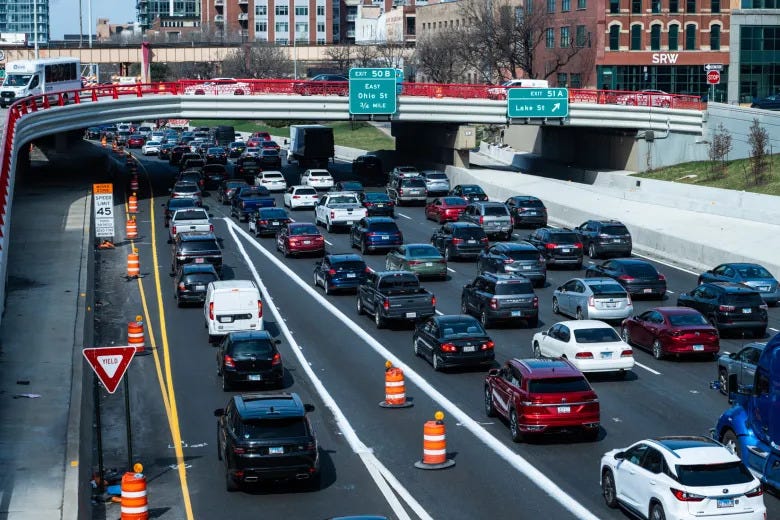
Photo by Colin Boyle/Block Club Chicago
On February 17, 2026, the federal government threatened to withhold $128 million in highway funding from Illinois.
The reason? A federal audit claimed the state improperly issued certain commercial driver’s licenses.
On paper, it sounds technical. Bureaucratic. Almost routine.
But if you’ve been paying attention, this doesn’t feel routine at all.
Because it’s not just this.
This Keeps Happening
Over the past year, Illinois hasn’t just faced one funding dispute — it’s faced several.
- Billions tied up in transit expansion
- A major electric vehicle infrastructure grant pulled back
- Safety-related funding threats tied to Chicago transit
- And now, highway dollars tied to CDL compliance
Each one arrives with a different justification.
Each one carries real consequences.
And each one raises the same underlying question:
At what point does enforcement start to look like pressure?
Illinois Isn’t Backing Down
To be clear, Illinois hasn’t folded here.
State officials pushed back almost immediately, arguing that:
- Their licensing practices are compliant
- Federal auditors misunderstood work authorization extensions
- And the threatened cuts are unjustified
At the same time, Illinois did something interesting.
It paused certain non-domiciled CDL issuances and tightened procedures.
Which creates a strange dual reality:
- Publicly: “We did nothing wrong.”
- Practically: “We’re making adjustments anyway.”
That tension isn’t accidental.
It’s the shape of modern governance under pressure.
What This Actually Is
This isn’t really about CDLs.
Not in the way it’s being presented.
This is about leverage.
The federal government doesn’t need to win every fight outright. It just needs to apply pressure in the right places:
- Infrastructure funding
- Regulatory compliance
- Certification authority
These are pressure points, not just policies.
And when you apply pressure repeatedly — across transit, energy, licensing, and safety — you don’t need total compliance.
You just need movement.
The Strategy Isn’t Surrender — It’s Adjustment
There’s a misconception baked into a lot of these headlines:
That the goal is to make Illinois “give in.”
That’s not quite right.
The more realistic outcome — and the one we’re already seeing — is subtler:
- Illinois resists publicly
- Adjusts quietly
- And avoids conceding outright
It’s not surrender.
It’s adaptation.
And from a federal standpoint, that still counts as a result.
Why Illinois?
This isn’t happening in a vacuum.
Illinois sits at the intersection of several things that make it a prime target:
- A high-profile Democratic governor in JB Pritzker
- A major national infrastructure hub centered around Chicago
- Ongoing political tension with federal leadership
That combination makes Illinois more than just another state.
It makes it a test case.
Not just for compliance — but for resistance.
What Happens Next
If you’re waiting for a clean resolution — don’t.
Illinois was given 30 days to respond — a window that has now passed, with the state pushing back rather than conceding.
The most likely outcome here isn’t dramatic.
It’s procedural.
Illinois will likely:
- Maintain that it was compliant
- Continue adjusting internal practices
- And ultimately retain most (if not all) of the funding
The federal government, in turn, will likely:
- Claim enforcement success
- Point to changes as validation
- And move on to the next pressure point
No clear winner.
No clear surrender.
Just… movement.
The Real Pattern
Even if Illinois “wins” this round, the broader pattern isn’t going away.
Because this isn’t about a single policy dispute.
It’s about a governing dynamic:
Apply pressure across multiple systems, and something will shift.
Maybe not everything.
Maybe not all at once.
But enough.
The Question That Matters
So the real question isn’t:
“Will Illinois lose $128 million?”
It’s this:
How many times can pressure be applied before adjustment becomes the norm?
Because Illinois hasn’t broken.
But it also hasn’t stood completely still.
And in a system like this —
that difference matters.
메타데이터
- post_id
- 2f86fd802af3
- slug
- illinois-isnt-folding-so-why-does-the-pressure-keep-coming-2f86fd802af3
- url
- https://medium.com/the-prairie-dispatch-in-the-land-of-lincoln/illinois-isnt-folding-so-why-does-the-pressure-keep-coming-2f86fd802af3
- canonical_url
- https://medium.com/the-prairie-dispatch-in-the-land-of-lincoln/illinois-isnt-folding-so-why-does-the-pressure-keep-coming-2f86fd802af3
- author_url
- https://medium.com/@annalkuyperbellettiere
- status
- ok
- fetched_at
- 2026-06-16 19:09:56