The Line I Still Remember
Polio, Vaccines, and the Difference Between Fear and History
The Line I Still Remember
Polio, Vaccines, and the Difference Between Fear and History
*The aim of public health is to create the greatest benefit for the greatest number.
- — C.-E. A. Winslow
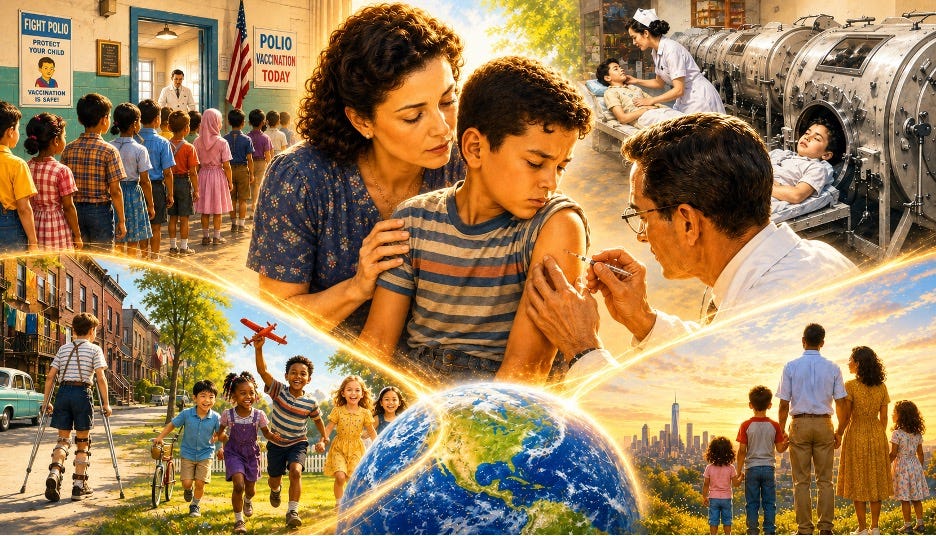
It was 1956. I can still see the line. Every kid in my grammar school was standing in it.
We stretched down the hallway waiting our turn while a doctor worked his way through classroom after classroom. The line moved slowly, and every kid knew exactly what was waiting at the end of it.
A shot.
I’d heard of polio, but I didn’t know what it was. What I knew was that there was a doctor ahead of me holding a needle, and sooner or later he was going to poke it in my arm.
My mom knew I was scared. With a smile, and both hands on my shoulders, she looked at me and said, “Just turn your head, close your eyes, and count to five. It’ll all be over.”
That was it. No lecture. No attempt to convince me I wasn’t afraid.
When my turn came, I turned my head, closed my eyes, felt the poke, and started counting. My mom was right again, as usual.
Only much later did I realize that while I was afraid of that needle, the adults around me were afraid of something much bigger.
They were afraid of polio.
A World Most People Never Saw
The parents of my generation didn’t need charts or public health campaigns to understand the danger. They saw children lose the ability to walk. They saw families whose lives changed overnight when disease struck without warning. Wheelchairs, braces, and iron lungs weren’t historical artifacts; they were part of the world around them. Every parent knew it could happen to their family as easily as someone else’s.
The fear wasn’t theoretical. It was everywhere.
When the polio vaccine arrived, families already knew what they were facing — the reality that a child could go swimming in the summer and end up permanently disabled by the fall.
For many people today, the vaccine is familiar. The disease that made it necessary isn’t.
The Strange Success of Vaccines
The success of vaccines created an unexpected problem. They worked so well that many eventually forgot what they were created to stop.
If a generation grows up without seeing polio, smallpox, or diphtheria, those diseases begin to feel distant — more historical than real. Meanwhile, every side effect, every bad reaction, and every personal story remain immediate and visible.
As a result, the vaccine stayed in the public eye while the disease faded into history. The risks of vaccination became easier to see than the dangers vaccination was designed to prevent.
Stories Matter — But They Aren’t the Whole Story
A parent believes a vaccine harmed a child. Someone experiences a serious reaction. A family spends years searching for answers.
Human suffering deserves respect whether it affects one person or one million. Dismissing people simply because their experience doesn’t fit a preferred narrative rarely leads to understanding and never builds trust.
A personal story tells us what happened to a particular person. It can’t tell us what happened across an entire society. Physicians evaluate both harms and benefits.
The question isn’t whether vaccines have ever caused harm. They have. The question is whether they’ve caused more harm than good.
Those are not the same question.
No Such Thing as Risk-Free
Every meaningful medical treatment carries risk.
Antibiotics can cause allergic reactions. Aspirin can cause bleeding. Surgery can cause infection. Blood pressure medications can cause dizziness. Cancer treatments can damage healthy tissue while trying to save a life.
That’s not because medicine is failing. It’s because the human body is complicated. The goal has never been to eliminate all risk. The goal has always been to prevent more suffering than a treatment creates.
Vaccines should be evaluated. They should be studied. They should be monitored honestly and continuously.
Following the Money
Whenever vaccines are discussed, the subject of profit eventually enters the conversation.
Drug companies do make money from vaccines, and any discussion about public health should acknowledge that reality.
At the same time, money is rarely involved on only one side of an issue.
During the COVID years, a lot of people started selling alternatives to vaccination. Some promoted supplements, vitamins, herbal remedies, and repurposed medications. Others sold books, newsletters, podcasts, conferences, memberships, consulting services, and specialty treatments to people looking for answers.
Profit deserves attention, but it isn’t evidence. The fact that someone makes money from an idea doesn’t tell us whether that idea is true or false. The evidence still has to speak for itself.
What Actually Happened After the Needle?
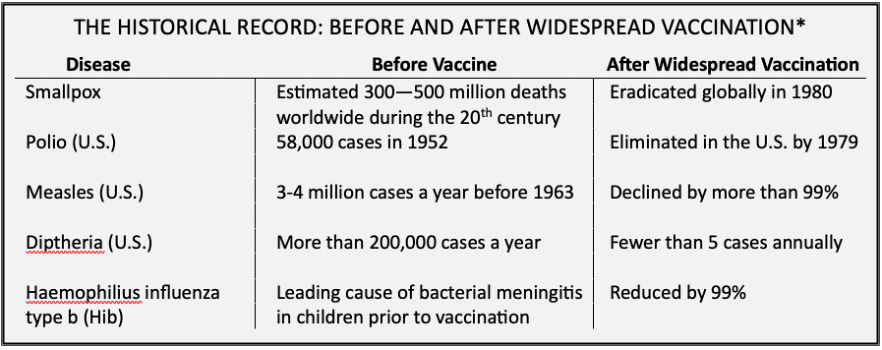
Smallpox disappeared. Polio nearly disappeared. Measles, diphtheria, tetanus, and other infectious diseases stopped killing and disabling people on the scale they once did.
Hospitals saw fewer children suffering from illnesses that had filled entire wards. Outbreaks that terrified communities became increasingly rare. Fewer children were left with lifelong disabilities.
These weren’t subtle changes that required advanced statistics to detect. The evidence wasn’t confined to laboratories or journals. It showed up in homes, schools, hospitals, and communities across the country.
The numbers below reflect what people saw with their own eyes:
The Verdict of History
I still remember standing in that line at school. At the time, I thought the needle was the important part. Now I think the important part was what happened afterward.
Children who might have spent their lives in wheelchairs didn’t. Families who might have buried a son or daughter didn’t. Entire generations grew up without seeing the suffering that had once been common.
Does that mean vaccines are perfect? Of course not. Nothing involving human beings ever is. Governments make mistakes. Pharmaceutical companies deserve scrutiny. Every vaccine, policy, and recommendation should be evaluated honestly on its own merits.
What it means is something much simpler.
Vaccines aren’t remarkable because they’re flawless. They’re remarkable because they have reduced death, disability, and suffering on a scale rarely matched in history.
Whatever their shortcomings, they remain one of humanity’s greatest public health achievements.
*SOURCES Smallpox: World Health Organization (WHO): Smallpox eradication Polio: Centers for Disease Control and Prevention (CDC): History of Polio in the United States Measles: CDC: Measles History and Impact of Vaccination Diphtheria: CDC Pink Book: Diphtheria Haemophilus influenzae type b (Hib): Children’s Hospital of Philadelphia Vaccine Education Center
메타데이터
- post_id
- 2f95d44b322c
- slug
- the-line-i-still-remember-2f95d44b322c
- url
- https://medium.com/@randycima/the-line-i-still-remember-2f95d44b322c
- canonical_url
- https://medium.com/@randycima/the-line-i-still-remember-2f95d44b322c
- author_url
- https://medium.com/@randycima
- status
- ok
- fetched_at
- 2026-06-12 10:20:10