What Are Design Patterns: A Deep Dive for Software Thinkers
When you first hear the term “design patterns,” you might imagine fancy diagrams or a laundry list of template names like “Factory” or…
What Are Design Patterns: A Deep Dive for Software Thinkers
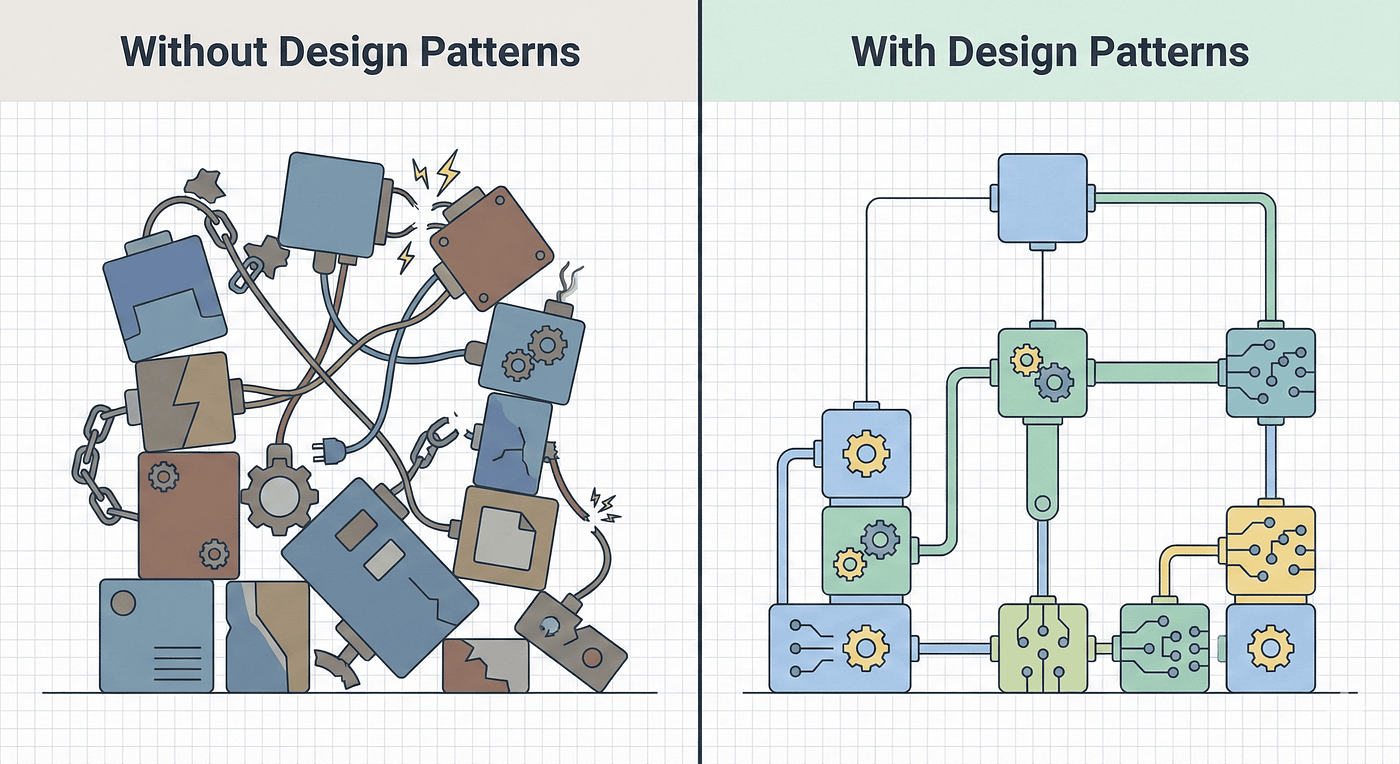
When you first hear the term “design patterns,” you might imagine fancy diagrams or a laundry list of template names like “Factory” or “Singleton”. But design patterns aren’t about memorizing names; they’re about reasoning in software design.
At heart, a design pattern is a reusable solution to a commonly occurring design problem. It’s not a ready-made piece of code but a blueprint or template that you can adapt to solve a specific structural, behavioral, or creational challenge in your program.
Why Design Patterns Exist
Software development isn’t arbitrary engineering; it’s about managing complexity. As systems scale, design decisions ripple outward: future extensions, team communication, maintainability, and adaptation to change all depend on how you structure your components.
Patterns emerged because experienced developers noticed the same problems arising, not just once, but routinely. Over time, they abstracted successful strategies into patterns so that others could apply them without reinventing the solution every time.
Put simply:
- Patterns capture collective experience, distilling what works for recurring problems.
- Patterns give us a shared vocabulary; when you say “Observer pattern,” seasoned developers know the gist of the solution without a full explanation.
This shared language is one of the most under-appreciated benefits of learning patterns.
A Brief History (Patterns Aren’t New)
Design patterns as a formal concept entered software engineering through the landmark 1994 book Design Patterns: Elements of Reusable Object-Oriented Software by the so-called Gang of Four, Erich Gamma, Richard Helm, Ralph Johnson, and John Vlissides. That work cataloged 23 classic design patterns in object-oriented design and grouped them by intent (creational, structural, behavioral).
Before that, good developers were already applying the same approaches — they just hadn’t formalized them. The GoF book crystallized these solutions so that they could be taught, learned, and debated.
Over time, other pattern catalogs and domains have emerged: architectural patterns (higher-level design), functional programming patterns, and domain-specific collections (e.g., web UI, AI systems).
Core Categories of Design Patterns
The classic design pattern catalog breaks patterns into three main groups:
- Creational Patterns: Control object creation, e.g., Factory, Abstract Factory, Builder, Prototype, Singleton.
- Structural Patterns: Organize classes and objects into larger structures, e.g., Adapter, Decorator, Facade, Composite.
- Behavioral Patterns: Manage object communication and responsibility, e.g., Strategy, Observer, Command, Iterator.
Many extended catalogs go beyond these, covering architectural, concurrency, and presentation patterns, among others. According to some industry resources, there are dozens to hundreds of named patterns when you aggregate across domains.
Why Use Design Patterns (Pros)
When applied well, design patterns yield real benefits:
1. Proven Solutions to Recurring Problems
Rather than reinventing the solution each time, patterns give you battle-tested templates that developers have used across projects and teams.
2. Common Vocabulary
Teams that understand patterns can communicate design intent succinctly. Saying “We should use a Strategy here” conveys the idea of interchangeable algorithms without getting lost in code.
3. Improved Maintainability and Reuse
Patterns produce modular code that’s easier to change without unintended side effects, an important property as requirements evolve.
4. Faster Development
When you recognize a design problem that matches a pattern you understand, you can implement the solution faster and with greater confidence.
5. Better Structure
Patterns help you manage complexity by organizing systems into components with clear responsibilities.
But Patterns Are Not Perfect (Cons & Criticisms)
Patterns attract strong opinions. Many developers praise them, but others caution against dogmatic use. Here are the main critical points:
Overuse and Overengineering
One common trap is applying patterns everywhere, whether or not they’re needed. When patterns are shoehorned into simple problems, they can make code more complex, not simpler.
Learning Curve
Understanding patterns deeply takes time and practice. Beginners may memorize names without grasping when or why to use them.
Language Dependence
Some patterns exist mainly to compensate for limitations in a programming language. In languages with advanced features (e.g., first-class functions), certain patterns are less relevant or can be expressed more simply.
Rigid Structures
Strict adherence to pattern structure can make code less adaptable when requirements change in unexpected ways.
Critics like Paul Graham argue that some patterns are essentially workarounds for weak abstractions in a language, and in more expressive languages, they can feel like unnecessary ceremony.
So patterns are a tool, not a religion.
Real World Application of Patterns
Patterns show up everywhere in professional software development:
- In frameworks and libraries (e.g., dependency injection frameworks often use patterns like Factory or Singleton).
- In large codebases, maintainability matters.
- In team discussions and architectural decisions.
They’re not just academic; they often solve real design problems you’ll encounter as systems grow.
Why Learning Design Patterns Matters
Now the skeptical question: Do you need to learn patterns before writing good code?
Patterns matter because they:
- Help you recognize common problems,
- Teach you better abstraction skills,
- Improve your design thinking,
- Equip you with a shared language in team settings.
Even developers who don’t consciously use pattern names often apply the same ideas intuitively. Learning them sharpens that intuition.
Patterns also prepare you for architectural thinking, moving from writing code that just works to writing code that’s robust, adaptable, and expressive of intent.
Conclusion: Clarity Over Buzzwords
Design patterns aren’t just another checklist. They’re a method of thinking about software structure and change.
Rather than memorizing them, the goal should be to:
- understand what problem a pattern solves,
- know when the pattern’s abstraction helps,
- and recognize when it’s better to keep things simple.
Good design isn’t about applying patterns everywhere; it’s about choosing the right tool for the right problem.
메타데이터
- post_id
- 2f9daebdc44a
- slug
- what-are-design-patterns-a-deep-dive-for-software-thinkers-2f9daebdc44a
- url
- https://medium.com/@syedh9837/what-are-design-patterns-a-deep-dive-for-software-thinkers-2f9daebdc44a
- canonical_url
- https://medium.com/@syedh9837/what-are-design-patterns-a-deep-dive-for-software-thinkers-2f9daebdc44a
- author_url
- https://medium.com/@syedh9837
- status
- ok
- fetched_at
- 2026-06-27 18:20:27