HealthAssure: Building India’s Primary Care Rails
Most conversations around healthcare in India orbit around hospitals, insurance claims and critical care. The headlines are always ICU…
HealthAssure: Building India’s Primary Care Rails
Most conversations around healthcare in India orbit around hospitals, insurance claims and critical care. The headlines are always ICU beds, surgeries, premiums. But the reality is quieter. Most healthcare interactions never reach a hospital at all.
They start much earlier.
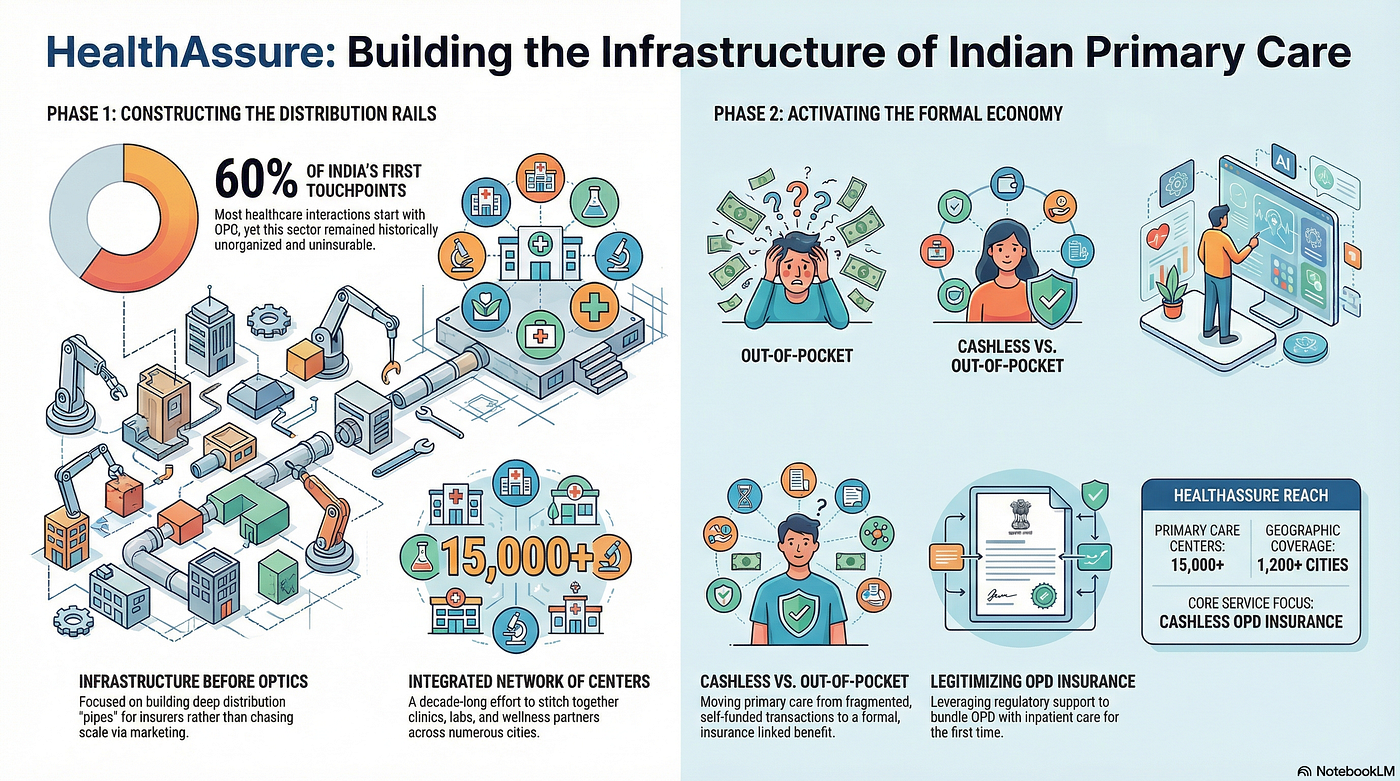
A cough. A check-up. A diagnostic test. A routine consultation. OPD, the touchpoint 60% of India uses first has historically been the most ignored layer of healthcare.
Fragmented clinics, no standard pricing, no visibility, no insurance coverage, and little digital trace. For decades, OPD remained too small for insurers to prioritise and too unorganised for productisation. Which meant millions paid out-of-pocket for primary care every year, without negotiation power or continuity.
To us, this gap always felt more like an infrastructure problem than a product problem.
And that’s the story of HealthAssure.
A Network Before an App. Infrastructure Before Optics.
When HealthAssure started in 2011, the idea of organising primary care in India wasn’t yet a trend. Tele-consultations weren’t mainstream, digital adoption was low, and healthtech was mostly claims-processing and hospital systems.
HealthAssure chose a slower path to build a network first platform.
Over a decade, they stitched together 15,000+ primary care centres across 1,200+ cities, integrated diagnostics, clinics, wellness partners, home care, fitness, pharmacy and labs into one PPO ecosystem. They didn’t chase scale by marketing spend, they built distribution rails insurers and corporates could plug into.
While others launched telemedicine apps, HealthAssure built the pipes beneath them.
This foundation allowed something important to happen later: primary care could finally become insurable.
Where Experience Meets Execution
The company reflects the depth of its leadership.
Varun Gera, ex-CEO of UnitedHealthcare India, had already spent years inside the insurance engine room underwriting behaviour, risk scoring, policy servicing, compliance, pricing models. He had seen firsthand how OPD was too fragmented to insure, yet too large to ignore forever. HealthAssure was his answer to that inefficiency: If they organise OPD, they can formalise it. If they formalise it, they can insure it.
The team approached primary care not as a tech experiment but as a systems business. One that needed patience, integrations and trust, not blitz scaling.
Some companies chase new markets. HealthAssure rebuilt the existing one.
The Shift: From Aggregator to OPD Insurance Platform
The first decade was foundational. Revenue came largely from insurance medicals, tele-medicals and corporate OPD programs. Stable, recurring, operationally heavy, but important. It built trust with insurers, created local network depth, and trained the organisation to operate inside healthcare’s regulatory guardrails.
Then came the turning point.
With IRDA support, HealthAssure launched OPD Insurance products bundled with IPD and also standalone group products. Suddenly OPD, long ignored, was a formal coverage layer consumers could access like any other benefit.
Not reimbursements. Cashless primary care. Across a distributed network.
It feels simple, but it is the first time OPD was brought into the formal insurance economy at scale. This transition is what excited us.
Aggregation alone is linear. Insurance-linked OPD is exponential.
Our conviction wasn’t built on TAM numbers alone. It was built on observing four truths coming together at the right time:
1. OPD is the real volume market. Hospitalisation is episodic; OPD is continuous. The wallet is already there, it’s just unstructured.
2. HA owns the rails. A distributed PPO network + insurer integrations isn’t easy to replicate. Time became a moat.
3. Regulatory alignment matters. OPD insurance is legitimised, and trust compounds faster in regulated healthcare.
4. Unit economics over adrenaline. This isn’t a burn-fuelled growth story. It is a business built patiently, profitably, decade-wise.
Our investment was not a bet on telemedicine or insurance hype. It was a bet on infrastructure becoming a product, and product becoming an industry behaviour.
Where the Road Points Next
If the past decade was about stitching the network, the coming years are about activating it.
-
More OPD products.
-
Deeper insurer partnerships.
-
Consumerisation of access.
-
AI-driven triage, recommendations and reporting.
-
Primary care isn’t transactional, but guided.
Healthcare today is fragmented for all, from self-managed care to caregiving. By bringing OPD into the insurance framework, HealthAssure is evolving toward managed care, where staying healthy becomes structured, affordable and continuous rather than reactive.
We imagine a future where calling a clinic, booking a test, renewing OPD coverage, all live on one layer that feels simple to the end user because the complexity runs quietly behind it.
And when that future arrives, it won’t look like disruption. It will look like continuity is finally formalised.Health Assure is building the primary care pipes of India so millions won’t have to navigate healthcare alone.
Through the blue lens, this is a story about infrastructure, patience and compounding trust.
메타데이터
- post_id
- 2fa2f75e4f47
- slug
- healthassure-building-indias-primary-care-rails-2fa2f75e4f47
- url
- https://medium.com/@blueashvacapital/healthassure-building-indias-primary-care-rails-2fa2f75e4f47
- canonical_url
- https://medium.com/@blueashvacapital/healthassure-building-indias-primary-care-rails-2fa2f75e4f47
- author_url
- https://medium.com/@blueashvacapital
- status
- ok
- fetched_at
- 2026-06-13 07:35:29




