Airbnb Design System: How an “Industry Standard” Exists Even If No One Has Ever Seen It
Somewhere in a parallel universe, Airbnb has a public design system portal as beautiful as a marketing landing page and as useful as real…
Airbnb Design System: How an “Industry Standard” Exists Even If No One Has Ever Seen It
Somewhere in a parallel universe, Airbnb has a public design system portal as beautiful as a marketing landing page and as useful as real API documentation. In our universe, it doesn’t.
What has surfaced publicly in recent years is their **Summer Release 2025: a new Airbnb app, new directions (Services / Experiences), a new visual language, and a direct statement that they built a new design system* with a more dimensional and animated* interface.
At the same time, various talks, videos, and posts from people involved in the redesign appeared — yet Airbnb still hasn’t released the system itself as an open library or documentation portal. LinkedIn remains full of hints, not answers.
So I did what any curious designer in 2026 does when “Airbnb DLS download” returns nothing: I spent a weekend digging through articles, talks, official releases, interviews, and open-source traces — and assembled the full picture of how their system actually works at the level of approach. In a way that’s understandable even to those who pronounce governance as “gavernance” and confidently pretend that’s correct.
Today we’re spilling some digital tea on Airbnb’s internal design kitchen. Grab your coffee. Here are the 10 key points.
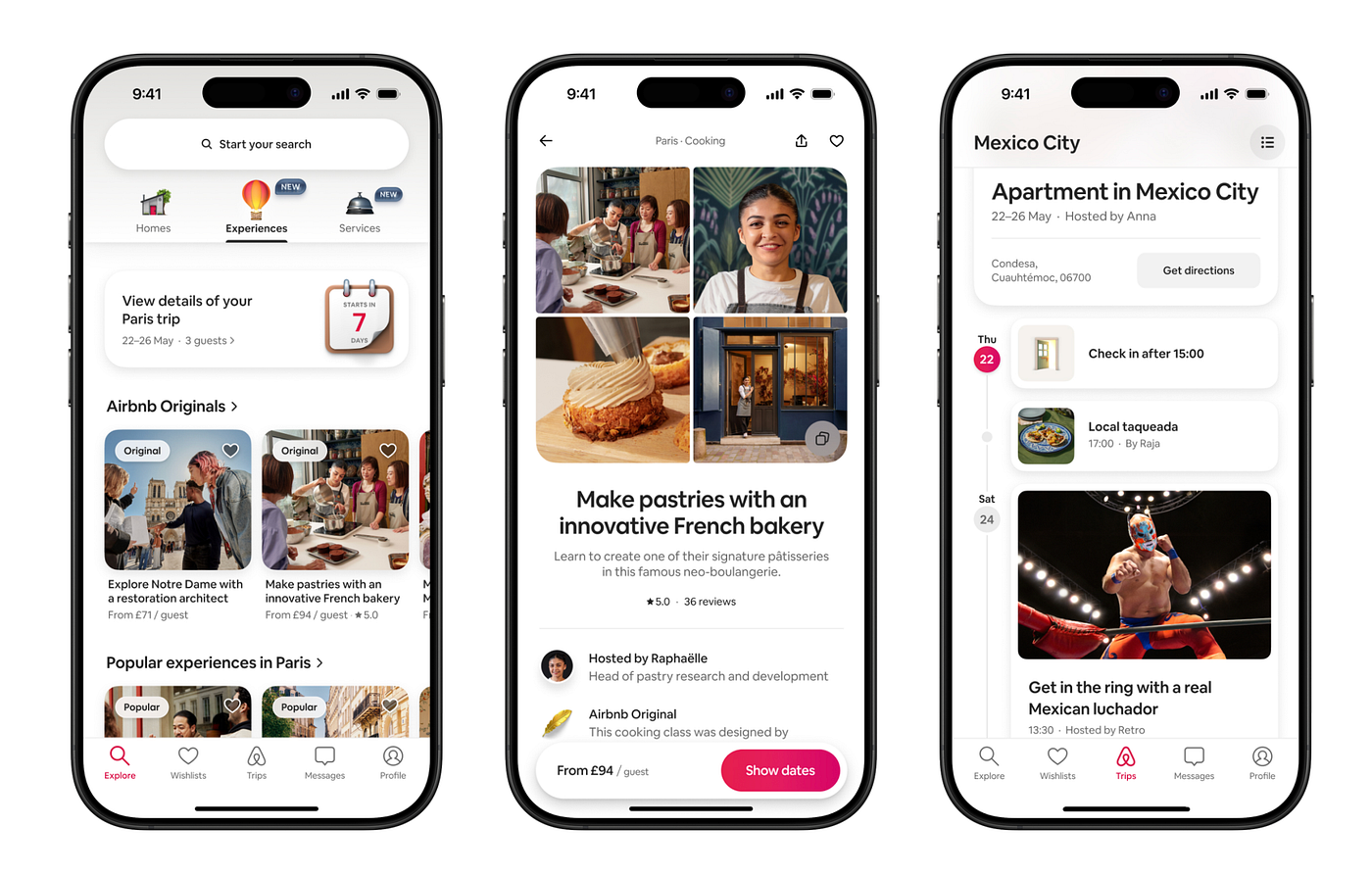
Image © Airbnb, source: airbnb.com/news
1) What Exactly Was “Updated” at Airbnb — and Why Everyone Is Talking About Their System Again
In the Summer Release 2025, Airbnb did not simply “repaint the buttons.” They announced that:
- the application now covers more scenarios (homes + services + experiences),
- they built a new technology stack to support this, and
- a new design system with a more “dimensional” and animated interface, so that trip planning feels more alive.
It is important to note that this is not someone’s blog saying, “I think they updated something,” but a direct statement from the official **Airbnb Newsroom**.
In addition, there are public interviews and media materials where Airbnb team members say that the new app required an entirely new design system. Which essentially confirms the scale of the work. (Design Week)
Why this matters for us: updates of this level almost always mean that their system is not a “UI Kit in Figma,” but real infrastructure capable of supporting shifts in product strategy.
2) Why They Still Do Not Release Their Design System Publicly (And Why That Makes Sense)
Short answer: because Airbnb’s DLS (Design Language System) is a competitive advantage, not a “community freebie.”
In a large product company, a design system is:
- a development accelerator,
- a consistency control mechanism,
- a way to scale hundreds of designers and engineers,
- part of the internal “production pipeline.”
A public release means:
- enormous costs for supporting external users,
- the need to document everything to a level that any random person on the street can understand,
- legal and brand constraints,
- and, most amusingly, the risk that in a year it will be outdated and people will point at you and say: “Well, this part of your documentation is wrong.”
The fact that Airbnb chose to leave public fragments of infrastructure and talks instead of a “public portal” is confirmed by their open projects and presentations: they share principles and engineering ideas, but not the entire product package. (GitHub)
3) “One System for Web and Mobile.” How Is That Even Possible If the Patterns Are Different?
The key idea here is simple: one system ≠ identical screens. One system = a shared language and a shared contract, while the platforms perform the translation.
3.1. What Exactly Is Unified (The Contract)
What is usually unified:
- the meaning of actions (primary / secondary / destructive),
- hierarchy (what is primary, what is secondary),
- states (disabled / loading / pressed / focus, and so on),
- rules of visual expression (contrast, emphasis, “weight” of elements),
- foundational tokens (color, typography, spacing, radii, shadows),
- accessibility as a guiding principle.
Why we confidently call this a “contract”: in their official communication around the Summer Release, Airbnb explicitly emphasizes that both the design system and the interface have become more “dimensional” and animated — which is precisely the level of language and behavior, not “here is a list of components.”
3.2. What Remains Platform-Specific
What differs is what is dictated by the platform:
- navigation patterns (iOS vs Android vs Web),
- gestures and “touch vs mouse / keyboard,”
- system components (alerts, sheets, navigation),
- nuances of accessibility APIs across platforms.
And here is the key principle: the system defines “what and why,” the platform decides “how exactly.” (YouTube)
This is not “religion”; it is forced engineering reality. And this is exactly why, in talks about building and rebuilding their system, they focus far more on architecture and scalability than on “beauty” (see point 5).
3.3. The Organic Evolution of the Approach
Historically, Airbnb’s approach looked like this: One system → different visual implementations → strict adherence to platform patterns
And then they made the next logical step: One language → one aesthetic → still platform differences, but minimal
Today we observe the next stage of maturity: visually, Airbnb’s interfaces have become noticeably closer to each other. Cards, spacing, shadows, radii, screen composition, motion behavior. All of this feels like a single visual organism, regardless of device.
Platform differences have not disappeared, but they no longer define the face of the product. On the contrary, it is Airbnb’s design system that now dictates the aesthetic, and the platforms merely adapt to it.
This is a classic sign of a mature product: first, the system adapts to the platforms; then, once the brand and experience are formed, the platforms begin adapting to the system.
4) Why Everyone Considers Them a Benchmark Even Without Seeing “Under the Hood”
Because the industry sees the effect:
- a unified product “tone,”
- interface predictability,
- the speed of evolution without collapsing into a “zoo” of random solutions.
And Airbnb were the first to state this very clearly: a design system is not a collection of buttons, but a Design Language. Aconsistent visual and behavioral language.
This is directly reflected in how they publicly describe their major changes: “new design system,” “new interface,” “dimensional and animated.” (Airbnb Newsroom)
There is also the myth factor: the fewer details are available, the easier it is for people to fill in the blanks with “perfect magic.” (No judgment. We have all done it.)
5) The Main Public “Under-the-Hood” Breakdown: Why They Rebuilt the System Instead of Simply “Maintaining” It
The most valuable material in terms of engineering logic is the talk “Building (And Re-Building) the Airbnb Design System”. (YouTube)
The value of this talk is not in “what their buttons look like,” but in which problems inevitably arise in a large company, and how they addressed them.
5.1. What Problems They Encountered (Typical for Any Enterprise)
According to retellings and materials around the talk (including the slides), the picture looks like this:
- fragmentation: teams start creating their own variations of components,
- forked code: the same component exists in several incompatible versions,
- increasing product complexity: new scenarios and entities appear (homes, experiences, and so on), and the old component structure can no longer support them,
- the system becomes either too rigid (it gets in the way) or too loose (it fails to maintain consistency).
This logic is directly reflected in the descriptions of the talk materials and the accompanying analyses. (SlideShare)
5.2. Airbnb’s Main Conclusion (More Valuable Than Any Tokens)
A design system is an architecture that must survive product growth and change. If a system cannot evolve — it breaks. Not “might break,” but will break, because the product is alive.
And this is where Airbnb did something very important: they publicly normalized the idea that a system sometimes needs to be redesigned, not endlessly “patched.”
6) What Can Be Learned from Their Open-Source Work: Lona as an Attempt at “Design System as Code”
The most illustrative open artifact of the Airbnb era is Lona.
Officially, Lona is described as a set of tools for:
- defining a design system,
- and generating cross-platform artifacts: UI code, Sketch files, and more. (GitHub)
6.1. Why This Matters
This reveals their way of thinking: a system is not “manually synchronized Figma/Sketch + React.” A system is data and rules from which different representations can be produced:
- a “single source of truth” (structured description),
- platform-specific UI code,
- design artifacts,
- documentation artifacts.
In other words, they were trying to move away from the eternal pain:
“The designer updated the component, but in the code it’s different, and in the application it’s something else entirely.”
Lona as a concept is an attempt to make both design and code derived from the same description, rather than existing as two parallel universes.
6.2. How This Is Structured in Layers (Based on What Can Be Reliably Stated)
In the public description of Lona, three key parts are explicitly mentioned:
- the .component component format,
- the visual editor (Studio),
- the Compiler, which generates artifacts.
In other words, “under the hood” we can clearly see a standard architecture of a mature system:
- model (data / structured description),
- tooling (editor / validator),
- compiler / generator (outputs for different platforms).
7) What Summer Release 2025 Tells Us About the “New System”: Not Only UI, but Experience
The official release emphasizes:
- a “dimensional” interface,
- “beautifully animated”,
- “brings the world of Airbnb to life.”
Translating this from marketing language into human language:
- they are embedding rules of depth and layering into the system (how cards stack, how content “breathes”),
- they are embedding motion behavior as part of the language (not “animations by individual team taste,” but a shared stylistic standard),
- they are doing this systematically, because at scale anything less immediately turns into a circus.
External media (It’s Nice That), when describing the redesign, repeat the same idea: the interface must remain “distinctly Airbnb” — lively, simple, and recognizable. That is exactly what a design system achieves when it functions as a language.
8) “A System for 200 Designers”: What We Can Learn from Public Interviews and External Materials
When interviews mention numbers like “a design team of hundreds of people,” the core meaning is always the same:
- without a system, you do not have a product, you have collective artistic expression,
- with a system, you have a factory that produces a unified experience.
In interviews and materials about the redesign, it is stated directly that the new app required a “whole new design system”, and that this work involved a large team. (Design Week)
This confirms a simple fact: Airbnb is considered a benchmark not because they have a beautiful UI, but because they know how to organize the production of interface.
9) Why “The Evidence Exists” but “There Is No Public Library”: Separating What We Know for Sure from What We Are Inferring
So that we do not turn into the very people who say “everyone talks about it, but no one has seen it,” here is an honest separation.
9.1. What Can Be Stated as Fact (There Is Confirmation)
- In 2025, Airbnb publicly announced a new design system and a new visual language / interface as part of the Summer Release.
- Airbnb had (and publicly discussed) a serious process of building and rebuilding their design system at company scale (React Conf talk).
- They shared tools and ideas related to describing a system and generating cross-platform artifacts (Lona).
9.2. What Cannot Be Honestly Claimed (Without Making Things Up)
We cannot claim that they have “this exact list of tokens,” “these exact components,” or “these exact rules” if this information does not exist in open documentation. We can talk about approaches, but not about their specific internal specification.
10) Practical Summary: How to Apply the “Airbnb Approach” to Your Own Product (Without Trying to Steal Their Buttons)
If we distill everything from the sources and turn it into practical conclusions, we arrive at a very pragmatic framework.
10.1. Build Your System as a Language + Contract
Not a “UI Kit”, but:
- component semantics (what primary and secondary actually mean),
- states as standards (loading / disabled / focus),
- hierarchy and composition,
- motion as part of the language (if your product has reached that level),
- accessibility as a default rule.
(And yes, this is exactly what Airbnb effectively confirmed in 2025 with their “dimensional + animated design system” — the language includes behavior.)
10.2. Treat Platforms as Dialects
One system — different implementations:
- Web: mouse / keyboard / focus / ARIA
- iOS / Android: touch / gestures / native navigation / accessibility APIs
The system defines what and why. The platform defines how.
10.3. Accept That the System Will Break — and Design for Rebuild
The most valuable legacy of Airbnb is the normalization of this idea:
- the system is not eternal,
- the product changes,
- therefore the architecture of the system must change too.
This is not a failure. This is maturity.
10.4. Tooling: Think in Terms of a “Single Source of Truth”
Lona demonstrates the direction of this thinking:
- describe the system structurally,
- generate artifacts from it,
- reduce manual synchronization between design ↔ code.
Even if you never use Lona itself, the idea of “not two worlds, but one” is extremely practical.
Instead of a Conclusion: Why You Don’t Need “A Design System Like Airbnb”
The most dangerous thought that may appear after all these discussions is:
“We need a design system just like Airbnb.”
No. You don’t need their system. You need their level of thinking.
Airbnb did not become the industry benchmark because they have “perfect buttons”. They became the benchmark because they stopped thinking in screens and started thinking in product language.
They understood a simple but painful truth: an interface is not a set of components, it is the way a product speaks to a human being. And a design system is the grammar of that conversation.
While most companies are still arguing about how to name a component and where to store tokens, Airbnb has been building UX production infrastructure for years. The kind that allows a product to survive growth, strategy shifts, new markets, and new products without turning the interface into a museum of random decisions.
So if, after reading this article, you did not feel the urge to “copy Airbnb”, but instead felt the urge to finally stop assembling interfaces and start building systems. Then none of this was in vain, and this analysis sparked useful ideas for improving your own product.
And yes, you may never see their design system. But now you understand exactly why it works.
Take care 🦫
If my approach to design and processes resonates with you, I’ve gathered it in the book “Design Systems. Step by Step”. A practical guide on building design systems in real teams, from structure and decision logic to the collaboration between design, development, and product. No theory for theory’s sake. Just experience, mistakes, and practices that actually work.
👉 Print & Kindle Amazon → 👉 PDF (Digital Edition) Gumroad →
메타데이터
- post_id
- 2fa9da2829cb
- slug
- airbnb-design-system-how-an-industry-standard-exists-even-if-no-one-has-ever-seen-it-2fa9da2829cb
- url
- https://medium.com/@chukreiev/airbnb-design-system-how-an-industry-standard-exists-even-if-no-one-has-ever-seen-it-2fa9da2829cb
- canonical_url
- https://medium.com/@chukreiev/airbnb-design-system-how-an-industry-standard-exists-even-if-no-one-has-ever-seen-it-2fa9da2829cb
- author_url
- https://medium.com/@chukreiev
- status
- ok
- fetched_at
- 2026-06-09 15:37:30