Trust in Action: Singapore’s Trust Technologies Showcase Unveils Next-Gen Innovations
On 20 March 2024, a full house gathered at IMDA’s Technical Sharing Session (TSS) to witness the future of digital trust technologies at…
Trust in Action: Singapore’s Trust Technologies Showcase Unveils Next-Gen Innovations
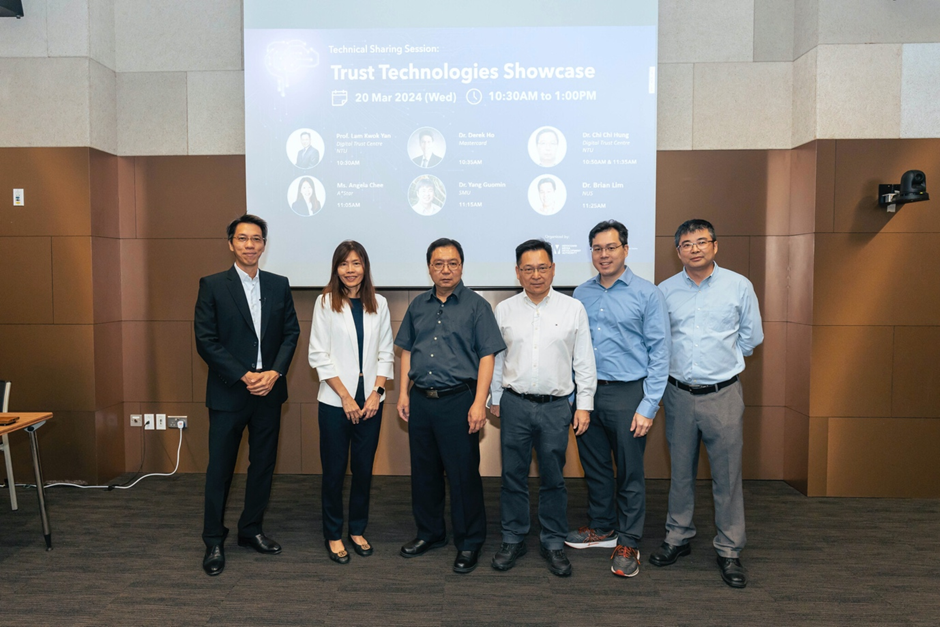
On 20 March 2024, a full house gathered at IMDA’s Technical Sharing Session (TSS) to witness the future of digital trust technologies at the Trust Technologies Showcase. Hosted by the Digital Trust Centre (DTC), the session featured leading experts from academia and industry: Prof Lam Kwok Yan (NTU), Dr Derek Ho (Mastercard), Dr Chi Chu Hung (NTU), Ms Angela Chee (A*STAR), Dr Yang Guomin (SMU) and Dr. Brian Lim (NUS) . They offered a deep dive into applied research, industry case studies, and strategic plans to strengthen Singapore’s position as a Trusted Digital Hub.

Prof Lam Kwok Yan, Executive Director of DTC at the Nanyang Technological University of Singapore (NTU), set the tone with a powerful vision for Singapore’s digital trust ecosystem. He outlined DTC’s vision:
- Strengthening the digital trust R&D pipeline
- Translating innovations into real-world deployments
- Fostering international partnerships for global impact
Backed by a $50 million grant from IMDA and NRF, DTC supports both deep tech research and industry pilots, including 20 funded R&D projects, a trust technology sandbox and industry engagement platforms. Prof Lam emphasised the criticality of system-level engineering to bring privacy-preserving technologies and explainable AI to production at scale.

Dr Derek Ho shared Mastercard’s experience in IMDA’s Privacy Enhancing Technologies (PET) Sandbox, showcasing a Proof-of-Concept using Fully Homomorphic Encryption (FHE) to securely query International Bank Account Number (IBAN) records across jurisdictions. This PET-enabled setup allowed institutions to query IBAN data without revealing the underlying data or violating cross-border regulations — essential for combatting US$2 trillion in annual global financial crime. His key takeaway: PETs offer new possibilities for collaborative intelligence — without breaching compliance.

Dr Chi Chi Hung from NTU focused on the importance of engineering for deployment. He unpacked how DTC projects are navigating the complex transition from science to industry-scale solutions. Featured projects included:
- Pandemic modelling using FHE-secured health data
- Interoperable Private Attribution with Meta for digital advertising
- Searchable encrypted databases for secure data sharing
These case studies highlighted the evolution from single-tech proof-of-concept to multi-tech systems that address interoperability, performance and regulatory concerns.

Ms Angela Chee spotlighted how A*STAR’s Institute for Infocomm Research (I2R) is turning PET and AI research into trusted applications in healthcare, forensic investigations and cross-border collaborations. Showcases included:
- Secure inference for sensitive data such as COVID-19 and tumor classification on external cloud
- Federated learning to detect anomalies across hospitals
- Cross-border encrypted analytics to tackle global health challenges
With ongoing collaborations with Japan, Brazil, the UK and Australia, and tools like PET Encryptor and Analyzer available for trials, A*STAR is exporting Singapore’s trust tech leadership globally.

Dr Yang Guomin gave a broad overview of the Singapore Management University’s (SMU) Trust Tech research in:
- Trusted Execution Environments (TEE) assisted access control
- Multi-key homomorphic encryption (MKHE)
- Decentralised identity (DID) systems
He highlighted award-winning research on privacy-preserving outsourced computation, person re-identification under occlusion, and how these innovations are enabling trusted workflows in sensitive sectors like finance and security.

Dr Brian Lim from the National University of Singapore (NUS) explored how Explainable AI (XAI) should be designed not just for algorithms — but for human reasoning. Drawing on psychology and cognitive science, his research offered a perceptual framework — a model for human-centered XAI to improve trust, interpretability, and fairness in AI. He introduced:
- RexNet: Explanation by relatable examples
- DiagramNet: Step-by-step visual diagnosis
- XAI Confounders Framework: Addressing bias, uncertainty, and oversimplification
His work shifts the focus from technical explanations to trust-building interactions, a key advancement for AI regulation and safety.

Wrapping up, Dr Chi Chi Hung introduced the DTC Innovation Grant Call, inviting researchers and industry players to submit proposals that promote and facilitate innovation in Trust Tech and its translation into real-world use cases. The grant focuses on three key areas:
- AI Governance and Testing
- Web3 & Decentralised Systems
- Secure Compute and PETs
Selected proposals will gain access to the DTC Trust Tech Sandbox, mentorship and testbed resources, accelerating innovation from lab to market.

Whether you’re a technologist, policymaker or entrepreneur, the showcase offered a compelling look into how Singapore is translating cutting-edge research into real-world, scalable trust solutions across sectors like finance, healthcare, advertising and AI.
Missed out on this session? Recap the insights here:
[embed]
Don’t miss out on future deep dives into emerging tech! Subscribe to our mailing list to be informed of upcoming Technical Sharing Sessions and stay connected with the forefront of technological advancements: https://go.gov.sg/imdabtg-connect
메타데이터
- post_id
- 2fac88b4f0e7
- slug
- trust-in-action-singapores-trust-technologies-showcase-unveils-next-gen-innovations-2fac88b4f0e7
- url
- https://medium.com/@imda-biztech/trust-in-action-singapores-trust-technologies-showcase-unveils-next-gen-innovations-2fac88b4f0e7
- canonical_url
- https://medium.com/@imda-biztech/trust-in-action-singapores-trust-technologies-showcase-unveils-next-gen-innovations-2fac88b4f0e7
- author_url
- https://medium.com/@imda-biztech
- status
- ok
- fetched_at
- 2026-08-15 20:19:00

