The Landscape of Dispute Resolution in the Digital Age: From Negotiation to Judicial Settlement
Disputes are an inevitable feature of economic exchange, organizational life, and international relations. As interactions among…
The Landscape of Dispute Resolution in the Digital Age: From Negotiation to Judicial Settlement

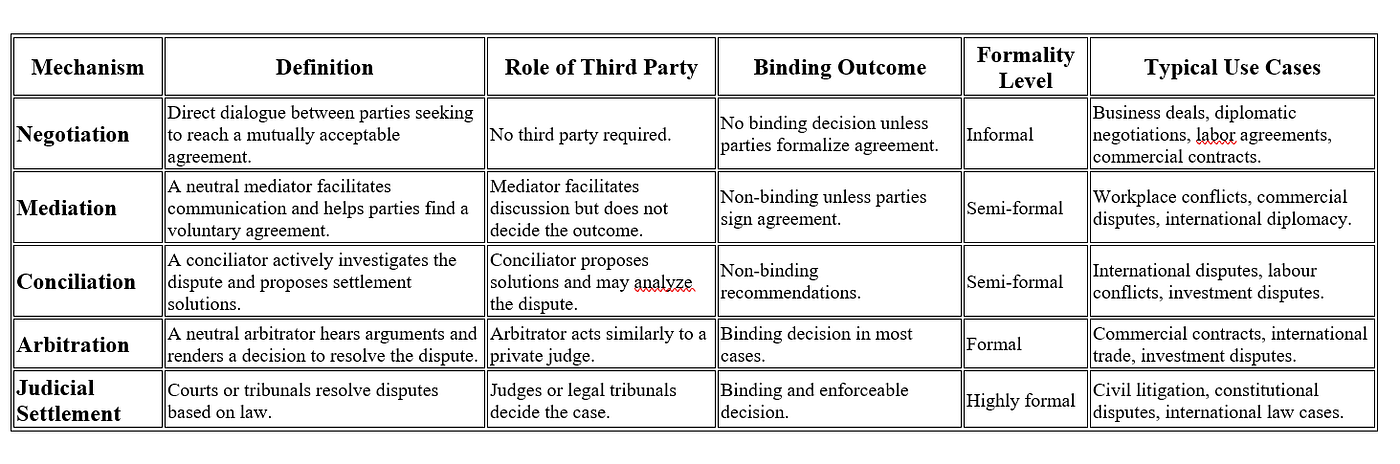
Disputes are an inevitable feature of economic exchange, organizational life, and international relations. As interactions among individuals, corporations, and governments become more complex, societies have developed structured mechanisms to manage disagreements and prevent escalation into destructive conflict. These mechanisms form a continuum of dispute resolution processes that range from informal dialogue to formal legal adjudication. Negotiation, mediation, conciliation, arbitration, and judicial settlement represent the principal approaches through which conflicts are addressed and cooperation is restored. The central insight of this framework is that dispute resolution mechanisms differ primarily in the degree of formality and third-party authority involved in resolving disagreements.
International law and governance frameworks have long recognized the importance of these mechanisms. The Charter of the United Nations explicitly identifies negotiation, mediation, conciliation, arbitration, and judicial settlement as peaceful means through which disputes between states should be resolved (United Nations, 1945). Article 33 of the Charter emphasizes that states should seek solutions through these mechanisms before allowing disputes to escalate. This reflects a fundamental principle of international governance: conflicts should first be addressed through dialogue before moving toward formal adjudication.
Similarly, the Organisation for Economic Co-operation and Development has developed governance frameworks that emphasize dialogue and mediation in international economic relations. Through the OECD Guidelines for Multinational Enterprises, governments establish National Contact Points that facilitate mediation between companies and stakeholders when conflicts arise concerning responsible business conduct (Organisation for Economic Co-operation and Development [OECD], 2023). The OECD framework demonstrates how mediation can function as a preventive governance tool, allowing disputes to be addressed before they escalate into legal conflicts.
The academic literature on dispute resolution has historically conceptualized these mechanisms as forming a continuum that varies according to the degree of third-party intervention and the level of formality involved. Negotiation occupies the least formal position in this continuum. It refers to direct communication between parties seeking to reach mutually acceptable agreements while pursuing partially divergent interests (Fisher et al., 2011; Raiffa et al., 2002). Negotiation is therefore the foundational mechanism of dispute resolution because it allows parties to retain full control over both the process and the outcome.
Building on negotiation, mediation introduces a neutral third party who facilitates communication between disputing actors. Mediators do not impose outcomes; instead, they structure dialogue, clarify misunderstandings, and assist participants in exploring possible solutions (Moore, 2014). Mediation has become a widely used mechanism in commercial disputes, labor relations, and international diplomacy because it preserves relationships while providing structured dialogue processes. The key insight is that mediation transforms adversarial interactions into collaborative problem-solving processes without removing decision-making authority from the parties.
Conciliation occupies a similar position within the dispute resolution spectrum but grants the neutral intermediary a somewhat more active role. Conciliators may investigate the dispute, gather information from the parties, and propose settlement recommendations intended to guide negotiations toward agreement (Bercovitch & Jackson, 2009). Unlike mediators, conciliators may propose specific settlement options, which can help break negotiation deadlocks when parties struggle to identify mutually acceptable solutions.
When voluntary mechanisms fail to resolve disputes, more formal procedures become necessary. Arbitration represents a structured process in which an arbitrator hears arguments from both sides and renders a decision that is typically binding on the parties. Arbitration has become particularly important in international commercial relations because it allows parties from different jurisdictions to resolve disputes through neutral adjudicators outside national court systems (Born, 2021). The defining feature of arbitration is that the parties voluntarily submit their dispute to a neutral authority whose decision becomes binding.
Judicial settlement represents the most formal stage of dispute resolution, in which courts or tribunals interpret legal rules and issue binding judgments. At the international level, judicial settlement is conducted by institutions such as the International Court of Justice, which serves as the principal judicial organ of the United Nations and provides authoritative interpretations of international law (Alter, 2014). Judicial settlement therefore represents the endpoint of the dispute resolution continuum, where legal authority replaces voluntary agreement as the mechanism for resolving disputes.
Together these mechanisms form a coherent framework for managing disputes. Negotiation allows parties to resolve disagreements directly, mediation and conciliation introduce facilitation and expert guidance, arbitration provides neutral adjudication, and judicial settlement ensures enforceable legal outcomes. The dispute resolution continuum can therefore be understood as a progressive escalation from voluntary dialogue to binding legal decision-making.
Despite the clarity of this framework, it often overlooks a significant transformation occurring within contemporary economic systems. Negotiation and dispute resolution processes increasingly take place within digital environments that shape information flows, evaluate proposals, and influence bargaining outcomes. Algorithmic pricing systems, automated customer-service platforms, and artificial intelligence tools capable of analyzing contractual terms are changing how parties interact and how agreements are reached. The critical shift is that negotiation is no longer purely a human interaction but increasingly a process mediated by digital infrastructures.
As argued by Martino Agostini, negotiation remains a foundational mechanism through which individuals, organizations, and states manage differences while maintaining cooperative relationships (Agostini, 2026). However, negotiation is also evolving as digital infrastructures increasingly mediate communication between parties. Rather than occurring exclusively through face-to-face dialogue or traditional diplomatic channels, negotiations now frequently unfold through digital platforms that structure interactions and shape decision processes. This suggests that modern negotiation should be understood as a socio-technical process combining human judgment with digital mediation.
Technological innovation has accelerated this transformation. Artificial intelligence systems can analyze contractual language, evaluate bargaining strategies, and identify negotiation patterns across large datasets. Research in management and information systems suggests that algorithmic decision-support tools can influence negotiation strategies and outcomes by improving information symmetry and reducing uncertainty in complex bargaining situations (Brynjolfsson & McAfee, 2014; Davenport & Ronanki, 2018). The key implication is that AI tools are increasingly augmenting human negotiators by providing analytical insights that shape bargaining strategies.
These tools allow organizations to augment human negotiators with analytical insights into pricing dynamics, risk assessment, and strategic alternatives. As discussed by Agostini (2024), AI-enabled negotiation platforms are beginning to reshape commercial bargaining processes by providing predictive analytics and real-time decision support during sales and contract negotiations. The integration of AI into negotiation processes marks a shift from intuition-based bargaining toward data-informed negotiation strategies.
The strategic dimension of negotiation has also become more visible in environments characterized by uncertainty and rapid change. Strategic management scholarship emphasizes negotiation as a central leadership capability within complex stakeholder ecosystems (Lax & Sebenius, 2006). In Negotiation Is Strategy: How Today’s Leaders — and Their Strategic Advisors — Turn Crisis into Competitive Advantage, Agostini (2025a) argues that negotiation is not merely a transactional activity but a strategic capability that enables leaders to align stakeholders, coordinate responses, and transform crises into opportunities for institutional adaptation. The key insight here is that negotiation functions not only as a conflict-resolution tool but also as a mechanism for strategic coordination among stakeholders.
In parallel, AI-driven agents are increasingly mediating everyday interactions between individuals and institutions. Digital assistants embedded within banking, insurance, and customer-service platforms often negotiate terms implicitly through dynamic pricing systems, automated contract adjustments, and personalized service offers. According to Agostini (2025b), these systems are reshaping human interaction within financial services by enabling adaptive and data-driven negotiation processes between organizations and users. This indicates that negotiation is becoming embedded within algorithmic systems that continuously adjust offers and conditions in response to user behavior.
Scholars in digital governance similarly observe that algorithmic systems increasingly structure decision-making processes within markets and organizations, shaping how workers, customers, and managers interact with digital platforms (Kellogg et al., 2020). The broader implication is that dispute resolution mechanisms must adapt to a world where algorithmic systems influence economic interactions before conflicts even emerge.
Recognizing this transformation has important implications for governance and institutional design. If negotiation processes increasingly occur within digital infrastructures, policymakers and organizations must reconsider how transparency, accountability, and fairness are ensured in algorithmically mediated interactions. Mediation and conciliation frameworks may evolve as digital decision-support tools assist mediators in analyzing disputes and identifying settlement options. At the same time, arbitration and judicial settlement will continue to provide authoritative mechanisms for resolving disputes when voluntary agreements cannot be achieved. The key governance challenge is therefore ensuring that digital negotiation systems remain transparent, accountable, and fair.
The traditional continuum of dispute resolution therefore remains relevant, but it must be interpreted within a changing technological context. Negotiation, mediation, conciliation, arbitration, and judicial settlement still represent the core mechanisms through which disputes are addressed. Yet the environments in which these processes occur are increasingly shaped by digital infrastructures that influence negotiation dynamics and institutional decision-making. Understanding dispute resolution today therefore requires integrating legal frameworks with technological analysis.
In this emerging landscape, the ability to navigate disputes constructively remains a central element of effective leadership and governance. The fundamental insight is that dispute resolution mechanisms remain essential for maintaining cooperation, but their operation is increasingly shaped by digital technologies that transform how negotiation and conflict management occur.
References
Agostini, M. (2026, March 25). The importance of negotiation. Medium. https://medium.com/@tarifabeach/the-importance-of-negotiation-2cb5a750f46d
Agostini, M. (2025a, June 12). Negotiation is strategy: How today’s leaders — and their strategic advisors — turn crisis into competitive advantage. Medium. https://medium.com/@tarifabeach/negotiation-is-strategy-how-todays-leaders-and-their-strategic-advisors-turn-crisis-into-04adda02bc96
Agostini, M. (2024, August 13). Empowering sales and negotiation: How AI is revolutionizing growth and buyer dynamics. Medium. https://medium.com/@tarifabeach/empowering-sales-and-negotiation-how-ai-is-revolutionizing-growth-and-buyer-dynamics
Agostini, M. (2025b, July 8). From creepy to essential: How AI agents are reshaping human interaction in financial services, insurance, and negotiation. Medium. https://medium.com/@tarifabeach/from-creepy-to-essential-how-ai-agents-are-reshaping-human-interaction-in-financial-services-cedebd5966d4
Alter, K. J. (2014). The new terrain of international law: Courts, politics, rights. Princeton University Press. https://press.princeton.edu/books/paperback/9780691154756/the-new-terrain-of-international-law
Bercovitch, J., & Jackson, R. (2009). Conflict resolution in the twenty-first century: Principles, methods, and approaches. University of Michigan Press. https://press.umich.edu/Books/C/Conflict-Resolution-in-the-Twenty-first-Century
Born, G. B. (2021). International commercial arbitration (3rd ed.). Wolters Kluwer. https://lrus.wolterskluwer.com/store/product/international-commercial-arbitration-third-edition/
Brynjolfsson, E., & McAfee, A. (2014). The second machine age: Work, progress, and prosperity in a time of brilliant technologies. W. W. Norton. https://wwnorton.com/books/the-second-machine-age
Davenport, T. H., & Ronanki, R. (2018). Artificial intelligence for the real world. Harvard Business Review. https://hbr.org/2018/01/artificial-intelligence-for-the-real-world
Fisher, R., Ury, W., & Patton, B. (2011). Getting to yes: Negotiating agreement without giving in (3rd ed.). Penguin Books. https://www.penguinrandomhouse.com/books/299675/getting-to-yes-by-roger-fisher-william-ury-and-bruce-patton/
Kellogg, K. C., Valentine, M. A., & Christin, A. (2020). Algorithms at work: The new contested terrain of control. Academy of Management Annals, 14(1), 366–410. https://doi.org/10.5465/annals.2018.0174
Lax, D. A., & Sebenius, J. K. (2006). 3-D negotiation: Powerful tools to change the game in your most important deals. Harvard Business School Press. https://store.hbr.org/product/3-d-negotiation-powerful-tools-to-change-the-game-in-your-most-important-deals/8006
Moore, C. W. (2014). The mediation process: Practical strategies for resolving conflict (4th ed.). Wiley. https://onlinelibrary.wiley.com/doi/book/10.1002/9781118304302
Organisation for Economic Co-operation and Development. (2023). OECD guidelines for multinational enterprises on responsible business conduct. https://www.oecd.org/mne
United Nations. (1945). Charter of the United Nations. https://www.un.org/en/about-us/un-charter
DisputeResolution #Negotiation #Mediation #Conciliation #Arbitration #JudicialSettlement #AlternativeDisputeResolution #InternationalDisputeResolution #CommercialArbitration #ConflictResolution #NegotiationStrategy #PrincipledNegotiation #HarvardNegotiationProject #AIinNegotiation #DigitalGovernance #CorporateGovernance #InternationalLaw #UNDisputeResolution #OECDGuidelines #ConflictManagement
메타데이터
- post_id
- 2fad79deebdb
- slug
- the-landscape-of-dispute-resolution-in-the-digital-age-from-negotiation-to-judicial-settlement-2fad79deebdb
- url
- https://medium.com/@tarifabeach/the-landscape-of-dispute-resolution-in-the-digital-age-from-negotiation-to-judicial-settlement-2fad79deebdb
- canonical_url
- https://medium.com/@tarifabeach/the-landscape-of-dispute-resolution-in-the-digital-age-from-negotiation-to-judicial-settlement-2fad79deebdb
- author_url
- https://medium.com/@tarifabeach
- status
- ok
- fetched_at
- 2026-06-09 15:37:30