MCP Isn’t Dead. You probably don't have skills.
MCP Isn’t Dead. You’re Just Deploying It Wrong.
MCP Isn’t Dead. You just have no Skills!
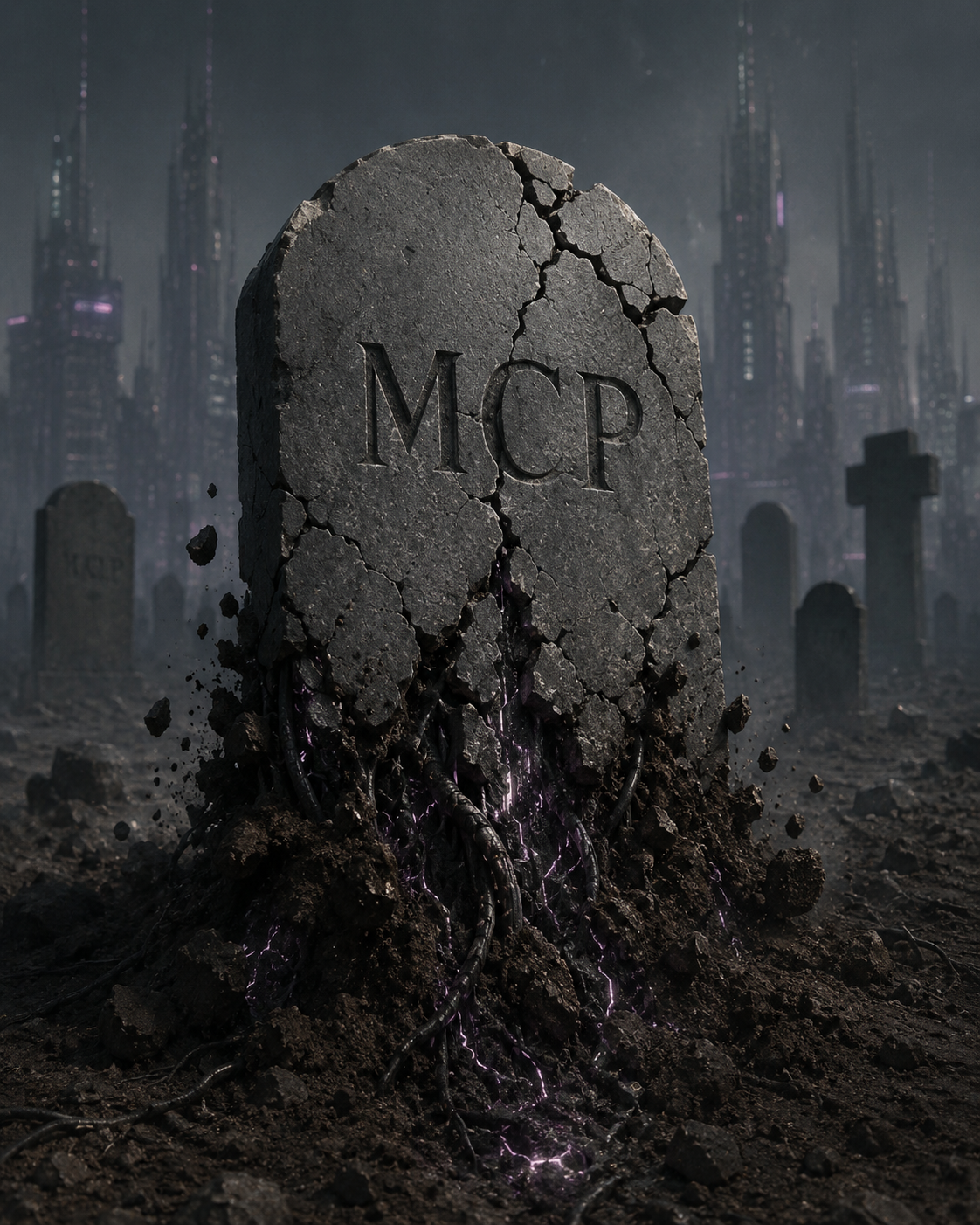
MCP Isn’t Dead. You’re Just Deploying It Wrong.
If you’ve been on AI developer forums lately you’ve seen the same hot take a hundred times: MCP is dead. Eric Holmes wrote “MCP is dead. Long live the CLI” and it hit the top of Hacker News in February. A couple weeks later Garry Tan, the CEO of Y Combinator, posted on X that “MCP sucks honestly,” pointing to context window consumption and bad auth. And there’s a 2025 research paper, MCPGAUGE, that put real numbers on the problem — across six commercial LLMs they measured a 9.5% average drop in accuracy and input token volume inflating by anywhere from 3.25x to 236.5x.
Read those three together and “MCP is dead” looks airtight. But the deployments most of these critiques are pointing were never built to succeed in the first place. Most teams hook up four or five MCP servers, dump every tool into the model’s context, write zero guidance, and then blame the protocol when the assistant hallucinates a column name or invents an asset count.
That’s not an MCP failure. That’s a deployment failure. The protocol is fine. The shape of the failure tells you the developer never gave the model what it actually needed: structure, constraints, and the discipline to look before it speaks.

The complaints are real. They’re also self-inflicted.
Take context bloat first. Every tool from every connected server gets preloaded into the model’s context window before you type anything. Tool names, descriptions, JSON schemas, parameters, types, constraints. Connect five MCP servers and you can easily burn 50,000+ tokens before the model reads your first prompt. Anthropic’s own engineering team has acknowledged seeing tool definitions consume 134K tokens before optimization.
The fix already exists. Anthropic shipped Tool Search Tool in late 2025, and the numbers are good — an 85% reduction in token usage while keeping access to your full tool library. On internal MCP evaluations, Opus 4 improved from 49% to 74% accuracy with Tool Search enabled. Opus 4.5 went from 79.5% to 88.1%. Most “MCP is dead” deployments aren’t using it.
Skills are the same story. They package expertise into folders the model loads on-demand instead of stuffing everything into context up front. Simon Willison called Skills “maybe a bigger deal than MCP” when they launched in October 2025.

A memory test, and what it tells us about LLMs
Quick story that’s worth keeping in your head every time you see an LLM doing something that looks fluent.
In college, a professor of mine ran an exercise where he rattled off a hundred random numbers and nouns and asked the class to write down everything we could remember. Most people got five to seven items. The strongest folks in the room got nine. Anything over that was exceptional. Those numbers happen to match the classic finding on working memory capacity — the famous “magical number seven, plus or minus two.” Humans have a context window too. Ours just happens to live behind our eyes.
Here’s the part that matters: every single person in that room wrote down only what they actually remembered. Nobody filled in the gaps with plausible-sounding nouns. Nobody invented a fake number to round out their list. We knew we’d forgotten, and we left the blanks blank.
An LLM is not allowed to do that. When you ask it a question, it has to produce an answer. There is no “I forgot” output token. There is no “I remember six things and the other ninety-four are gone.” Whatever is missing from its context, the model has to manufacture from priors and pattern-matching — fluently, confidently, and in a way that reads exactly like the things it actually knows.
If the class had been forced to write down all one hundred items, true or invented, we’d have produced output that looked complete and was mostly fiction. That is exactly what every ungrounded LLM call is. That is what an MCP deployment with no skills and no guardrails forces the model to do.
The protocol gives the model the ability to go look. Skills give it the discipline to actually look, and the structure to know where. Take either one away and you’re back to filling in blanks.

What “deploying it right” looks like
I’ll go deep on this in a sister article, but here’s the short version. I built an MCP server called navi-mcp that exposes my navi CLI — the Tenable Exposure Management API wrapper — to Claude. It works. It works specifically because I didn’t just expose the tools; I wrote a layered set of skills that tell Claude how to use them.
The principles, condensed:
- A real backing store. Claude isn’t guessing at counts or pulling from training data. There’s a local SQLite database (
navi.db) populated from real Tenable API calls. Every answer traces back to something the model actually looked at. - Read-first as a hard rule. Skills tell Claude to read schemas, check counts, verify scope before writing anything. The model doesn’t get to estimate. It runs a real query or it tells you it can’t answer.
- Write-gates on anything that changes state. Tagging, ACR adjustments, scan creation — all require explicit per-operation confirmation. Two locks, two keys, no batching.
- Freshness checks built in. Claude checks how old the data is at the start of any workflow. “We have no Log4j exposure” lands very differently when it’s followed by “(as of the last sync, 41 days ago).”
- Some commands deliberately not exposed. Remote command execution, the full database sync — these stay on the CLI side. A model that could push commands to remediation targets without a human in the loop is a security incident waiting to happen.
- Skills as the orchestration layer. A router skill points at domain skills (navi-core, navi-explore, navi-enrich, and so on). Each loads only when relevant. Each tells Claude what the gotchas are and what to look up first.
Strip those out and you get exactly the experience the “MCP is dead” crowd is describing — bloated context, confused models, plausible-but-wrong answers. The protocol is the engine. Skills are the steering wheel, the brakes, and the lane markings. Take any of those away and you crash.
If you want the full walkthrough of how those six mechanisms work in practice — including the real failure modes they prevent, with concrete examples from Tenable workflows — see the sister article: “The Navi MCP — 11 Skills driving accurate Exposure Management automation.”
Why the loudest critics are mostly right about the wrong thing
The phrase that does the most work in the “MCP is dead” discourse is “nobody uses it correctly.” That’s the actual problem, dressed up as a protocol obituary.
Some critiques are real. MCP was built for functionality, not security — TLS protects the pipe, not the message, and corporate proxies routinely decrypt and re-encrypt traffic at every hop. Discovery is genuinely rough too: you find MCP servers by Googling them, with no central registry, no verified publishers, no security audits. Both are legitimate maturity problems. Neither is a death sentence — npm looked exactly like that for years and got there.
The complaints worth taking seriously are about ecosystem maturity. The complaints that don’t survive scrutiny are about the protocol itself, and almost always trace back to developers shipping tools without skills, scoping, or any of the discipline a real deployment needs.

Wrapping Up
MCP isn’t dead. The lazy deployments are. If your MCP integration feels broken, the question isn’t whether to abandon the protocol. The question is whether you’ve written the skills that tell the model how to use it — and if you haven’t, you’re forcing it to fill in the blanks the same way that college class would have if the professor had demanded all one hundred items on the page.
Most of the class would have written fiction. Most ungrounded LLMs do too. Skills are how you stop forcing the fiction.
Sources
- Eric Holmes, “MCP is dead. Long live the CLI.” — February 28, 2026.
- Garry Tan, “MCP sucks honestly…” — March 11, 2026.
- MCPGAUGE paper, “Help or Hurdle? Rethinking Model Context Protocol-Augmented Large Language Models” — arXiv:2508.12566.
- Anthropic Engineering, “Introducing advanced tool use on the Claude Developer Platform” — Tool Search Tool figures.
- Simon Willison, “Claude Skills are awesome, maybe a bigger deal than MCP” — October 16, 2025.
- Charles Chen, “MCP is Dead; Long Live MCP!” — March 14, 2026.
- Micheal Lanham, “MCP Isn’t Dead. But It’s Not the Default Answer Anymore.” — March 16, 2026.
- “Claude Code Just Cut MCP Context Bloat by 46.9%” — January 16, 2026.
메타데이터
- post_id
- 2fb09ee47347
- slug
- mcp-isnt-dead-you-probably-dont-have-skills-2fb09ee47347
- url
- https://medium.com/@packetchaos/mcp-isnt-dead-you-probably-dont-have-skills-2fb09ee47347
- canonical_url
- https://medium.com/@packetchaos/mcp-isnt-dead-you-probably-dont-have-skills-2fb09ee47347
- author_url
- https://medium.com/@packetchaos
- status
- ok
- fetched_at
- 2026-06-20 20:29:01