Trusted Execution Environments (TEEs): A Comprehensive Guide
Introduction
Trusted Execution Environments (TEEs): A Comprehensive Guide
Introduction
Trusted Execution Environments (TEEs) have emerged as a critical technology in modern computing, providing hardware-isolated spaces for running sensitive code and data securely, even on compromised systems. They bridge the gap between software security and hardware enforcement, enabling applications from mobile payments to confidential cloud computing. This blog explores TEE fundamentals, implementations, real-world uses, benefits, challenges, and future trends.
The Core Concept of TEEs
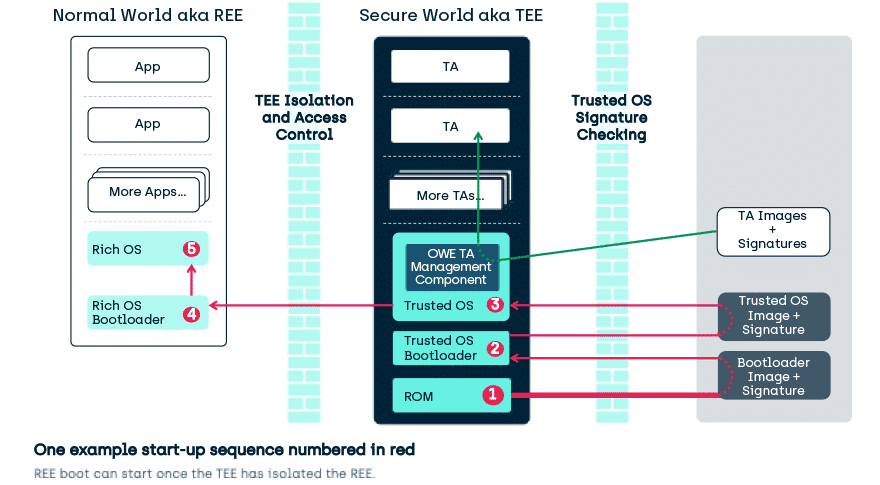
TEEs partition the processor into a “Secure World” for trusted operations and a “Normal World” or Rich Execution Environment (REE) for general tasks. Unlike software isolation, TEEs use hardware features to guarantee confidentiality and integrity, resisting OS-level attacks.
Key Components:
- Secure Boot: Verifies firmware and TEE components via cryptographic signatures, building a chain of trust from hardware ROM.
- Runtime Isolation: Processor bits (e.g., ARM’s Non-Secure bit) segregate memory and peripherals.
- Context Switching: Instructions like Secure Monitor Call (SMC) enable secure communication between worlds.
Major TEE Technologies
TEEs vary by architecture, with ARM TrustZone dominating mobiles and Intel SGX leading in servers.
ARM TrustZone
TrustZone divides cores into Secure and Non-Secure Worlds, hosting Trusted OS like OP-TEE. Implementation involves enabling TrustZone in hardware, building the OS, developing Trusted Applications (TAs) in C, signing them, and calling from REE clients via APIs.
Intel SGX
SGX forms encrypted “enclaves” immune to privileged software. Developers use the SGX SDK to define secure functions via ECALLs, entering enclaves with EENTER for computations like secure data processing.
Real-World Applications
TEEs power everyday security: Samsung Pay isolates payment keys in TrustZone; Netflix secures DRM decryption; biometrics process fingerprints without exposing data; cloud providers use SGX for confidential AI training. In fintech, TEEs protect crypto trading keys in arbitrage bots.
Benefits and Advantages
TEEs protect data-in-use (not just at-rest), support remote attestation for zero-trust, and incur minimal overhead (around 10%). They outperform traditional security against kernel exploits and insiders.
Challenges and Limitations
Trusted OS vulnerabilities (e.g., QSEE bugs), side-channel attacks (Spectre), and development complexity pose risks. Microkernel designs mitigate some issues, but secure coding remains essential.
Future Directions
By 2026, advancements like ARM’s Realm Management Extension (RME) and enhanced Intel protections bolster TEEs for AI, blockchain MPC, and edge computing. Developer tools simplify integration with web stacks like React/Next.js.
Conclusion
TEEs represent a cornerstone of secure computing, transforming how we handle sensitive operations across devices. While challenges persist, their hardware roots ensure resilience, paving the way for trustworthy digital ecosystems.
Sources:
- https://www.trustonic.com/technical-articles/what-is-a-trusted-execution-environment-tee/
- https://blog.quarkslab.com/introduction-to-trusted-execution-environment-arms-trustzone.html
- https://sergioprado.blog/introduction-to-trusted-execution-environment-tee-arm-trustzone/
- https://www.tencentcloud.com/techpedia/106077
메타데이터
- post_id
- 2fbc8fde59c6
- slug
- trusted-execution-environments-tees-a-comprehensive-guide-2fbc8fde59c6
- url
- https://medium.com/@vansh.khandelwal06/trusted-execution-environments-tees-a-comprehensive-guide-2fbc8fde59c6
- canonical_url
- https://medium.com/@vansh.khandelwal06/trusted-execution-environments-tees-a-comprehensive-guide-2fbc8fde59c6
- author_url
- https://medium.com/@vansh.khandelwal06
- status
- ok
- fetched_at
- 2026-06-24 13:29:15






