How Are Employee Handbooks and Stand-Alone Policies Making an Impact on Federal, State, and Local…
Employee policies have always served as the bridge between what the law requires and what actually happens on the ground in a workplace…
How Are Employee Handbooks and Stand-Alone Policies Making an Impact on Federal, State, and Local Requirements?
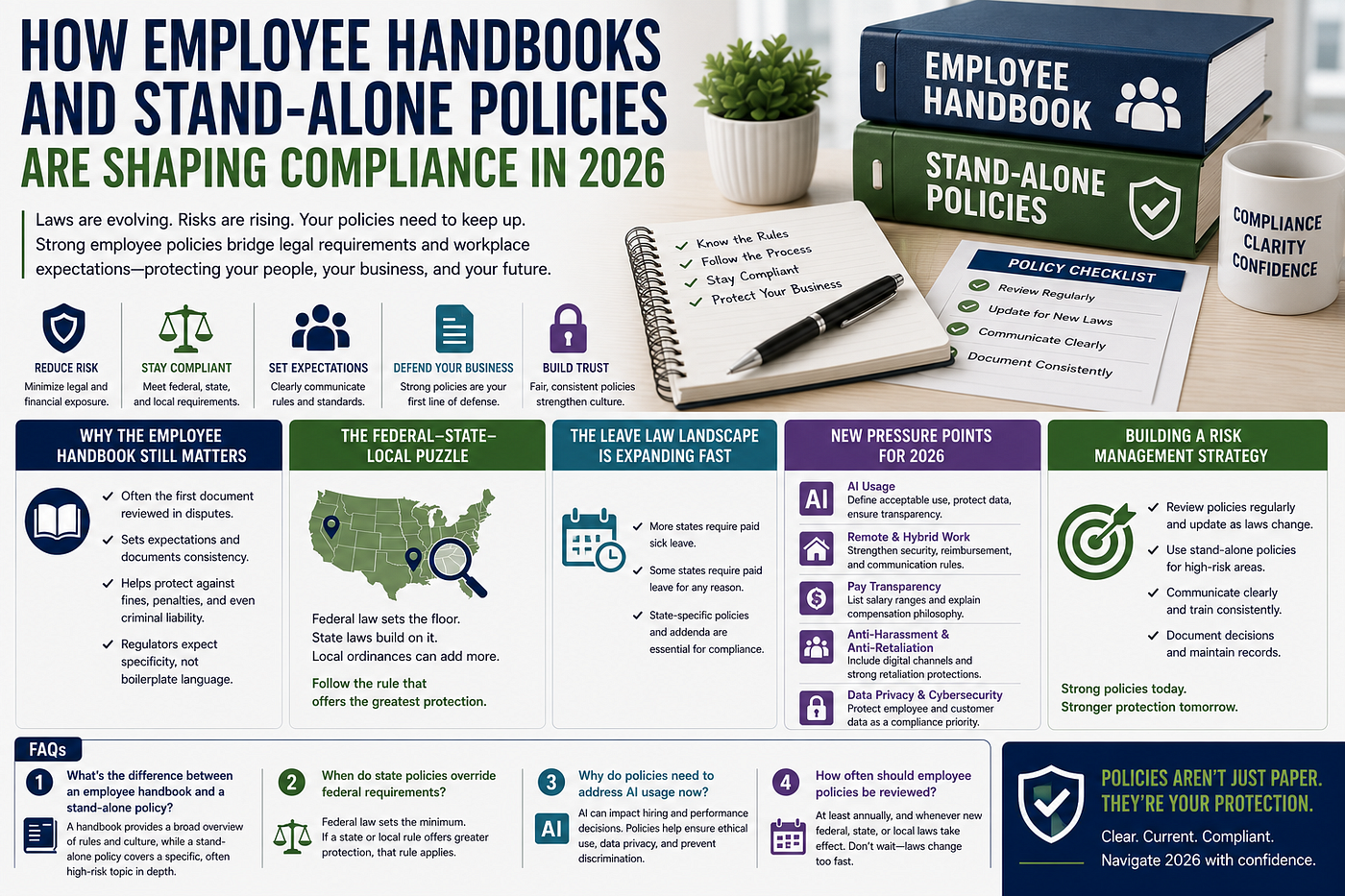
Employee policies have always served as the bridge between what the law requires and what actually happens on the ground in a workplace. But heading into 2026, that bridge is being rebuilt almost from scratch. Federal, state, and local requirements are multiplying and frequently contradicting one another, and employers are discovering that an outdated handbook is no longer a paperwork problem — it’s a legal liability. Understanding how **employee policies** intersect with this shifting regulatory landscape has become one of the most pressing tasks for HR leaders, compliance officers, and business owners alike.
Why the Employee Handbook Still Matters
Despite predictions that the traditional handbook would eventually be replaced by digital onboarding modules or scattered memos, it has proven remarkably durable. The reason is simple: a well-maintained handbook is often the first document regulators, courts, and plaintiffs’ attorneys examine when a workplace dispute arises. It sets expectations, documents consistency, and — when done correctly — can shield an employer from costly fines, penalties, and even criminal sanctions in industries with heightened regulatory scrutiny.
What has changed is the relationship between the handbook and stand-alone policies. Many organizations now maintain separate, detailed policies for high-risk areas (such as workplace violence prevention or data security) rather than burying them in a few paragraphs of the general handbook. This distinction matters because regulators increasingly expect specificity, not boilerplate language. A generic “we do not tolerate violence in the workplace” sentence no longer satisfies the detailed violence-prevention plans that a growing number of states now mandate by law.
The Federal-State-Local Puzzle
One of the trickiest parts of building compliant employee policies is figuring out which layer of regulation actually governs. Federal law sets a floor, not a ceiling, and many states have moved well beyond it — particularly on leave entitlements, pay transparency, and data privacy. Local ordinances can add yet another layer on top of state law, especially in major metro areas.
This creates a real strategic question for multi-state employers: when do state rules supersede federal guidance, and when does a local ordinance override both? Getting this wrong isn’t just an administrative headache — it can expose a company to fines and, in some cases, criminal liability. Employers need a defensible process for tracking which jurisdiction’s rule applies to which employee, especially as remote and hybrid work means a single team can span a dozen different regulatory zones.
The Leave Law Landscape Is Expanding Fast
Paid leave is a clear example of how quickly the ground is shifting. A growing number of states and the District of Columbia now require employers to provide paid sick leave, and a smaller but increasing group of states mandate paid leave that can be used for any reason at all, not just illness. For employers operating across multiple states, this means a single national leave policy is rarely sufficient anymore. Instead, companies need state-specific addenda that spell out eligibility, accrual rates, and usage rules clearly enough to survive an audit.
New Pressure Points for 2026
Several themes stand out as the issues employers most need to address in their employee policies this year:
- Artificial Intelligence Usage: Policies must now define what counts as acceptable use of generative AI tools, address how employee and customer data is handled within those tools, and ensure transparency when AI plays a role in hiring or performance decisions — primarily to guard against unintended discrimination.
- Remote and Hybrid Work: Security protocols, home-office expense reimbursement, and communication expectations all need far more detail than they did just a few years ago.
- Pay Transparency: As more jurisdictions require salary ranges in job postings, handbooks need to clearly explain compensation philosophy and how employees can raise pay-related questions.
- Anti-Harassment and Anti-Retaliation: Reporting procedures must now account for harassment that happens over Slack, Teams, or other digital channels — not just in-person conduct — with a strong emphasis on protecting employees from retaliation after they report.
- Data Privacy and Cybersecurity: As remote work persists, protecting both employee and customer data has become a compliance issue in its own right, not just an IT concern.
Building a Risk Management Strategy
The common thread running through all of this is that **employee policies** can no longer be static documents updated once a year out of habit. They need to function as a living risk management strategy — one that tracks evolving regulations, distinguishes clearly between handbook language and stand-alone policies where specificity is legally required, and gives employees genuine clarity about expectations.
For employers, the payoff for getting this right is significant: fewer fines, reduced exposure to penalties, and a stronger defense if a dispute ever escalates. For employees, it means a workplace where the rules are actually clear. As the regulatory patchwork across federal, state, and local levels continues to grow more complex, organizations that treat their employee policies as a strategic priority — rather than an HR formality — will be the ones best positioned to navigate whatever 2026 brings next.
FAQs
- What’s the difference between an employee handbook and a stand-alone policy? A handbook gives a broad overview of workplace rules and culture, while a stand-alone policy goes deep on one specific, often high-risk topic — like workplace violence prevention or data security — with the detail regulators now expect.
2. When do state employee policies override federal requirements? Federal law sets a minimum standard, so any state or local rule that’s more protective of employees generally applies instead. Employers must follow whichever layer gives employees the greater benefit.
3. Why do employee policies need to address AI usage now? As AI tools influence hiring and performance decisions, policies must spell out acceptable use, protect data privacy, and ensure transparency to prevent unintended discrimination claims.
4. How often should employee policies be reviewed? At least annually, but ideally whenever a new federal, state, or local law takes effect — leave laws, pay transparency rules, and data privacy requirements are changing too quickly for a “set it and forget it” approach.
메타데이터
- post_id
- 2fbe3fa3887d
- slug
- how-are-employee-handbooks-and-stand-alone-policies-making-an-impact-on-federal-state-and-local-2fbe3fa3887d
- url
- https://medium.com/@david94808/how-are-employee-handbooks-and-stand-alone-policies-making-an-impact-on-federal-state-and-local-2fbe3fa3887d
- canonical_url
- https://medium.com/@david94808/how-are-employee-handbooks-and-stand-alone-policies-making-an-impact-on-federal-state-and-local-2fbe3fa3887d
- author_url
- https://medium.com/@david94808
- status
- ok
- fetched_at
- 2026-06-28 14:26:31