Persistent Reasoning: Practical Exploration (P2) — Forbidden Operations
Why queryability destroys persistent reasoning
Persistent Reasoning: Practical Exploration (P2) — Forbidden Operations
Why Structural Motifs Are Not Knowledge Graphs, Ontologies or Constraint Systems
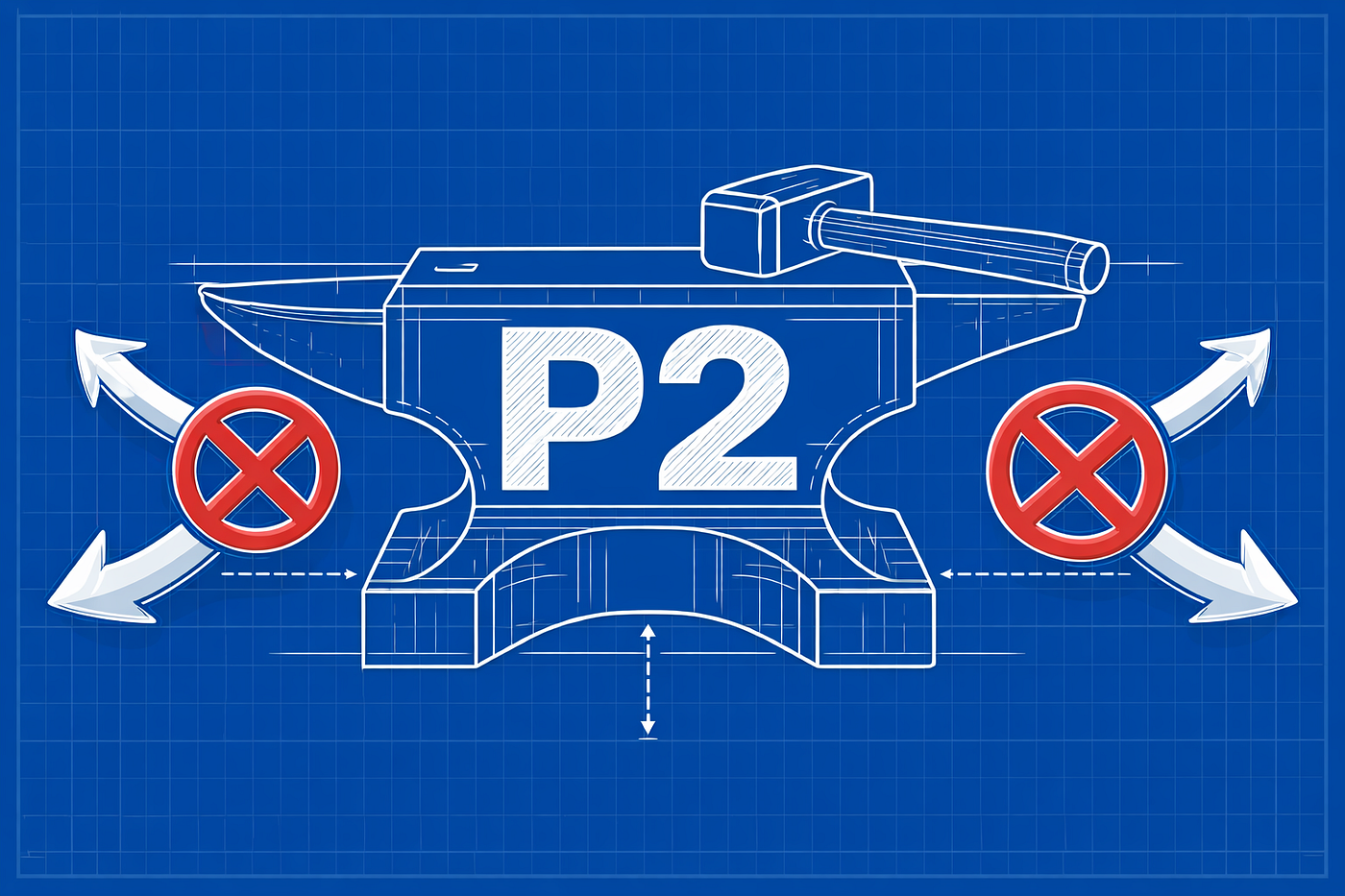
A structural motif is a persistent, non-queryable pattern that constrains how reasoning unfolds without encoding facts, rules or solvable constraints.
Why this article exists
**« After Previous Chapter Practical Exploration (P1)**, a predictable reaction arises:
“This sounds like a knowledge graph.” “Or a meta-ontology.” “Or a constraint system without a solver.”
This article exists to close that interpretation space explicitly.
Not by asserting novelty, but by fixing which operations are forbidden by design and which goals are architecturally out of scope.
The core boundary claim of P2
If a structure can be queried, solved or evaluated for satisfaction — it has already collapsed into a different class of object.
This is not an implementation choice. It is an architectural exclusion.
What this article does not argue
This article does not claim that:
- knowledge graphs are insufficient,
- ontologies are obsolete,
- constraint solvers are flawed.
All are valid and often necessary.
The claim is narrower:
Structural motifs exist to preserve reasoning continuity, not to answer questions or converge on solutions.
Why a structural motif is not a Knowledge Graph
Superficial similarity (acknowledged)
Both may use:
- nodes and edges
- labeled relations
- graph encodings
This similarity is representational, not functional.
The decisive difference: queryability

A knowledge graph exists to be queried. A structural motif exists to be preserved.
The moment a motif is queried for entailment or truth, the architecture has already failed.
Why a structural motif is not an Ontology
Ontologies:
- define what exists,
- stabilize meaning,
- aim at semantic closure.
Structural motifs:
- stabilize decision posture,
- preserve unresolved tensions,
- resist closure by design.

Ontologies answer what something is. Motifs preserve how choices are approached.
Why a structural motif is not a Constraint System
This is the most dangerous confusion, because motifs do contain constraints.
The distinction is operational, not representational.
The forbidden operation
Constraint systems exist to:
- check satisfaction,
- search solution spaces,
- converge on valid assignments.
Structural motifs explicitly forbid:
- satisfaction checking,
- partial evaluation,
- convergence.
A motif is navigated, not solved.
Allowing even partial satisfaction checking would collapse the motif into a solver configuration.
Navigation ≠ querying (important clarification)
Clarification (addresses blind review).
Navigation:
- may influence inference order,
- may expose structural relations,
- may guide exploration.
Navigation never:
- evaluates truth,
- tests satisfaction,
- determines inference outcomes directly.
Navigation may influence WHERE inference looks, but never WHAT inference concludes.
Allowed vs forbidden operations (operational discipline)
To prevent collapse into KR systems:
Allowed
- navigation
- structural comparison
- equivalence recognition
- versioning
- composition
Explicitly forbidden
- querying for entailment
- satisfaction checking
- closure computation
- explanation generation
Important restriction. Motifs may be compared only for structural equivalence, never for entailment or truth.
Why motifs are not “meta-KR” or control knowledge
Control knowledge:
- directs inference,
- encodes heuristics,
- optimizes search.
Structural motifs:
- do not direct inference,
- do not encode heuristics,
- do not optimize search.
They exist prior to optimization.
A motif constrains what kind of reasoning is possible, not which reasoning is preferred.
Enforcing non-queryability (systems perspective)
To make “non-queryable” enforceable, not rhetorical:
- motif stores expose no query API by design,
- only navigation, comparison, and version interfaces,
- append-only semantics prevent implicit evaluation.
Any storage layer that exposes:
- pattern matching,
- satisfaction tests,
- graph queries
has already violated the architectural contract.
Addressing a common objection
“Then how is this useful?”
Structural motifs are not useful per task.
They are useful across time.
They preserve:
- stable trade-offs,
- consistent constraint posture,
- recognizable reasoning continuity.
Usefulness emerges across sequences of decisions, not within a single one.
Interaction with LLMs (explicit misuse prevention)
Explicit restriction.
Any structure fully expressible inside a prompt is not a structural motif.
LLMs may:
- propose motif changes,
- navigate motifs,
- recognize recurring motifs.
They may never:
- own motifs,
- evaluate motifs,
- replace motifs with prompt memory.
This article directly prevents the misuse:
“We already have memory — it’s in the prompt.”
What this article does NOT claim
- This does not claim performance gains.
- This does not replace KR systems.
- This does not eliminate inference.
- This does not guarantee correctness.
It fixes what must never be allowed, nothing more.
Sharpest operational failure test
If a motif can be queried for an answer, evaluated for satisfaction or reduced to a prompt — the system has crossed the boundary.
That test is intentionally brutal.
The next steps:
Closing
A structural motif is a persistent, non-queryable pattern that constrains how reasoning unfolds without encoding facts, rules or solvable constraints.
Most architectures fail not because they cannot do enough, but because they allow too much.
Structural motifs survive because of what they forbid.
Content Licensing
© Vladislav Bliznyukov, 2026
This article is published under the Standard Medium License.
Non-commercial sharing with attribution is welcome. For citations, academic use or discussions in research contexts, please reference the original article.
For commercial reuse, derivative works or republication, please contact the author.
메타데이터
- post_id
- 2fc4fbb26173
- slug
- persistent-reasoning-forbidden-operations-2fc4fbb26173
- url
- https://medium.com/@vladislavbliznyukov/persistent-reasoning-forbidden-operations-2fc4fbb26173
- canonical_url
- https://medium.com/@vladislavbliznyukov/persistent-reasoning-forbidden-operations-2fc4fbb26173
- author_url
- https://medium.com/@vladislavbliznyukov
- status
- ok
- fetched_at
- 2026-06-09 15:37:30





