We Are More Connected Than Ever — So Why Are We So Stressed? (Part 1)
A deeper look into how modern lifestyles, comparison, loneliness, and constant pressure are silently affecting mental well-being.
We Are More Connected Than Ever — So Why Are We So Stressed? (Part 1)
A deeper look into how modern lifestyles, comparison, loneliness, and constant pressure are silently affecting mental well-being.
Have you ever felt mentally exhausted even on days when you did not do much physical work?
Or found yourself worrying constantly about the future, work pressure, relationships, finances, or simply the speed of life itself?
If yes, you are not alone.
Stress has quietly become one of the most common experiences of modern life.
Stress can be understood as a state of mind in which we experience mental tension, pressure, or worry because we perceive a situation as difficult or threatening.
Stress disturbs our sense of balance and comfort in life.
Stress is a natural human response. In many ways, stress is actually the mind and body signalling that something in our life needs attention, balance, or change.
Interestingly, stress is not something new. Even monkeys kept under captivity show visible signs of stress. However, modern lifestyles, consumerism, constant stimulation, and rising expectations have increased stress levels more than ever before.
And the truth is — all of us deal with stress differently.
Some people overeat. Some become silent and withdraw socially. Some move towards alcohol, tobacco, or unhealthy habits. Others continue functioning normally on the outside while feeling emotionally exhausted within.
Stress may lead to physical symptoms such as headaches, body pain, poor concentration, loss of appetite, and disturbed sleep. Over time, prolonged stress can also lead to hopelessness, emotional exhaustion, and a gradual loss of interest in life
Is Stress Always Bad?
Not really.
In fact, a certain level of stress can actually make life exciting.
Why do we enjoy sports, movies, competitions, adventures, or challenging goals?
Because human beings naturally enjoy challenge and stimulation.
Imagine a life with absolutely no pressure, no goals, and nothing challenging to do. Most people would eventually feel bored, unmotivated, and emotionally drained.
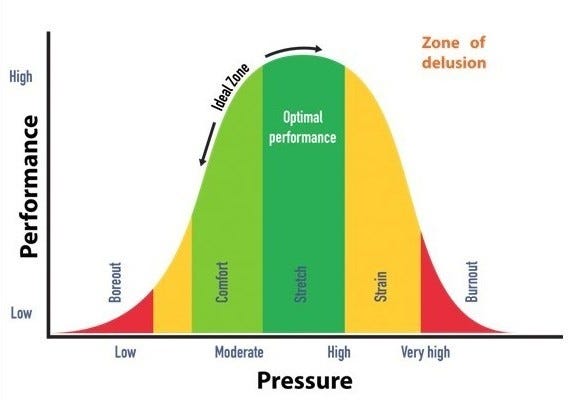
When pressure is too low, performance is usually low as well.
But as pressure increases to an optimal level, something interesting happens — performance improves. We feel energized, focused, challenged, and fully involved.
However, when pressure crosses a certain limit, it stops motivating us and starts exhausting us. That is when stress turns into strain, burnout, frustration, and emotional fatigue.
The important thing to remember is this: The “ideal pressure zone” is different for every person.
What feels exciting for one person may feel overwhelming for another.

Major Causes of Stress
Stress can broadly be divided into three categories — physical stress, emotional stress, and environmental stress. Let us explore how each of these quietly influences our daily lives.
1. Physical Stress
When was the last time we walked somewhere simply because we could?
Modern conveniences have made life easier, faster, and more comfortable. But they have also quietly reduced natural physical movement from our daily lives.
Today, many of us use vehicles even for very short distances. Desk jobs, screens, and technology have drastically reduced physical activity.
While modern conveniences save time, they also reduce opportunities for natural movement. Interestingly, research on human longevity shows that regular natural physical movement can significantly improve health and even increase lifespan.
The result of this inactive lifestyle is visible everywhere: rising obesity, diabetes, high blood pressure, cholesterol problems, fatigue, and declining energy levels.
But lack of movement affects us more deeply than we realize.
Imagine a caveman suddenly being chased by a wild animal.
Within seconds, his entire body shifts into survival mode. His heart starts beating faster. Breathing becomes rapid. Muscles tighten. Stress hormones are released instantly. The body prepares itself to fight or escape.
Then what happens?
The caveman runs for his life, climbs a tree, or escapes danger somehow. In the process, the stress gets released physically through movement.
Now compare that to modern life.
An employee makes a mistake at work or works under the pressure of a critical project. He fears criticism, humiliation, failure, or even losing his job.
But instead of running, fighting, or physically releasing stress, he sits at his desk overthinking. He drinks more coffee, smokes cigarettes, stares at screens, and keeps worrying silently.
The body still enters survival mode.
But the stress never truly gets released.
It slowly keeps accumulating inside the mind and body.
Many of us are eating more, moving less, sleeping poorly, and carrying constant stress within our bodies.
And somewhere along the way, we stopped eating to nourish the body and started eating mainly to satisfy taste and cravings.
Sleep is another major factor.
Our ancestors slept after sunset and woke up with daylight. Human biology is still deeply connected to natural rhythms. Yet many people today sleep late, spend hours on screens, and struggle with irregular sleep cycles.
And when the body does not recover properly, stress increases even more.
2. Emotional Stress
If there is one area that affects emotional stress deeply, it is relationships.
Modern life has created more opportunities, but it has also increased emotional pressure.
Families are becoming increasingly nuclear. Couples often juggle careers, responsibilities, expectations, financial pressure, and lack of time simultaneously. Relationships today operate under far greater strain than before.
Earlier, difficult phases were often absorbed by larger family support systems. Today, many people face emotional struggles alone.
And emotional strength, like physical strength, differs from person to person.
One person may emotionally handle a difficult situation calmly, while another may feel completely overwhelmed by the same situation.
That does not always mean one person is stronger or weaker.
Sometimes life simply demands different emotional weights from different people.
Personality and attitude also influence stress greatly.
Take the example of Rahul Dravid and Yuvraj Singh.
Both were exceptional players, but with completely different personalities and strengths. Rahul Dravid built innings patiently, while Yuvraj Singh thrived in aggressive, high-pressure situations.
Now imagine forcing both to constantly play outside their natural strengths.
Stress often increases when life continuously demands from us what is not aligned with our personality, emotional capacity, or natural style.
We saw something similar during the COVID lockdown as well.
Some people felt trapped, lonely, and emotionally exhausted within four walls.
Others used the same period to read, reflect, spend time with family, learn new skills, or reconnect with themselves.
The situation was the same. The mindset was different.
And that mindset shapes how we experience stress.
People with a more negative outlook are generally more vulnerable to stress because negativity fuels emotions like fear, anger, jealousy, guilt, hopelessness, resentment, and anxiety.
Interestingly, studies suggest that most of the things we worry about never actually happen.
Yet many of us continue mentally suffering because of imagined fears and future uncertainty.
Another important factor is what we constantly feed our minds.
How much negativity are we consuming every single day through news, crime series, social media, endless scrolling, and digital overload?
News channels chase attention. Influencers chase engagement. Algorithms chase our screen time.
But very little of this helps our emotional well-being.
Perhaps that is why meaningful reading, reflection, learning, and silence feel increasingly rare — and increasingly necessary.
The Silent Loss of Human Support Systems
Look at our traditional joint family systems. Multiple brothers lived together with their parents, along with their wives and children. Even if one or two family members were going through a difficult phase emotionally or financially, others were there to support them.
Children rarely felt lonely. They grew up playing together, sharing everything, and building strong emotional bonds with parents, grandparents, uncles, aunts, and cousins. In many ways, life’s pressures were shared collectively.
But somewhere along the way, many of us started moving away from these deeply connected family structures and began adopting a far more individualistic lifestyle. Relationships that once felt emotionally secure are increasingly becoming distant and transactional.
Brothers who once shared everything sometimes become divided over property, money, or status. As emotional connection reduces, loneliness increases. And when people start carrying life’s struggles alone without strong emotional and social support, stress quietly becomes much heavier to handle.
3. Environmental Stress
Have you noticed how modern society constantly tells us that we need “more” to be happy?
More money. More success. More possessions. More status.
And slowly, life starts becoming a race.
Many people spend years chasing wealth while unknowingly neglecting health, peace of mind, relationships, and emotional balance.
Organizations, too, operate under intense competitive pressure. Employees are expected to perform more, work faster, stay available longer, and constantly deliver results.
But not everyone handles pressure in the same way.
This often leads to burnout, exhaustion, poor work-life balance, emotional fatigue, and rising negativity at workplaces.
Remote work has added another challenge.
For many people, office hours no longer end when work ends. Professional life has started entering personal space continuously.
Even environmental factors like traffic, crowding, pollution, excessive noise, extreme temperatures, and chaotic urban environments quietly increase stress levels.
Who has not experienced frustration sitting in traffic for long periods?
Even animals instinctively move away from excessively loud environments.
Human beings are deeply connected to nature too.
Yet modern life has gradually disconnected many of us from natural surroundings, silence, open spaces, and slower rhythms of living.
Perhaps this is why so many people today feel mentally tired even when life appears “comfortable” externally.
In the next article (part 2), we will explore practical and natural ways to reduce stress, restore balance, and build a healthier, calmer, and more resilient mind.
Reflection Question
What do you think is the biggest hidden cause of stress in modern life — pressure to succeed, unhealthy lifestyles, emotional struggles, or the constant race for more?
Thank you for reading.
Sanjay Goel
Learning Consultant | Behaviour & Leadership Development Specialist
(Specializing in customized leadership development, behavioural transformation, team collaboration, and experiential learning solutions)
메타데이터
- post_id
- 2fce2e7c1bbd
- slug
- we-are-more-connected-than-ever-so-why-are-we-so-stressed-part-1-2fce2e7c1bbd
- url
- https://medium.com/@sanjaybgoel/we-are-more-connected-than-ever-so-why-are-we-so-stressed-part-1-2fce2e7c1bbd
- canonical_url
- https://medium.com/@sanjaybgoel/we-are-more-connected-than-ever-so-why-are-we-so-stressed-part-1-2fce2e7c1bbd
- author_url
- https://medium.com/@sanjaybgoel
- status
- ok
- fetched_at
- 2026-06-09 15:37:30




