Are there much lower-cost alternatives to restore the boat ramp?
We can spend the State’s $1 million confirming a boat ramp solution that we still can’t afford — or finding new answers for alternative and…

There are far lower cost options for dredging than we already spent for the failed dredging project (graphic by Tam Hunt). Data from from DLNR, Tweed Sand Bypassing, and Delaware DNREC figures.
Are there much lower-cost alternatives to restore the boat ramp?
We can spend the State’s $1 million confirming a boat ramp solution that we still can’t afford — or finding new answers for alternative and far more affordable dredging options.
The State has appropriated $1 million to plan and design a “two jetty solution” for Pohoiki Bay. With Governor Green’s signature, that money is real.
Durable engineering is the right direction, and securing planning money is a real step. But before that million dollars of taxpayer money is spent, Puna deserves an honest accounting of where this path leads. The two-jetty concept carries a construction estimate north of $60 million — and that figure remains entirely unfunded.
We have already seen this movie. In 2023, a $35 million Pohoiki request was cut to $6.65 million in a budget squeeze (my opinion is that the state refused to fund a higher amount because FEMA never said it would reimburse any higher amount and our legislators have refused to commit any funding beyond what FEMA would reimburse).
The squeeze is worse today. A $1 million study that can only design jetties will spend a year producing a beautiful set of drawings for a project the Legislature has already shown us it will not fund, or even come close to funding.
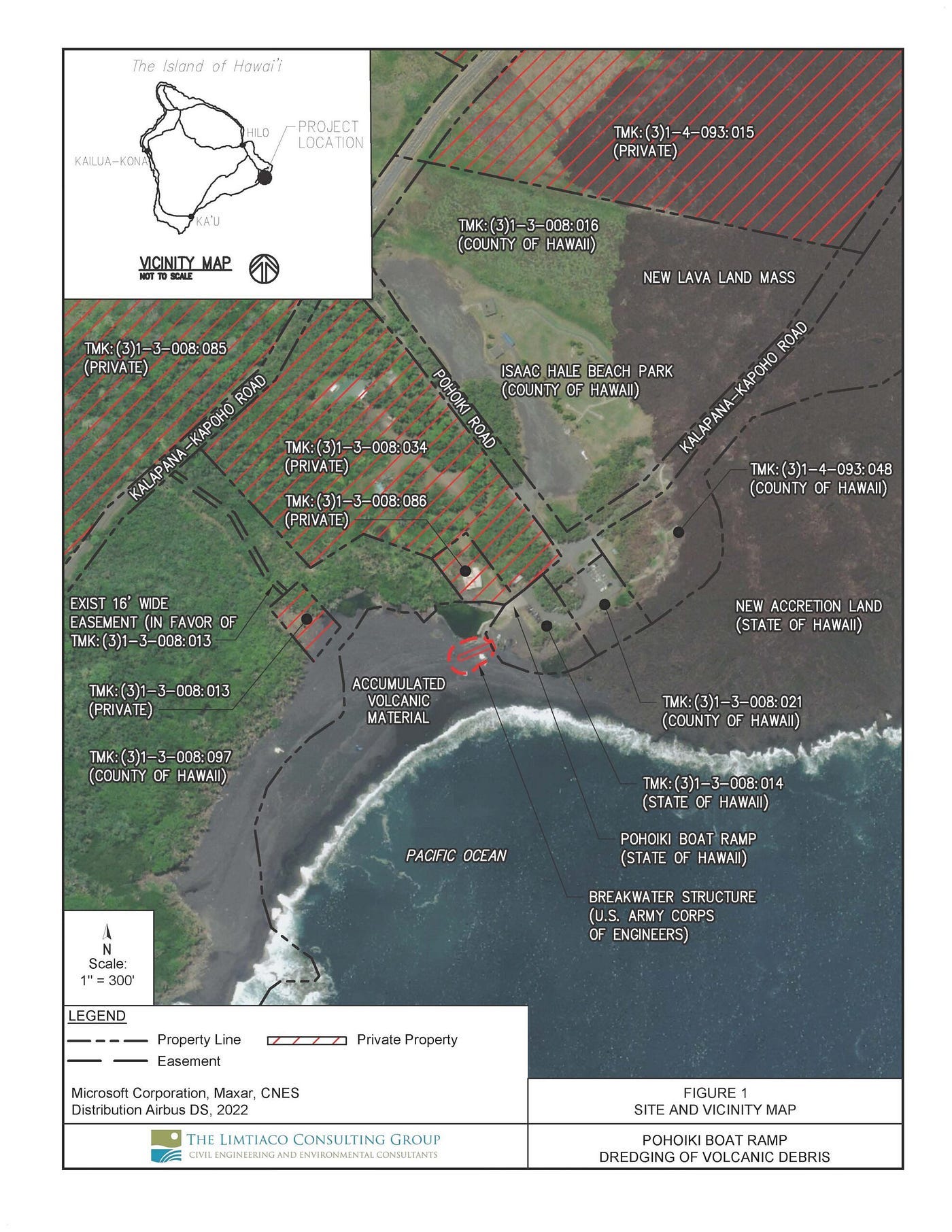
Meanwhile, the lesson of October 2025 is still sitting in the bay. The State spent $9.28 million on a channel dredge its own 2023 environmental assessment warned would fail. The channel opened October 10. The ocean closed it within days. That works out to about $221 per cubic yard for sand that came right back — and one of the eight irreplaceable thermal ponds created by the 2018 eruption was destroyed in the process.
The failure was not bad luck. It was a wrong problem statement. Pohoiki is not blocked by a pile of sand; it is fed by a river of sand gravel and rock, from the lava flow just to the east of the bay. The 2018 eruption built a delta that sheds black sand and cobbles into the bay continuously, swell after swell, year after year. You cannot beat a massive supply with a one-time project — any more than you can bail a canoe once and call it dry.
What beats a continuous supply is continuous removal, faster than it comes in. This is not speculation; it is based on forty years of engineering practice. At the Gold Coast Seaway in Australia, jet pumps on a jetty have been bypassing sand continuously since 1986 — through the most severe storms — moving some 500,000 cubic meters a year.
The Tweed River system next door has done the same since 2001: roughly ten Pohoiki blockages’ worth of sand, every year, indefinitely.
In Delaware, the Army Corps has run a sand bypass at Indian River Inlet since 1990, moving 100,000 cubic yards a year on a $600,000 annual budget — about $6 per cubic yard. Six dollars, against our $221.
The cost of moving a cubic yard of sand: Pohoiki’s failed 2025 dredge vs. two permanent sand-bypassing systems. Chart: Tam Hunt, from DLNR, Tweed Sand Bypassing, and Delaware DNREC figures.
Pohoiki has one advantage those sites would envy: deep water sits just outside the bay. Sand and gravel moved over the nearshore ledge drops beyond the waves’ reach and never comes back. And the technology for moving this sand and gravel keeps getting cheaper — remote-operated crawler dredges that could work the bay patiently, month after month, powered from Puna’s own renewable energy grid (about 70% of our power is now renewable energy, with 30% still oil-based, shrinking rapidly), are now commercial products.
A machine that never sleeps, versus an ocean that never stops. That might be a fair fight for the first time.
It may be feasible to clear the sand, gravel and rock around the boat ramp and existing jetty in this manner and to preserve the rest of the new beach and ponds to the west — so hot pond use and boat ramp use are still not in conflict. We can have hot ponds and a functional boat ramp at the same time.

Less than half a mile from shore the water it’s 500 ft deep, plenty deep to stop sand and gravel coming back to shore. (Graphic by Tam Hunt)
Continuous systems do carry permanent operating costs — $1 to $3 million a year, based on historical figures. But here the money story gets better, not worse. The State’s Boating Special Fund runs about a $3 million annual surplus — it can never finance $60 million of concrete, but it can absolutely sustain the operations of a modest bypassing system. And FEMA’s hazard-mitigation dollars, which cost-share projects 75/25, require a benefit-cost test that a $15 million solution passes far more easily than a $60 million one. The cheaper path is not just easier to build. It should be easier to fund at every level.
[These figures are all just my estimates and not of course in any way binding or firmed up by actual engineering studies yet; the point of this article is to provoke thinking and discussion about possible alternatives]
So here is the ask, and it is modest: should we spend the new $1 million on a true alternatives study or a two jetty pre-design? My idea would compare the two-jetty concept honestly against a single jetty, a sediment trap with scheduled maintenance, fixed sand bypassing, and robotic continuous dredging— each priced over 30 years, each screened for federal cost-share, each weighed for cultural impact by the community itself.
And let’s start by finally measuring the sand: eight years into this crisis, the State still has no quantitative sediment budget for the bay. We are designing blind.
None of this requires taking anything away from anyone. The appropriation is for Pohoiki planning and design; a rigorous alternatives analysis is exactly that. It requires only that the Department of Land and Natural Resources write its request for proposals as a genuine study rather than a foregone conclusion. And as I wrote above all the hot ponds except the one right at the boat ramp would be preserved.
If the study finds that the engineering says jetties are the best solution, so be it — we will have lost nothing and gained some certainty before figuring out how to fund the $60 million required for jetties. But if a continuous robotic dredging system can put fishermen back on the water in two years for a quarter of the cost (or less), Puna deserves to know before the next $60 million question gets asked and answered for us.
[Claude helped to write this]
메타데이터
- post_id
- 2fded68d6d52
- slug
- are-there-much-lower-cost-alternatives-to-fully-dredge-pohoiki-bay-2fded68d6d52
- url
- https://medium.com/@tamhunt/are-there-much-lower-cost-alternatives-to-fully-dredge-pohoiki-bay-2fded68d6d52
- canonical_url
- https://medium.com/@tamhunt/are-there-much-lower-cost-alternatives-to-fully-dredge-pohoiki-bay-2fded68d6d52
- author_url
- https://medium.com/@tamhunt
- status
- ok
- fetched_at
- 2026-09-03 01:23:18