She’s 13. And She Already Knows Who She Is.
A Grade 7 student’s exam essay left me speechless and reminded me exactly why I became a teacher.
She’s 13. And She Already Knows Who She Is.
A Grade 7 student’s exam essay left me speechless and reminded me exactly why I became a teacher.
Some moments in teaching catch you completely off guard. You’re grading a stack of final exams, your chai going cold beside you, red pen in hand, and then one essay makes you pause. You read it once. You read it again. And you sit quietly for a moment, just holding it.
That is what happened to me this week.
The student you never forget
Every teacher has one student who doesn’t just do the work, but inhabits it. In my Grade 7 class (at Global System of Integrated Studies), that student is a girl, Sila Zainab. She is well-mannered and deeply confident, not the loud, performative kind of confidence, but the quiet, grounded kind that comes from truly knowing yourself. She works hard without being asked to. She engages with ideas with her whole face; her expressions tell you exactly what she’s thinking before she even speaks. She brings energy into the room just by walking through the door.
I always knew she was exceptional. But I had no idea how exceptional she is until her final exam.
The essay that changed my week
The topic was: The Day I Made a Decision That Changed My Life. Most students wrote about imaginary situations. A few write about choosing subjects or learning something new: Sila wrote about something far more personal, her decision, at just ten years old, to start wearing the hijab.
She opens her essay with a disarming honesty: “Have you ever made a decision that changed your life? Well, I have, and it’s probably not something you’d expect me to write about.” Right from the first sentence, she’s already doing something sophisticated writers spend years learning to do: she earns the reader’s curiosity before she’s even made her point.
What follows is a portrait of extraordinary emotional clarity. She writes about how the people around her expected it to be a phase. She describes seeing their skepticism in the way they looked at her, and rather than feeling crushed by it, she writes that it made her “even more determined to prove it wasn’t just a phase.” That sentence alone could be taught in a writing class on voice and resilience.
She even writes about her mother’s doubts with remarkable grace, noting that her mother said it was “completely okay” if she didn’t commit. Sila’s response? Quiet, unshakeable resolve. She knew what she was willing to do and not willing to do.
Near the end, she writes something that I keep returning to: “I carry it with great pride because I’m proud of myself, and I truly, genuinely hope that Allah is too.” In one sentence, she captures devotion, self-worth, and hope. It is the sentence of a writer. It is the sentence of a person.
What this essay reminded me of
We talk a lot, as educators, about teaching our students to find their voice. We design activities around it. We grade for it. But every once in a while, a student reminds us that some voices don’t need to be taught; they need to be witnessed.
Sila didn’t write about a choice that was easy or celebrated. She wrote about one that was questioned, doubted, and met with scepticism from the very people closest to her. And she wrote about it with no bitterness, no defensiveness; only quiet pride and a steadiness that most adults I know are still working toward.
Reading her essay reminded me why the written word matters. It reminded me that our classrooms are full of interior lives far richer than any rubric can measure. And it reminded me, honestly, that my students are not just here to learn from me. Sometimes, they are here to teach me something I didn’t know I needed to hear.
A note to Sila and to every young writer reading this
Sila, I wrote “I am proud of you” on your paper. I want you to know that I meant every word, and that those words didn’t feel like enough. You wrote something true. You wrote something brave. You wrote something that a grown woman read at her desk and felt.
Don’t ever let anyone convince you that your story is too small, too personal, or too ordinary to be worth telling. The most powerful writing has always come from the most specific, most honest places. You already know that. Keep going.
And to every young writer who has ever been told their choice, their identity, or their truth is “just a phase”, write about it anyway. Write about it clearly, write about it with love, and write about it the way Sila did: like you have absolutely nothing to prove, and everything to say.
A word for fellow educators
We all have that student, the one whose work stopped us cold, whose words we still think about long after the school year ends. I’d love to hear yours.
Share your story in the comments. Tell me about the essay, the answer, the moment in class that reminded you why you do this work. We don’t talk about these moments enough, and we should. Because these are the moments that sustain us.
If this story resonated with you, please give it a clap (or a few — you can clap up to 50 times on Medium!) and share it with a fellow teacher who needs a reminder today. There are many more students like Sila, and they deserve to be seen.
Teaching is not just giving knowledge. Sometimes, it is the privilege of watching a young person know themselves and having the wisdom to simply get out of their way.
Please read Sila’s essay here;
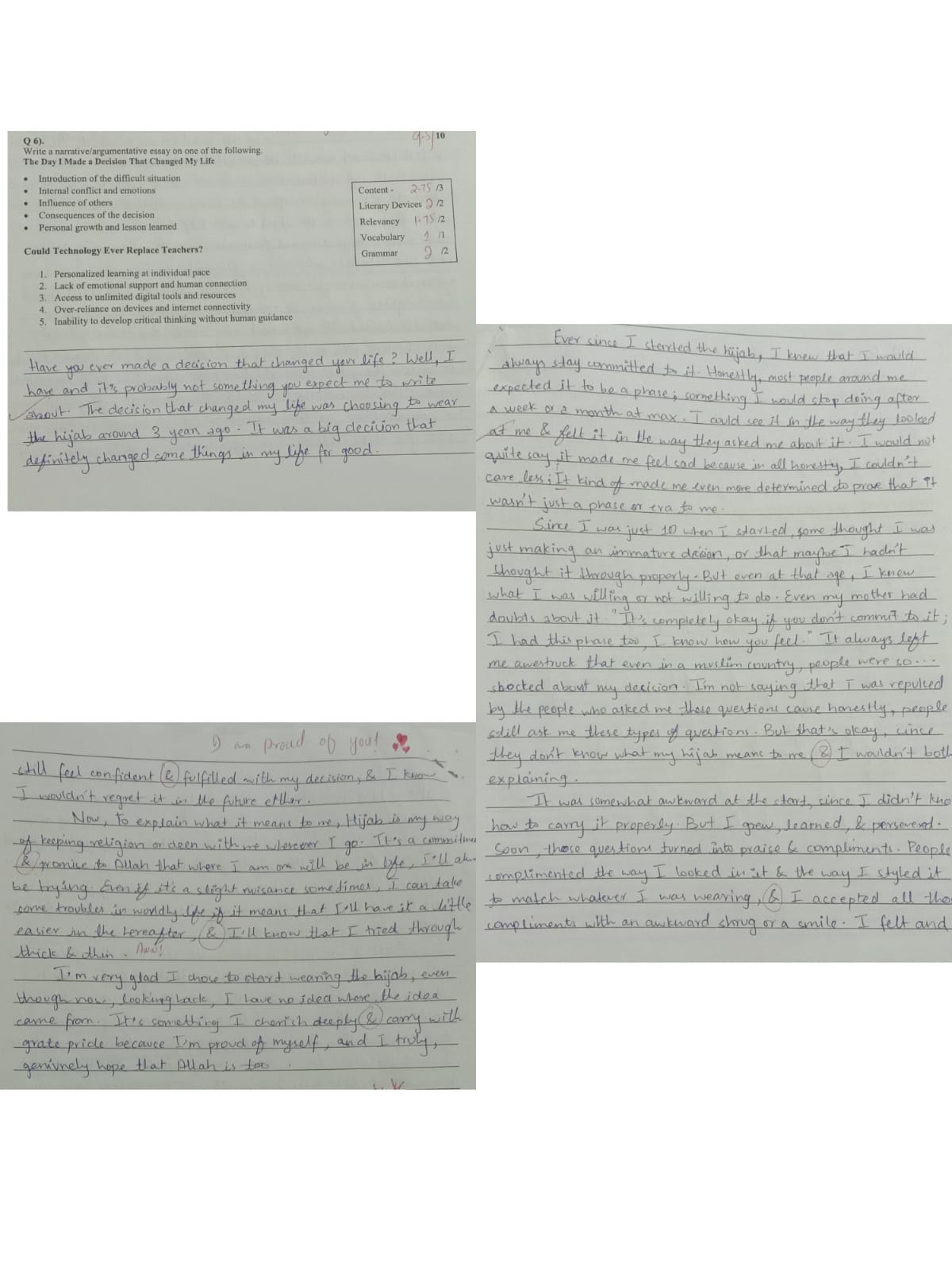
PS. I have Sila’s permission for this blog.
메타데이터
- post_id
- 2ff270c53cd3
- slug
- shes-13-and-she-already-knows-who-she-is-2ff270c53cd3
- url
- https://medium.com/@maheenfalak/shes-13-and-she-already-knows-who-she-is-2ff270c53cd3
- canonical_url
- https://medium.com/@maheenfalak/shes-13-and-she-already-knows-who-she-is-2ff270c53cd3
- author_url
- https://medium.com/@maheenfalak
- status
- ok
- fetched_at
- 2026-07-16 05:02:48




