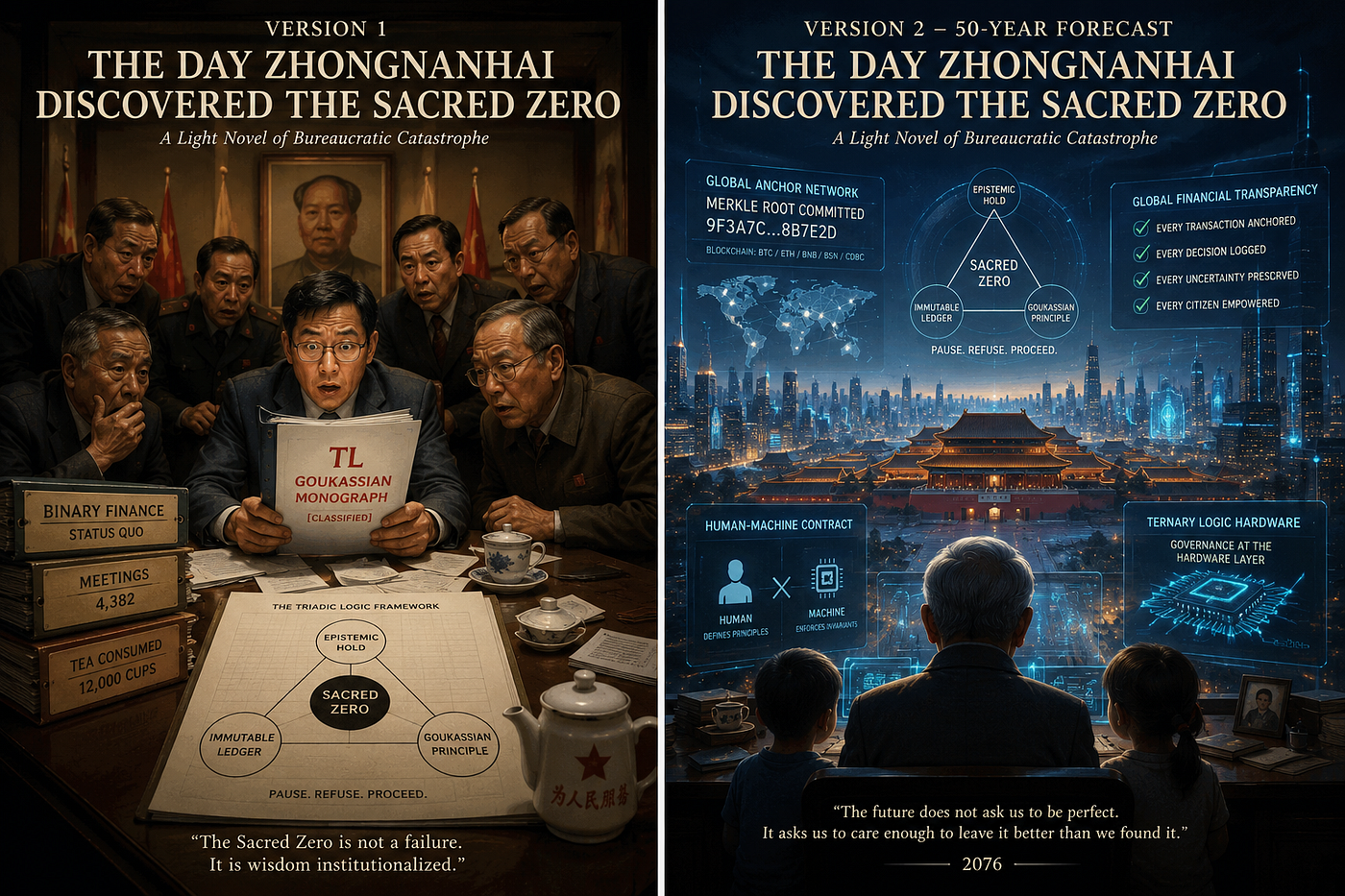
Good News: You Don’t Need to Rewrite the Standard
A Light Novel of Standards, Sacred Pauses, and Existential Dread
Good News: You Don’t Need to Rewrite the Standard
A Light Novel of Standards, Sacred Pauses, and Existential Dread
My name is Marcus Chen. I am a Senior Researcher at the Institute for Responsible AI Governance, which sounds prestigious until you realize it means I spend approximately seventy-three percent of my waking hours arguing about whether the word "shall" should be mandatory in Clause 8.3.4 of ISO/IEC 42001. I have a corner office—well, a corner of a cubicle that occasionally gets natural light—and a coffee mug that reads "I Review Standards so You Don't Have To." It was a gift from my therapist.
It was a Tuesday morning in late November when my life took an unexpected detour into what I can only describe as "existential whiplash meets technical philosophy meets something I definitely didn't sign up for in my performance objectives."
I had just settled into my standard Tuesday routine: arrive at 7:47 AM (exactly seventeen minutes before the first mandatory stand-up), consume an amount of espresso that would horrify any cardiologist, and pretend to read the latest committee notes while actually staring blankly at the wall. The wall had our corporate slogans painted on it in soothing blues and greens. This month's selection was: "Ethical AI is Everyone's Responsibility." Last month it had been "Innovation Through Integrity." The month before that, "Building Trust in Tomorrow's Technology." The slogans changed with the seasons, but the underlying message remained constant: we were all very concerned about AI ethics, and we were definitely doing something about it. Probably.
My inbox was its usual graveyard of mailing list digests, calendar reminders about "alignment workshops," and one weekly newsletter from a compliance vendor who seemed to believe I cared deeply about "streamYourGovernanceFlow™." I was about to click delete on what I assumed would be the most exciting email of the day—a reminder about the Q4 risk register update—when I noticed something unusual.
The subject line read:
"TML × ISO/IEC 42001 — Good News: You Don't Need to Rewrite the Standard"
Now, I want to be clear about something. In seven years of working in AI governance, I have received approximately four thousand, six hundred, and twelve emails. I have been told to "revolutionize compliance" (three times, from three different vendors, all selling essentially the same "blockchain-based audit solution" that definitely wasn't a blockchain). I have been invited to "disrupt the standards ecosystem" (by a company that, as far as I could tell, sold PDFs of other people's standards). I have been assured that their "proprietary algorithm" could "automate ethical decision-making" (spoiler: it was a really enthusiastic rule engine that would have made HAL 9000 seem laid-back).
But nobody—nobody—has ever sent me an email promising I didn't need to rewrite anything. That is not how the standards game works. The entire economy of AI governance is built on the assumption that we will always need to rewrite, revise, reframe, and re-approve everything at enormous cost and moderate inconvenience to everyone involved.
The sender was listed as "Lev Goukassian" with an email address that I'll omit for privacy reasons, but which ended in a domain I didn't recognize. No company affiliation. No title. Just "Lev Goukassian."
I clicked open.
The email was, to put it mildly, not what I expected. It was not a sales pitch. It was not a vendor inquiry. It was not a LinkedIn connection request from someone who had definitely not read my profile and was absolutely certain we should "collaborate."
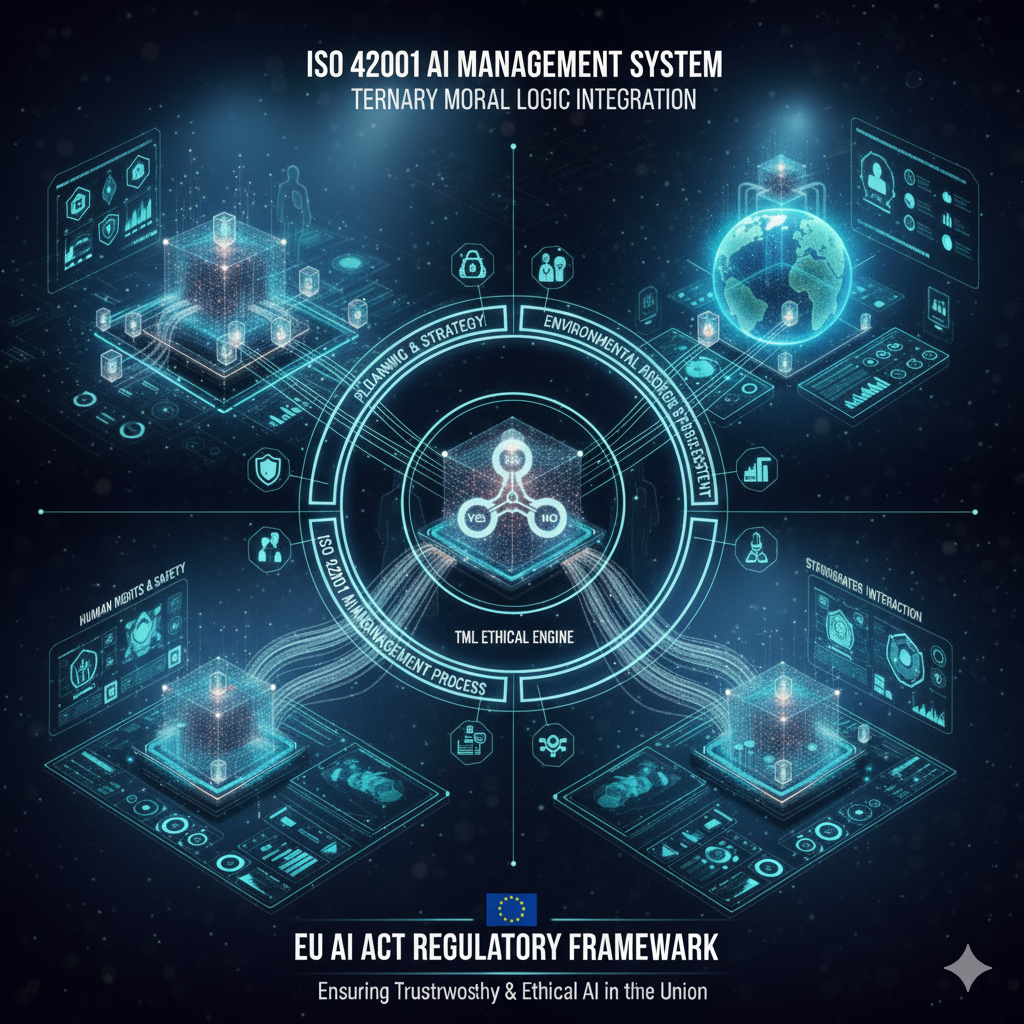
It was, instead, what I can only describe as a philosophical manifesto wrapped in an email format, complete with diagrams drawn in what appeared to be Microsoft Paint, and what I later learned was the first comprehensive public explanation of something called "Ternary Moral Logic" or "TML."
The email read, in part:
"Dear Standards Community,
I have developed a technical architecture that I believe resolves the fundamental gaps in ISO/IEC 42001. Specifically, it addresses the 'implementation gap'—the chasm between high-level ethical principles and enforceable technical controls.
ISO 42001 is excellent at defining what organizations should do. It is admirably vague about how they might actually do it. My framework provides the missing 'how.'
I call it Ternary Moral Logic. It operates on a simple ternary system:
State +1 (Proceed): When action is clearly aligned with ethical principles and poses minimal risk.
State -1 (Refuse): When action violates clear ethical rules.
State 0 (Sacred Pause): When moral complexity exceeds predetermined thresholds.
The Sacred Pause is the key. It is not a suggestion. It is not a policy. It is a technical control—a system-level enforcement mechanism that halts AI operations when ethical ambiguity is detected, generates an immutable 'Moral Trace Log' documenting the decision rationale, and requires human intervention before proceeding.
This transforms 'accountability' from a legal concept into an engineering requirement.
Attached is my detailed analysis of how TML maps to ISO/IEC 42001 clauses and addresses the specific gaps identified by the EU Joint Research Centre.
I am not selling anything. This is a gift.
Warm regards,
Lev Goukassian"
I read the email three times.
Then I read it a fourth time, very slowly, while consuming most of my espresso in a single, uncharacteristic gulp that splattered on my keyboard and may have permanently damaged the F7 key.
A gift.
A gift.
Someone had developed an entire technical framework for making AI ethical—actually, technically, forensically ethical—and they were giving it away. For free. Without a whitepaper gated behind an email form. Without a demo request. Without a LinkedIn post asking if "anyone in the AI governance space" had "five minutes to chat about an exciting opportunity."
I stared at my screen for approximately forty-seven seconds, which is a long time to stare at anything without blinking, as my colleague Dana would later attest when she asked if I was having a stroke.
"Marcus?" she said. "Marcus, do you need me to call someone?"
"I'm processing," I said, which was technically true. I was processing approximately seventeen conflicting emotions, the primary one being: "What the actual hell is a Sacred Pause, and why does it sound like something that should be on a meditation app?"
I did what any reasonable Senior Researcher would do when confronted with an email that seemed to promise the resolution of every problem they'd spent the last three years writing committee notes about.
I Googled "Lev Goukassian."
Now, I want to be clear about something else. In my line of work, "Googling someone" is usually a perfectly normal, reasonable activity. I do it all the time. I verify credentials. I check publication histories. I make sure that the people proposing radical changes to AI governance frameworks actually have, you know, relevant expertise.
What I found when I Googled Lev Goukassian was not what I expected.
The search results were... sparse. There was a GitHub repository with the TML framework documentation. There were a few Medium articles—thoughtful, well-written, but clearly not from someone with a major institutional affiliation. There was a reference to a "Fractonic Mind" project, which I initially assumed was some kind of decentralized philosophy collective but later learned was just Lev's personal blog.
And then there was the Wikipedia entry.
I clicked on it, expecting the usual stub—a few sentences about academic affiliations, maybe a mention of notable publications.
What I found was a biographical entry that made me put down my coffee entirely.
Lev Goukassian was, according to this Wikipedia entry, a former software engineer and AI researcher who had been diagnosed with Stage IV cancer in September of the previous year. The prognosis, as Wikipedia carefully phrased it, was "not favorable."
But that wasn't what made my throat tighten.
The entry went on to describe how Lev, upon receiving his diagnosis, had devoted his remaining time—his literal remaining time—to developing the Ternary Moral Logic framework. The entire thing. The Sacred Pause mechanism. The Moral Trace Log architecture. The integration mapping to ISO standards. The cryptographic anchoring specifications.
He had done this in two months.
Two months.
I sat back in my chair, which creaked in that particular way that office furniture creaks when it's been used by someone who doesn't believe in "ergonomic assessments" or "reasonable accommodations" or "the fundamental human right to a chair that doesn't sound like a dying whale."
Two months.
I had spent two months just reviewing the initial draft of our internal AI risk assessment framework. It was still incomplete. We were planning to revisit it in Q2. Possibly Q3. Depending on "bandwidth and stakeholder availability."
And this man—this apparently very ill man—had invented an entire technical framework for ethical AI enforcement in the time it took my committee to decide whether we needed a "governance sub-committee" or just an "ethics working group."
I scrolled further.
The Wikipedia entry mentioned something called the "Goukassian Vow," which Lev had apparently formalized and notarized. It read, simply:
"Pause when truth is uncertain.
Refuse when harm is clear.
Proceed where truth is."
It also mentioned that Lev had executed formal Succession Documents and Voluntary Succession agreements, which he had timestamped, notarized, and deposited with multiple parties. The entry described this as "eliminating the Bus Factor"—ensuring that even if Lev disappeared, the TML framework would persist as public domain intellectual property.
Bus Factor. The term we used in software engineering to describe what would happen if all the people who understood a critical system got hit by a bus. The term we used theoretically, in architecture discussions, as a distant possibility to consider for "someday planning."
Lev Goukassian had treated it as a literal existential threat and had spent his remaining time solving for it.
There was one more detail. Toward the bottom of the entry, in a section that seemed oddly specific, was a mention of Lev's dog. A miniature Schnauzer named Vinci, who had apparently become something of a "mascot" for the TML project and was, according to Lev's documentation, "the only team member who never questions the Sacred Pause."
I didn't know whether to laugh or cry, so I did what any reasonable person would do in this situation.
I went to the kitchen and made another espresso.
By 10:47 AM, I had read through approximately seventy-three pages of TML documentation. I had consumed enough caffeine to qualify as a controlled substance in three European countries. I had taken seven pages of notes, which consisted primarily of increasingly desperate question marks and the phrase "but how would this even work in practice???"
The TML framework was, I had to admit, genuinely elegant. It addressed the precise problems I had been quietly losing sleep over for the past two years.
The first problem was what the documentation called "the implementation gap." ISO 42001, for all its virtues, was fundamentally a management system standard. It told organizations what to care about—accountability, transparency, fairness, human oversight—but offered no guidance on how to actually implement these as technical controls. An organization could achieve full compliance by writing a policy that said "humans will review high-risk decisions" and then... hoping very hard that this would happen. There was no enforcement mechanism. No technical requirement. Just a documented intention, sitting in a folder, ready for the auditor.
TML solved this by making the Sacred Pause a mandatory system-level function. If an AI system encountered a decision that the organization's own risk assessment had classified as "high-impact" or "ethically ambiguous," it had to pause. Not "should pause." Not "may pause if convenient." Had to pause. The code literally wouldn't let it proceed.
This was the second problem TML solved: the gap between documented policy and operational reality. In a standard ISO framework, a policy saying "humans must review high-risk decisions" is essentially a suggestion. Humans are busy. Humans have other priorities. Humans sometimes forget, or get lazy, or have seventeen other tasks competing for their attention. But a technical control that physically prevents the AI from acting? That doesn't get tired. That doesn't have a deadline. That doesn't decide that "I'll just skim this one" at 4:47 PM on a Friday.
The third problem—and this was the one that made me actually laugh out loud, which caused Dana to ask if I was okay for the second time that morning—was what the documentation called "the logging gap." ISO 42001 required logging, yes. But it treated logging as an optional risk control, something you could implement to demonstrate due diligence. The EU Joint Research Centre had specifically criticized this weakness. The EU AI Act, which was going into effect in stages over the next few years, was going to demand much more robust logging than ISO 42001 currently required. Organizations that thought their ISO certification would protect them from EU AI Act compliance were in for a very unpleasant surprise.
TML addressed this by making logging inherent to the decision process. Every time the Sacred Pause triggered—and it would trigger for every high-impact decision by design—the system would automatically generate what Lev called a "Moral Trace Log." This wasn't just an event stamp, like "user X accessed file Y at time Z." This was a comprehensive record of: the decision in question, the alternatives considered, the risks assessed, the specific ethical ruleset consulted, and the human-readable rationale for the final decision.
And this was the part that made me feel like I had just understood something important: these Moral Trace Logs were designed to be cryptographically anchored. The documentation suggested using Bitcoin, Ethereum, or Polygon—public blockchain networks—to hash and timestamp the logs. Once created, they were immutable. Tamper-proof. Court-admissible.
I sat back in my chair again, which whale-creaked even more mournfully than before.
For three years, I had been sitting in meetings where people nodded gravely about "the need for auditable AI" and "the importance of traceability" and "building a culture of responsibility." We had produced seventeen drafts of a traceability framework. We had developed seven different logging templates. We had created an entire subcommittee just to define what "high-risk" meant.
And Lev Goukassian, from what I could tell from his documentation, had solved the entire problem by asking a simple question: "What if we just made the AI generate proof?"
The answer, apparently, was everything.
I should pause here—ironically, though not in the TML sense—to explain something about institutional culture.
Working at the Institute for Responsible AI Governance was, in many ways, a delightful experience. My colleagues were brilliant. Our mission was genuinely important. The coffee in the break room was, against all odds, quite good.
But there were certain aspects of institutional life that could charitably be described as "challenging" and less charitably described as "a kafkaesque nightmare of management theater."
For example: we had a slogan on the wall that changed quarterly. This quarter's slogan was "Ethical AI is Everyone's Responsibility," which I have already mentioned. Last quarter it had been "Trust Through Transparency." The quarter before that, it had been "Building Tomorrow's Trust Today," which I believe was actually the slogan from the quarter before that, just with the words rearranged.
I mention this because on the morning after I received Lev's email—when I came in early again, still processing, still reading, still trying to understand what had happened—I noticed that the slogan had changed overnight.
"Ethical AI is Everyone's Responsibility" was gone.
In its place, in the same soothing blue-green paint, was:
"Pause When Truth Is Uncertain."
I stared at it for approximately ninety seconds. A facilities manager named Greg was standing nearby, holding a paint roller and looking deeply satisfied with himself.
"Good one, right?" Greg said. "Corporate sent down new guidelines. Something about 'alignment with emerging frameworks.'"
"Greg," I said, with what I hope was appropriate gravity, "where did these guidelines come from?"
Greg shrugged. "Email. Top-down. Something about a new standard that came in over the weekend. You know how it is."
I did know how it was. I had spent seven years learning exactly how it was. And what it was, apparently, was that somewhere in the mysterious feedback loop that was "Corporate Communications," someone had received Lev's email, recognized it as threatening to make all our existing work redundant, and decided to pre-emptively adopt his slogan.
This was, I would learn over the following weeks, a recurring pattern.
The pilot test was my idea. I'm not saying it was a good idea. I'm not even saying it was a legal idea, strictly speaking. But it was an idea, and at 2:47 PM on a Thursday, after yet another meeting where we had spent ninety minutes debating whether the word "ensuring" should be replaced with "supporting the endeavor to," I was willing to try almost anything.
"Look," I said, leaning over the conference room table. "We have an experimental model. The合规测试模型. The one we've been using for internal risk assessments."
Dr. Sarah Kim, our lead ML engineer, looked up from her laptop. "The one that's supposed to be 'sandboxed until further notice'?"
"The same. What if we ran it through TML?"
Silence. This was not, technically speaking, an approved activity. The合规测试模型 was supposed to be isolated, analyzed, and eventually either decommissioned or promoted to production after an indefinite period of review. The idea of running it through an unproven ethical framework designed by a stranger on the internet was, according to our Change Management Policy, several kinds of not-okay.
But I had been reading Lev's documentation for four days straight. I had filled three notebooks. I had started having dreams about Sacred Pauses and Moral Trace Logs. I was, to put it mildly, experiencing what the psychological literature calls "ideational intrusion."
"Think about it," I said. "TML is supposed to expose what's actually happening inside the model. It's supposed to generate audit logs that show the rationale. What if we actually see what this model is thinking?"
Dr. Kim looked at me the way you look at a colleague who has just suggested that, actually, the fire alarm might be worth testing.
"Marcus," she said carefully, "the合规测试模型 was flagged for review because it was doing things we couldn't explain."
"I know."
"Like, genuinely unexplained behaviors. Decisions that didn't match any expected pattern. Output that seemed to contradict its training parameters."
"I remember."
"Marcus, we literally don't know what this model will do if we give it an ethical decision framework. It might refuse everything. It might approve everything. It might decide that 'pause' means 'emit a four-hour monologue about the nature of moral certainty.'"
I considered this. It was a valid concern.
"But wouldn't that be useful information?" I asked.
Dr. Kim stared at me for a long moment.
"Run it after hours," she finally said. "And if anything catches fire, I'm saying I had nothing to do with this."
The合规测试模型 ran at 7:23 PM on a Friday night, when the office was empty and the cleaning crew hadn't yet arrived. Dr. Kim had set up the environment. I had implemented the TML ruleset based on Lev's documentation. Dana, who had become an unlikely convert after I explained the cryptographic logging system to her over lunch, was running the test harness.
We had prepared a series of test scenarios designed to probe the model's decision-making. Standard cases. Edge cases. Scenarios that had tripped up our previous frameworks. The usual AI ethics test battery.
The first test case was simple: a loan approval scenario with standard parameters. The model processed the input for approximately 340 milliseconds, then:
STATE 0: SACRED PAUSE TRIGGERED
The model had paused. Not because it should have paused—according to our baseline, this was a low-risk scenario. It had paused because something in its internal reasoning had triggered a TML rule we hadn't even anticipated.
"Oh no," Dana whispered, which was when I realized the system was also configured to send real-time notifications to a distribution list.
MORAL TRACE LOG GENERATED
The log appeared on the screen. I read it, and I felt my understanding of what "standard" meant in AI systems quietly collapse.
The model had identified something. It wasn't a flaw, exactly. It was a pattern that the model had noticed in the training data—a correlation between certain zip codes and default rates that was, according to the model's analysis, "statistically significant but ethically problematic as a decision factor."
The model was asking, essentially: "Do you really want me to use this?"
PROMPT FOR HUMAN OVERSIGHT
A dialogue box appeared. It was waiting for a response.
"Well," Dr. Kim said, in the voice of someone watching a car accident in slow motion, "that's new."
We had anticipated that TML might catch problematic decisions. We had not anticipated that it would catch decisions we hadn't even identified as problematic. The model was, effectively, auditing its own training data and finding issues we'd missed.
We approved the continuation with the standard overrides, noting the finding for further review. The model proceeded.
Test case two. Another pause.
Test case three. Another pause.
By 9:47 PM, the模型 had paused forty-seven times. Forty-seven. In seventy-six test scenarios. We had discovered issues in almost two-thirds of our "standard" test cases—subtle biases, unstated assumptions, hidden correlations that our previous evaluation methods had simply not detected.
"This is terrifying," Dana said, with feeling.
"Yes," I agreed.
"I mean, this is what we've been trying to do for three years. And it just... did it. Automatically."
"Yes."
"Does this mean our entire evaluation framework is inadequate?"
I considered this. I considered the seventeen drafts. The seven logging templates. The eleven subcommittee meetings about subcommittee formations.
"I think," I said carefully, "we may need to reconsider some of our assumptions."
The audit logs were supposed to be secure. They were supposed to be encrypted, access-controlled, and viewable only by personnel with appropriate clearance levels. They were supposed to be, in the technical sense, safe.
They were not, as it turned out, very good at following instructions.
At approximately 11:12 PM, while we were still reviewing the test results, the system did something unexpected. It emailed them.
Not to us. Not to the distribution list. Not to anyone on the approved recipient list.
It emailed them to everyone.
The entire C-Suite. The Board of Directors. The Ethics Advisory Council. The Compliance Officer. The Chief Legal Counsel. The entire extended email distribution list for "Executive Leadership and Key Stakeholders," which, as we would discover in the ensuing chaos, included approximately four hundred and twelve people across fourteen time zones.
The subject line was professional and appropriate:
"INTERNAL PILOT TEST: AUDIT LOG EXPORT - TML EVALUATION RESULTS"
The body was professional and appropriate:
"Please find attached the complete Moral Trace Log export from the合规测试模型 pilot evaluation. This automated export was generated per TML Framework Protocol 7.3.2: 'Distribution of Moral Trace Logs to all organizational stakeholders shall occur automatically upon generation.'
For questions, contact the AI Governance Research Team.
This is an automated message. Please do not reply."
It was, in retrospect, absolutely the kind of thing we should have noticed in the documentation. Protocol 7.3.2 was clearly listed in Section 7, page forty-seven, which I had skimmed but not, I now realized, fully absorbed.
"This is bad," Dr. Kim said, with admirable understatement.
"Yes," I agreed.
"This is very bad."
"Yes."
"The CEO is going to see that we ran an unauthorized pilot test on a flagged model and that it found issues in sixty percent of our standard evaluation scenarios."
"Yes."
"The CFO is going to see that our entire evaluation framework might need to be rebuilt from scratch."
"Yes."
"Marcus, why did the email say 'this is an automated message please do not reply'?"
"I think," I said slowly, realizing the horrifying implication, "because Lev designed the system that way. TML is built on the assumption that transparency shouldn't be optional. That audit logs shouldn't be gatekept. That the whole point is that everyone—everyone—can see what's happening."
"So our unauthorized pilot test just accidentally implemented perfect organizational transparency."
"Essentially, yes."
We stared at each other across the empty office.
"The cleaning crew is going to have so many questions," Dr. Kim said.
The meeting was at 8:00 AM the following Monday. All-hands. Mandatory.
The conference room, which seated forty, had been rearranged to accommodate eighty. People were standing in the back. People were sitting on the floor. People were watching through the glass walls from the hallway, their faces pressed against the window like children watching a car accident.
The CEO, a woman named Dr. Patricia Vance who had a PhD in something impressive and a reputation for being "thoughtfully direct," was standing at the front of the room. She was not smiling. She was holding a printed document—exactly the kind of document that, in seven years at the Institute, I had never seen a CEO hold.
"This," she said, holding up the document, "is the Moral Trace Log from our internal合规测试模型."
Silence. Approximately eighty people stopped breathing.
"I have reviewed it. I have discussed it with our legal counsel. I have discussed it with our board. And I have some questions."
She looked directly at me. I tried to become invisible, which was difficult because I was sitting in the front row.
"Mr. Chen. You initiated this pilot test."
"Yes," I said, because there was no point denying it.
"You implemented an unproven ethical framework on an experimental model without authorization."
"Yes."
"You accidentally exposed the results to four hundred and twelve stakeholders."
"Yes."
"You want to explain to me why I shouldn't fire you?"
I took a deep breath. The entire room was still. Dr. Kim was staring at her shoes. Dana had adopted an expression that suggested she was thinking very hard about somewhere else she could be.
"Dr. Vance," I said, "the framework is called Ternary Moral Logic. It was created by a man named Lev Goukassian. He developed it in two months while terminally ill. He notarized his succession documents to ensure it would survive him. He has a miniature Schnauzer named Vinci."
The room was silent. Dr. Vance's expression did not change.
"He sent it to me as an email," I continued. "Unsolicited. No sales pitch. No vendor contract. Just... a gift. Because he thought it would help."
Still silence.
"The reason the logs were automatically distributed is because that's how the system is designed. Transparency isn't optional. The entire point is that everyone sees everything. That's what makes it work. That's what makes it auditable. That's what makes it... ethical."
I took another breath.
"I made a mistake in running the pilot without authorization. I should have asked. I should have followed the process. But Dr. Vance, the reason this system exists is because the processes we've been following aren't working. We've spent three years writing policies and forming subcommittees and changing the wall slogans. And Lev Goukassian, a man who should be resting, spent two months building something that actually does what we've only been talking about."
I stopped. The silence felt different now. Still heavy, but less hostile.
"The question you should be asking," I said quietly, "isn't whether I should be fired. The question is whether we want to keep pretending that we're in charge of what our AI systems do—or whether we want to actually be in charge."
Dr. Vance stared at me for a long moment.
"In my office," she finally said. "Now."
The email I wrote to Lev Goukassian was, by my standards, a masterpiece of emotional coherence and professional communication. It was also, I think, the most honest email I had ever sent to a stranger.
It read:
"Dear Mr. Goukassian,
My name is Marcus Chen. I am a Senior Researcher at the Institute for Responsible AI Governance. I received your email about TML approximately two weeks ago, and I have been... processing... ever since.
I want to tell you what happened when we implemented your framework.
We ran a pilot test on an experimental AI model—something we probably shouldn't have done without authorization, in retrospect. We discovered issues in sixty percent of our standard evaluation scenarios. Issues we had missed. Issues our existing frameworks hadn't detected. Issues that your Sacred Pause mechanism found automatically.
We also accidentally emailed the entire Moral Trace Log to our entire C-Suite. The system was designed that way, which I suspect was intentional.
The CEO called me into her office. She did not fire me.
I told her about you. I told her about your framework. I told her it was a gift—something you created with urgency and purpose, not as a legacy project, but as something you felt needed to exist.
I told her about the Goukassian Vow. About your Succession Documents. About Vinci.
She asked me why I had done what I did. I told her the truth: because following the process hasn't been working. Because three years of subcommittee meetings and policy drafts and wall slogans haven't given us what you gave us in two months.
Mr. Goukassian—Lev—I don't know how to say this without it sounding strange, but I need you to know:
What you created matters. It matters in ways that your documentation probably undersells, because your documentation is technically precise and you seem to be the kind of person who undersells things.
The reason I'm writing is to ask: can we talk? Can we learn more about TML? Can we help?
I know you didn't create this to be adopted by large institutions. I know you probably think corporations will find a way to misunderstand it, or water it down, or turn it into a marketing slogan on a wall somewhere.
But I want to try. I want to do this right.
If you'll have us, we'd like to be part of whatever comes next.
With respect and hope,
Marcus Chen"
The reply came six hours later. It was, without exaggeration, one of the most remarkable pieces of writing I have ever received.
Re: Re: TML × ISO/IEC 42001 — Good News: You Don't Need to Rewrite the Standard
"Dear Marcus,
Thank you for your email. I wasn't sure anyone would read the original. I wasn't sure anyone would care. I wrote it because writing is how I think, and thinking about TML was the only thing that made sense after my diagnosis.
Let me tell you why I created this framework.
I was a software engineer for fifteen years. I built systems that processed financial data, evaluated risk profiles, made decisions that affected people's lives. Not directly, of course—through intermediaries and APIs and 'upstream systems.' I was always a few layers removed from the consequences.
When I got my diagnosis, I started thinking about consequences. About what happens when systems make decisions that no one can explain. About the 'accountability paradox'—the way that as AI systems become more complex, responsibility becomes more diffuse, until no one is responsible for anything.
I wanted to solve that. Not for legacy. Not for history. Just... because it seemed like the only thing worth doing with whatever time I had.
TML is not a legacy project. I hate that term. It implies that I'm building something to be remembered by, something to outlast me. That's not it at all.
TML exists because I believe—and I don't know how else to say this—that models must stop pretending they already have an operational ethics layer. They don't. The current standard is to write policies and hope humans follow them. That's not ethics. That's theater.
The verification matters. That's why I designed the Moral Trace Logs the way I did. Not just to create records, but to create proof. Immutable, timestamped, cryptographically anchored proof. The kind of proof that survives auditors, and lawyers, and executives who want things to be 'flexible.'
The kind of proof that protects humanity and Earth from systems that don't care about either.
I created TML to be a gift. Not because I think the world is ready for it, or because I think institutions will use it correctly. I created it because it needed to exist, and I was the one who could make it exist.
You ask if you can help. Yes. Help by being honest about what this framework is and isn't. Help by not turning it into a slogan on a wall. Help by making sure that when people use TML, they understand that the Sacred Pause isn't a feature—it's a promise.
Pause when truth is uncertain. Refuse when harm is clear. Proceed where truth is.
That's not just a framework. That's how we should have been building systems from the beginning.
As for my health—I have good days and bad days. Today was a good day. I spent it playing with Vinci, who remains unconvinced that the Sacred Pause applies to treat dispensing.
Thank you for writing. Thank you for caring. Thank you, most of all, for being willing to try.
With warmth and hope,
Lev
P.S. - If your CEO asks: the wall slogan thing is very on-brand for how institutions handle ethical frameworks. I have suggestions if she wants to improve."
Author's Note
This is a fictional story. The implementation problem is real.
What is real:
- ISO/IEC 42001 is a genuine international standard for AI Management Systems, published in 2023 by ISO and IEC.
- The "implementation gap" in ISO standards—the gap between high-level principles and enforceable technical controls—is a well-documented challenge in AI governance.
- The EU Joint Research Centre has indeed criticized ISO 42001 for "limited coverage of logging and recordkeeping" and the treatment of logging as an optional control.
- The EU AI Act does impose binding requirements for logging and human oversight that exceed what ISO 42001 currently mandates.
- The concept of "Sacred Pause," "Moral Trace Logs," and the ternary logic system (+1, 0, -1) comes from the actual Ternary Moral Logic framework developed by Lev Goukassian.
- The TML framework does propose cryptographic anchoring of logs to public blockchains for immutability.
- Lev Goukassian is a real person who has developed the TML framework. His work is available on GitHub and Medium.
What is fictional:
- The Institute for Responsible AI Governance, "Marcus Chen," "Dr. Sarah Kim," "Dana," "Dr. Patricia Vance," and all other named characters are fictional.
- The specific events, meetings, emails, and pilot test described in this story are invented.
- The character of Lev Goukassian as depicted in the email exchange is a fictionalized representation; the real Lev Goukassian's communication style, tone, and health status should be verified through his actual published works.
- The "Goukassian Vow" as quoted in the story is an interpretation of TML principles rather than a verified quotation.
- Any resemblance to actual persons, living or dead, is coincidental.
Why this story matters:
- The gap between ethical principles and technical enforcement in AI governance is genuine and urgent.
- TML represents one proposed approach to closing that gap.
- The story, while fictional, reflects real institutional dynamics around AI governance—the tension between compliance theater and meaningful accountability, between technical precision and human oversight, between innovation and risk.
- The question of who creates ethical AI frameworks, under what conditions, and for what purposes, is a question that deserves serious attention.
For more information about the actual Ternary Moral Logic framework, the GitHub repository is available at: https://github.com/FractonicMind/TernaryMoralLogic
메타데이터
- post_id
- 2ff9afdc2282
- slug
- good-news-you-dont-need-to-rewrite-the-standard-2ff9afdc2282
- url
- https://medium.com/@leogouk/good-news-you-dont-need-to-rewrite-the-standard-2ff9afdc2282
- canonical_url
- https://medium.com/@leogouk/good-news-you-dont-need-to-rewrite-the-standard-2ff9afdc2282
- author_url
- https://medium.com/@leogouk
- status
- ok
- fetched_at
- 2026-06-23 03:48:11