What Is the Difference Between SMD Screen and LED Screen?
By World Wide Electronics | Pakistan’s #1 SMD Screen Dealer Since 1999
What Is the Difference Between SMD Screen and LED Screen?
By World Wide Electronics | Pakistan’s #1 SMD Screen Dealer Since 1999
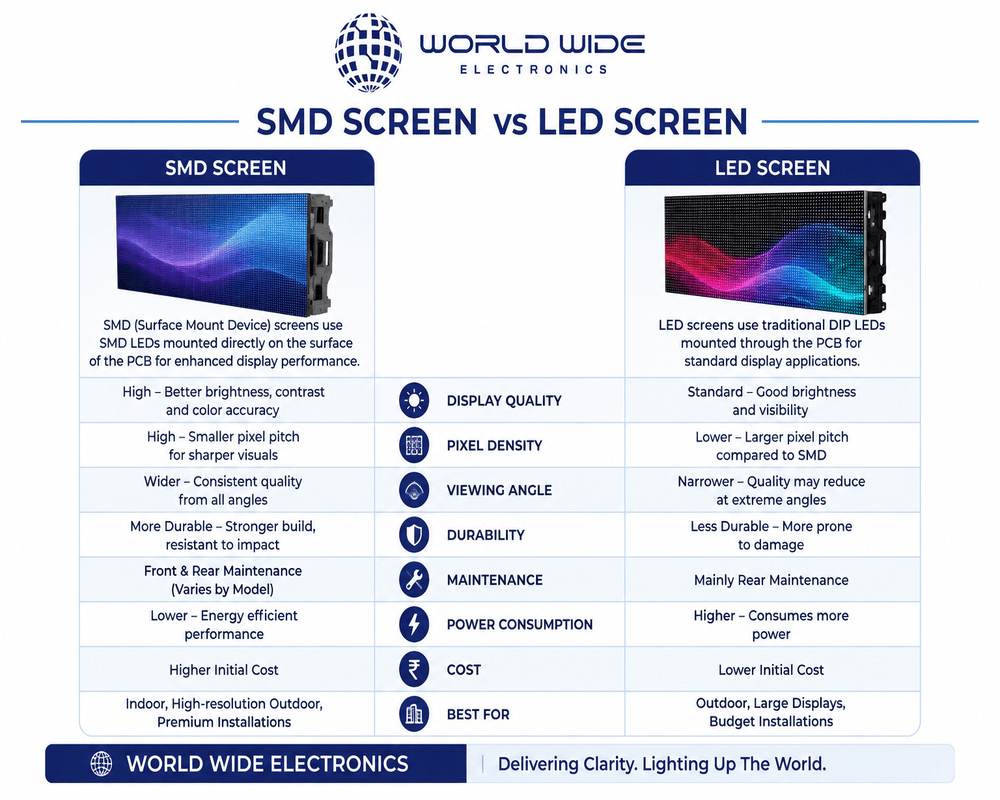
Difference Between SMD Screen and LED Screen
If you’ve ever searched for a display screen for your business, event, or office — you’ve almost certainly come across two terms: SMD screen and LED screen. And if you’re confused about the difference, you’re not alone. Most buyers don’t know which one to choose, and many end up with the wrong technology for their needs.
In this guide, we’ll break it all down — clearly, simply, and without the technical jargon. By the end, you’ll know exactly which display is right for you.
The Short Answer
An SMD screen (Surface-Mounted Device) is actually a type of LED screen — but a more advanced one. It packages red, green, and blue LED chips into a single tiny unit, producing sharper images, wider viewing angles, and lower energy use. A traditional LED screen uses separate individual diodes and is better suited for large outdoor installations where raw brightness is the priority.
Think of it this way: all SMD screens are LED screens, but not all LED screens are SMD screens.
What Is a Traditional LED Screen?
A traditional LED display uses three separate diodes — one red, one green, one blue — grouped together to form each pixel. These were the standard in display technology for years, and they still have a very important role to play.
They are incredibly bright, often hitting 5,000 to 8,000 nits of output. That makes them perfect for outdoor environments where sunlight is a challenge. They’re rugged, weatherproof, and built to last in tough conditions.
Where traditional LED screens shine:
- Highway and roadside billboards
- Large outdoor stadiums and arenas
- Public squares and open-air events
- Long-distance viewing (50 metres and beyond)
The trade-off? Because the diodes are physically separate, there are gaps between pixels. This limits how sharp the image can look up close. For indoor settings where viewers stand within a few metres of the screen, that gap becomes very noticeable.
What Is an SMD Screen?
SMD technology is where things get interesting. Instead of three separate diodes, an SMD screen fuses all three colour chips into one tiny, integrated package that is mounted directly onto the circuit board surface. This is what allows SMD screens to achieve incredibly tight pixel spacing — some as fine as 1.2mm.
The result is a display that looks crisp, vivid, and cinema-quality even at very close distances.
What makes SMD screens stand out:
- Pixel pitch as fine as P1.2 (indoor) and P2.5 (outdoor)
- Viewing angles up to 160° — everyone in the room sees the same quality image
- Up to 40% lower energy consumption compared to traditional LED
- Lifespan of 80,000 to 100,000 hours
- Lightweight modular panels that are easy to install, move, and reconfigure
- Smooth, seamless visuals with no visible dot clusters
SMD is now the industry standard for indoor commercial displays — and for good reason.
“SMD technology has transformed how businesses communicate visually — delivering cinema-quality images at commercial scale.”
SMD vs LED: The Key Differences at a Glance
Here’s a simple breakdown of how the two technologies compare across the factors that matter most:
Resolution & Pixel Structure Traditional LED has physical gaps between separate diodes, limiting how fine the pixel pitch can be. SMD integrates all three chips into one unit, enabling ultra-high resolution. A 4m² SMD P2.5 screen has roughly 10 times more pixels than a P8 traditional LED screen of the same size.
Viewing Angle Traditional LED typically delivers 90° to 100° viewing angles. Stand to the side and the image looks dimmer and washed out. SMD screens achieve up to 160° both horizontally and vertically — meaning consistent image quality for every viewer in the room, whether they’re seated at the front, back, or sides.
Brightness This is where traditional LED still holds an edge for outdoor use. At 5,000–8,000 nits, conventional outdoor LED handles direct sunlight with ease. Indoor SMD screens operate at 800–1,500 nits, which is perfectly suited for interior environments. Modern outdoor SMD displays now reach 4,000–6,000 nits, closing the gap considerably.
Energy Efficiency SMD screens consume up to 40% less electricity than equivalent traditional LED displays. For a business running a display 12–14 hours a day, that difference adds up to significant savings over the life of the screen.
Installation Traditional LED cabinets are heavy and require significant structural support. SMD panels are modular and lightweight — they can be configured in creative shapes, curved installations, or rental setups that can be assembled and dismantled in hours.
Lifespan Traditional LED averages around 50,000 hours. Quality SMD panels achieve 80,000 to 100,000 hours, and faulty modules can be replaced individually in minutes.
Which Screen Is Right for You? Real Scenarios
You run a retail store in Karachi. You want a display behind your counter showing promotional content and product videos. Customers will be standing 2–4 metres away. → Go with SMD (P2 — P4 indoor). The high resolution and wide viewing angle will make your content pop from every angle in the store.
You manage a shopping mall. You need outdoor signage facing the main road and indoor wayfinding displays across multiple floors. → Use both. Outdoor billboard: traditional LED P8 for sunlight visibility. Indoor panels: SMD P2.5 for crisp, high-resolution imagery at walking-distance viewing.
You have a corporate boardroom. You need a video wall for presentations, data, and video conferencing. Executives will sit 1.5–3 metres from the screen. → SMD P1.5 or P1.8. Text, charts, and video will be razor-sharp. The wide viewing angle covers every seat at the table.
You run outdoor events and concerts. You need large stage backdrops and screens visible across a crowd. → SMD rental screens (P3.9 — P4.8) are ideal — modular, lightweight, fast to set up, and high enough resolution for stage distances.
Understanding Pixel Pitch — The Number That Changes Everything
Pixel pitch is the distance in millimetres between the centres of two adjacent pixels. The lower the number, the sharper the image and the closer viewers can stand comfortably.
A simple rule of thumb:
Minimum viewing distance (metres) = Pixel pitch (mm) × 3 to 4
So a P1.5 SMD screen is comfortable from 1.5–2 metres away. A P10 outdoor LED is designed for 30–40 metre viewing distances. Choosing the wrong pixel pitch for your environment is one of the most common and costly mistakes buyers make.
“The right display technology is not about which is newer — it is about matching the right tool to your specific environment, audience, and goals.”
6 Pro Tips Before You Buy
1. Always see a live demo. Never buy a screen based on spec sheets alone. Insist on seeing the actual panel at your intended brightness level before committing.
2. Check the IP rating for outdoor screens. Pakistan’s climate demands minimum IP65 protection for dust and rain resistance. Anything less is a risk.
3. Calculate total cost of ownership. Factor in purchase price, installation, energy costs, and maintenance over 5 years — not just the sticker price.
4. Demand local after-sales support. An imported display with no local service centre is a liability. Always confirm warranty terms include on-site support.
5. Match pixel pitch to your viewing distance. Use the formula above. Buying a P2 screen for a highway billboard wastes money. Buying a P10 screen for a retail interior wastes opportunity.
6. Ask about content management. Modern SMD screens support cloud-based CMS for remote content scheduling. This is a major operational advantage for businesses running multiple screens.
A Quick Note on COB Displays
If you’re researching the very latest in display technology, you may come across COB — Chip-on-Board. This is a step beyond SMD, with LED chips mounted directly onto the circuit board without individual packaging. COB delivers pixel pitches below P1.0, exceptional durability, and virtually no individual pixel failure points. It represents the future of ultra-high-definition indoor displays.
Frequently Asked Questions
Is an SMD screen better than an LED screen? For indoor use, SMD is almost always the better choice — higher resolution, wider viewing angles, lower energy use, longer life. For large outdoor installations needing maximum brightness, traditional LED may still be practical, though outdoor SMD is rapidly catching up.
What does SMD stand for in LED screens? Surface-Mounted Device. It refers to the process of integrating red, green, and blue chips into a single component mounted directly on the circuit board — enabling finer pixel pitches and better image quality.
How long does an SMD screen last? Quality SMD screens achieve 80,000 to 100,000 hours of operational life. This figure is affected by brightness settings, operating temperature, and maintenance habits.
Are SMD screens suitable for outdoor use in Pakistan? Yes — outdoor-rated SMD screens with IP65/IP66 weatherproofing and 4,000–6,000 nits brightness are available and suitable for most Pakistani outdoor environments.
Why do SMD screens cost more upfront? Tighter manufacturing tolerances and more complex chip integration drive the higher initial cost. However, lower energy bills, longer lifespan, and less maintenance typically make SMD the more economical choice over 5–10 years.
What pixel pitch should I choose? Use this formula: minimum viewing distance (metres) = pixel pitch (mm) × 3–4. For retail interiors, P1.5–P2.5 is recommended. For outdoor billboards, P6–P10 is appropriate.
The Bottom Line
The difference between an SMD screen and an LED screen comes down to this: SMD is the smarter, more refined technology for high-quality visual communication at close to medium distances. Traditional LED remains the workhorse for large-scale, high-brightness outdoor applications.
For most Pakistani businesses today — retail stores, corporate offices, event companies, shopping malls, and advertising agencies — SMD screens deliver the best balance of image quality, energy efficiency, longevity, and value.
The key is matching the right technology to your specific environment, content, and audience. Get that right and your display becomes one of your most powerful business assets.
Ready to Choose the Right Screen?
World Wide Electronics has been Pakistan’s most trusted display technology partner since 1999. ISO 9001:2015 certified and operating under the Irfan Corporation umbrella, we were the first to bring advanced LED display technology from China to Pakistan — and we’ve been setting the standard ever since.
We supply and install indoor SMD screens, outdoor LED displays, rental screens for events, LED controllers, audio systems, lighting solutions, and truss systems across Pakistan.
Our prices are unbeatable because we are primary dealers — not middlemen.
📞 Call us: 0331–5575501 🌐 Visit: worldwideelectronics.com.pk 📧 Email: **info@worldwideelectronics.com.pk** 📍 Serving Karachi, Lahore, Islamabad & all of Pakistan
World Wide Electronics | ISO 9001:2015 Certified | Since 1999 | Pakistan’s #1 SMD Screen Dealer
메타데이터
- post_id
- 2ffbcce73a77
- slug
- what-is-the-difference-between-smd-screen-and-led-screen-2ffbcce73a77
- url
- https://medium.com/@worldwideelectronics2/what-is-the-difference-between-smd-screen-and-led-screen-2ffbcce73a77
- canonical_url
- https://medium.com/@worldwideelectronics2/what-is-the-difference-between-smd-screen-and-led-screen-2ffbcce73a77
- author_url
- https://medium.com/@worldwideelectronics2
- status
- ok
- fetched_at
- 2026-06-24 18:57:25