Neo4j vs Spanner Graph vs BigQuery Graph: How to Choose for Enterprise Data Platforms
A practical decision guide for cloud data architects
Neo4j vs Spanner Graph vs BigQuery Graph: How to Choose for Enterprise Data Platforms
Every few months, a stakeholder walks into an architecture review and says some version of the same sentence:
We have a graph problem. Should we use Neo4j?
It’s a fair question. But it’s also the wrong question.
In the last two years, the graph landscape has shifted dramatically. Google Cloud has released Spanner Graph for real-time operational graph workloads and BigQuery Graph for analytical graph workloads - both speaking the same ISO standard GQL language. Suddenly, the default answer of “spin up Neo4j” is no longer obvious, especially if you live in a GCP-heavy environment.
This article is a working architect’s view on how to actually pick between the three. No marketing slides. No academic theory. Just the trade-offs I weigh when designing graph use cases for enterprise data platforms.
The mental model that fixes 90% of the confusion
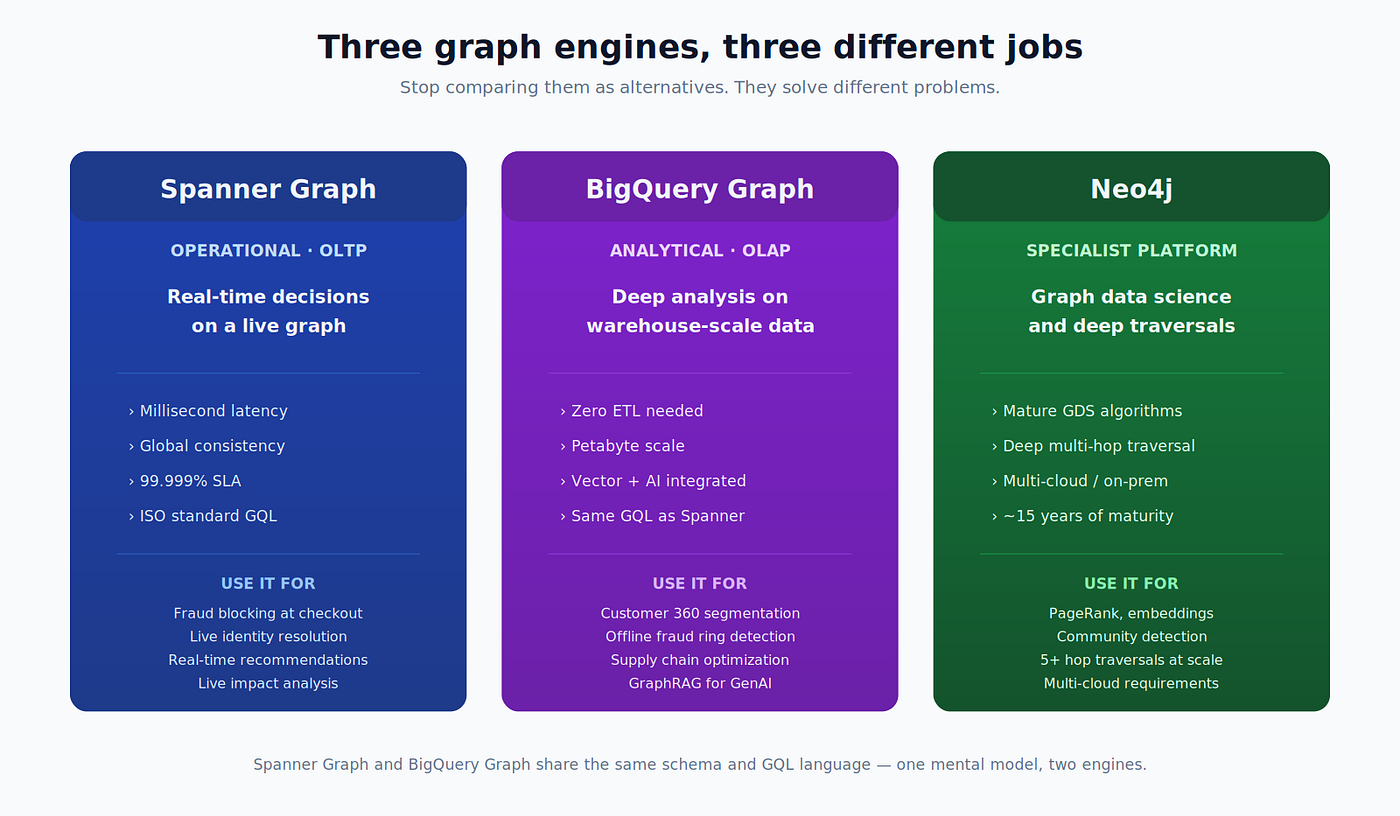
Most teams compare these three products as if they’re interchangeable. They’re not. Here’s the cleaner framing:
- Spanner Graph → Operational graph. Real-time decisions on a live graph (OLTP).
- BigQuery Graph → Analytical graph. Deep pattern analysis on warehouse-scale data (OLAP).
- Neo4j → Specialized graph platform. Pick it when you need mature graph data science, deep multi-hop traversals, or platform independence.
If you internalize just that one slide, you’ll make better decisions than 80% of teams I’ve seen.
The honest comparison
DimensionNeo4jSpanner GraphBigQuery GraphWorkload typeOLTP + advanced graph analyticsOLTP, real-timeOLAP, analyticalQuery languageCypher + GQLGQL + SQL interopGQL + SQL interopData storageNative graph engineSpanner tables, queried as a graphExisting BQ tables mapped to a graph schemaLatencyLow (ms) for traversalsLow (ms), predictableSeconds to minutesScaleLarge, vertical-leaningGlobally distributed, virtually unlimitedPetabyte-scale, serverlessGraph algorithms (GDS)Best in classLimitedLimited, but integrates Vertex AI + vector searchOperational burdenMedium–HighLow (managed)Lowest (serverless)Cost shapeLicense / AuraDBSpanner node-hours (high baseline)Per-query (BQ slots)PortabilityYes (multi-cloud)GCP-lockedGCP-lockedMaturity ~15 yearsNewer, production-readyNewer, production-ready
When each one is the right call
Spanner Graph
Pick it when you need real-time graph lookups as part of a live application - fraud blocking at checkout, identity resolution during an API call, real-time recommendations, live impact analysis triggered by an operational event.
The graph is operational. It’s being written and read continuously by applications. You need millisecond latency, strong consistency, and a 99.999% SLA.
Avoid when: the workload is purely analytical, or your budget is tight. Spanner has a meaningful baseline cost even when idle.
BigQuery Graph
Pick it when your graph data already lives in BigQuery - which, in most modern enterprises, it does. You map existing tables to a graph schema and start querying with GQL. No ETL. No new platform. No data movement.
This is where most enterprise use cases actually fit: customer 360 segmentation, offline fraud ring detection, supply chain optimization, knowledge graphs over your data catalog, and GraphRAG for GenAI use cases on top of your warehouse.
Avoid when: you need sub-second response or transactional writes back to the graph.
Neo4j
Pick it when you need things the cloud-native options don’t do well yet:
- Mature graph data science - PageRank, community detection, centrality, node embeddings, graph-native ML.
- Very deep multi-hop traversals (5+ hops on large graphs), where native graph storage outperforms a relational engine wearing a graph hat.
- Multi-cloud or on-prem portability.
- A team that already speaks Cypher and has invested in Bloom, Browser, and the GDS library.
Avoid when: you’re fully on a single cloud, you don’t need GDS algorithms, and adding a parallel platform with its own ops, IAM, and skill burden isn’t justified by a clear value driver.
A practical decision flow
When I’m sitting in an architecture review and someone raises a graph use case, this is the order of questions I actually ask:
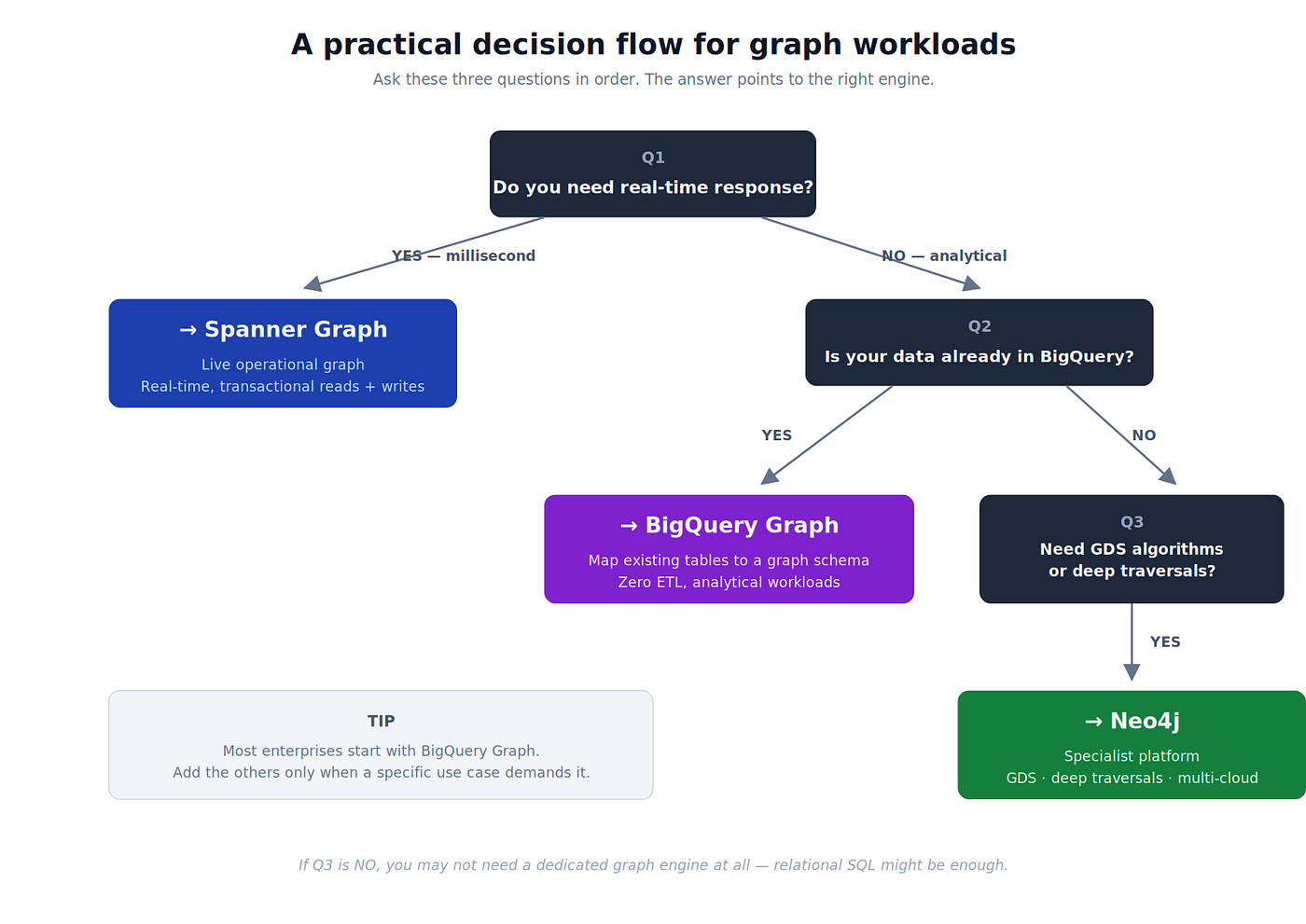
Three questions, in order. The answer points to the right engine. Most teams skip Q2 entirely and jump straight to picking a product - which is how you end up with a parallel platform you didn’t need.
The piece most architects miss
Spanner Graph and BigQuery Graph share the same schema and the same GQL query language.
That’s not a marketing line - it’s an architectural advantage. You can run live operational graph queries in Spanner and the exact same analytical patterns at scale in BigQuery without remodeling your data or translating your queries.
Spanner Graph handles the live operational graph. BigQuery Graph handles the historical and analytical view of the same graph. One mental model, one query language, two engines optimized for two workloads.
This is the strongest argument against introducing Neo4j into a GCP-native shop unless you have a very specific reason to.
How to sequence the decision in a real enterprise
If you’re working on an enterprise data platform - large data volumes, multiple source systems, multiple stakeholder teams, GenAI ambitions - here’s how I’d sequence the decisions:
1. Default to BigQuery Graph for analytical use cases. The data is already in BigQuery. There’s no new platform, no new ops model, and it covers most of what enterprise teams actually need:
- Customer 360 and segmentation
- Offline fraud and risk analysis
- Entity resolution and master data relationships
- Supply chain and bill-of-materials analytics
- Knowledge graphs and GraphRAG over your data catalog and metadata
2. Add Spanner Graph only when a use case genuinely needs real-time. Fraud blocking at transaction time. Live identity resolution during an API call. Real-time recommendations. These are the patterns that justify Spanner’s baseline cost.
3. Consider Neo4j only as an exception. A specific need for GDS algorithms. A multi-cloud mandate. A team with deep Neo4j investment. Otherwise, the cloud-native combo wins on TCO, governance, and team simplicity.
Risks and watch-outs
A few things I see teams under-estimate:
- Spanner Graph baseline cost. Spanner is not cheap when idle. Don’t pick it for analytical work - you’ll pay OLTP prices for OLAP queries.
- BigQuery Graph deep traversals. For very deep multi-hop patterns on huge graphs, slot consumption climbs fast. Pre-aggregate where you can. Model carefully.
- Neo4j skill scarcity. Cypher and GDS expertise is rare in teams trained on SQL and BigQuery. Hiring and training is real cost.
- Schema design discipline. A bad graph model hurts all three engines. Spend time on node/edge granularity and supernode mitigation before committing.
- Governance. BigQuery Graph inherits your existing BQ IAM, lineage, and DLP. Spanner Graph and Neo4j need their own governance overlay - don’t underestimate this at enterprise scale.
The recommendation, plainly
If you’re in a cloud-native enterprise - and especially on GCP - start with BigQuery Graph for your first real graph use case. The friction is near zero, the data is already there, and the value lands fast.
Add Spanner Graph when a real-time use case demands it. Treat that decision as deliberate, not default.
Treat Neo4j as a specialist tool you reach for when GDS algorithms, deep traversal performance, or platform portability are the actual value drivers. It’s a great product. But in a modern cloud-native enterprise, it’s no longer the default answer to “we have a graph problem.”
The default answer now is: Which graph problem - operational or analytical? Let’s pick the right tool.
That single reframing is worth more than any vendor comparison.
If this resonated, I write regularly about cloud data architecture, enterprise data platforms, and applied AI for data. Connect with me on LinkedIn - I’d be glad to hear how you’re approaching graph workloads in your own platform.
메타데이터
- post_id
- 2ffc3f2e6433
- slug
- neo4j-vs-spanner-graph-vs-bigquery-graph-how-to-choose-for-enterprise-data-platforms-2ffc3f2e6433
- url
- https://medium.com/@ahmed-tammam/neo4j-vs-spanner-graph-vs-bigquery-graph-how-to-choose-for-enterprise-data-platforms-2ffc3f2e6433
- canonical_url
- https://medium.com/@ahmed-tammam/neo4j-vs-spanner-graph-vs-bigquery-graph-how-to-choose-for-enterprise-data-platforms-2ffc3f2e6433
- author_url
- https://medium.com/@ahmed-tammam
- status
- ok
- fetched_at
- 2026-06-09 15:37:30




