Gravity and Time: Are They Fundamental or Emergent?
A 2025 Perspective on the Deepest Question in Physics. For more than a century, physics has relied on the idea that gravity and time are…
Gravity and Time: Are They Fundamental or Emergent?

A 2025 Perspective on the Deepest Question in Physics**
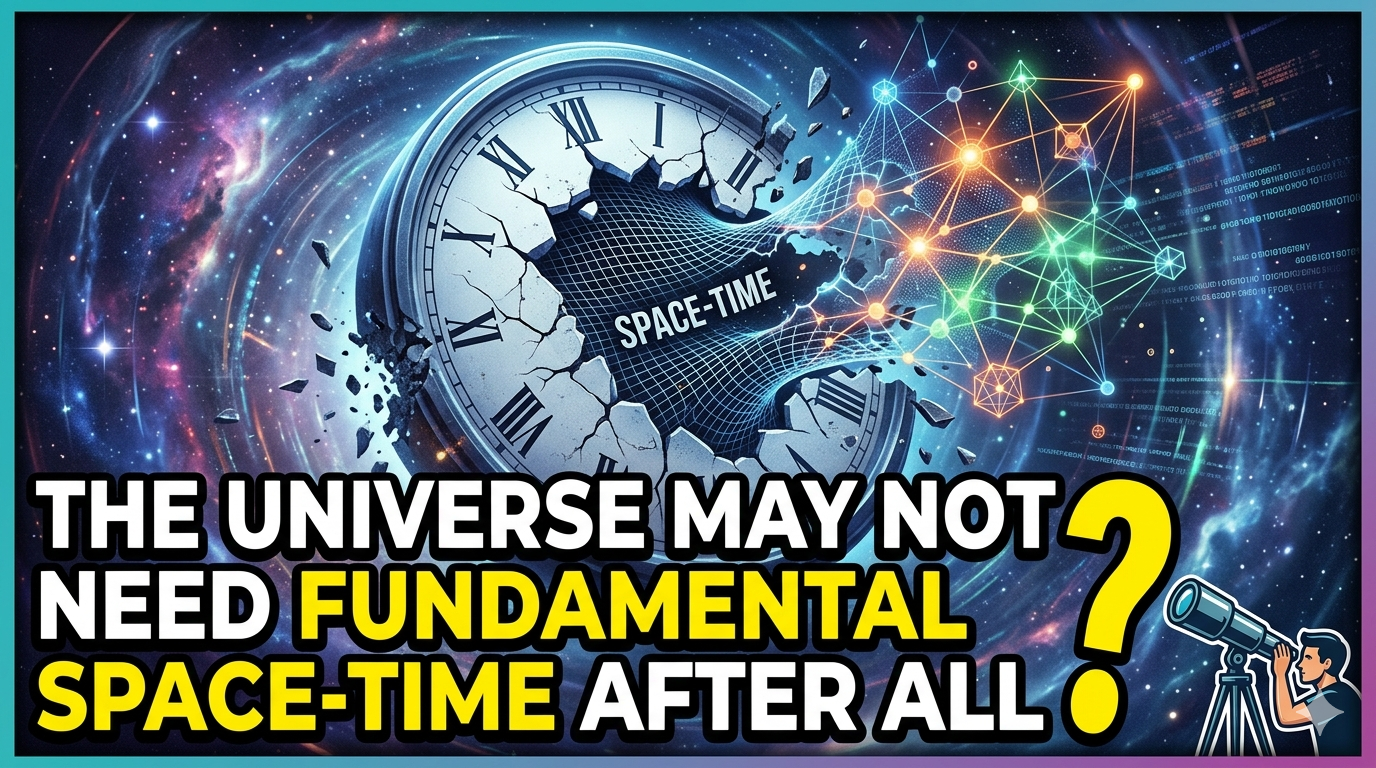
For more than a century, physics has relied on the idea that gravity and time are part of the basic architecture of reality. Einstein unified them into a single geometric structure — spacetime — and this framework explained everything from planetary motion to black holes with astonishing precision.
But by 2025, an entirely different picture has emerged.
A growing body of evidence suggests that space, time, and gravity are not fundamental at all. Instead, they may arise from quantum information, entanglement, and statistical mechanics operating on a deeper, non-spatiotemporal substrate.
This article summarizes where the field stands today.
1. The Classical Picture (1915–1980)
Einstein’s General Relativity revolutionized physics by showing that:
G{\mu\nu} = 8\pi G T{\mu\nu}
Matter tells spacetime how to curve; spacetime tells matter how to move.
Key achievements:
Accurate predictions of light bending
Black holes, gravitational waves
Cosmic expansion
But the theory assumes a smooth continuum. At the Planck scale (~10⁻³⁵ m), this picture collapses. Quantum fluctuations become so intense that a differentiable spacetime manifold cannot survive.
This is the first crack in the foundation.
2. The Quantum Crack in the Foundation
Quantum field theory (QFT) transformed our understanding of “empty space.”
The vacuum is not empty. It seethes with fluctuations governed by:
\Delta E \Delta t \ge \frac{\hbar}{2}, \qquad \Delta x \Delta p \ge \frac{\hbar}{2}
At small scales:
Fields fluctuate violently
Virtual particles constantly appear/disappear
Energy density becomes uncertain
Geometry cannot remain fixed
This led physicists to ask a profound question:
Is spacetime itself a product of quantum fluctuations, rather than a backdrop where they occur?
- Gravity as Entropy, Not Force
Between 1995 and 2025, several independent developments converged on one conclusion: gravity may be emergent — a thermodynamic or entropic effect.
(a) Jacobson (1995): Einstein’s equation as thermodynamics
Ted Jacobson derived Einstein’s equation purely from:
\delta Q = T dS
applied to local Rindler horizons. This means:
Gravity behaves exactly like an equation of state — not a fundamental force.
(b) Verlinde (2010): Entropic Gravity
Gravity arises from changes in entanglement entropy on holographic screens. Force = information imbalance.
(c) AdS/CFT and holography (2009–2025)
The most powerful line of evidence:
Bulk spacetime geometry is encoded in boundary quantum entanglement
Einstein’s equations follow from the entanglement structure
Ryu–Takayanagi and quantum extremal surfaces relate geometry to entropy
“Islands” resolve the information paradox using entanglement wedges
This is no longer speculation. It is exact mathematics in anti–de Sitter (AdS) spacetime.
Gravity = thermodynamics of entanglement.
4. Time Without Time
Time becomes even more radical in quantum gravity.
Wheeler–DeWitt equation
\hat{H}|\Psi\rangle = 0
The wavefunction of the universe does not evolve. No global time.
Rovelli’s Thermal Time (1993–2025)
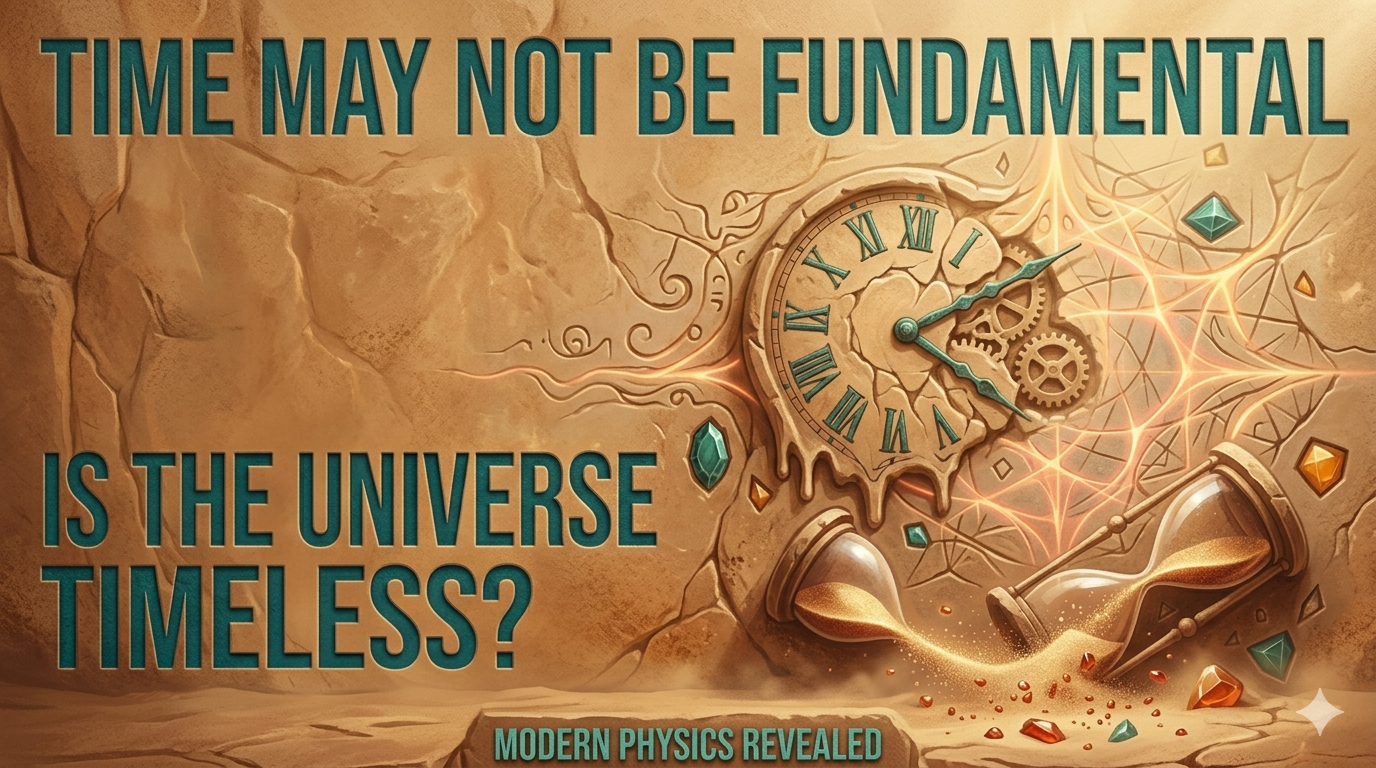
Time is not fundamental. It emerges from the statistical state of a system:
No entropy gradient → no time
Time = ordering of events from thermodynamic flow
Page–Wootters mechanism
A globally static universe + entanglement between a “clock” and other subsystems creates apparent time evolution.
In today’s language:
Time is not something the universe “has.” Time is how subsystems experience relational change.
5. The November 2025 Consensus
Among active researchers in quantum gravity, the majority position can be stated as:
Spacetime, gravity, and the arrow of time are emergent phenomena arising from quantum entanglement and information flow in a deeper non-spatial, non-temporal system.
Supporting evidence:
Exact derivations of gravity from boundary entanglement (AdS/CFT)
Newtonian gravity reconstructed from quantum relative entropy
Tensor-network / MERA models reproducing expanding FLRW cosmologies
“Islands” showing that spacetime grows from entanglement
Complexity = volume/action correspondences linking spacetime to computational cost
This is the most consistent and mathematically complete picture we have.
6. The Big Unsolved Problem: de Sitter Space
All our exact tools work beautifully in AdS (negative cosmological constant). But our universe is de Sitter (positive cosmological constant).
The holy grail:
Find a non-perturbative holographic dual for de Sitter spacetime.
Progress is steady (dS/CFT, static patch holography, complexity proposals), but the final formulation is still missing as of late 2025.
Most physicists expect the emergent paradigm to survive this transition. But the last step is not yet complete.
7. The Minority Position
A small but respected group still argues:
Spacetime may remain fundamental
Einstein’s equation may be quantized directly
Asymptotic safety could preserve continuity at all scales
This view is increasingly rare but not disproven. The debate remains scientifically healthy.
8. The New Paradigm (2025)
Physics has seen paradigms like this before:
Temperature is emergent (statistical mechanics)
Fluidity is emergent (molecular dynamics)
Classical trajectories are emergent (quantum decoherence)
Now:
Gravity and time join the list.
They are real, measurable, and extraordinarily accurate — but only as large-scale collective behaviors.
At the Planck scale:
No geometry
No continuity
No time
No gravity
All of them emerge from the entanglement structure of microscopic degrees of freedom.
The universe is not built on spacetime. Spacetime is built on quantum information.
This is no longer fringe. It is the leading framework guiding quantum gravity research in 2025.
The next step is to identify the exact microscopic rules that generate:
4D spacetime
de Sitter expansion
dark energy
and the arrow of time
We are closer than ever.
If this article helped you think differently, follow for more thoughtful, in-depth writing.
메타데이터
- post_id
- 301bfb06ca8e
- slug
- gravity-and-time-are-they-fundamental-or-emergent-301bfb06ca8e
- url
- https://medium.com/@udilip00/gravity-and-time-are-they-fundamental-or-emergent-301bfb06ca8e
- canonical_url
- https://medium.com/@udilip00/gravity-and-time-are-they-fundamental-or-emergent-301bfb06ca8e
- author_url
- https://medium.com/@udilip00
- status
- ok
- fetched_at
- 2026-07-17 12:36:49