Why magnetic fields fade like 1/r³
At first, it sounds strange to say that magnetic fields obey an inverse-cube law.
Why magnetic fields fade like 1/r³
At first, it sounds strange to say that magnetic fields obey an inverse-cube law.
After all, the Biot–Savart law is not an inverse-cube law. It is an inverse-square law. A tiny piece of current-carrying wire contributes to the magnetic field with a strength that falls roughly like 1/r², where r is the distance from that piece of wire.
So where does the 1/r³ behavior come from?
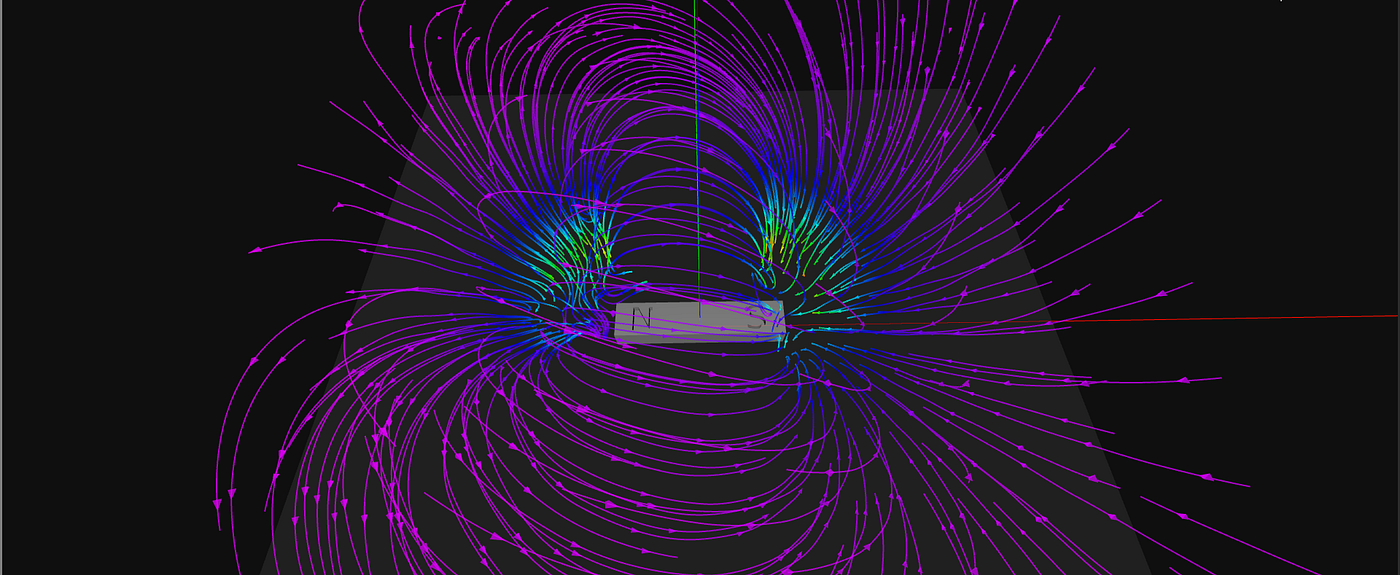
The key is that a complete current loop is not just one piece of wire. It is many pieces of wire, all pointing in different directions. If you are very far from the loop, every small segment of the wire is almost the same distance from you. Each segment produces its own inverse-square contribution, but those contributions point in different directions.
Most of them nearly cancel.
That cancellation is the important part. If you simply look at one piece of wire, you see 1/r². But if you look at the whole loop from far away, the leading inverse-square pieces almost wipe each other out. What remains is the next strongest term, which falls like 1/r³.
This is very similar to what happens with an electric dipole. A positive charge alone gives an inverse-square electric field. A negative charge alone does the same. But when the two charges are close together and you observe them from far away, their fields almost cancel. The remaining far-field behavior is not 1/r² anymore. It becomes dipole-like, and falls like 1/r³.
A current loop works in much the same way. From far away, it looks like a magnetic dipole.
There is also a deeper reason static magnetic fields behave this way. Static magnetic fields are produced by localized steady currents. A localized steady current cannot have a net current flowing out of a closed region without charge building up somewhere. In other words, if you integrate a steady current over a volume that contains the whole source, the net flow cancels out.
Because of that cancellation, there is no isolated magnetic “charge” equivalent to a single electric charge in ordinary magnetostatics. The long-distance field cannot behave like the field of a lone source. The first nonzero contribution is usually dipole-like, and that means a 1/r³ falloff or faster.
This is why a small current loop, seen from far away, does not behave like a single current element. It behaves like a magnetic dipole.
There is one important exception: time-varying fields.
The inverse-cube behavior is a statement about static, localized magnetic fields. Once the fields change with time, new behavior appears. A changing electromagnetic system can produce terms that fall like 1/r², and a radiating system can produce fields that fall like 1/r.
That is what happens in the far field of an oscillating dipole. Both the electric and magnetic fields can travel outward as radiation, and their leading behavior is 1/r.
So the short version is this: Biot–Savart starts with inverse-square contributions from tiny current elements, but a whole localized steady current loop cancels its leading terms. What survives at long distance is dipole behavior, and dipole fields fade like 1/r³.
메타데이터
- post_id
- 3022501f34a0
- slug
- why-magnetic-fields-fade-like-1-r³-3022501f34a0
- url
- https://medium.com/@frisellagiuseppe/why-magnetic-fields-fade-like-1-r%C2%B3-3022501f34a0
- canonical_url
- https://medium.com/@frisellagiuseppe/why-magnetic-fields-fade-like-1-r%C2%B3-3022501f34a0
- author_url
- https://medium.com/@frisellagiuseppe
- status
- ok
- fetched_at
- 2026-06-09 15:37:30