Why were Widows Burned Alive in India for Centuries?
The Most Heinous Practice of All Time In India
Why were Widows Burned Alive in India for Centuries?
The Most Heinous Practice of All Time In India
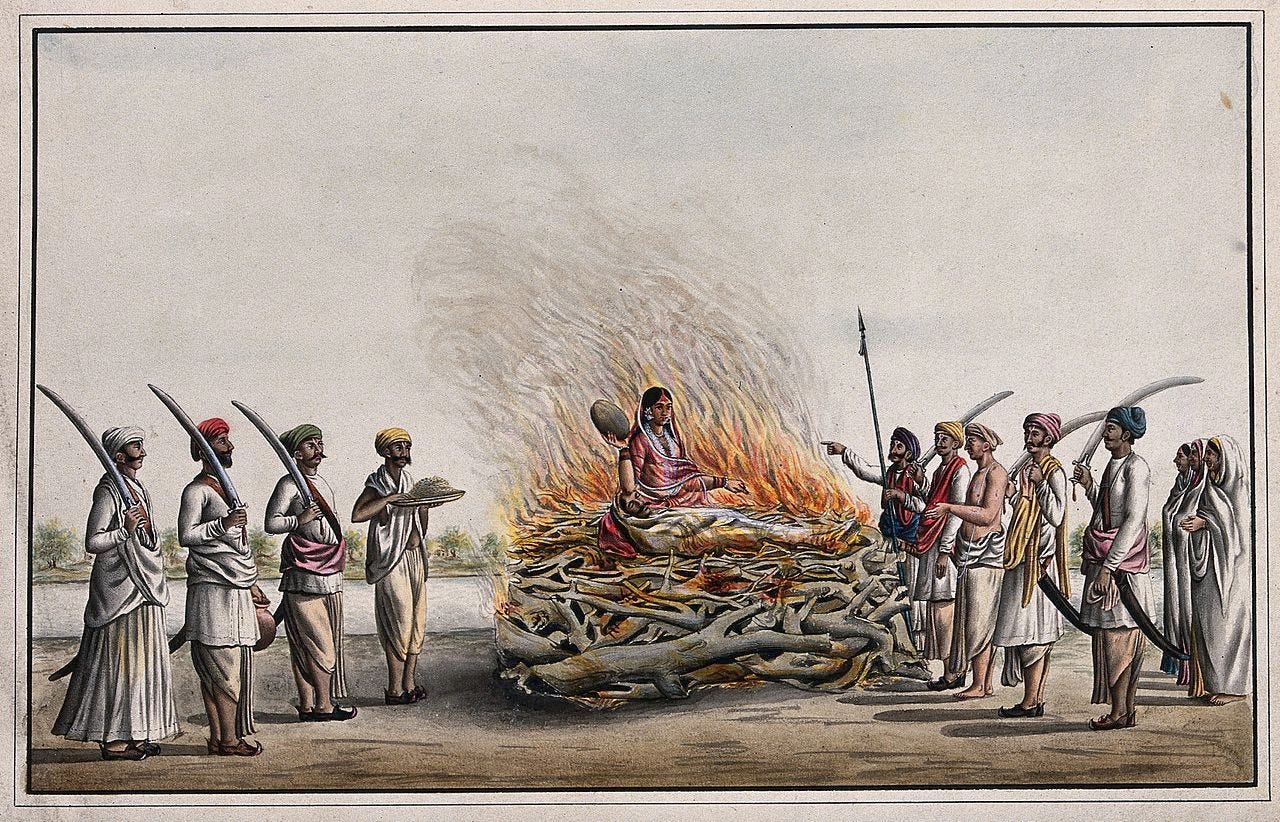
A picture of Sati practice | Image Source: Wikipedia
Today, in this age we witness an impeccable rise in feminism and we all do focus on equality and human rights, human values.
Today’s generation may find it difficult to digest the facts of the Hindu practice of Sati.
Sati — the ‘burning to death’ ceremony of a widow on her husband’s funeral pyre.
Although this practice has been banned and is illegal now, yet it is still regarded as the ultimate form of womanly sacrifice and devotion.
The burning of widows alive never happened to perform willingly.
The widow was forced by the dominating society.
It was as if the women didn’t have any rights to live after the death of their man.
Sati as a practice was first mentioned in 510 CE in Madhya Pradesh Of India. It began to grow popular especially in southern India. For many centuries, this custom prevailed in the south only.
Later it caught hold of its grip in Rajasthan and Bengal.
The British East India Company had recorded the following facts — from the year 1813–1828: Number of Satis: 8,135
However, this estimate was far away from reality.
The actual number of satis as in the year 1823 was 575 — in Bengal state alone.
Historically, the practice of Sati was to be found to be a practice among all — among all castes and at every social level; irrespective of them being rich or poor, educated or uneducated.
Sati practice was believed an act of supreme loyalty. It was done to purify her of all her sins, release her from the cycle of birth and rebirth. They say that sati ensures protection for her dead husband and the seven generations that followed her.
The spread of this custom was inspired Indo — European times. It was when both the man and woman were taken to the funeral pyre. Though it was not intensely observed during the time. It was revived during the Gupta times.
It was an act of bravery and pride for the wives to burn themselves alive.
The time when the Muslims were involved in Sati Pratha. It was a part of Sanskritization when the warriors wanted to develop their hierarchy.
Mostly widespread into the regions of South Asia during the era of Islamic invasion.
It was practiced during that time to reduce the obstacles and difficulties that the widows may have had to face after the death of their warrior husbands. The ritual was inspired not only by the Sati practice but also by the Jauhar that is popular after Rajput’s empress “Padmavati” had committed Jauhar, as she considered it as a win against Allauddin Khilji.
The intention of the widow accepting Sati was not mandatory but it was the enforced hardships and situations that led them to die alive in the fire.
It was a sign of protest and pride to die with respect and avoid the critical situations that followed with the death of their husbands.
How Sati became mandatory?
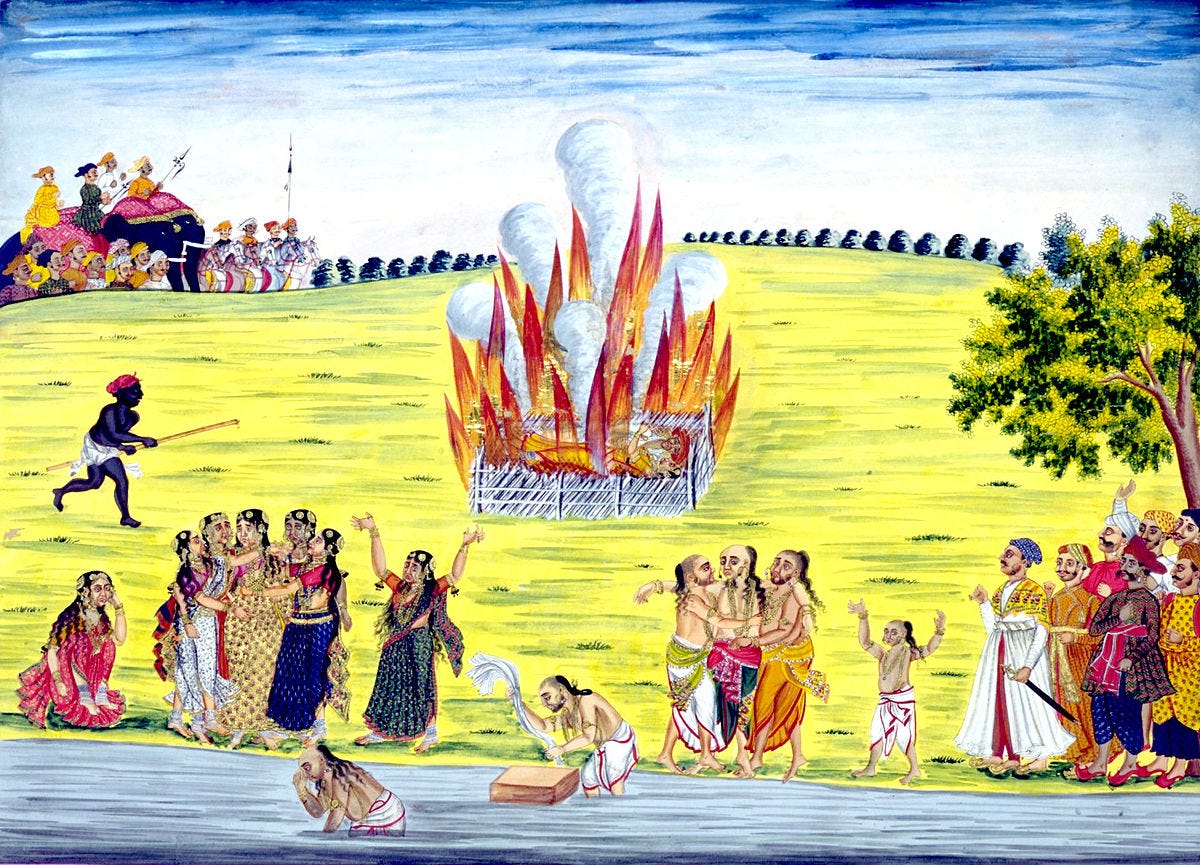
Sati Ceremony | Image Source: Wikimedia Commons
Later during the 1800s, the Sati practice turned to be essential. The rituals of women widows are taken to a mandatory tradition in the parts of Bengal.
Young girls of mere age of 15–20 were married to old men of 60 or 70. After the death of the old men, the woman was laid to the fire along with her husband.
The entire procedure of child marriage and burning at an early age was worsening the situation.
Poverty is one of the reasons that child marriage and marrying old men were strongly encouraged. Poor family girls were married to the old men on behalf that the young age girl or women can take care of the unhealthy, old husbands.
It was not at all as per the desire or decision of the widows. The ritual was performed against their wishes or decisions. Young women of hardly 12 to 16 were also forced to die with old dead husbands.
The ritual that was a pride to accept slowly turned into a frightening murder of the young woman.
Child marriage and Sati Pratha
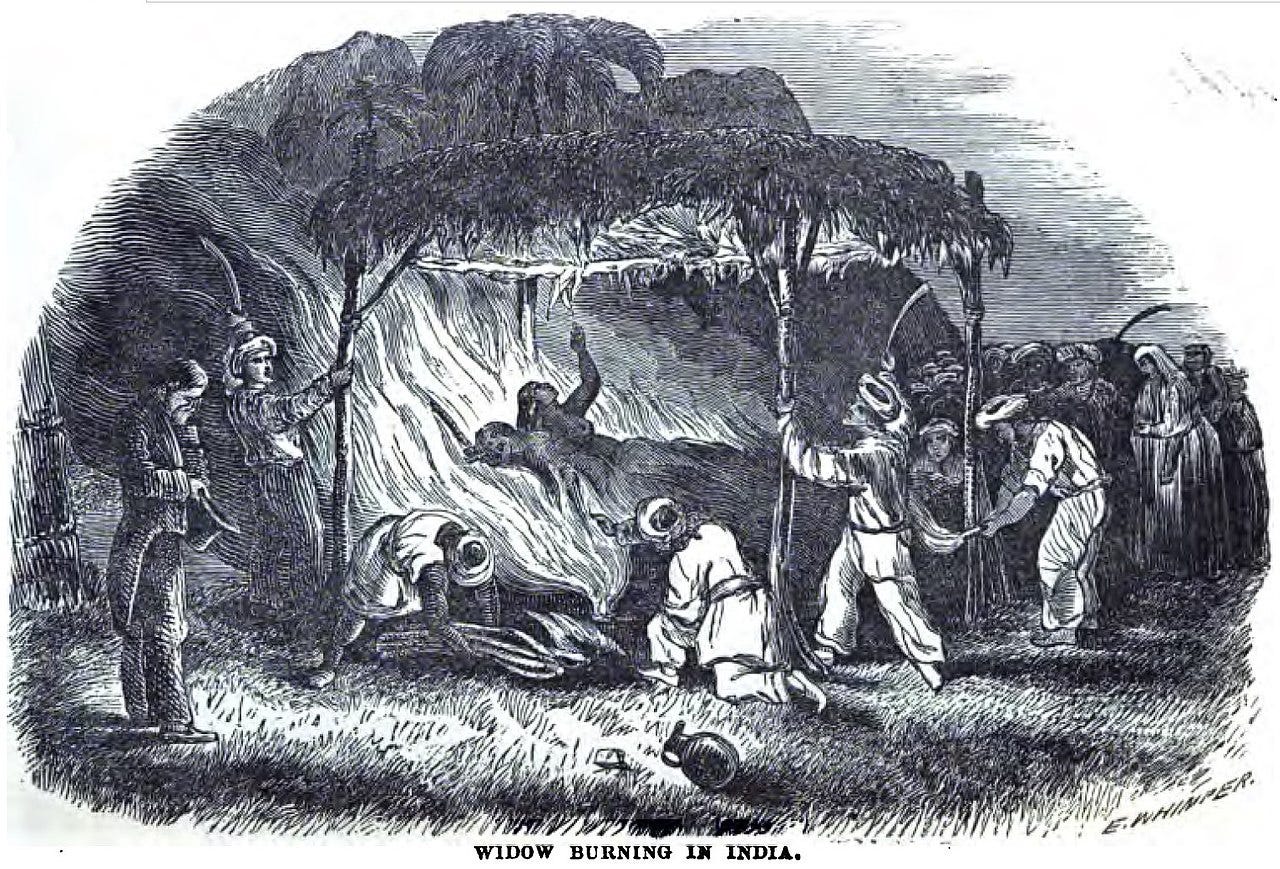
sati practice | Image Source: Wikipedia
Rajputs, Bengalis of West Bengal during the 1600s to 1800s, had the rituals of both Sati Pratha and child marriages. Poverty during the period and caste issues were both responsible for the increasing spread of Sati in West Bengal.
Lower caste, poor, and young girls who hardly had turned teenagers were forcibly married to the rich men or upper caste men.
It was turning to become a trend when child abuse through marriages and burning widows alive are increasing with time.
Finally, during the British period, it brought a sigh of relief when the Sati Pratha and Child marriage campaigns begin to grow as a revolution.
Child marriages as well as the surrounding rituals were hampering the life of women. Dominance in West Bengal was from caste, class, and sufferings due to poverty.
Altogether, women were a gender to suffer till early young age.
Apart from it, the Sati practice had diversified to unwilling sacrifice which was once a path to show pride and bravery. With time the meaning and use of Jauhar and Sati Pratha had entirely changed.
Contribution of Leader To Ban Sati
In 1829, the Sati Pratha was abolished after the death rate of young women was increasing.
The principal reformers are Raja Ram Mohan Roy and William Carey.
Raja Ram Mohan Roy was highly shattered by the death of his sister-in-law. She was forced to accept Sati practice. It was during the period of William Bentinck, Governor-General of India declared the act of Sati, leading to burning or burying of widows alive will be a punishable act of crime.
Despite Banning Sati, it was still in practice.
Dying with a dead body, and an alive woman with a dead husband has a religious value.
Despite the banning of Sati, in 1984 after more than 9 decades it was performed by Javitri. She was a local woman who delightedly committed Sati in the Jari village of Bundelkhand.
The practice of Sati still exists in Rajasthan, the last was in 2005 at the Jari temple. There are hundreds of devotees who visit the temples.
They have a blind belief in the live burning of women at the funeral pyre of the husband.
Jari temple is one of the famous temples with built-in memory of Javitri.
Another temple was dedicated after the suicide of Roop Kanwar in 1987, it was in Uttar Pradesh.
There are many temples dedicated to Sati, above all Uttar Pradesh stands as the most infamous state committing the banned ritual.
When asked to a villager of Chitrakoot(Rajsthan), “Why is the ritual still practiced despite the ban?” — She said it is all about faith.
It means the women of Rajasthan still have blind faith in Sati that seems hard to pull out.
The establishment of temples and shrines has given flame to their faith. India’s law and the order have not been able to demolish the faith which exists in the form of temples in the states of Rajasthan and Uttar Pradesh.
Sources:
메타데이터
- post_id
- 30715630f0bf
- slug
- why-were-widows-burning-alive-in-india-for-centuries-30715630f0bf
- url
- https://medium.com/lessons-from-history/why-were-widows-burning-alive-in-india-for-centuries-30715630f0bf
- canonical_url
- https://medium.com/lessons-from-history/why-were-widows-burning-alive-in-india-for-centuries-30715630f0bf
- author_url
- https://medium.com/@kvchaudhary
- status
- ok
- fetched_at
- 2026-07-17 05:29:28