The City Looks Busy
Busy is not the same as prosperous.
The City Looks Busy
Busy is not the same as prosperous.
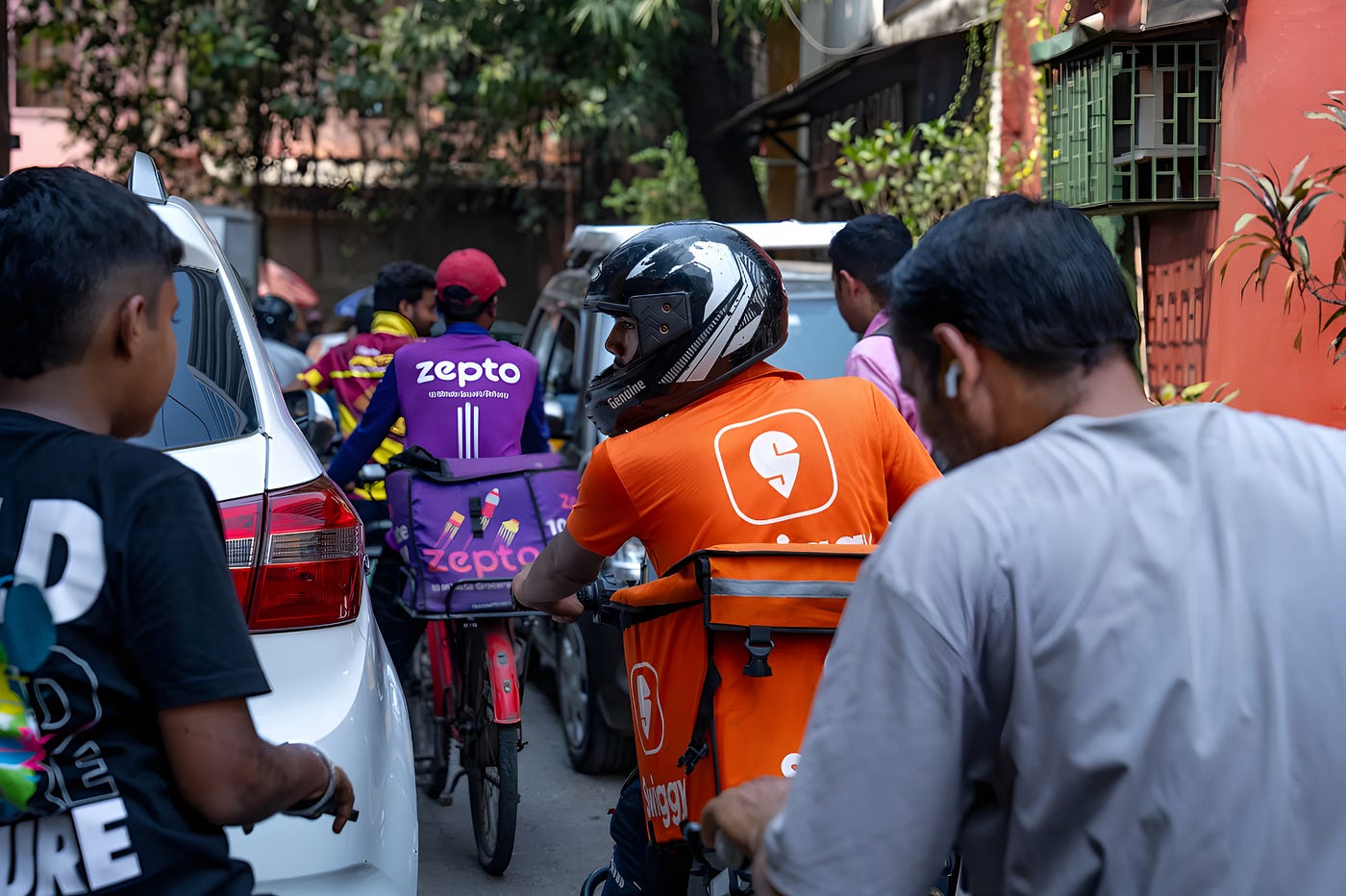
Photo: Abeer Khan/Bloomberg.
India’s cities have never looked more economically active.
Delivery riders move through traffic at all hours. Groceries arrive in ten minutes. Ride-hailing vehicles fill the roads late into the night.
Apartment complexes, warehouses, restaurants, smartphones, and routing algorithms now operate together as one continuous urban network. Each part feeding the others. The whole thing humming at a scale that would have seemed implausible twenty years ago.
From a distance, it looks like a modern digital economy doing exactly what modern digital economies are supposed to do.
But look a little closer, and a different question starts to form.
“Not what is being built, but what it’s actually built on.”
This question isn’t unique to India. Versions of it are unfolding in Jakarta, São Paulo, Lagos, and every fast-urbanising economy where platforms have arrived faster than formal employment.
India’s case is simply the most intensified. Larger in scale, more visible in its contradictions, more consequential for what it might reveal about where this model leads.
The graduate on the bike

Photo: Ayush Singh Thakur/Pexels.
Here is a detail that tends to get lost in the broader story about India’s gig economy: a significant share of the people working inside it are educated.
Engineers driving Ola and Uber. Graduates working in delivery logistics for Swiggy and Blinkit.
Degree holders who entered the workforce expecting one kind of life and ended up navigating a different one, measured in orders completed and incentive windows and the rising price of fuel.
This isn’t an anecdote. It’s a structural feature of the system and one of the more uncomfortable ones to sit with.
NITI Aayog estimated India had roughly 7.7 million gig workers in 2020–21, with projections reaching 23.5 million by 2029–30. Those numbers capture scale. They don’t capture composition. And the composition is what matters here.
Consider two twenty-three-year-olds entering the workforce.
One joins a manufacturing or engineering role where technical skills deepen over time, compounding with experience and specialisation.
The other enters app-based delivery work, where earnings stay closely tied to hours worked, local demand, and whatever the platform decides to pay this week.
Both are employed. The statistics count both as employed. But the long-term trajectories are very different, and that gap is exactly what tends to disappear inside the headline numbers.
India doesn’t just have a job shortage. It has a mismatch.
The credentials being issued don’t match the industries capable of absorbing them. What the education system produces doesn’t match what the economy actually needs.
The platforms didn’t create that mismatch. But they became one of the primary systems absorbing its consequences.
Software coordinated what already existed
India’s gig economy did not invent precarious work. Informal labour has existed for decades and still accounts for roughly 80 to 90 per cent of total employment, depending on how it’s measured.
What platforms changed was the coordination layer.
Smartphones, GPS, digital payments, and routing algorithms made informal labour easier to organise, measure, and scale. They turned fragmented urban labour into continuously managed logistics networks operating across entire cities.
A platform can now match thousands of workers to demand in real time, optimise routes, process payments, and keep its network moving with minimal human oversight.
That operational efficiency is real, and it shouldn’t be dismissed.
But the economics still rest on something much older: abundant, low-cost labour.
The cheap rides and the ten-minute grocery deliveries are not purely products of software cleverness. They depend on millions of workers operating on thin and unstable margins in cities where better alternatives remain scarce.
India’s digital convenience economy runs on very old economics: uneven wealth and surplus labour. The technology is modern. The structure underneath it is not.
One group buys time. Another monetises availability.
The rapid expansion of quick commerce like food, groceries, pharmacy runs, courier services, and hyperlocal logistics makes more sense when you look at the two conditions that make it possible.
On one side: a relatively affluent urban consumer class with enough disposable income to outsource everyday inconvenience.
On the other: a large labor surplus that keeps delivery and fulfillment costs low enough to make the economics work.
These two conditions don’t just coexist. They depend on each other.
That imbalance isn’t a side effect of the system. It’s part of what makes it function. And it helps explain why similar platforms keep flooding the market.
They are not just competing for today’s orders. They are racing to control long-term urban distribution networks, customer behaviour, and logistics density across cities still growing fast
Worth noting: most of these companies are not profitable. The expansion is underwritten by investor capital betting on future market dominance, not present-day returns. The system absorbing India’s labour surplus is itself dependent on capital that could dry up.
Activity is not the same as stability

Photo: Shutterstock.
Across Indian cities, rows of delivery riders wait outside restaurants, phones open across two or three apps, watching for the next order before incentive windows expire.
The technology is seamless. The economic pressure underneath it is visible if you’re paying attention.
This is the distinction worth holding onto: activity and stability are not the same thing.
A platform can generate constant motion while still leaving workers exposed to volatile earnings, rising fuel costs, vehicle maintenance expenses, shifting incentives, and hours that quietly exceed what any formal employment contract would permit.
India attempted to address this with its Code on Social Security in 2020, which included provisions for gig and platform workers. The implementation has been slow and uneven. The structural tension it was trying to resolve remains largely intact.
Cities appear economically energised. And in some ways they are. But visible motion can also obscure what’s happening underneath. Unemployment pressure converts into continuous low-margin activity. It registers as economic participation. It doesn’t necessarily build toward anything more.
Economies become significantly wealthier by expanding industries where skills, technology, and output compound over time. Manufacturing. Infrastructure. Engineering. Advanced supply chains. Industries where labour becomes harder to replace, not easier.
South Korea, Taiwan, and China at different points managed this by building sectors where labour became more valuable over decades, not just more available.
Logistics coordination at the consumer level is useful. But coordinating the movement of food and groceries does not compound the same way a manufacturing or engineering workforce does.
A delivery rider completing fifty orders a day is participating in the economy. The harder question is whether that participation leads anywhere, and over what timeframe.
The fragility underneath
The system works as long as urban consumers keep spending. Fewer people are holding it up than it looks.
Quick commerce and platform delivery ecosystems depend heavily on a relatively concentrated group of higher-income urban professionals like people in technology, finance, and corporate services whose discretionary spending funds the whole apparatus.
When that group slows down, during layoffs, salary freezes, or broader economic stress, order volumes decline quickly. Incentives shrink. Worker earnings fall. Competition between workers intensifies, often invisibly.
There’s a longer-run uncertainty layered on top of this. Many of these platforms currently rely on large amounts of human labour: drivers, pickers, warehouse workers, delivery riders. But automation, AI-assisted logistics, and warehouse technologies are advancing in ways that may reduce the labour needed to operate these networks over time.
Which raises an uncomfortable question.
“If platform systems are currently absorbing millions of workers from a labour market that can’t place them elsewhere, what happens if the platforms themselves become far less labour-intensive?”
India’s case is intensified by demographic scale, graduate underemployment, and the sheer size of its labour surplus. That gives these platforms an unusual weight inside the broader employment system and makes the question of what replaces them considerably harder to answer.
A pressure valve for a harder problem
India’s gig economy is not an anomaly. It’s an adaptation. The result of several pressures arriving at the same time: slow formal job creation, urban inequality, surplus labour, mass smartphone adoption, and digital infrastructure that dramatically reduced the cost of coordination.
The platforms solve several problems at once.
They create income quickly. They reduce visible unemployment. They support urban convenience. They generate measurable economic activity.
In that sense, they function as a pressure valve, one that keeps deeper stress from becoming immediately visible.
But pressure valves don’t resolve the underlying pressure. They manage it.
Coordination efficiency is valuable. But coordination efficiency alone cannot create pathways into compounding, skill-deepening work. The kind where workers become more valuable over time, not just more available.
The platforms didn’t create India’s deeper economic tensions. They became one of the systems that carried them, organised them, and made them legible.
Which leaves the harder question sitting underneath all of it:
“Can a country become significantly more prosperous if millions of educated young people increasingly depend on moving food, groceries, and passengers through app-based networks?”
The apps are extraordinary pieces of infrastructure. The question isn’t really about the apps.

Photo: Rupinder Singh/Pexels.
I don’t have clean answers here. Neither does anyone else. But the question of what economies owe their educated young people, and what happens when that debt goes unpaid, deserves more than the silence it usually gets.
메타데이터
- post_id
- 3076c93cec8f
- slug
- the-city-looks-busy-3076c93cec8f
- url
- https://medium.com/activated-thinker/the-city-looks-busy-3076c93cec8f
- canonical_url
- https://medium.com/activated-thinker/the-city-looks-busy-3076c93cec8f
- author_url
- https://medium.com/@sayantanpati
- status
- ok
- fetched_at
- 2026-06-09 15:37:30