The Messy Magic of Monjayaki: Tokyo’s Delicious Culinary Chaos
The Messy Magic of Monjayaki ― Tokyo’s Delicious Culinary Chaos

It may not look appetizing? Photo by Auther
Imagine yourself seated at a lively Tokyo restaurant, the air buzzing with excitement and the tantalizing aroma of cooking food. Before you lies a sizzling iron griddle, its surface gleaming with anticipation. Suddenly, a server approaches, carrying a bowl filled with what appears to be a watery batter teeming with an assortment of ingredients. As they begin to pour this mysterious concoction onto the hot griddle, you can’t help but wonder, “What on earth am I about to experience?”
Welcome to the wonderful world of monjayaki, Tokyo’s beloved and bewildering specialty that proves appearances can be delightfully deceiving when it comes to culinary delights.
The Ugly Duckling of Japanese Cuisine
Let’s address the elephant in the room right off the bat: monjayaki is not a pretty dish. In fact, it’s downright ugly. But here’s the thing — its unattractiveness is precisely what makes it so captivating. In a world obsessed with picture-perfect, Instagram-worthy food, monjayaki boldly goes against the grain, daring to be unapologetically messy and visually chaotic.
As a food enthusiast who’s traveled across Japan sampling everything from exquisite kaiseki meals to convenience store onigiri, I can confidently say that monjayaki stands out as one of the most intriguing culinary experiences I’ve had. Why? Because it challenges everything we think we know about food presentation while delivering a taste that will make you forget all about its appearance.
Monjayaki 101: What Is This Delicious Mess?
Monjayaki is a savory pancake-like dish that originated in Tokyo. It’s often compared to its more famous cousin, okonomiyaki, but trust me — they’re quite different beasts. While okonomiyaki maintains some semblance of structure, monjayaki embraces chaos from start to finish.
The dish is typically made with a liquid batter of flour, dashi (Japanese soup stock), and various chopped ingredients. Common additions include cabbage, seafood, meat, cheese, and pretty much anything else you can imagine. The beauty of monjayaki lies in its flexibility — you can throw in whatever your heart desires, and somehow, it always works out.

The beautifully arranged ingredients for Monjayaki, showcasing fresh cabbage, mentaiko, and other delicious components before being mixed and grilled. Photo by Author
Monja Street: Where Ugly Food Reigns Supreme
If you find yourself in Tokyo and want to experience the heart of monjayaki culture, head to Tsukishima’s Monja Street. This lively thoroughfare in eastern Tokyo is lined with over 70 monjayaki restaurants, each offering its own unique take on the dish.
Walking down Monja Street is a sensory overload in the best possible way. The air is filled with the sizzle of griddles and the enticing aroma of grilling ingredients. You’ll see groups of friends and families huddled around tables, laughing and chatting as they cook their monjayaki together. It’s a communal experience that embodies the warm, convivial spirit of Tokyo’s food scene.
The Monjayaki Experience: A Culinary Rollercoaster
Now, let me take you through my personal monjayaki adventure. I chose a restaurant that came highly recommended by locals, its windows steamed up from the heat of countless griddles within. As I sat down, the server handed me a menu filled with an overwhelming array of ingredient combinations.
After much deliberation, I settled on a monjayaki topped with mentaiko (spicy cod roe), mochi (rice cakes), and cheese. An odd combination, you might think, but remember — with monjayaki, there are no rules.
The Art of Ugly: Watching Monjayaki Come to Life
Here’s where things get interesting. The server brought over a bowl of batter mixed with my chosen ingredients, and this is when I realized that monjayaki’s journey from ingredients to finished dish is like watching a beautiful painting slowly transform into abstract art.

“Cooking in action: Sautéing fresh cabbage on the teppan grill, the first step in creating a delicious Monjayaki. Photo by Author
At first, as the batter hit the hot griddle, it looked promising. The ingredients were clearly visible, the mentaiko adding vibrant pops of orange, the mochi gleaming white, and the cheese beginning to melt enticingly. “This doesn’t look so bad,” I thought to myself, naively.
But then, the cooking process began in earnest. The server used two small spatulas to chop and mix the ingredients, spreading them across the griddle. As the batter cooked, it began to bubble and ooze, losing any semblance of structure it might have had. The cheese melted completely, creating stringy webs that stretched across the griddle. The mochi softened and blended into the mix, while the mentaiko dispersed, turning the whole concoction a slightly alarming shade of pink-orange.
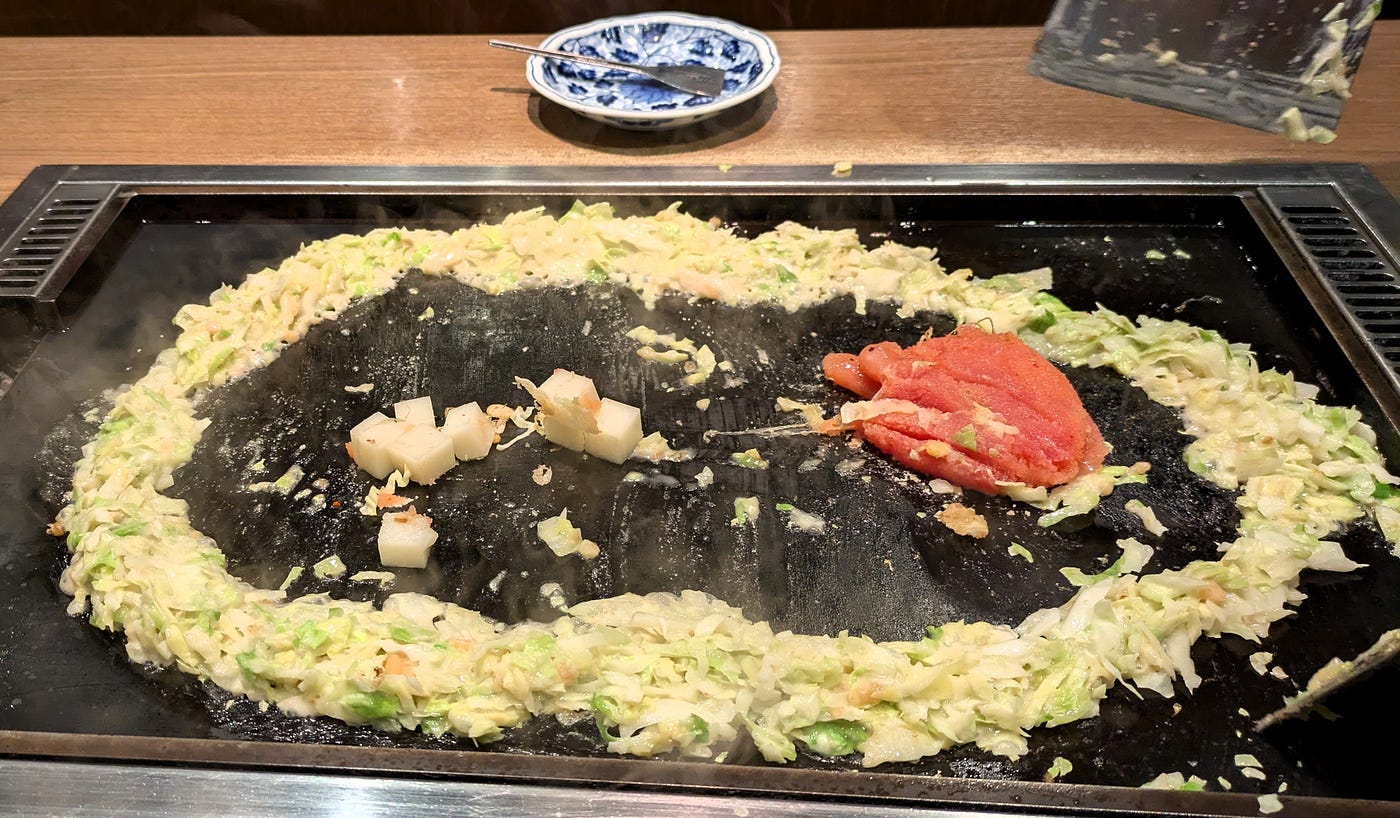
Mochi and mentaiko are mixed in, ready to create the unique flavors of Monjayaki. Photo by Author
The Ugly Duckling Transformation
As the cooking continued, I watched in fascination as my monjayaki transformed from a somewhat recognizable mixture of ingredients into what can only be described as a culinary Rorschach test. The once-distinct components had melded into a bubbling, gurgling mass that spread across the griddle like some sort of sentient food blob.

The Monjayaki takes shape as the batter is mixed with mochi and mentaiko, creating a savory and unique dish. Photo by Author
By the time it was deemed ready to eat, my monjayaki looked like it had been through a small apocalypse. It was a strange, amorphous creation that bore little resemblance to its original ingredients. If I’m being honest, it looked like something that might have been scraped off the bottom of a malfunctioning food processor.
But here’s the kicker — it smelled absolutely divine.
Taste Triumphs Over Appearance
As I picked up my small spatula (used for both cooking and eating monjayaki), I’ll admit I felt a twinge of apprehension. How could something that looked so… well, let’s say “unique”… possibly taste good?
I scraped off a small portion, blew on it to cool it down, and took my first bite. And just like that, any doubts I had about monjayaki vanished.
The flavor was incredible. The mentaiko provided a salty, spicy kick that was perfectly balanced by the creamy, melted cheese. The mochi added delightful chewy pockets throughout, giving the dish a variety of textures. The batter itself, crisped on the bottom from the hot griddle, offered a satisfying crunch that contrasted beautifully with the gooey interior.
Each bite was a new adventure, with different flavor combinations emerging as I made my way across the griddle. Sometimes I’d get a pocket of pure, molten cheese. Other times, a burst of mentaiko would dominate. And occasionally, I’d encounter a piece of mochi that had crisped up on the griddle, providing an unexpected textural twist.
The Allure of Imperfection
As I happily devoured my monjayaki, I found myself reflecting on why this dish is so captivating despite — or perhaps because of — its unattractive appearance.
In a world where we’re constantly bombarded with images of perfectly plated, meticulously arranged dishes, there’s something refreshing about a food that completely disregards visual appeal. Monjayaki is the culinary equivalent of that friend who always speaks their mind, regardless of social niceties. It’s brash, it’s bold, and it doesn’t care what you think of its appearance.
This disregard for aesthetics is, paradoxically, what makes monjayaki so Instagram-worthy. In a sea of carefully arranged avocado toasts and color-coordinated smoothie bowls, a glob of delicious chaos stands out. It’s so un-photogenic that it loops back around to being photogenic again, in its own weird way.
Monjayaki: A Metaphor for Life?
As I scraped the last bits of crispy batter from the griddle, I realized that monjayaki offers more than just a unique dining experience — it provides a valuable life lesson.
Too often, we judge things (and people) based on their outward appearance, missing out on the richness that lies beneath the surface. Monjayaki teaches us to look beyond the superficial, to find beauty and value in unexpected places. It reminds us that perfection is overrated, and that sometimes, the messiest, most chaotic experiences can be the most rewarding.
Moreover, the communal nature of cooking and eating monjayaki — gathered around a hot griddle, everyone participating in the creation of this delicious mess — speaks to the importance of shared experiences and the joy of embracing imperfection together.
A Culinary Rebel in the Age of Food Beauty
In our current era of carefully curated food photos and #foodporn hashtags, monjayaki stands as a rebellious icon. It thumbs its nose at the very idea of “beautiful” food, choosing instead to focus entirely on flavor and the joy of eating.
This rebellion against food beauty standards is, in its own way, a return to the roots of what eating should be about. It’s not about how many likes your dinner photo gets on social media; it’s about the pleasure of good food shared with good company. Monjayaki strips away the pretense and the pressure to create picture-perfect meals, allowing us to focus on what really matters: taste, texture, and the simple joy of eating.
Embracing the Chaos: Final Thoughts on Monjayaki
As I left the restaurant that day, still marveling at the culinary journey I’d just experienced, I couldn’t help but feel a newfound appreciation for monjayaki. This dish, with its utterly chaotic appearance and sublime taste, had reminded me of the importance of looking beyond the surface and embracing the unexpected.
So, the next time you find yourself in Tokyo, I urge you to seek out a monjayaki restaurant. Sit down at that hot griddle, order the strangest combination of ingredients you can think of, and watch as they transform into a glorious mess before your eyes. Then, take that first bite and let your taste buds discover what your eyes could never have predicted.
In monjayaki, we find a testament to the fact that true beauty — and deliciousness — often lies where we least expect it. It’s a reminder to approach life, and food, with an open mind and a willingness to embrace the chaos. After all, sometimes the ugliest dishes make for the most beautiful memories.
So here’s to monjayaki — Tokyo’s deliciously ugly culinary masterpiece. May it continue to challenge our perceptions, delight our taste buds, and remind us that in both food and life, it’s what’s on the inside that truly counts.
메타데이터
- post_id
- 308ca1fadf0c
- slug
- the-messy-magic-of-monjayaki-tokyos-delicious-culinary-chaos-308ca1fadf0c
- url
- https://medium.com/@beyond-nippon/the-messy-magic-of-monjayaki-tokyos-delicious-culinary-chaos-308ca1fadf0c
- canonical_url
- https://medium.com/@beyond-nippon/the-messy-magic-of-monjayaki-tokyos-delicious-culinary-chaos-308ca1fadf0c
- author_url
- https://medium.com/@beyond-nippon
- status
- ok
- fetched_at
- 2026-06-27 18:20:27