The Autonomous Ship Is No Longer Science Fiction: How Agentic AI Is Rewriting Maritime Transport
From energy arbitrage to collision avoidance, a new class of intelligent agents is quietly transforming the way vessels navigate, consume…
The Autonomous Ship Is No Longer Science Fiction: How Agentic AI Is Rewriting Maritime Transport
From energy arbitrage to collision avoidance, a new class of intelligent agents is quietly transforming the way vessels navigate, consume power, and stay in service with implications far beyond the sea.
When a vessel leaves port today, it carries not only cargo and crew but an increasingly dense web of software making decisions in real time. Adjust the throttle. Reroute around a weather system. Defer the desalination pump. Charge the batteries now, sell power back to the grid later. These are not decisions a human officer makes on a slow schedule, they are continuous, millisecond-level trade-offs being executed by a new generation of agentic AI systems designed specifically for maritime operations.
We are at an inflection point. The shipping industry, which moves more than 90% of world trade, is under simultaneous pressure to decarbonise, cut operating costs, and address a chronic shortage of qualified seafarers. Agentic AI , autonomous software agents that perceive their environment, reason over goals, and take action without constant human instruction is emerging as a structural answer to all three.
What Is Agentic AI, and Why Does Maritime Need It?
Conventional automation is rule-based: if sensor X exceeds threshold Y, trigger action Z. It is fast and reliable within narrow boundaries, but brittle the moment conditions fall outside what the engineer anticipated.
Agentic AI is different in kind. An agent holds a goal say, “minimise fuel consumption while maintaining schedule” and continuously plans and replans in response to a changing world. It perceives through sensors, reasons over models of the environment, takes actions, and learns from outcomes. Multiple agents can coordinate, negotiate, and divide responsibilities across a system far too complex for any single controller.
This is precisely the challenge profile of a modern vessel:
- Energy sources (batteries, fuel cells, diesel generators, shore power) must be balanced in real time against a load that shifts every time a pump starts or a wave hits.
- Voyage plans must be recomputed continuously as weather windows open and close, currents shift, and port queues evolve.
- Collision avoidance demands not just obstacle detection but intent inference , understanding what another vessel is likely to do and compliance with an international rulebook (COLREGS) that is explicitly situational.
- Maintenance cannot wait for scheduled dry-dock intervals; failure patterns emerge in sensor data weeks before a breakdown, but only if something is watching.
No single algorithm handles all of this. A multi-agent architecture does.
Five Agents, One Ship
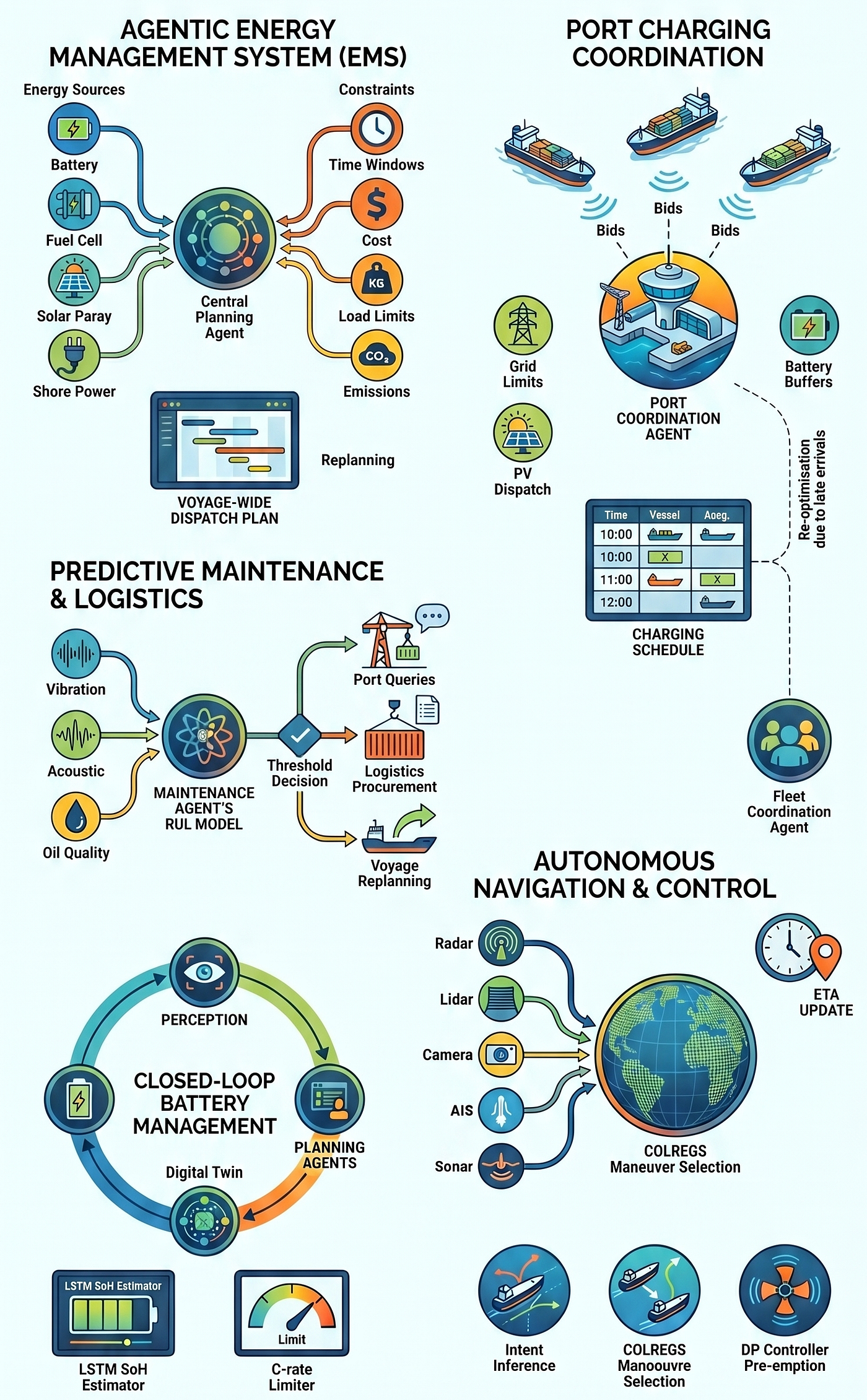
The most capable maritime AI deployments today share a common structural pattern: a vessel orchestrator coordinating a set of specialised agents, each owning a domain, all sharing a real-time data bus.
1. The Energy Management Agent
Energy is the central resource constraint of any electric or hybrid vessel. The Energy Management Agent continuously solves a real-time optimisation problem: given the current state of charge across the battery bank, the output of active fuel cell stacks, the tariff cost of shore power, and the prioritised list of load consumers , what is the optimal power split right now, and how should it evolve over the next four hours?
This is harder than it sounds. Battery health is not linear; deep cycling damages cells in ways that compound over years. Fuel cell efficiency curves are non-trivial. Shore power availability changes the moment you leave the dock. The agent must hold a short-term optimisation (minimise cost this hour) and a long-term one (maximise battery longevity over the vessel’s service life) simultaneously.
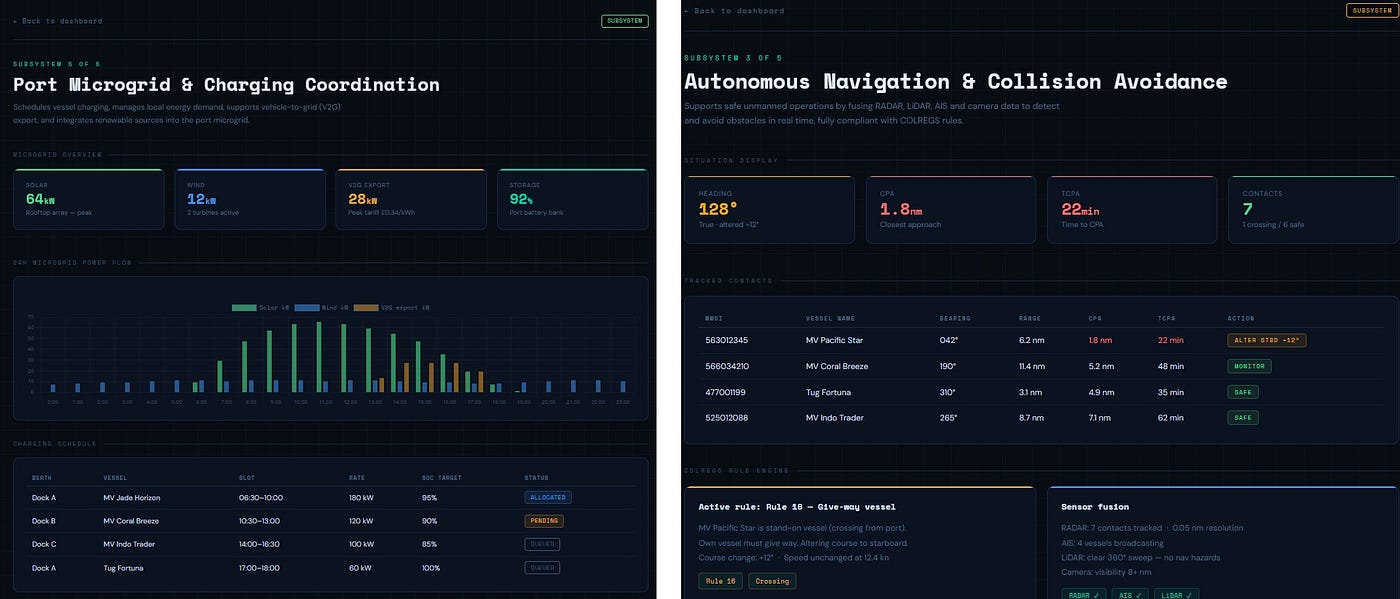
When a crossing-situation alert comes in from the navigation agent , we need a sprint burst in 22 minutes , the energy agent must immediately replan: reserve sufficient battery headroom, spin up an additional fuel cell stack if needed, defer low-priority loads. This kind of inter-agent coordination is what distinguishes agentic architecture from siloed automation.
2. The Route Optimisation Agent
A voyage plan filed at departure is a snapshot of a world that no longer exists by the time the vessel clears the harbour. The Route Optimisation Agent treats the voyage as a continuously re-solvable problem, ingesting GRIB weather files, ocean current models, AIS traffic density, and port berth availability to recalculate the optimal track every few minutes.
The objective function is multi-dimensional: minimise fuel consumption, maintain schedule, avoid weather that stresses the hull, and preserve sufficient battery reserve for port manoeuvring. These objectives conflict, and the agent must manage the trade-offs explicitly, surfacing its reasoning to the officer of the watch rather than hiding it behind a single output.
In practice, rerouting around a high-pressure weather system on a Singapore–Batam crossing might save 38 minutes and 4% of energy at the cost of two extra nautical miles. That is a trade-off a human could make in principle, but would make inconsistently across thousands of voyages. An agent makes it consistently, with full auditability.
3. The Autonomous Navigation and Collision Avoidance Agent
Collision avoidance is where the stakes become most visceral. The International Regulations for Preventing Collisions at Sea (COLREGS) constitute a legal framework and a practical protocol, but they were written for human judgment. Encoding them for autonomous execution, particularly Rule 16 (give-way vessel) and Rule 17 (stand-on vessel) in complex crossing situations involving multiple contactsis a genuine research challenge.
The Navigation Agent fuses data from RADAR, LiDAR, AIS transponders, and optical cameras to maintain a real-time situational picture. For each tracked contact, it computes the Closest Point of Approach (CPA) and Time to CPA (TCPA) , the standard maritime risk metrics and classifies the encounter type. When a COLREGS obligation arises, the agent selects and executes the appropriate action: alter course to starboard, reduce speed, or in extremis, stop.
What makes this agentic rather than algorithmic is the intent modelling layer. The agent does not merely react to where another vessel is; it predicts where it is going, and reasons over scenarios in which that vessel might also manoeuvre. This is closer to the reasoning of an experienced officer than to the output of a deterministic rule engine.
4. The Predictive Maintenance Agent
Unplanned downtime is among the most expensive events in maritime operations — not just in repair costs, but in missed slots, demurrage, and the cascade effects on port scheduling. The Predictive Maintenance Agent addresses this by treating the vessel as a continuously monitored patient.
Every bearing vibration signature, thermal reading, and battery cell capacity measurement is compared against a baseline model. Anomalies are detected not by threshold breaches (the traditional approach) but by pattern deviation, a 3% capacity drift in one battery cell over 200 hours is not an alarm condition in isolation, but it is a statistically significant departure from the cell’s prior trajectory, and it predicts a failure horizon of approximately 340 hours.
This changes the economics of maintenance entirely. Instead of scheduled interventions that are either too early (wasting serviceable life) or too late (risking failure), the agent enables condition-based maintenance , a service event scheduled precisely when it is needed, at the next port call, while the vessel is already stopped.
5. The Port Microgrid and Charging Coordination Agent
The final agent in this architecture operates not on the vessel but at the dock. Ports are increasingly sophisticated energy hubs: rooftop solar, wind turbines, stationary storage, and a fleet of vessels with large battery banks arriving and departing on known schedules. The Microgrid Coordination Agent treats this as a distributed energy management problem.
Its core tasks are scheduling charging slots for incoming vessels (accounting for their state of charge, departure time, and berth availability), peak shaving the port’s grid demand, and crucially managing Vehicle-to-Grid (V2G) operation. When wholesale electricity prices are high and a vessel’s battery bank is sufficiently charged, the agent can export power back to the grid, turning the vessel fleet into a collectively dispatchable energy asset.
Integrating renewables adds a forecasting dimension: solar output varies with cloud cover, wind output with gusts. The agent must hold a probabilistic model of renewable generation and sequence charging events to maximise renewable consumption rather than defaulting to grid imports.
The Data Bus: What Makes Coordination Possible
Five agents solving five problems would be merely parallel automation. What elevates this to a coherent system is the shared data bus , a real-time feed of sensor state, agent decisions, and environmental data that all agents read and write.
When the Navigation Agent executes a course change, the Route Agent immediately knows and replans the downstream waypoints. When the Energy Agent defers a non-critical load, the Maintenance Agent knows and adjusts its monitoring cadence for the affected system. When the Microgrid Agent receives a grid demand response signal at the dock, the vessel’s Energy Agent can begin adjusting its expected charge profile hours before arrival.
This shared situational awareness is what transforms a collection of single-domain optimisers into something closer to a cognitive architecture for the vessel, a system that holds a coherent picture of its own state and acts towards coherent goals.
The Human in the Loop
A natural concern whenever autonomous systems are discussed is the displacement of human judgment. The most thoughtful deployments of maritime agentic AI take a different view: the goal is not to remove the officer of the watch but to amplify their situational awareness and free their attention for the decisions that genuinely require human judgment.
An agent that has already computed the optimal course alteration, surfaced the relevant COLREGS rule, and displayed the predicted CPA trajectories for all contacts is not replacing the navigator, it is giving them the analysis that would otherwise take minutes to compile, in seconds. The human retains override authority. The agent provides the foundation.
This is not a permanent state. As the technology matures, the appropriate boundary between autonomous operation and human supervision will shift. Some ferries on well-characterised routes, harbour tugs, unmanned survey craft will operate with minimal crew and substantial autonomy. Others will maintain full complement with agents in advisory roles. The architecture described here supports the full spectrum.
What Comes Next
Several developments will accelerate the deployment of maritime agentic AI over the next decade.
Regulatory frameworks are catching up. The International Maritime Organisation’s Maritime Autonomous Surface Ships (MASS) Code is moving from a voluntary to a mandatory framework, creating legal certainty for operators deploying autonomous systems.
Foundation models are arriving in the maritime domain. Large language and multimodal models are beginning to be fine-tuned on vessel operational data, COLREGS text, and maintenance records , enabling agents that can reason in natural language about situations that fall outside their training distribution, and that can explain their decisions to crew and regulators.
The V2G opportunity is maturing. As grid operators formalise demand response markets, the fleet of electric vessels becomes a collectively dispatchable energy asset of meaningful scale. A port with 20 vessels averaging 400 kWh battery banks represents 8 MWh of dispatchable storage, comparable to a small grid-scale battery installation.
Digital twins are closing the loop. High-fidelity simulation models of vessels, routes, and port energy systems allow agents to be trained and validated in simulation before deployment, and to run offline what-if analysis alongside live operations.
Conclusion
The autonomous ship is not a single technology. It is a system of agents, each sovereign in its domain, each connected to the others, all oriented towards the shared goals of safety, efficiency, and sustainability.
The Energy Management Agent arbitrating between batteries and fuel cells. The Route Agent replanning around a weather window. The Navigation Agent holding Rule 16 while tracking seven contacts. The Maintenance Agent flagging a cell that will fail in 340 hours. The Microgrid Agent exporting surplus power to the grid while the vessel sleeps at dock.
None of these agents alone transforms maritime transport. Together, coordinated through a shared data architecture and governed by human oversight, they represent something genuinely new: a vessel that thinks about its own operation, continuously, at a resolution and consistency no human crew could sustain.
The sea has always demanded intelligence. For the first time, we are building systems that can meet that demand autonomously.
Dr Cheng Siong Chin is Chair Professor of Intelligent Systems Modelling & Simulation and Director of the Newcastle University–NVIDIA Joint Laboratory at Newcastle University Singapore. His research spans autonomous marine systems, multi-agent AI architectures, and intelligent energy management for maritime applications.
메타데이터
- post_id
- 30c8a0ca3b40
- slug
- the-autonomous-ship-is-no-longer-science-fiction-how-agentic-ai-is-rewriting-maritime-transport-30c8a0ca3b40
- url
- https://medium.com/@mcschin75/the-autonomous-ship-is-no-longer-science-fiction-how-agentic-ai-is-rewriting-maritime-transport-30c8a0ca3b40
- canonical_url
- https://medium.com/@mcschin75/the-autonomous-ship-is-no-longer-science-fiction-how-agentic-ai-is-rewriting-maritime-transport-30c8a0ca3b40
- author_url
- https://medium.com/@mcschin75
- status
- ok
- fetched_at
- 2026-06-09 15:37:30