How to win in Enterprise AI: Snowflake Cortex for Scaled AI and MLOps
Introduction to Snowflake Cortex and its capabilities around Gen AI with LLMs, Streamline Machine Learning and more.
How to win at Enterprise AI: Snowflake Cortex for Scaled AI and MLOps
Introduction to Snowflake Cortex

Credits: Snowflake’s Blog
One of the biggest topics nowadays is Enterprise AI, and how it’s integrating applications for AI, specially generative, in business operations. I personally think this is not “the future” any more, it’s how we work today to accomplish more scalable and democratized AI applications.
Snowflake is for sure one of the major players in this scene, with the announcement and launch of Snowflake Cortex. They are introducing a new way of seeing enterprise AI by offering advanced functionalities tailored for large-scale data operations from the inside of your database.
As businesses increasingly adopt AI to enhance decision-making and operational efficiency, I feel Snowflake Cortex emerges as an interesting solution to test in terms of learning how enterprise AI works in practical terms. Snowflake themselves don’t recommend using Cortex in production yet, but I would suggest learning about it as soon as possible so you don’t get behind the market on AI and MLOps integrations.
Core Features of Snowflake Cortex
Snowflake Cortex’s core functionalities are mostly split into Machine Learning Operations (MLOps) and developing solutions with Large Language Models. So essentially, Cortex is a package and compiler that facilitates the communication with LLM models on its AI functions and helps you develop streamline Machine Learning Models directly from your database.
An important note is that it works both in Python and SQL within Snowsight’s worksheets, or in your local environment with a package you can install very easily.
ML Functions

Credits: Snowflake’s Documentation
So going a bit deeper on Machine Learning applications, Cortex serves as a point of communication between your data in Snowflake and the algorithms it handles for Binary Classification, Multi-Class Classification, Time Series Forecasting and Anomaly Detection. It allows you to develop MLOps from inside your database, saving the trouble of developing a separate pipeline and handling data privacy, leakage and ETL issues since everything is from inside your pre-existing database.
Here’s an example on applying a Multi-class Classifier based on their documentation:
-- Building the view

CREATE OR REPLACE VIEW multiclass_classification_view AS
    SELECT user_interest_score, user_rating, class
FROM training_purchase_data;

-- create a multi-class classification model from this view

CREATE OR REPLACE SNOWFLAKE.ML.CLASSIFICATION model_multiclass(
    INPUT_DATA => SYSTEM$REFERENCE('view', 'multiclass_classification_view'),
    TARGET_COLNAME => 'class'
);

-- Getting predictions with the module predict

SELECT *, model_multiclass!PREDICT(
    INPUT_DATA => object_construct(*))
    as predictions from prediction_purchase_data;

-- Saving results into a table

CREATE OR REPLACE TABLE my_predictions AS
SELECT *, model_multiclass!PREDICT(INPUT_DATA => object_construct(*)) as predictions from prediction_purchase_data;

-- Exploring predictions

SELECT
    predictions:class AS predicted_class,
    ROUND(predictions:probability:not_interested,4) AS not_interested_class_probability,
    ROUND(predictions['probability']['purchase'],4) AS purchase_class_probability,
    ROUND(predictions['probability']['add_to_wishlist'],4) AS add_to_wishlist_class_probability
FROM my_predictions
LIMIT 5;
Cortex enables Data Scientists to develop predictive models much faster than the traditional way. As expected, it might need some improvements and customization as time passes, but it’s still a very interesting feature when thinking about the landscape of its competitors.
Large Language Models, AI Applications

Credits: Snowflake’s Documentation
The first topic to address on Snowflake Cortex’s LLM functions is that they come with Snowflake’s own LLM model called Arctic. Arctic, as said on their documentation, was designed to answer questions about your data, so it implies it has access to the databases you allow it to. One of the core applications of this model is within their own version of Copilot, powered by Arctic, that allows you to select a database, a schema, and ask for SQL scripts, python scripts, questions about how your data is looking, faster documentation reading and much more.
It’s important to consider that arctic was built initially to work on SQL queries and data analysis from inside your database, so it doesn’t aim at being a smart conversational model such as the GPT and Gemini families, it aims at code review and related efforts, so its context window will perform worse in comparison to those. Here’s how Arctic compares to other famous LLMs in terms of pricing:

Credits: artificialanalysis.ai at June 27th 2024
Now going back to the core of its LLM Functions, Snowflake Cortex acts as a middle point between open LLM models such as llama-2, llama-3, mistral, gemma-7, and the prompt results. In short, it saves time from developing a connection to each model’s API, connecting them to a pipeline and then start testing or prompt engineering, everything happens within cortex and the user just needs to pass the prompt and the model they want to test.
If you are a Data Scientist working with LLMs and AI for the past months as I am, you know for a fact that this saves days, if not weeks, of backend work, and this is what, in my opinion, makes Cortex so easy to adapt to. It compiles in SQL or in Python with Snowpark, so the syntax is very similar to packages most scientists are used to.
Here are some examples of Snowflake Cortex’s AI functions Complete and EMBED_TEXT:
-- getting response from a prompt based on columns from the database:

SELECT SNOWFLAKE.CORTEX.COMPLETE(
    'mistral-large',
        CONCAT('Critique this review in bullet points: <review>', content, '</review>')
) FROM reviews LIMIT 10;

-- vector embedding with embed_text:
SELECT SNOWFLAKE.CORTEX.EMBED_TEXT_1024('nv-embed-qa-4', 'I like snowflake');
Recent Innovations in Snowflake Cortex
Credits: Snowflake’s Blog
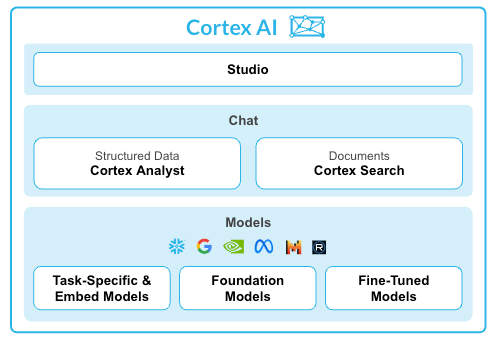
The recent news from Snowflake’s Summit have solidified Cortex’s position as one of the best options in enterprise AI. The introduction of no-code development tools has simplified AI model creation, allowing non-technical users to develop complex AI solutions without writing a single line of code, which is definitely good news for most businesses. Cortex Search and Analyst are a game changer for democratizing AI implementation, I’m excited to getting more details on them.
They also announced a big partnership with NVIDIA, being a milestone in the summit. By integrating NVIDIA’s NeMo, Snowflake Cortex can be even better in developing and deploying sophisticated AI models, particularly for NLP and conversational use cases. They mentioned that Cortex will leverage NVIDIA’s GPU acceleration, which makes snowflake as a database and as an enterprise AI provider much more reliable to handle complex workflows.
How you can use Snowflake Cortex in your businesses
We mentioned the capabilities and functions it has, but something important is also to grasp use cases so you can grow these ideas with your own creativity:
- Retail: Using inventory management data in Snowflake to train a forecasting model that allows you to predict overstocking, sales efficiency and product sales. Another idea would be feeding the data to a fine-tuned LLM and enable your team to ask questions such as “When should I buy more of product X to prevent having overstock?”, it will learn from your past data and sales cycles and tell you when it's best for you to make a new order.
- Healthcare: Using patient or employee data to personalize or automate treatment plans. Imagine having a classification model that can learn from the prescriptions, treatments and patterns in patients and predict those who are at higher risk. Or maybe automating nurses notes by inputting a screenshot of their notebooks and standardizing the way it's written to increase reliability.
- Marketing: Imagine having all your digital marketing data in Snowflake and enabling a classification model to predict hot leads based on their attributes and feature importance, or maybe having an LLM reading your leads’ data and performance to help you create a personalized campaign in minutes. It would enable automating real-time hyper specific e-mail marketing campaigns in seconds if you integrated it to external tools such as Mailchimp, HubSpot or Salesforce.
Every single industry has an AI application and use-case, we just have to be creative!
Conclusion
If you got here, you probably realized how much enterprise AI will transform our workflows. It’s coming to help us develop better, faster and more scalable solutions. And in my personal perspective, Snowflake Cortex is going to be one of the big players in this market. It enables businesses to streamline AI workflows, drive innovation and get competitive advantages without the need for a full team to build the entire back-end, Cortex did it for you!
Enterprise AI came to stay and will probably show up even more in the media, so stay ahead of the competition by studying the big players now. Don’t forget to be creative, you will only succeed with innovation.
Thanks for reading! Follow me to continue with the series — Vinícius A. R. Z.
I’m a Data Scientist and when people ask me what do I work with, my answer is always “I work with Decision Intelligence” because I try not to limit myself to data! 🦊
메타데이터
- post_id
- 30d7d5bce19c
- slug
- how-to-win-in-enterprise-ai-snowflake-cortex-for-scaled-ai-and-mlops-30d7d5bce19c
- url
- https://medium.com/snowflake/how-to-win-in-enterprise-ai-snowflake-cortex-for-scaled-ai-and-mlops-30d7d5bce19c
- canonical_url
- https://medium.com/snowflake/how-to-win-in-enterprise-ai-snowflake-cortex-for-scaled-ai-and-mlops-30d7d5bce19c
- author_url
- https://medium.com/@viniciusarz
- status
- ok
- fetched_at
- 2026-07-16 00:55:23