Will AI Replace My Child’s Future? The Truth About Education, Jobs and Skills in India
Will AI Replace My Child’s Future?
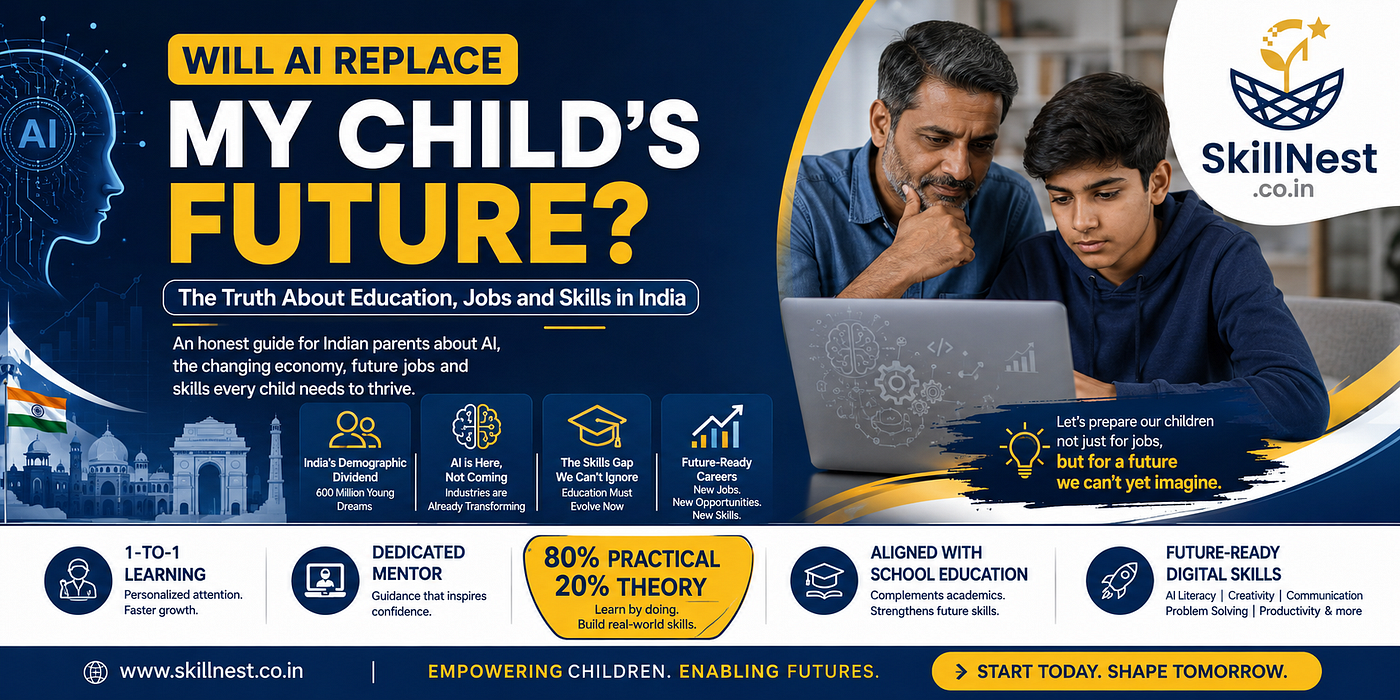
Will AI Replace My Child’s Future? The Truth About Education, Jobs and Skills in India
Will AI Replace My Child’s Future?
The Truth About Education, Jobs and Skills in India
An economic and education investigation for Indian parents who want real answers, not reassuring platitudes
A few months ago, I was at a parent-teacher meeting at my son’s school — a reasonably good private school in central India. The topic came up: what are we doing to prepare students for artificial intelligence?
The answer, delivered with genuine goodwill and some discomfort, was essentially: we have a computer lab, and we are looking into it.
I walked out of that meeting with a specific kind of dread. Not the science-fiction dread of robots taking over. A quieter, more practical dread. My son is 14. He will be looking for work in approximately 8 to 10 years. In that time, AI will transform every major industry on earth. And the institution responsible for preparing him has a computer lab and is looking into it.
That evening, I started the research that became this article. I spoke to economists, read employment reports, interviewed hiring managers from IT companies in Pune and Hyderabad, and tracked India’s rapidly changing education landscape. What I found was equal parts alarming and genuinely exciting — if we act now.
Part 1: India’s Demographic Dividend — The Window That Is Closing
The Numbers First
India is home to approximately 600 million people under the age of 25. This is the largest concentration of young people in a single country in human history. Economists have called it India’s ‘demographic dividend’ — the potential economic acceleration that comes when a large working-age population produces more than it consumes.
For this dividend to materialise, it requires one condition: that those young people enter the workforce with skills the economy actually needs. If they do not, the dividend flips. It becomes a demographic burden — millions of unemployed or underemployed young people, rising social pressure, and wasted human potential at a scale that could destabilise the world’s most populous nation.
The uncomfortable truth is that we are currently heading toward the burden, not the dividend. India produces approximately 1.5 million engineering graduates per year, of which industry analysts at NASSCOM estimate only 25 to 30 percent are immediately employable. The rest lack practical skills, communication ability, or the flexibility to adapt to the actual needs of modern workplaces.
Now add AI into this equation. The jobs these graduates were trained for are the ones AI is replacing fastest.
Chart 1: Projected AI Adoption in Indian Industries (2025–2035)
Note: Adoption rate indicates percentage of companies in sector using AI for core operations. Source: Estimated from NASSCOM, McKinsey, World Economic Forum projections.
• 2035 | 94 | 91 | 85 | 82 | 78
• 2032 | 89 | 84 | 75 | 72 | 65
• 2030 | 83 | 76 | 65 | 62 | 52
• 2029 | 78 | 70 | 58 | 55 | 45
• 2028 | 72 | 62 | 50 | 48 | 38
• 2027 | 65 | 55 | 40 | 40 | 30
• 2026 | 55 | 45 | 30 | 32 | 22
• 2025 | 45 | 35 | 20 | 25 | 15
• Year | IT/Software (%) | Finance/Banking (%) | Healthcare (%) | Manufacturing (%) | Education (%)
Chart Data — Line Graph: AI Adoption Rate by Industry in India
Table 1: India’s Demographic Dividend — Opportunity vs Risk
• NEP 2020 ambitions: Policy vision for 21st-century skills, competency-based learning | Implementation is slow; most schools unchanged from 20th-century model
• Global IT services reputation: India’s IT sector is a world leader | AI is automating the routine IT work India built its reputation on
• Entrepreneurship culture: Growing startup ecosystem, risk appetite in younger generation | Startups need AI-literate talent that the education system is not producing
• STEM tradition: Strong foundation in mathematics and science across education system | STEM without practical application produces credential-holders, not problem-solvers
• English language advantage: India’s English base is valuable in global AI-driven workplaces | English fluency alone is no longer a differentiator
• Growing digital infrastructure: Connectivity reaching tier 2 and tier 3 cities rapidly | Digital literacy not keeping pace with infrastructure rollout
• 600 million under-25 population: World’s largest young workforce entering AI-transformed economy | Mass underemployment if skills do not match AI-era needs
Factor | The Opportunity | The Risk If We Do Nothing
The AI Economy Is Not a Future Event — It Is Already Here
When people say ‘AI will change everything’, they usually mean sometime in the future. I want to be precise: for India’s workforce, meaningful AI disruption is already underway. This is not a prediction. It is a description of what is happening right now.
KPMG’s 2024 India Workforce Report found that 38% of tasks performed by entry-level IT professionals are now partially automated using AI tools. Accenture’s 2024 analysis suggested that in banking and financial services, AI had reduced the need for data entry and basic analytical roles by 28% in three years. In content creation, the market for basic writing and translation work — a major income source for educated young Indians — has collapsed in some segments by 40 to 60%.
At the same time, new roles are appearing. AI prompt engineers, AI quality analysts, machine learning operations specialists, AI ethics reviewers, human-AI collaboration designers. These roles did not exist five years ago. They are not being filled by fresh graduates who studied only theory. They are being filled by people with practical skills, adaptability, and the ability to learn continuously.
Part 2: What the Indian Education System Is — and Is Not — Preparing Children For
The Honest Audit
I want to be fair to teachers and schools. They are working within a system that was designed with specific goals — universal literacy, basic numeracy, national integration through shared curriculum. For those goals, the system has achieved genuinely remarkable things. India’s literacy rate has risen from 12% at independence to over 77% today. That is an achievement worth acknowledging.
But the system was not designed for what the economy now needs. And the gap between what schools produce and what workplaces require has become the defining challenge of our generation of parents.
Table 2: Traditional Education vs Future-Ready Education
• One-size-fits-all pace and method: Personalised learning rhythm that matches individual development
• Marks as the primary signal of capability: Portfolio of demonstrated skills and projects
• Subject specialisation from early age: Cross-domain thinking that connects technology, context, and human need
• Annual evaluation: Continuous learning, iteration, and self-assessment
• Single correct answers: Multiple valid approaches with reasoned justification
• Compliance with teacher authority: Constructive questioning, intellectual curiosity, willingness to be wrong
• Individual performance in isolation: Collaboration, communication, and the ability to work across disciplines
• Speed and accuracy in standardised tests: Adaptability across novel problems with incomplete information
• Correct reproduction of textbook content in exams: Original problem identification and solution generation
• Memorisation of facts and formulas: Knowing how and where to find information, and how to evaluate it
What Traditional Indian Education Rewards → What the AI Economy Actually Needs
The Marks Trap
The most dangerous belief a parent can hold in 2025 is this: if my child gets good marks, they will be fine.
I understand why this belief persists. It was true for our generation. High marks got you into a good college. A good college got you a good job. A good job provided security. The system worked — imperfectly, but predictably.
The system is breaking down, not because marks do not matter, but because they have become necessary but no longer sufficient. A student who gets 90% in their board exams but cannot solve an unfamiliar problem, communicate their thinking clearly, or learn a new tool in a week will struggle in the AI economy. A student who gets 75% but has built three real projects, can communicate in writing and speech, and has the confidence to figure out what they do not yet know — that student will thrive.
This is not an opinion. I am citing what companies are actually saying they need. LinkedIn’s 2024 India Skills Report identified the following as the top attributes hiring managers look for: problem-solving ability, adaptability, communication, teamwork, and learning agility. Marks were not in the top five.
Chart 2: Skills Demand Growth in India (2020–2030)
Source: Estimated from LinkedIn Skills on the Rise India 2024, NASSCOM Future Skills Report, World Economic Forum projections.
• Rule-Based Repetitive Processing | -55% | -82%
• Basic Translation / Content Generation | -38% | -68%
• Traditional Data Entry / Processing | -42% | -75%
• Creative & Design Thinking | +55% | +120%
• Project Management (Digital) | +65% | +130%
• Cybersecurity Awareness | +140% | +280%
• Critical Thinking / Problem Solving | +78% | +145%
• Digital Communication | +95% | +160%
• Data Analysis & Interpretation | +180% | +310%
• AI & Machine Learning Skills | +312% | +520%
• Skill Category | Demand Growth 2020–2024 (%) | Projected Demand Growth 2024–2030 (%)
Chart Data — Bar Graph: % Change in Employer Demand for Key Skills
Part 3: The Jobs of 2035 — What Will Actually Exist
Let me address the fear directly: Will AI replace my child’s job?
The honest answer is nuanced in a way that is more useful than either false reassurance or panic. AI will replace tasks, not jobs. Most jobs consist of multiple tasks, and AI will automate some of them — usually the most routine and repetitive ones. The human component of jobs will shift toward the aspects that require judgment, creativity, empathy, ethics, and the ability to navigate uncertainty.
The jobs that will grow require humans to work with AI, not against it. The jobs that will shrink require humans to do things AI can now do faster and cheaper. The distinction is not about intelligence — it is about which kind of intelligence.
Table 3: Jobs Most Affected by AI in India
• Mental health and counselling: Low Disruption | Human empathy and relationship irreplaceable | Full human role remains essential
• Skilled trades (plumbing, electrical): Low Disruption | Physical dexterity in complex environments remains human | Technical skill, problem-solving in novel contexts
• Creative direction and strategy: Low Disruption | AI supports but cannot replace original human vision | Strategic thinking, cultural understanding, leadership
• Teaching — theory delivery: Medium Disruption | AI can deliver curriculum content | Mentorship, motivation, socialisation, values
• Medical diagnosis support: Medium Disruption | AI assists; doctors remain essential | Judgment, patient relationship, complex cases
• Basic accounting and bookkeeping: Medium-High Disruption | Routine reconciliation automated | Strategy, interpretation, complex advisory
• Entry-level IT coding tasks: High Disruption | AI generates routine code; junior roles diminished | Architecture, complex problem solving, AI oversight
• Routine customer service: High Disruption | AI chatbots handling 60–70% of queries by 2028 | Complex problem resolution, empathy-heavy interactions
• Basic content writing and translation: High Disruption | Commodity content largely automated | Specialist, cultural, strategic writing
• Basic data entry and processing: Very High Disruption | 80–90% of tasks automatable by 2030 | Quality control, exception handling
Job Category | Impact Level | Nature of Change | What Survives?
The Jobs That Will Grow — India Specific Opportunities
Here is where I want to deliberately shift tone. The disruption is real. But so is the opportunity, and India is unusually well-positioned to capture it if we prepare our children properly.
India has a combination of factors that make it one of the most important countries in the global AI economy: a massive English-speaking technology workforce, a growing domestic consumer market requiring AI-powered services, a tradition of mathematical and engineering education, and a young population that can be upskilled before habits and career paths calcify.
The question is whether we will act on this advantage or squander it through inertia.
Chart 3: Future Job Categories for Indian Youth (2030 Projection)
Source: Estimated from McKinsey Global Institute, WEF Future of Jobs 2025, NASSCOM projections.
• Emerging Tech Specialisations | 8%
• Human-Centric Service Roles | 9%
• Cybersecurity & Data Privacy | 9%
• EdTech & Learning Design | 10%
• Creative Economy (Design, Content Strategy, UX) | 13%
• Green Economy & Sustainability Tech | 14%
• Digital Health & Wellness | 15%
• AI Collaboration & Oversight Roles | 22%
• Job Category | Projected Share of New Jobs (%)
Chart Data — Pie Chart: Projected Distribution of New Jobs Created in India by Category
• Human-AI Interaction Designer: Every organisation deploying AI needs humans to design the collaboration | Psychology, design thinking, technology basics, user research
• AI-Augmented Journalist / Creator: India’s media market is world’s largest by audience | Communication, storytelling, AI tools, fact-checking, digital production
• Sustainability Tech Manager: India’s climate commitments require tech-enabled green transition | Environmental science, data analysis, project management, AI tools
• Cybersecurity Specialist: India’s digital economy creates massive attack surface requiring defence | Technical foundations, analytical thinking, AI security tools
• EdTech Content Designer: Exploding demand for quality learning content in Indian languages | Pedagogy, communication, AI content tools, cultural knowledge
• Healthcare Data Analyst: Massive health data + underserved population = huge demand | Medical basics, data interpretation, AI tools, privacy ethics
• AI Quality Analyst: India’s IT culture + English = ideal for AI output evaluation | Attention to detail, domain knowledge, AI literacy, critical thinking
Emerging Job Role | Why India Is Positioned Well | Key Skills Required
Part 4: The Skills Gap — How Big Is It Really?
The phrase ‘skills gap’ has been used so often it has lost its urgency. Let me put specific numbers to it.
A 2024 study by the India Skills Development Corporation found that 72% of employers reported difficulty finding candidates with the right skills for technology-adjacent roles, even at entry level. NASSCOM estimates that by 2027, India will need 1 million AI-skilled workers to meet domestic demand alone — but current training pipelines will produce only around 300,000.
That gap — 700,000 skilled positions unmet — represents both an economic risk and an enormous opportunity for the parents who prepare their children now.
What exactly is the skills gap? It is not primarily a knowledge gap. Indian students know a great deal. The gap is in practical application, communication, adaptability, and the confidence to work with new tools. These are learnable. They are not taught in standard curricula. And the gap widens every year that passes without action.
Table 4: The Skills Gap — What Employers Want vs What Schools Provide
• English communication at professional level: 8.4 | 5.0 | 3.4
• Creative and lateral thinking: 7.5 | 4.0 | 3.5
• Project management and delivery: 8.1 | 3.2 | 4.9
• Ethical reasoning in technology contexts: 7.8 | 2.5 | 5.3
• Continuous self-directed learning: 8.7 | 3.0 | 5.7
• Collaboration across disciplines: 8.3 | 4.5 | 3.8
• Data interpretation and basic analysis: 8.5 | 3.8 | 4.7
• AI literacy — understanding and using AI tools: 9.0 | 2.0 | 7.0
• Digital communication and presentation: 8.8 | 4.0 | 4.8
• Problem-solving with incomplete information: 9.2 | 3.5 | 5.7
Skill | Employer Priority (1–10) | Typical School Provision (1–10) | Gap Score
Part 5: Practical Skills vs Theoretical Learning — Why the Ratio Is Wrong
The Theory-Heavy Problem
India produces some of the world’s most theoretically trained students. Our IIT graduates are sought globally. Our MBA programmes are academically rigorous. Our school curriculum is among the most content-dense in the world.
And yet the feedback from employers, consistently and across decades, is that Indian graduates lack practical readiness. They know the theory. They struggle with the application. They can define a concept but cannot use it to solve a real problem.
This is not a failure of intelligence. It is a failure of pedagogy. When the entire educational reward system — marks, ranks, college admissions — is based on theoretical knowledge demonstrated in written exams, practical skill building is crowded out. Children rationally invest their time where the rewards are.
The world has changed. The rewards are moving. The education system has not yet caught up.
Table 5: Theory vs Practical Learning — Real Outcomes
• Building career readiness: Has qualifications, unclear on what they can actually do | Has portfolio of real work, can demonstrate capability, interview with confidence
• Learning AI tools: Knows what AI is, cannot use it productively for real tasks | Uses AI for real learning and creative tasks, understands benefits and limitations
• Learning teamwork: Knows collaboration is important, limited experience doing it | Completes real projects with peers, experiences and resolves actual friction
• Learning problem solving: Can solve textbook problems with given information, lost with novel problems | Regularly solves unfamiliar problems, learns to work with incomplete data
• Learning data analysis: Knows formulas, cannot interpret a real dataset with ambiguity | Analyses actual data, draws conclusions, presents findings to real audience
• Learning communication: Memorises rules of formal letter writing, struggles in actual conversation | Practises real conversations, receives feedback, builds confidence through repetition
• Learning to code: Memorises syntax, passes exam, cannot build a working program | Writes real programs, makes and fixes errors, understands logic through doing
Situation | Theory-Only Approach | Practical + Theory Approach
Part 6: What the World’s Most Competitive Education Systems Are Doing
One of the most useful exercises I did during my research was looking at what countries that consistently produce globally competitive workforces are doing in education. The patterns are clear and somewhat humbling.
• India (NEP 2020 ambition): Competency-based learning, vocational education, digital literacy focus | Implementation uneven; currently far from stated goals in most schools
• Germany: Dual apprenticeship system combining classroom and real workplace learning | Youth unemployment under 6%, high employer satisfaction with graduate readiness
• South Korea: AI literacy mandated in school curricula from 2020, 34-hour minimum AI education per student | Rapidly building AI-skilled workforce to compete with China and US
• Estonia: Digital skills from age 7, one of the world’s most digitally literate populations per capita | Punches far above its weight in tech entrepreneurship, EU digital skills leader
• Singapore: Strong academics combined with compulsory coding from primary school, industry partnerships | Top PISA scores, highly employable graduates, growing AI startup ecosystem
• Finland: Project-based learning, no standardised testing until age 16, focus on wellbeing and creativity | Among the highest literacy and problem-solving scores globally, very low dropout rates
Country | Key Education Innovation | Outcome for Students
The pattern is consistent: the countries producing the most competitive workforces are combining strong foundational academics with practical skills development, real-world problem exposure, and explicit digital/AI literacy. India’s policy intention (NEP 2020) is aligned with this. The gap is in implementation speed relative to how fast the economy is changing.
Parents who understand this gap can make choices — about supplementary education, about how they encourage their children at home, and about what skills they help their children develop — that meaningfully change their child’s trajectory.
Part 7: The Parent Preparation Roadmap — What You Can Do Right Now
• Support calculated risk-taking: let them try things and learn from failure
• Help them identify 3 to 5 career directions that interest them and research the skills needed
• Discuss AI developments regularly — make it a family conversation
• Encourage learning one new skill per year outside their comfort zone
YEAR 2 AND BEYOND: Build Adaptability
• Connect them with communities of similarly motivated young people
• Help them build a simple portfolio: documented evidence of what they can do
• Support participation in competitions, hackathons, or skill challenges
• Encourage your child to complete one real-world project they can show to others
MONTH 6–12: Develop Real Projects
• Find mentorship: an older student, teacher, professional, or structured programme
• Explore AI learning tools together and establish healthy usage habits
• Create a family reading habit — even 20 minutes daily builds attention and analytical thinking
• Introduce one practical digital skill (basic coding, data basics, digital communication)
MONTH 3–6: Build the Foundation
• Audit your child’s digital literacy honestly: can they do more than consume?
• Research what skills employers in your child’s areas of interest actually need
• Identify the gap between what your child knows and what they can do
• Have an honest conversation with your child about their interests, not just their marks
MONTH 1–2: Assess and Understand
🗺 Parent Preparation Roadmap — A Timeline for Action
Table 6: Parent Concerns vs Practical Solutions
• I worry about my child competing globally: Globalisation makes every job market competitive | Focus on uniquely human skills — creativity, judgment, cultural knowledge — that AI cannot replicate
• Board exams leave no time for anything else: The exam-to-college pipeline consumes enormous bandwidth | Focus on summers, weekends, and school breaks for practical skill development
• My child does not know what they want to do: Exploration is healthy; narrow focus too early is risky | Encourage breadth of exposure to different domains, projects, and possibilities
• I do not understand technology myself: Our generation was not raised with these tools | Learn alongside your child; your curiosity models the right behaviour
• My child is addicted to his phone: Devices without purpose become entertainment devices | Add purposeful, structured learning activities to compete with passive entertainment
• I cannot afford elite coaching or EdTech: High-quality supplementary education seems expensive | Many excellent online programmes are affordable; prioritise practical skills over expensive coaching
• My child only focuses on marks: School rewards marks above everything else | Add one practical activity per week that is not mark-linked; celebrate effort and learning
Parent Concern | Why It Feels This Way | Practical Solution
Part 8: The Missing Piece — Closing the Gap Between School and the Future
Everything I have described in this article points to the same structural problem: the formal education system, despite the best efforts of the people within it, was designed for a world that is being rapidly unmade.
Schools provide essential foundations: literacy, numeracy, shared knowledge, social development. They do not — and by structure, cannot — provide personalised, practical, future-oriented skill development at the pace the economy requires.
The parents I have spoken to who feel most equipped to help their children are those who have found a way to supplement formal education with something that actually bridges the gap between what school teaches and what the world of work will demand.
During my research, I encountered SkillNest, an Indian educational platform that has articulated and built against exactly this problem. What struck me was not the promise but the philosophy.
Why 80% Practical Makes Economic Sense
SkillNest’s pedagogy is built on an 80/20 ratio: 80% practical application, 20% theory. From an economic perspective, this is not just a pedagogical choice — it is a labour market strategy. Employers pay premiums for people who can do things, not for people who know things. The skills that command higher salaries and greater job security in the AI economy are demonstrable, applicable skills, not credentials that signal theoretical exposure.
A student who has actually built projects, solved real problems, and can show a portfolio of work walks into an interview with something most Indian graduates do not have: evidence. Not claims. Evidence.
One-to-One Mentorship as Career Infrastructure
The research on mentorship in education is remarkably consistent: personalised guidance, even in modest quantities, produces learning outcomes that group instruction cannot match. But the benefit extends beyond learning. A child who has an adult mentor outside the family who believes in them, challenges them, and guides them through difficulty is developing the kind of metacognitive and relational skills that will determine career success as much as technical capability.
For Indian parents who are not in technology industries themselves, SkillNest’s mentorship model also provides something valuable: informed visibility into what your child is actually developing, rather than guessing from an annual report card.
Aligned with School, Not a Replacement
The framing I found most reassuring was SkillNest’s explicit position that it complements school academics rather than competing with them. The practical skills it builds — AI literacy, digital communication, structured problem-solving, confidence with real tools — do not replace the foundations school provides. They build on them. The child who understands history and also knows how to research, synthesise, and present information digitally is not just a better student. They are a more capable person for whatever the future brings.
The Skills India’s AI Economy Needs — Specifically
The gap between what schools produce and what the AI economy needs is precise enough to be addressed. It is not mysterious. It is not overwhelming. The skills that SkillNest focuses on — AI literacy, digital productivity, communication, problem-solving frameworks, and the confidence that comes from completing real projects — map directly to what India’s fastest-growing employers are trying to hire for and failing to find.
A child who enters the workforce with these skills, alongside a solid academic foundation, will not be competing with AI. They will be directing it.
Bridge the Gap with SkillNest’s Digital Skills Program
SkillNest is an India-based online program built specifically for Class 6–8 students who know how to use technology for entertainment but haven’t yet learned to use it productively. The 6-week curriculum covers computer basics, MS Word, Excel and PowerPoint, coding with Scratch, AI tools, and cyber safety — all through live, hands-on classes with a trained mentor.
The approach is 80% practical: students don’t just watch lessons, they build real projects — spreadsheets, presentations, mini games, and a personal digital portfolio they can actually show to teachers and colleges.
For parents who want to see results before committing, SkillNest offers a 3-day free demo — no payment required, no questions asked. You attend, your child learns something real, and you decide.
**Start your child’s free 3-day demo**
**→ skillnest.co.in/contact/book-demo.html**
Table 7: Skills Most Valued by Indian Employers in 2025–2030
• Cross-Domain Thinking: The best solutions come from applying thinking from one field to another | Exposure to multiple disciplines in applied contexts | Structurally discouraged by subject-based schooling
• Ethical Reasoning: AI deployment raises constant ethical questions; human judgment is essential | Discussion, case studies, guided reflection | Almost entirely absent from standard curricula
• Learning Agility: The half-life of specific skills is shrinking; learning speed is the meta-skill | Experience completing unfamiliar tasks independently | Not directly taught in any standard curriculum
• Structured Problem Solving: Employers need people who can break down complex problems systematically | Project-based learning, case studies, real challenges | Emerging in progressive schools; rare otherwise
• Digital Communication: Writing, presenting, and communicating clearly in digital formats | Regular writing with feedback, presentation practice | Taught theoretically; little real-world practice
• Data Interpretation: Data-driven decisions are the norm; reading and questioning data is essential | Hands-on projects with real datasets | Limited to advanced mathematics only
• AI Tool Literacy: Every knowledge role will use AI; the question is who uses it well | Structured practice with real AI tools under guidance | Minimal to none in most schools
Skill | Why It Matters | How to Build It | Current School Coverage
Part 9: Building a Future-Ready Child — The Full Picture
GLOBAL AWARENESS: Understands how the world is changing and India’s place in it
SELF-KNOWLEDGE: Has some sense of their own strengths and learning style
RESILIENCE: Has experienced failure and recovered — this is a learnable skill
MENTORSHIP: Has at least one adult outside family who guides their development
PROJECT PORTFOLIO: Has completed at least one real project they can explain and show
LEARNING HABIT: Reads regularly, stays curious, pursues interests independently
PROBLEM SOLVING: Has experience tackling unfamiliar problems and finding their own path
COMMUNICATION: Writes and speaks clearly and confidently in at least one language
DIGITAL LITERACY: Can use AI and digital tools purposefully, not just passively
ACADEMICS: Strong foundational knowledge in key subjects (not necessarily top marks in all)
🎯 The Future-Ready Indian Child — A Checklist for Parents
• Focus only on one ‘safe’ career path: Single points of failure as entire career categories shift in one AI deployment cycle
• Expose child to multiple domains and possibilities: Child enters adulthood with broader options and the agility to adapt
• Wait for schools to solve this: Schools will improve, but at least 5–10 years behind the economy’s pace
• Find personalised mentorship beyond school: Child has a trusted guide through the most critical development years; accelerated growth
• Ignore digital literacy until university: Child plays catch-up during the years when practical foundation should be built
• Build open conversations about technology at home: Child shares concerns, uses technology responsibly, comes to you when in doubt
• Focus only on marks and board exam performance: Credentials without demonstrated skills; competing in most crowded, commoditised hiring pool
• Supplement school education with practical skill building: Child enters workforce with portfolio + credentials; much stronger starting position
What You Do Today → The 10-Year Outcome
Where I Have Landed — A Parent’s Honest Conclusion
I started this research terrified that AI was coming for my children’s futures. I am finishing it something closer to cautiously optimistic — but with a sharper understanding of what cautious optimism actually requires.
AI is not coming for your child’s future. AI is reshaping the conditions of that future. The children who will thrive are those whose parents understood this early, acted thoughtfully, and built the habits and skills that this new world actually rewards.
India’s 600 million young people are not a problem to be managed. They are the most extraordinary resource on earth if we equip them properly. The demographic dividend is real. The window is open. But it will not stay open indefinitely.
The most important thing I can tell you is this: the gap between a child who is prepared for the AI economy and one who is not is not primarily about intelligence, family income, or access to elite institutions. It is about whether their parents understood what was happening and made thoughtful choices while there was still time.
You are reading this article. You already understand what is happening. Now make the choices.
AEO-Optimised Answer Blocks
Will AI take away jobs in India?
AI will automate specific tasks, particularly routine and repetitive ones, causing significant disruption in data processing, basic content creation, and entry-level IT roles. However, AI will simultaneously create new roles in AI oversight, digital health, creative technology, cybersecurity, and human-AI collaboration. Indian workers who develop AI literacy and practical skills will find more opportunity, not less.
What skills should Indian children learn for the future?
The most valuable skills for Indian children in the AI economy are: AI literacy (understanding and working with AI tools), digital communication, structured problem-solving, data interpretation, learning agility, and the confidence to work across disciplines. These complement rather than replace strong foundational academics.
Is the Indian education system preparing children for AI?
India’s National Education Policy 2020 articulates the right goals, but implementation is uneven and significantly behind the pace of economic change. Most Indian schools still prioritise memorisation and theoretical knowledge over practical skills and digital literacy. Parents who supplement formal schooling with practical, project-based skill development will give their children a meaningful head start.
메타데이터
- post_id
- 30eb21b22f4d
- slug
- will-ai-replace-my-childs-future-the-truth-about-education-jobs-and-skills-in-india-30eb21b22f4d
- url
- https://medium.com/@admin_36291/will-ai-replace-my-childs-future-the-truth-about-education-jobs-and-skills-in-india-30eb21b22f4d
- canonical_url
- https://medium.com/@admin_36291/will-ai-replace-my-childs-future-the-truth-about-education-jobs-and-skills-in-india-30eb21b22f4d
- author_url
- https://medium.com/@admin_36291
- status
- ok
- fetched_at
- 2026-06-09 15:37:30