What Separates Top Python Development Companies From Average Vendors
The distinguishing factors between the best and average Python development vendors.
What Separates Top Python Development Companies From Average Vendors
The distinguishing factors between the best and average Python development vendors.
The Python development services market has become much more segmented in 2026 than in the last decade. Vendors that are at the top are now getting away from the middle tier, and that’s something that procurement teams see in action but don’t always hear in conversations with their potential vendors. The difference is not in pricing or the smoothness of a marketing proposal, both levels can produce a competitive marketing proposal. It’s the idea of engineering depth, AI specialization, operational discipline, and the dozens of little decisions that add up over the course of an engagement.
There is a pattern that is most common to most disappointing encounters. The vendor was competitive on paper, it was a contract signed in good faith and the structural differences didn’t become apparent until work began. By then, there had been some investment of “political capital” on the part of both sides in the decision, there had been some “switching costs” and the question had become “how do we make this work” versus “is this the right vendor.” This guide is designed to uncover those structural differences at an earlier stage, before they can have a bearing on the decision.
What Makes the Best Python Development Companies Stand Out from the rest?
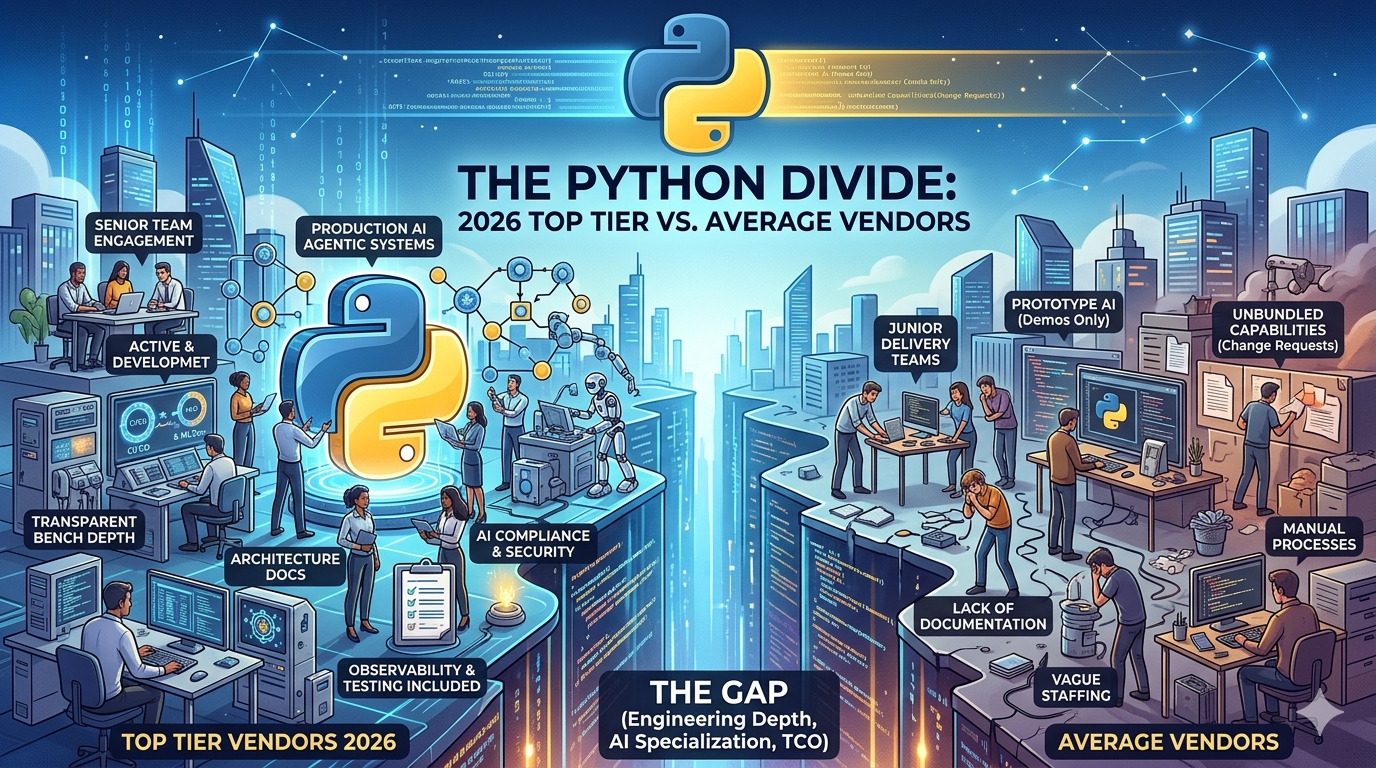
The key differences between the top Python development companies and the rest are visible and can be illustrated by the following eight characteristics: senior engineering team engagement throughout the engagement (not just sales), production knowledge of AI (agentic systems), capabilities baked in instead of sold as an afterthought (such as testing and observability), architecture documentation as standard deliverables for the scope, MLOps and model deployment experience, compliance and security awareness for AI, staffing transparency with bench depth, total cost of ownership that covers honest scope transitions and not the illusion of unbundling. These differences are not technical and don’t need any special expertise to assess, they merely need to be aware of what to look for.
The disparities aren’t subtle, if you know how to bring them into the light. They are consistent so that the patterns of evaluation are the same in markets, geographies and engagement models.
In 2026, the Top Tier has separated from the rest.Why the Top Tier has pulled away in 2026?
There are three forces that have created a divide between leading and standard Python companies.
AI specialization has truly emerged as a differentiator. The middle level has been given 3 years to absorb AI capability, and many still haven’t. In 2026 sales, vendors that shipped only one or two AI prototypes in 2023 continue to identify themselves as AI capable, even if they haven’t shipped production agentic systems or developed a proper evaluation infrastructure. At the top, however, they have sent dozens of production AI systems, and developed the institutional knowledge that accompanies that experience.
The gap has been compounded by the addition of AI-assisted development. The leading vendors have already adopted AI coding assistants into well-established processes, and their code review processes are disciplined and follow strict quality guidelines, avoiding technical debt. Average vendors don’t use AI tools at all (at a disadvantage in productivity) or they use them without discipline (shipping code that passes visually and fails a bit in the background). After a year of compounding this is an important difference to note: Top vendors offer more functionality and higher code quality per engineer-month.
The floor has been set high for compliance and security. Now, the basic compliance posture is more significant due to the enforcement of the EU AI Act, changing privacy compliance laws in the United States and the requirements for audits specific to AI. The best sellers have built up advanced compliance programmes, meaning they can save their clients months of retrofitting. Average vendors just assume that compliance is a matter for the future and expose clients who fail to recognize it during evaluation.
The cumulative effect: clients that select high quality vendors will see measurable benefits, even if the price gap is as wide as 20–40%. The savings in average vendors on the hourly may turn out to be quite evident once the client has been working for a while and rework and changes start taking their toll.
Choose which ones to apply.Decide which of the 8 Observable Differences to use.
Senior Engineering Involvement Beyond Sales.
The top Python development companies place their experienced engineers at the forefront of the client before entering into agreements and keep them on display during the process of implementation. Average vendors bring on senior engineers for sales calls, and switch to junior engineers during delivery, and sometimes within weeks of a kickoff.
The key to watch for is consistency. Do the engineers that you meet to evaluate them during the evaluation process, work for the same company that you will eventually get to work for? Will they be available for Architecture decisions, code review, and Escalation? Or are they “consulting” engineers, who will show up at the kickoff and then be gone?
If you’re looking for a good test, ask to meet with the actual delivery team, the engineers who will work on the daily issues, not the architects who are only around the house during milestone reviews. Easy to get a top vendor to agree. I’ve encountered an average vendor, who explains after the contract that those introductions occur.
Production AI Experience, including Agentic Systems
The largest skill deficit in 2026 will be Production AI Experience, specifically in the context of Agentic AI. Leading Python development firms have deployed tools that allow for autonomous agents to execute multi-step workflows, implemented multi-tool calling at scale, and created evaluation tools that highlight quality drift before it becomes apparent to customers.
Average vendors’ experience with agentic AI is prototype-level. They have developed demos which worked before. They’ve experimented with frameworks. They have never shipped systems in production that were exposed to real traffic patterns, incidents, and that were running for months.
The diagnostic question is straightforward: Describe an agentic system you sent out, the biggest production problem you debugged, and how you fixed it. The top vendors respond with specifics the cost of the tokens being exceeded in infinite loops, tool calls failing on unexpected input, or evaluation regressions identified through harnesses they’ve written. Average vendors reply to questions in general terms since they do not have the firsthand experience of those incidents.
Basic Skills Assumed a. Technical Skills b. Communication Skills c. Knowledge of the Business d. Team Skills
Builds that constitute part of the scope of top Python development companies consist of core engineering capabilities, such as multi-layer testing, observability, security baselines, CI/CD pipelines and even AI evaluation infrastructure. Average vendors separate such capabilities and charge competitively on an hourly basis and bill them separately as the project progresses.
The unbundling technique is among the most costly patterns offered in the marketplace. A vendor at $60/hour that does not provide testing, observability, and AI evaluation infrastructure usually runs into more costs over 12 months, than a vendor at $90/hour that does provide the infrastructure, as the omitted capabilities will become change requests, rework, or issues after the product is launched.
The signal for evaluation is whether the proposal items these capabilities as scope items or as optional add-on. They are considered a natural part of the job for top vendors, who don’t even need to be asked to make them part of their job. Average vendors only provide what you’ve asked for and don’t consider anything else to be out of scope.
The documentation of architecture as a standard deliverable is.
Written architecture documentation by top Python development companies in first 2 weeks of engagement: Architecture Decision Records (ADRs), component diagrams, data flow documentation, infrastructure topology. Average vendors would not bother with this work, and would reverse engineer everything they had decided during incidents for months.
You’ll not see the cost of not documenting the architecture initially. It appears as a longer onboarding time for new engineers, slower debugging when there is an error in the production environment, and a rewriting that might not have been needed if the initial logic was documented. Some top vendors have learned this by experience repeatedly and practice the discipline of documentation. Average vendors haven’t yet factored the cost.
Established MLOps and Model Deployment Practices
While many of the capabilities of AI tools rely on external APIs, enterprise apps frequently include at least some of their own AI models for cost, latency, privacy, or specialization. The best Python model developer companies have released self-hosted model deployments and have a say on quantization trade-offs, provisioning GPUs, autoscaling patterns and cost monitoring at the inference level.
Average vendors provide mostly theoretical skills for MLOps. They have learned the documentation of vLLM and Triton. They are not currently running the production model of the service using the right observability and incident response procedures.They are not running the production model of their service with proper observability and incident response. It becomes apparent when projects require some workflow adjustment, or when the API-only design approach has reached its cost or latency limits and needs alternative self-hosted solutions.
Compliance and Security Posture (AI-Specific)
In today’s compliance environment, it’s actually a gamechanger to have a posture that is AI-focused. Leading Python development companies have developed PII compliance programs that handle PII correctly within prompts and logs, audit trail requirements for AI systems, as well as bias evaluation as part of the standard practice and documentation following emerging regulations. They are able to create attestation documents and they have industry references.
Average vendors take AI compliance as Phase 2.Average vendors give AI compliance a second thought. They’re good at the basics of security and compliance, but they lack the muscle for AI-related requirements. For most commercial enterprises this will be manageable, but for regulated industries, this will be a big risk and come to light when pre-launch review is in progress, and when it is most expensive to implement a fix.
There is a helpful breakdown of the best Python development companies that specialize in AI, adhere to compliance standards, have a good understanding of MLOps, and have the engagement models that suit the project’s compliance demands.
Transparent Staffing Models With Real Bench Depth
The best Python development firms will be honest about the team members who will be working on the project, their seniority, their availability, what to expect if they are not available, and what they’d be replaced by on their bench. The reason average vendors are not specific about staffing is because the actual staffing is not what people are thinking.
The signal is if the vendor will contract specific names and capacity percentages. Top vendors do because they have the manpower to deliver on promises. Average vendors say things like ‘Subject to availability’ because they have never really assessed their bench.
The depth of the bench is important in particular if your project takes more than a few days. Senior engineering staff members depart organizations. Those with a large number of products stored in large bins do not get upset about it. Thin benches are a pain for the client, typically in the form of flip flops where the client has to invest time to get the new guy up to speed.
TCO Reflecting Honest Scope
The best Python development companies create proposals that are transparent on all the scope of the project, including testing, observability, security, compliance, AI evaluation, documentation, and post-launch support, all of which are included as an integral part of the scope, not as optional extras to be added later. It is a fact that average vendors create proposals that may seem competitive in terms of rates, but miss out on scope that would be pertinent for the project.
This difference is best illustrated by comparing the TCO. Develop models that account for rework, volume of change requests, post launch support and the cost of capabilities not part of the base. Most short-lists are re-ordered substantially in the TCO comparison, and almost always in favor of the vendor with the higher hourly rate and the more comprehensive package of included scope.
The problematic compounding of those differences at execution
There are eight differences and all are significant on their own, but together they make a difference in engagement outcomes.
Senior engineering involvement increases along with the basics: senior engineers are more apt to use mature practices, and junior engineers are not. Production AI experience goes hand in hand with MLOps maturity — teams with more production AI experience make better architecture decisions. With architecture documentation, compounded with bench depth — written decisions means the team can rotate without losing institutional knowledge.
Average vendors don’t just perform three or four times worse on three or four of these dimensions than top vendors, the gaps compound, they perform multiplicatively worse. That is why the difference between the best and average vendors seems insignificant in the proposal and gigantic in the delivery.
Once you have narrowed down your list of vendors to average, there are a number of red flags that will help you determine which ones are worth pursuing.
There are some signals that will reliably help you differentiate between averagish vendors and best-in-class vendors prior to signing a contract.
Senior engineers who are not involved in the day-to-day work.Senior engineers who only show up at sales meetings. In the above mentioned technical evaluations, top vendors include the actual delivery team. Average vendors deflect those introductions until after contract signing.
The characteristics of AI in general. The top vendors mention specific systems, incidents and trade-offs. Average vendors talk about the experience of AI but without any production examples.
Essential skills characterized as “optional extras. Leading vendors include scope of testing, observability and security as standard. Average vendors break them apart to provide competitive hourly rates.
Vague staffing commitments. The best sellers will agree upon specific names and capacity percentages that will be binding in the contractual agreement. The average vendor uses availability disclaimers.
Avoiding sharing sanitized code samples. The top vendors are at ease with demonstrating their work. The average vendor will have an NDA which doesn’t prevent sanitized examples.
Proposals that are very brief and summary heavy. Technical information is included at the top by the best vendors. When technical depth is lacking, average vendors will back themselves up with marketing resources.
Frequently Asked Questions
How do the best Python development companies excel over mediocre ones?
The key differences between the best Python development companies and average vendors are evident in these eight areas: senior engineering personnel are consistently engaged during the entirety of the engagements, production systems experience with AI systems (including agentic systems), foundational capabilities are included as an automatic bonus, architecture documentation is a standard output of the job, the development company has a mature MLOps practice, compliance posture is AI-specific, the company is transparent in the number of engineers in their team, and the scope is accurate and reflects the total cost of ownership (TCO) of the project.
What are the best ways to find the best Python development businesses when checking vendors?
Vendors with high-quality delivery teams can be identified by scheduling a meeting with the actual delivery team before signing; requiring foundational capabilities be part of standard scope; asking for code samples sanitized from similar engagements; and demanding contractual guarantees for particular named senior engineers. Vendors who readily agree to all of these are typically the greatest. Vendors that come across as cheapskates on several fronts are typically recreational.
Do best Python development companies always cost more than average ones?
Typical top vendors have hourly rates that are 20–40% higher than average vendors, but they are able to provide lower total cost of ownership over a 12-month contract. The true cost of average vendors — rework due to incomplete scope, change requests (CR) for things they should have included, retrofitting compliance and security, incidents caused by inadequate observability — are always more than the simple hourly rate savings.
Which is the most crucial skill to seek in the Python developers of 2026?
The one area that has gained the highest impact is production AI, specifically agentic systems and evaluation frameworks. Today, most enterprise Python builds come with an AI capability, and it is a significant gap between a team that is able to integrate AI well and another that encounters performance, costs or quality issues. Most enterprise tasks require AI knowledge as well as general Python skills.
What do the best Python development companies do about MLOps and model deployment?
Top Python companies have delivered self-hosted model deployments at scale and opinions on the quantization side-effects, GPU provisioning, pattern of autoscaling, and cost at the inference layer. They have the ability to refine workflows if applicable and provide observability to production AI systems. Average vendors talk about the theoretical capabilities of MLOps, but haven’t actually served in production.
Is it best to hire the best Python development firms for AI applications in particular?
The variation in quality between top and average vendors is very large in the case of AI projects. Average vendors are also learning on the job, but at a high price since the top Python development companies have already deployed production AI systems to make the job a breeze. The expenses of unsuccessful AI projects are usually far larger than the rate difference, and these can include stalled launches, lack of evaluation, compliance concerns, etc.
Which are the questions that I should ask to assess the Python Development services?
Inquire about specific production AI system shipped (with incident histories), basic capabilities included in standard scope, named senior engineers who will lead the engagement, bench depth for replacements, practices for writing architecture documentation, MLOps experience with self-hosted models, AI compliance posture, and 12-month overall cost of ownership. Vendors that come up with answers to these questions in detail are generally good vendors, those who answer in general are ordinary vendors.
Closing Thought
The differences between top Python development companies and average vendors aren’t hidden. They are visible when you have them as part of the evaluation if you know where. The companies that consistently succeed in engagements are not the ones that have the most bells and whistles, but those that took 2 additional weeks to evaluate them before signing and brought the differences to the surface during the pre-signing phase.
This is a discipline that is being rewarded more in the 2026 market than in the past. The market has been divided by specialization with AI; scope has turned into a true differentiating factor with the “included-by-default” option; and the price of average vendors has risen. The price of opting for the best vendors has remained at a comparable level. This is why structured evaluation is a worthwhile use of the investment — not because it guarantees success, but because it always sorts the market in a way that hourly rate comparison will never. The vendors who clearly and effectively communicate the difference in their own proposals are the ones who have developed the capacity to deliver them. The unsuccessful ones who are too busy to try are the ones that fail to make it.
메타데이터
- post_id
- 30f40bfc0cb8
- slug
- what-separates-top-python-development-companies-from-average-vendors-30f40bfc0cb8
- url
- https://medium.com/@devang.chavda_31684/what-separates-top-python-development-companies-from-average-vendors-30f40bfc0cb8
- canonical_url
- https://medium.com/@devang.chavda_31684/what-separates-top-python-development-companies-from-average-vendors-30f40bfc0cb8
- author_url
- https://medium.com/@devang.chavda_31684
- status
- ok
- fetched_at
- 2026-06-09 15:37:30