Are There Eternal Enemies?
Life Lessons from VP Osinbajo’s Comic Relief at IBB’s Autobiography Launch
Are There Eternal Enemies?
Life Lessons from VP Osinbajo’s Comic Relief at IBB’s Autobiography Launch
Selling a book is one of the biggest challenges contemporary authors face — though many would argue that this isn’t a new problem. Authors try to navigate this hurdle by securing good reviewers to read the book, provide commentary, and bring in a reputable figure to chair the launch. This person delivers the very first public review at the glamorous book launch event, a crucial moment that often determines the book’s reception and, ultimately, its sales. While I am not a marketer who can cite exact statistics, as an editor involved in book publishing and launches, I understand the significance of getting the right person for that first review — especially when dignitaries grace the event. This was precisely the role Professor Yemi Osinbajo, Nigeria’s former Vice President, played at the launch of General Ibrahim Babangida’s autobiography, Journey in Service. And he did it masterfully.
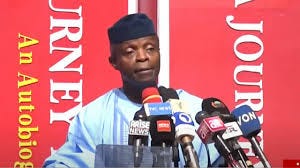
This article isn’t an academic analysis dissecting Osinbajo’s speech through pragmastylistics, lexicosemantics, phonogrammatical structures, or any other linguistic lens. Instead, it’s a reflection on the social and political lessons embedded within his words — particularly his introduction — and how these lessons apply to the ongoing divides and conflicts we witness in today’s social media landscape.
Are There Truly Eternal Enemies?
In the pursuit of wealth, fame, and power, divisions are inevitable. We are barely two months into 2025, yet social media has already seen numerous face-offs: Nedu versus VeryDarkMan, Nedu versus Lucky Udu, Saidaboj versus GehGeh, Saidaboj versus VeryDarkMan, Saidaboj versus Nedu (alongside The Honest Bunch). The list is endless. While social media didn’t exist during the era of Nigeria’s military and civilian leaders — General Yakubu Gowon, Lt. General Murtala Mohammed, Former President Muhammadu Buhari, Former President Olusegun Obasanjo, and General Ibrahim Babangida — the quest for dominance and influence was just as intense.

The struggle for power isn’t new. It’s as old as humanity itself. Osinbajo, with his characteristic wit, used his speech to highlight how quickly perceived enemies can become allies. His storytelling, a hallmark of great public speaking, captivated the audience. Rather than relying on fictional anecdotes or statistics, he wove a compelling narrative using real historical figures — many of whom were seated in the audience.
Here’s the striking excerpt from his speech:
“Seated among us is General Yakubu Gowon, who became Nigeria’s Head of State at just 32 and led the country for nine years. His government was overthrown in 1975 by a coup involving then-Brigadier Olusegun Obasanjo, Brigadier Theophilus Danjuma, and the author himself, Babangida, then Lt. Col. Babangida, commander of the newly formed Armoured Corps. Also involved were then-Lieutenant Colonels Muhammadu Buhari, Sani Bello, and Sani Sami. Yet, here we are today, with former President Obasanjo and General Danjuma present, not as adversaries of the author but as witnesses to history, celebrating a fellow statesman.
In a striking turn of fate, the author notes that it was President Obasanjo who, after the tragic assassination of General Murtala Mohammed, insisted that a young Lt. Col. Babangida be appointed to the Supreme Military Council, making him its youngest member at the time. Also represented here is immediate past President Muhammadu Buhari, another leader whose path intertwined with Babangida. Babangida played a key role in the coup that brought President Buhari to power in 1983 and, later, in another coup that removed him and brought Babangida himself to power. Yet, today President Buhari is represented at this occasion, celebrating the man who overthrew him and detained him for three and a half years.
Then there is a gentleman here who was an elected senator in 1992 during Babangida’s transition program. When Babangida annulled the 1993 election and General Abacha took over, dissolving the Senate, this senator resisted, attempted to reconstitute the Senate, and was detained and charged. He eventually fled into exile. Today, he is here, not as a victim, but as the President and Commander-in-Chief of the Armed Forces of the Federal Republic of Nigeria, President Bola Tinubu, GCFR.”
*https://www.yemiosinbajo.ng/former-president-ibrahim-babangidas-autobiography-a-journey-in-service/*
What Really Changed?
Was it time? The fading of youthful ambition? The shifting tides of political necessity? Perhaps, if social media had existed in their era, they too would have had fervent followers, amplifying their rivalries and divisions. Yet today, these once-bitter adversaries sit together at the same roundtable, celebrating one another. But what about their imagined social media followers — would they also reconcile?
In today’s ever-evolving digital landscape, online feuds mirror these historical power struggles. Social media users align themselves with influencers and public figures, choosing sides in conflicts that may ultimately be transient. For instance, some followers of Nedu have accused VeryDarkMan of being anti-Igbo. The Honest Bunch podcast, initially seen as an entertaining platform for frank discussions, has revealed internal conflicts leading to Nedu’s resignation. But beyond entertainment, these public spats often have real-world consequences, with followers internalizing the disputes of those they admire.
The Cost of Holding onto Strife
Telling a story is easy; living through it is another matter. As a secondary school student, I loved Government as a subject — and I proudly earned an A1 in it during my WASSCE. My late teacher, Mr. Okoro, had a way of making Nigerian political history come alive in class. His narratives about coups and conflicts were so vivid that some of my classmates — especially the more emotional ones — would often be moved to tears. Mr. Okoro, an Igbo man who lived through the Nigerian Civil War, recounted these events with deep emotion, his lived experiences adding weight to his words.
And yet, today, those same coup stories were summarized humorously in Osinbajo’s speech, with the key players themselves laughing along. The irony is stark. The real cost of these historical events — the lives lost, the pain endured — could never be fully captured in a witty speech.

The Takeaway
Don’t inherit hatred or prejudice. Nigeria’s political and historical landscape offers ample lessons on the absurdity of power struggles. What we see today in social media conflicts is merely a digital reflection of what has played out in history. Those we idolize or vilify today may reconcile tomorrow, just as the military and political actors of the past have done.
Those involved in past conflicts are not gods, nor are they devils. They do not determine your destiny. Eventually, something greater may bring them together — just as this book launch did. But what about those who lost their lives in the real events behind these stories? They are absent, unable to share in the humor or reconciliation.
History remembers them. And so, before you engage in the next social media feud, ask yourself: what role are you playing in the story? A round character? A dynamic one? A static or flat one?
For us, we’ll be here for another review.
메타데이터
- post_id
- 30f6599c49f2
- slug
- are-there-eternal-enemies-30f6599c49f2
- url
- https://medium.com/@dicelson/are-there-eternal-enemies-30f6599c49f2
- canonical_url
- https://medium.com/@dicelson/are-there-eternal-enemies-30f6599c49f2
- author_url
- https://medium.com/@dicelson
- status
- ok
- fetched_at
- 2026-06-20 20:29:01