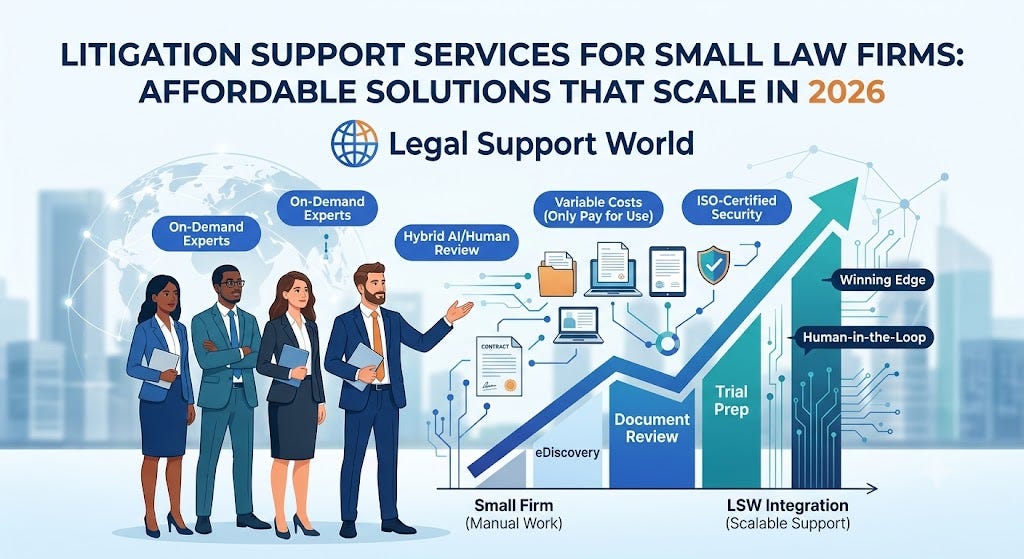
How LPOs Help Law Firms Scale Without Hiring (2026 Guide)
Every managing partner has faced the same bottleneck: caseload spikes, the team is stretched, and the reflex is to hire. But adding…
How LPOs Help Law Firms Scale Without Hiring (2026 Guide)
Every managing partner has faced the same bottleneck: caseload spikes, the team is stretched, and the reflex is to hire. But adding headcount in 2026 is neither fast nor cheap. The average fully loaded cost of a junior associate — salary, benefits, overhead, and supervision time combined — sits between $142,000 and $169,000 per year. And that number does not flex when a matter concludes or a quiet quarter arrives.
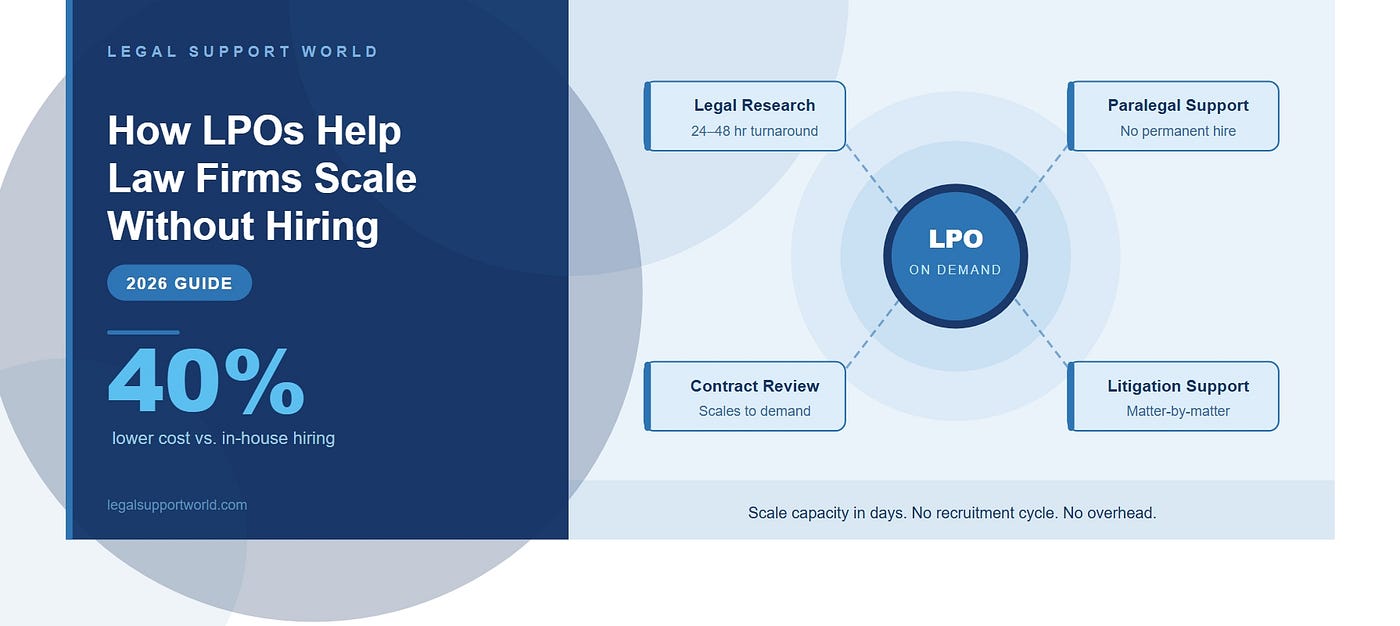
The smarter move a growing number of firms are making is legal process outsourcing (LPO). As a starting point, outsourcing legal research alone saves law firms 40% or more compared to maintaining an in-house associate — and that is before factoring in the broader operational advantages of an LPO model across paralegal support, contract review, and litigation work.
LPOs give law firms something permanent hiring never could: capacity that expands and contracts with actual demand. No recruitment cycle. No idle headcount between matters. No overhead that lingers after a case closes.
This guide explains exactly how LPOs help law firms scale without adding permanent headcount, which services they cover, why the economics work, and what to look for when choosing a provider.
What Is Legal Process Outsourcing (LPO)?
Legal process outsourcing (LPO) is the practice of delegating specific legal tasks — such as research, document review, contract management, or paralegal support — to an external specialist provider rather than handling them in-house.
Unlike a staffing agency, an LPO delivers finished work product under its own quality controls. The firm retains professional responsibility for the output; the LPO handles execution under robust confidentiality agreements.
The global LPO market is projected to reach $29.2 billion in 2026, driven by law firms seeking cost efficiency without sacrificing quality. The shift is no longer experimental — it is a mainstream operating strategy for firms of all sizes.
The Law Firm Scaling Problem in 2026
Traditional law firm scaling relies on one lever: hiring. But that lever is slow, costly, and structurally inefficient for the way legal work actually arrives.
Case volumes do not scale linearly. A litigation firm can see 300% more discovery requests in a single quarter, then return to baseline the next. Corporate teams spike during M&A seasons and slow during market downturns. Hiring permanent headcount to meet peak demand creates structural overhead that persists long after the peak passes.
The problem is compounded by the 2026 talent market. Associate turnover at mid-size firms runs at 15–20% annually according to NALP data, meaning firms that hire to scale are also constantly rebuilding capacity they have already paid to develop.
LPOs solve this by converting fixed staffing costs into variable operating costs — capacity that scales to demand rather than committing ahead of it.
How LPOs Help Law Firms Scale Without Hiring
1. On-Demand Legal Research
Legal research is one of the highest-volume, most time-intensive tasks in any practice — and one of the most straightforward to delegate to a specialist.
LPOs like Legal Support World (LSW) provide qualified researchers with expertise across US, UK, and multi-jurisdictional frameworks. Firms submit a research brief and receive a structured memorandum — case law analysis, statutory research, regulatory review — with a typical turnaround of 24 to 48 hours.
The scaling benefit is immediate: a firm handling three concurrent matters can commission three independent research streams in parallel, without adding a single full-time hire. Research volume contracts equally fast when those matters conclude.
2. Paralegal and Litigation Support
Litigation support is another area where demand volatility makes permanent headcount a poor fit. Document review, deposition summaries, trial preparation, and exhibit management all spike around case milestones and fall flat between them.
LPOs provide trained paralegals and litigation support specialists who integrate into the firm’s workflow for the duration of a matter. Managed document review, in particular, can require dozens of qualified reviewers for a large discovery exercise — a demand profile that no mid-size firm can staff permanently.
3. Contract Review and Management at Scale
Corporate and transactional teams regularly face contract review bottlenecks. A single M&A deal may require hundreds of contracts to be reviewed, abstracted, and flagged for risk — within a compressed timeline.
LPOs handle this through dedicated contract review teams working to firm-defined protocols, delivering structured outputs: risk flags, clause-level summaries, and deviation reports. The work is scoped to the matter, delivered to deadline, and billed to the project rather than the payroll.
4. Scalable Capacity Without Headcount Risk
Beyond individual task types, the structural advantage of LPO is flexibility. Law firms that outsource do not carry:
• Benefits, payroll taxes, or PTO accruals on outsourced capacity
• Onboarding and training investment that walks out the door when an associate leaves
• Supervision overhead — LPOs include structured quality assurance in their delivery model
• Per-head real estate and software licensing costs
The result is a capacity model that grows and contracts with the firm’s actual workload, rather than locking in overhead against projected demand.
The Cost Advantage: LPO vs. In-House Hiring
The financial case for LPOs is not only about avoiding headcount — it is about what that headcount actually costs.
A US mid-market associate in 2026 carries a fully loaded annual cost of $142,000 to $169,000 when salary, benefits, overhead, and supervision time are accounted for (Salary.com, February 2026; Legal Alphabet Legal Salary Guide, March 2026). At an effective cost of $68–$81 per productive research hour, that associate is significantly more expensive than comparable LPO providers.
Law firms outsourcing to LSW consistently achieve savings of 40% or more against fully loaded in-house costs — without compromising turnaround speed or output quality. For firms scaling to meet demand spikes, the savings compound: LPO cost is incurred only when capacity is used, not whether it is.
People Also Ask
Q: What does LPO mean in law?
LPO stands for Legal Process Outsourcing. It refers to the delegation of legal support tasks — such as research, document review, paralegal work, or contract management — to an external specialist provider. The supervising attorney retains professional responsibility; the LPO handles execution.
Q: How do law firms use legal process outsourcing?
Law firms use LPOs to handle high-volume, time-intensive tasks that do not require a permanent hire. Common uses include legal research for active matters, document review in litigation, contract review during transactions, and paralegal support at case milestones.
Q: Can small law firms and solo practitioners use LPOs?
Yes. LPOs are particularly cost-effective for smaller firms that cannot justify the overhead of full-time research associates or paralegals. Most providers offer per-project and hourly billing, so small firms pay only for what they use.
Q: What tasks can be outsourced to an LPO?
Commonly outsourced tasks include case law and statutory research, multi-jurisdiction legal memoranda, document review and management, contract review and abstraction, deposition summaries, trial preparation support, and paralegal-level administrative work.
Q: Is using an LPO ethical and bar-compliant?
Yes. ABA and SRA guidelines explicitly permit outsourcing of legal support tasks, provided the supervising attorney maintains responsibility for the work product, client confidentiality is protected, and fee arrangements are handled transparently.
Is Using an LPO Ethical and Bar-Compliant?
ABA Model Rules and SRA guidance both explicitly permit law firms to delegate legal support tasks to outside providers. The three conditions are straightforward:
• The supervising attorney must retain professional responsibility for all work product delivered to the client
• Client confidentiality must be maintained under appropriate data security and NDA protocols
• Fee arrangements must be handled transparently — the firm cannot profit improperly from outsourcing
Reputable LPOs, including LSW, structure their delivery model to fully satisfy these requirements. NDA coverage, data security certification, and white-label output are standard — not optional extras.
How to Choose the Right LPO Partner
Not all LPOs are equal. When evaluating providers, law firms should assess:
• Credentials: Qualified talent
• Researchers and paralegals should be trained attorneys or certified legal professionals, not generalist freelancers
• Security: Data security certifications
• Look for ISO 27001, SOC 2, HIPAA, and GDPR compliance as a baseline
• Confidentiality: NDA-backed confidentiality on all matter information from day one
• Jurisdiction depth: Documented experience with your jurisdiction — US, UK, or multi-jurisdictional frameworks
• Pricing transparency: Hourly, per-project, and retainer models with clear rate structures
• Quality assurance: Structured QA process on every deliverable before it reaches your desk
LSW operates under ISO 27001, SOC 2, HIPAA, and GDPR frameworks as standard, with full NDA coverage on all engagements and a dedicated quality review on every deliverable.
Frequently Asked Questions
Q: How quickly can an LPO scale capacity for a law firm?
Most LPO providers can onboard a new firm and begin delivering within days. For existing clients, capacity can be scaled up within 24–48 hours to meet sudden demand increases — no recruitment cycle required.
Q: What is the difference between an LPO and a legal staffing agency?
A staffing agency places individuals at a firm — the firm then manages, supervises, and equips them. An LPO delivers finished work product under its own quality controls, without the administrative burden of managing additional personnel.
Q: Do LPOs work with boutique and specialist firms?
Yes. Many LPO providers, including LSW, work with firms of all sizes — from solo practitioners handling specific matters to large firms outsourcing high-volume practice area support.
Q: How does an LPO protect client confidentiality?
Reputable LPOs operate under NDA-backed confidentiality protocols, data security certifications, and strict matter isolation — meaning no information from one client engagement is ever shared with another.
Q: What is the typical cost of working with an LPO?
Costs vary by provider, task complexity, and billing model. US-based ALSPs typically charge $150–$350 per hour; offshore and hybrid India-based providers range from $25–$80 per hour. LSW prices competitively below prevailing market rates — contact us for a firm-specific quote.
Conclusion
The firms winning in 2026’s legal market are not necessarily the biggest — they are the most agile. Legal process outsourcing removes the bottleneck between caseload growth and operational capacity, letting firms take on more work, serve clients faster, and protect margins without the overhead of permanent hiring.
LSW provides law firms with on-demand legal research, paralegal support, contract management, and litigation support — all under ISO-certified data security and ABA-compliant protocols.
메타데이터
- post_id
- 30f9ebcdbffb
- slug
- how-lpos-help-law-firms-scale-without-hiring-2026-guide-30f9ebcdbffb
- url
- https://medium.com/@bernicetmelvin/how-lpos-help-law-firms-scale-without-hiring-2026-guide-30f9ebcdbffb
- canonical_url
- https://medium.com/@bernicetmelvin/how-lpos-help-law-firms-scale-without-hiring-2026-guide-30f9ebcdbffb
- author_url
- https://medium.com/@bernicetmelvin
- status
- ok
- fetched_at
- 2026-06-11 22:20:54