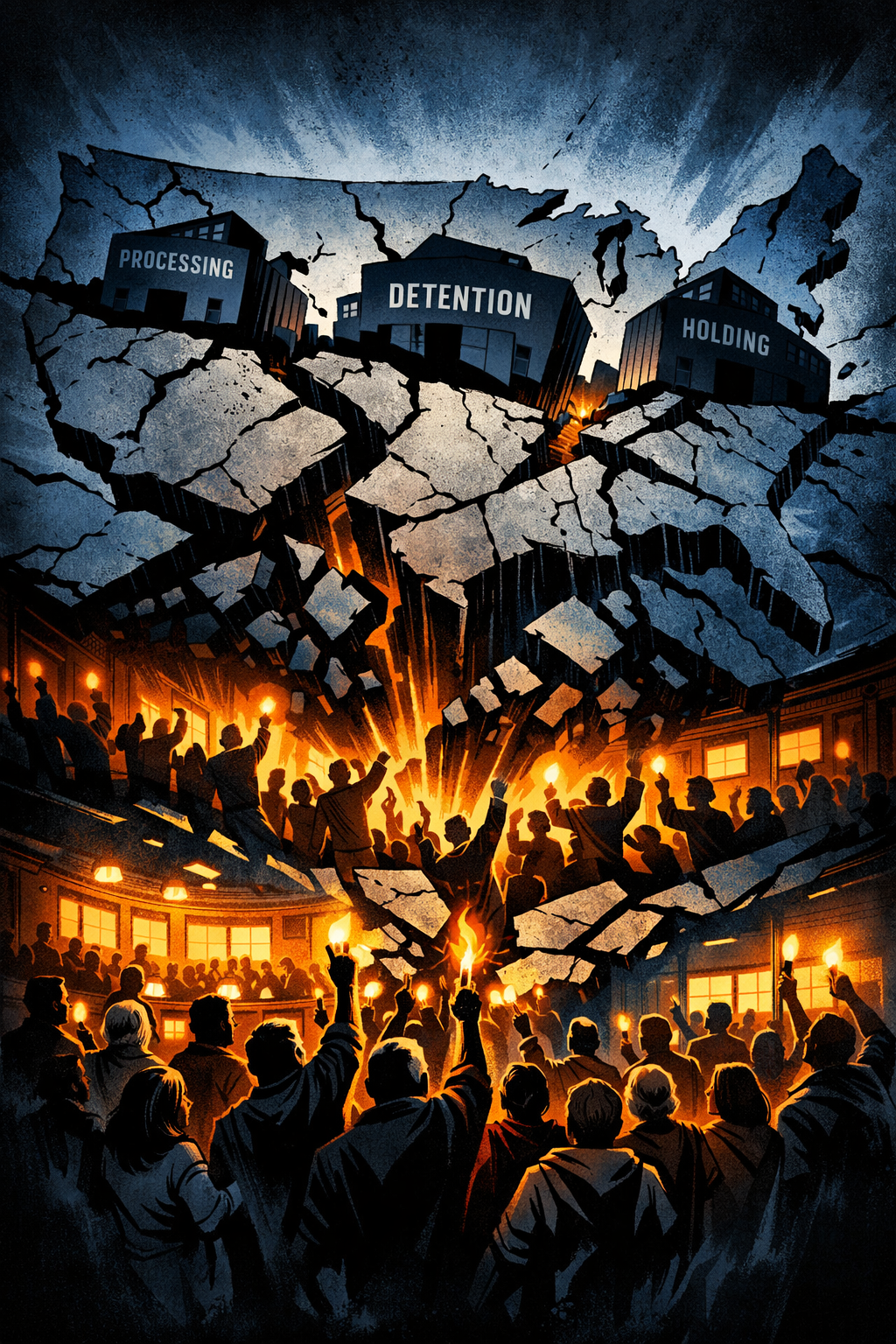
THE BODY DOESN’T BELIEVE YOU
What happens when the thing you thought you survived keeps living inside you?
INVISIBLE DOES NOT MEAN IMAGINARY
THE BODY DOESN’T BELIEVE YOU
What happens when the thing you thought you survived keeps living inside you?
Photo by Stefano Pollio on Unsplash
There is a strange cruelty to nightmares. You wake, and the room is exactly where you left it. The bed is still there. The walls haven’t moved, the ceiling hasn’t collapsed, the door is still locked, and morning is still coming on schedule. Nothing in that room has changed at all.
Your body has not gotten the message.
Your heart is still going. Your muscles are still tight. Your breathing is shallow and fast, and some part of your mind is still searching the dark for whatever was chasing you. Then the reasonable thought arrives, the one your intellect hands you like a glass of water. It wasn’t real.
Except your body doesn’t believe you.
That is not a figure of speech. The National Center for PTSD’s clinical overview describes durable changes in both the central and autonomic nervous systems after trauma:
A sympathetic system running hot, an acoustic startle reflex turned up and left there, imaging that shows an overactive amygdala alongside a prefrontal cortex and hippocampus that have gone quiet.
Clinicians consider that startle response so particular to this injury that they treat it as the most telling symptom on the list. The body is not being dramatic. It is doing precisely what it was retrained to do, by an event it did not choose.
It was around ten thirty at night on June 20, 2015, and Charnesia Corley had pulled into a convenience store lot off Ella Road in north Houston. Harris County deputies had stopped her over a stop sign. They said they smelled marijuana. They searched her car and found none. Then they turned to her.
They told her to take her pants off.
She said no, because she was not wearing any underwear. According to the federal civil rights suit she later filed, the deputy answered her with a single syllable.
So?
What followed happened on the pavement of an open lot, lit store behind her, cars coming and going past the pumps. Her attorney eventually released the dashcam video, and on it you can hear Corley afterward, still working at the part she could not get past. Not the search itself. The fact that it had an audience. She keeps asking whether they had really not noticed all those people out there, whether they had somehow missed that she was being seen.
The deputies said they came away with two-hundredths of an ounce of marijuana, about half a gram. Corley’s lawsuit records the claim as officers saying they found it on her. They never specified where.
Her attorney’s position is that they found nothing at all.
Then the machinery started. The sheriff’s office stated that its own policy forbids deputies from conducting strip searches without a warrant, and that any warranted search must happen somewhere private and sanitary.
There was no warrant, and there was nothing private or sanitary about a Texaco lot. Its internal affairs review found no policy violation.
County lawyers denied in their federal filings that any cavity search had occurred at all.
Prosecutors dropped every charge against Corley. One grand jury indicted two deputies; a second grand jury, shown what the district attorney’s office described as new evidence it would not identify, cleared them.
In January 2018, county commissioners agreed to pay her $183,000 to end the suit, and the county attorney’s office characterized the result as a mutual agreement.
Nobody was ever wrong. There was simply a payment.
Hold onto that, because it is this entire essay in miniature. Something was done to a woman in a parking lot, and then, for three years, one institution after another established that it had not happened, or had not happened in that way, or had happened and violated nothing.
Now ask yourself what she is supposed to do with the memory.
People assume that what happens afterward is remembering. It isn’t, and the distinction matters more than almost anything else in this essay. The Veterans Administration’s plain-language description of re-experiencing explains that a sight, a sound, or a smell can return the event whole, and that the returning is not chosen.
The clinical literature on posttraumatic flashbacks goes further. What separates an intrusive memory in PTSD from an ordinary painful one is the sense of nowness, of the thing occurring rather than being recalled, and at the far end of that range a person loses contact with their surroundings altogether.
Not remembering.
Reliving.
There is a difference, and it is the whole difference.
So when someone asks why you don’t just get over it, understand what is actually being asked. You are being asked to talk a nervous system out of a conclusion it reached without consulting you.
You are being asked to erase a physiological adaptation by deciding to. And you are being asked to do it on a schedule set by someone who was not there.
Time is not the same thing as healing. The same clinical overview notes a delayed variant, in which the full syndrome does not surface for months or years, and often surfaces when something in the present rhymes with the past.
Time does not always close the thing. Sometimes it just gives it more places to hide: in the footsteps you hear behind you, in a siren, in a uniform, in a hallway, in a hand that lands on your arm before your brain has been consulted about whether that is all right.
This is what makes it nearly impossible to explain to people who have not lived it. They see the person standing in front of them.
They do not see the person standing behind that person, the one still inside the moment, who learned that screaming does not guarantee that anyone comes, that authority does not guarantee safety, and that dignity can be taken off a human being in about the time it takes to read this sentence.
And that is the deception. From the outside, you look fine.
You go to work. You raise children. You teach. You laugh with friends. You accomplish things people once told you were not possible for someone like you. And somewhere behind all of it there is a room you do not discuss, where the lights never quite come on, and the door has a habit of opening on its own.
Here is what almost nobody grants the person in that room:
They do not want to be there. They want their old nervous system back. They want to sleep without fighting anyone. They want to walk into a room without counting the exits. They want to meet a stranger without first running an assessment. They want their body to accept what their mind settled long ago, which is that it is over.
Now let me put the harder question where it belongs, which is not on them.
Why do we treat invisible wounds as imaginary wounds?
We do not ask a person with a shattered femur to walk normally in order to prove the fracture was real. We do not tell them the X-ray is an excuse.
But we routinely ask the psychologically injured to perform recovery as the price of being believed, and we withdraw belief the moment the performance slips.
The professional record does not support us in that. When the American Psychiatric Association added post-traumatic stress disorder to the DSM in 1980, the decisive change was not the name. It was the location of the cause.
The diagnosis placed the origin of the injury outside the individual, in the event, rather than inside the individual, as a defect of character or nerve. That was the argument, and it was settled more than forty years ago.
So why does the culture keep relitigating it?
I think we know. If the injury is real, the cause is real.
And causes have names, addresses, badge numbers, employers, chains of command, and insurance carriers.
To believe the wound is to accept an obligation about the thing that made it.
Doubt is cheaper. Doubt requires nothing of us except that we look at a survivor and privately conclude that they are exaggerating, and then go on with the afternoon.
That is the second injury, and it is administered by people who consider themselves reasonable.
None of which means the room is permanent. It isn’t, and the evidence there is also documented:
Cognitive processing therapy, prolonged exposure, and cognitive behavioral approaches have produced strong results across very different populations, including survivors of sexual violence and combat.
Treatment works. Not uniformly, not on command, but it works.
What it looks like from inside is smaller than people expect.
It is the first time you recall something without being transported by it.
It is the first night that ends without panic.
It is the first time you notice you have driven twenty minutes without checking the cars around you.
Healing is remarkably ordinary, and that may be the best thing about it, because after a stretch of living inside a nightmare, ordinary is the rarest thing there is. A locked door becomes a locked door. A hallway becomes a hallway. Sleep becomes sleep, and not a negotiation.
I want to be careful here, because this is exactly the point where essays like this one start lying.
The door does not open once. The clinical literature describes a course marked by remission and relapse, which in plain English means that people who have walked out sometimes find themselves back in the room, and that being back is not a failure of will or proof that the earlier progress was fake.
Some doors take years. Some open only partway. Anyone who tells you that recovery is a single triumphant exit is selling something, and the last thing a survivor needs is another timetable handed to them by a stranger.
What is true is this. Whatever the nervous system learned, it learned it. What it learned can be worked with. And you are not required to make your pain convenient for anyone, apologize for still healing, or pretend that a thing which changed you did not change you simply because you lived through it.
The nightmare happened. Some nights it still does. It is not your identity.
I did not come to this subject as a spectator.
I have spent my working life in the paperwork, reading case files and documenting what state actors do to Black women, and I have carried that record as far as the United Nations Human Rights Committee in Geneva. I have written reports like the ones in the Corley file. I have read them.
So let me put my judgment where anyone can check it.
I know how a finding of no policy violation gets built. I know which details never reach the narrative section of a report and who decides they won’t. I know that an investigation can be procedurally flawless and still land nowhere near the truth, because arriving there was never what it was designed to do.
And when a survivor’s account and an agency’s account of the same traffic stop cannot both be true, I know which one the record has more often vindicated in the end.
That is my read, and my name is on it.
So when I tell you the door opens, understand that I am not consoling you. I am telling you what the evidence says. The injury is real. It has a cause. The cause is not you.
And you are not required to stay in that room to prove to anybody that you were ever in it.
If you believe invisible injuries deserve the same respect we give the ones that show up on an X-ray, give this piece some claps so it reaches the people still being asked to prove that what happened to them was real.
Further Reading and Viewing
Lawsuit: Cops subjected woman to 11-minute body cavity search during traffic stop — Julia Dahl’s August 2017 report for CBS News, published the day her attorney released the dashcam footage. It quotes Corley’s federal complaint directly, which makes it the most reliable public source for what the lawsuit actually alleges, including the deputies’ claim about the marijuana and the sheriff’s office’s own written policy against warrantless strip searches.
Houston Police officers will not be tried over invasive body cavity search of black woman — Larry Hannan’s August 2017 report for The Appeal on the second grand jury’s decision to clear the two Harris County deputies, months after a first grand jury had indicted them. It lays out the sequence of the traffic stop, the contents of Corley’s federal civil rights complaint, and the district attorney’s refusal to say what the new evidence was. It is also where the record shows the county’s civil rights division declining to defend the search even while the charges went away.
Harris County settles lawsuit with woman in roadside cavity search — The Houston Defender’s January 2018 account of the settlement, drawn from federal court records and documents released by the county attorney’s office. Founded in 1930 and still the leading Black newspaper in Houston, the Defender followed this case from the arrest through the payout, and its reporting is the source for the settlement figure and for the county’s description of the outcome as a mutual agreement.
PTSD History and Overview — The National Center for PTSD’s clinical overview, written for providers by Dr. Matthew J. Friedman. It traces the diagnosis from its 1980 entry into the DSM through the current criteria, and it is the clearest short account of the neurobiology, the delayed-expression variant, and the evidence base behind the treatments that work.
PTSD Basics — The Veterans Administration’s plain-language explanation of the four symptom clusters, written for the general public rather than clinicians. Useful for anyone trying to understand what a trauma reminder actually is and why an ordinary sound can undo an ordinary day.
Common Reactions After Trauma — A short VA resource on what people typically experience in the aftermath of a traumatic event, and the source of the flat clinical statement this essay is built around: these reactions are normal, and they are not weakness.
Re-experiencing traumatic events in PTSD: new avenues in research on intrusive memories and flashbacks — Chris R. Brewin of University College London, writing in the European Journal of Psychotraumatology in 2015, open access and free to read in full. It is the most precise account I found of why a flashback is not recollection: what marks it is the sense that the event is happening now, and Brewin traces how that distinction moved from clinical observation into the formal diagnostic criteria.
메타데이터
- post_id
- 310bf581e27e
- slug
- the-body-doesnt-believe-you-310bf581e27e
- url
- https://medium.com/illumination/the-body-doesnt-believe-you-310bf581e27e
- canonical_url
- https://medium.com/illumination/the-body-doesnt-believe-you-310bf581e27e
- author_url
- https://medium.com/@jusbouey
- status
- ok
- fetched_at
- 2026-08-17 00:58:49