Cognitive Collaboration: Rethinking Human–Computer Interaction in the Age of AI-Assisted Software…
Over the last 15 years, the way software engineers interact with computers has fundamentally changed. Not just tools or productivity. But…
Cognitive Collaboration: Rethinking Human–Computer Interaction in the Age of AI-Assisted Software Engineering
Over the last 15 years, the way software engineers interact with computers has fundamentally changed. Not just tools or productivity. But the nature of Human–Computer Interaction itself.
AI coding systems such as Claude, OpenAI Codex, and GitHub Copilot represent a shift from deterministic interaction to cognitive collaboration. This shift is transforming how code is written, how engineers think, how skills are formed, and how organizations define expertise.
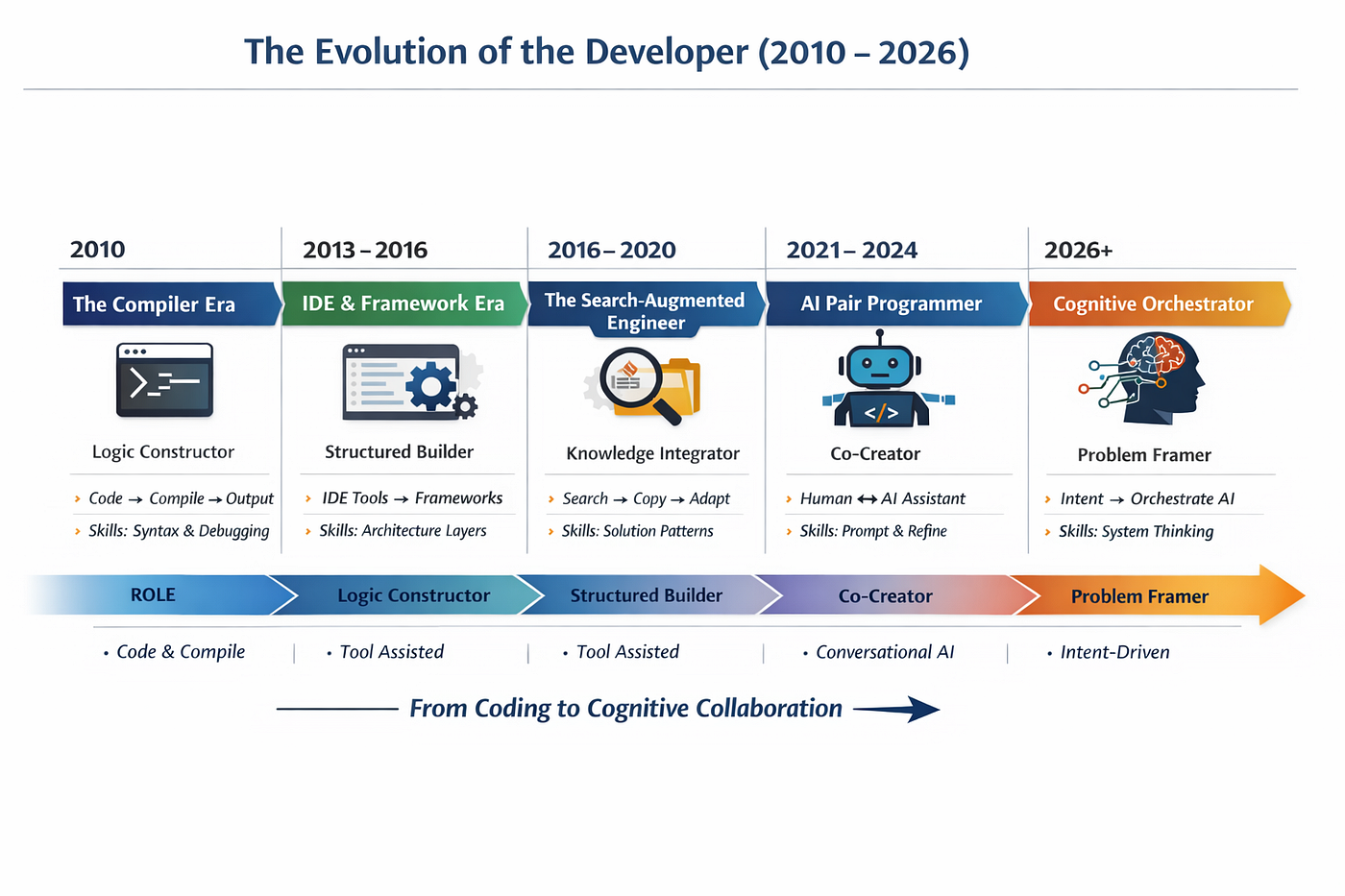
The Evolution of the Developer: 2010 → 2026
2010 — The Compiler Era — Human → Code → Compiler → Output — Role: Logic Constructor — Skill Focus: Syntax, algorithms, debugging — Interaction: Deterministic Notes: Engineers wrote explicit instructions and were the sole thinkers.
2013–2016 — The IDE & Framework Era — Human → IDE (e.g., Visual Studio) → Structured Build — Role: Structured Builder — Skill Focus: Framework mastery, architecture layers — Interaction: Tool-assisted Notes: Abstraction increased; productivity improved, but humans remained central to logic.
2016–2020 — The Search-Augmented Engineer — Human → Stack Overflow → Code Adaptation — Role: Knowledge Integrator — Skill Focus: Pattern reuse, solution adaptation — Interaction: Retrieval-based Notes: Engineers optimized for search and adaptation rather than memorization.
2021–2024 — The AI Pair Programmer — Human ↔ AI Assistant ↔ Codebase — Role: Co-Creator — Skill Focus: Prompting, validation, refinement — Interaction: Conversational & probabilistic Notes: Systems now suggest solutions; humans refine rather than write everything manually.
2025+ — The Cognitive Orchestrator — Human → Intent → AI Systems → Multi-layer Output — Role: Problem Framer & Validator — Skill Focus: System thinking, oversight, orchestration — Interaction: Intent-driven.
Notes: Engineers are moving from writing instructions to expressing intent.
Psychological Impact Across Engineering Levels
Junior Engineers — Benefits: Faster learning curve, reduced fear of complex tasks — Risks: Shallow understanding, illusion of mastery
Mid-Level Engineers — Benefits: Productivity boost, rapid experimentation — Risks: Skill plateau, reduced deep reasoning
Senior Engineers / Architects — Benefits: Faster design exploration, comparative architectural reasoning — Risks: Shift from creator to curator, identity transformation
Shift in role: “I build everything” → “I frame problems and validate solutions.”
The Productivity–Expertise Paradox — AI dramatically increases short-term output. — Potential long-term reduction in deep debugging experience and mental model formation.
Organizational Implications — Hiring & Evaluation: Interviews may focus more on reasoning and problem framing than code recall. — Code Reviews: AI-generated suggestions change ownership and responsibility dynamics. — Skill Differentiation: Architects focus on orchestration; engineers become AI validators.
Future Outlook — Prompt literacy will become a core engineering skill. — Code writing may become partially commoditized. — System thinking and architectural judgment will be premium differentiators. — Cognitive collaboration will redefine what “expertise” means in software development.
Reflection AI coding systems are not just productivity tools; they are cognitive collaborators. The most valuable engineers in the next decade won’t necessarily be the fastest coders — they will be the best problem framers, system thinkers, and disciplined validators.
AI amplifies architectural thinking, but it also exposes shallow reasoning.
Discussion Questions — How has your own interaction with development tools evolved over the past decade? — Do you feel more productive or more dependent on AI systems? — How should organizations adapt skill evaluation in this new era?
Note: This article is written with the help of AI tools.
메타데이터
- post_id
- 31387f84969d
- slug
- cognitive-collaboration-rethinking-human-computer-interaction-in-the-age-of-ai-assisted-software-31387f84969d
- url
- https://medium.com/@diptihumraskar/cognitive-collaboration-rethinking-human-computer-interaction-in-the-age-of-ai-assisted-software-31387f84969d
- canonical_url
- https://medium.com/@diptihumraskar/cognitive-collaboration-rethinking-human-computer-interaction-in-the-age-of-ai-assisted-software-31387f84969d
- author_url
- https://medium.com/@diptihumraskar
- status
- ok
- fetched_at
- 2026-06-23 19:38:28




