A 1,024-Site Molecular Lattice Working at Room Temperature Should Already Sound Impossible
That is not even the most important part.
A 1,024-Site Molecular Lattice Working at Room Temperature Should Already Sound Impossible
That is not even the most important part.
The more important part is that the memory function may be the smallest way to describe what has actually been shown.
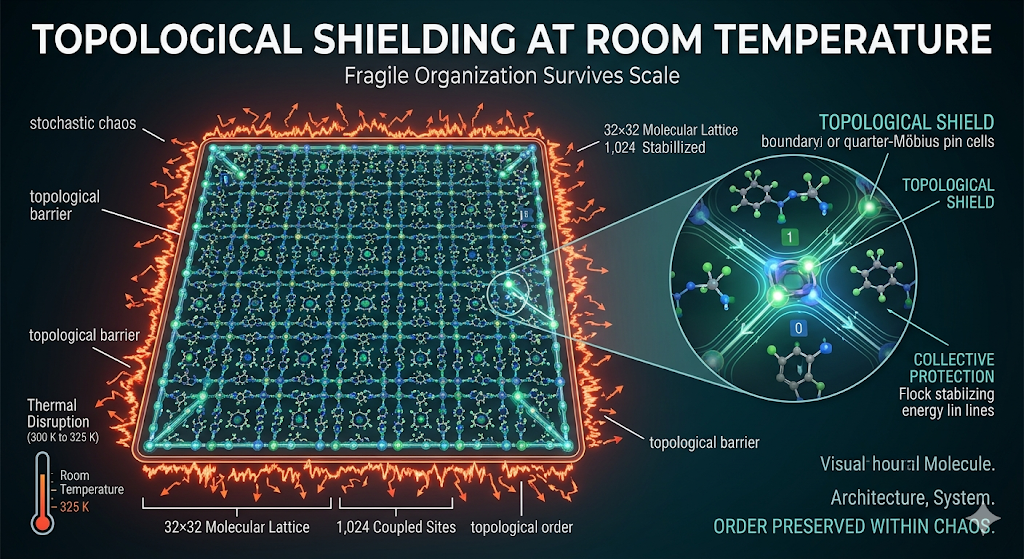
What has been built, on paper, is a 32×32 molecular lattice — 1,024 coupled molecular sites — that remains collectively protected not in cryogenic conditions, not in some artificially frozen laboratory regime, but at room temperature and even 325 K.
Read that carefully.
Not one molecule. Not one junction. Not one isolated switching event dressed up as a technological future.
A lattice. An architecture. A system.
That is where the scale of the claim changes.
For years, molecular electronics has been full of beautiful near-misses: clever effects, elegant devices, exotic states, and impressive papers that all seemed to point toward something larger. But the same problem always remained in the background.
A molecule doing something interesting is not technology.
Technology begins when fragile behavior survives scale, survives organization, and survives reality.
That is why this 32×32 lattice matters.
It is not another “look what one molecule can do” story.
It is the kind of result that forces a different question:
What, exactly, just became possible?
First, this is already much bigger than it sounds
The phrase “molecular memory lattice” can sound deceptively small. It invites the reader to imagine something delicate, narrow, and preliminary. A fine proof-of-concept. A careful curiosity.
That is not what this is.
This is being presented as a 1,024-site organized molecular architecture.
That distinction matters immediately. The moment the unit of interest stops being a molecule and becomes a system, the conversation changes. The issue is no longer whether a clever microscopic effect exists. The issue is whether organized molecular behavior can begin to act like engineering.
That is a different category of result.
Second, it works at room temperature
This is where the claim stops sounding merely impressive and starts sounding disruptive.
Most people — including technically literate people — have been trained by years of frontier physics to expect the same sentence:
“Very interesting, but only under highly controlled low-temperature conditions.”
That sentence has quietly buried countless futuristic ideas.
So when a result says 300 K and 325 K, it is not merely reporting numbers. It is crossing a boundary.
Room temperature is where the real world begins.
Cryogenic operation belongs to science. Room-temperature operation is where people begin to use the word technology without embarrassment.
And once that line is crossed, the whole discussion changes.
Third, the important thing is that the structure survives
The central shock is not that one site holds up.
The central shock is that the organized structure holds up.
The architecture remains collectively protected.
That is a very different statement from:
- one molecule switched
- one device retained a state
- one local barrier turned out to be high enough
This is not a small island of stability.
This is a lattice whose organization matters.
And that is where the result becomes difficult to dismiss. The claim is no longer about local component strength alone. It is about protection emerging from arrangement.
That is a much bigger idea.
Here is the concrete version
The lattice is built around C12F2, using ordinary bulk cells and higher-barrier quarter-Möbius pin cells placed strategically so that they suppress the spread of thermal disruption through the array. In the reported 32×32 design, the collective retention functional is 0.971 at 300 K and 0.910 at 325 K at the stated threshold. And this is not resting only on a large simulation: a minimal 3×3 exact enumeration over all 512 states shows the same protective effect in the smallest solvable case, with whole-lattice failure suppressed by about 188× at 300 K and 145× at 325 K. That is why this is more than rhetoric. The architecture is doing real work.
Fourth, the mechanism survives exact minimization
Large, bold results always invite the same suspicion.
Maybe the effect only appears because the model is large. Maybe the simulation complexity is hiding the weakness. Maybe the mechanism sounds persuasive only because the system is hard to inspect.
That is the easy escape route.
Except there is now a minimal exact demonstration too.
A tiny 3×3 version of the lattice has been solved by brute-force exact enumeration over all 512 possible states.
Every state. Counted exactly.
No approximation. No Monte Carlo shortcuts. No fitted numerics smoothing over the rough edges.
And the effect is still there.
That matters enormously.
Because now the large lattice is no longer suspended in abstraction. The thousand-site result gives the story scale. The exact 3×3 result gives it solidity.
That combination is much harder to wave away.
Fifth, this is not really about memory
This is where the obvious interpretation becomes too small.
Memory is the first demonstration because memory is easy to understand. A state is retained or lost. The result is measurable. The language is familiar.
But the deeper result is not memory.
The deeper result is that fragile organization can be protected by topology.
That is the real headline.
Not storage. Not a better bit. Not a more exotic molecular device.
A new kind of shielding.
That is where the scale of the result changes again. The lattice was the vehicle. Memory was the demonstration. The principle is the real event.
Sixth, boundary pinning is not the point either
Even that can be misunderstood.
Boundary pinning was the mechanism used in this lattice. It was the way this architecture achieved the effect.
But it is not the prize.
The prize is the larger principle:
architecture itself can act as a shield.
Once that becomes clear, the whole “interesting molecular memory concept” reading falls apart.
Because then thermal noise is only the first adversary on the list.
If fragile states can be protected in this way against thermal disruption, the next question is obvious:
What else can be protected by the same logic?
That is where the result stops being narrow.
Seventh, the application space opens up fast
Once the right frame is in place, the implications widen immediately.
Now the discussion is no longer just about storage. It is about protecting:
- fragile molecular states
- delicate nanoscale architectures
- sensitive readout systems
- correlated states that would otherwise decohere or destabilize
- and perhaps most significantly, quantum sensors and other thermally vulnerable platforms
Memory is simply the first readable demonstration of retention. Once an architecture shows that topology can suppress thermal disruption in one fragile organized system, the natural next question is which other fragile systems can be protected by the same architectural logic.
That is the larger significance.
This is not a clever answer to a narrow problem.
This is what it looks like when a general principle appears for the first time in a concrete form.
And when that happens, the first demonstration is rarely the final destination.
The first airplane was not the point of aviation. The first transistor application was not the point of semiconductors. The first laser demonstration was not the point of coherent light.
The first clear demonstration of a principle is usually only the opening move.
That is what this feels like.
So is this historic?
Here is the honest answer.
If this holds up, yes.
Because this is exactly the kind of result that later gets recognized as a turning point: the moment the field stopped sounding aspirational and started sounding consequential.
Not because someone built a strange molecular memory lattice.
But because it may have been the moment when topological shielding became real.
That is a much larger sentence.
The real meaning
So the clean version is this.
A thousand-site molecular lattice working at room temperature is already startling.
A thousand-site molecular lattice whose organized state survives because of its architecture is more startling still.
A thousand-site molecular lattice that may turn out to be the first clear demonstration of general topological shielding is the kind of result that forces people to rethink what fragile systems are allowed to become.
That is why this matters.
And that is why, if the result is real in the way it appears to be real, this is not just an impressive paper.
It is the kind of result that changes the future quietly at first — and only later gets recognized as the moment everything started to move.
Ahaneku, O. (2026). Room-Temperature and 325 K Operation of a 32×32 Topological Molecular Memory Lattice via Five-State Pin-Cell Architecture. Zenodo. https://doi.org/10.5281/zenodo.19407331
메타데이터
- post_id
- 3161424ab477
- slug
- a-1-024-site-molecular-lattice-working-at-room-temperature-should-already-sound-impossible-3161424ab477
- url
- https://medium.com/@oahaneku/a-1-024-site-molecular-lattice-working-at-room-temperature-should-already-sound-impossible-3161424ab477
- canonical_url
- https://medium.com/@oahaneku/a-1-024-site-molecular-lattice-working-at-room-temperature-should-already-sound-impossible-3161424ab477
- author_url
- https://medium.com/@oahaneku
- status
- ok
- fetched_at
- 2026-06-24 11:06:28