Robotics in Manufacturing: The Key to Global Competitiveness
Robotics is no longer a futuristic concept. It is a present day competitive necessity. From automotive assembly lines to electronics…
Robotics in Manufacturing: The Key to Global Competitiveness
Robotics is no longer a futuristic concept. It is a present day competitive necessity. From automotive assembly lines to electronics manufacturing, robotics is transforming how products are designed, produced, and delivered worldwide. Companies that embrace robotics are not just improving efficiency. They are redefining their position in the global market.
What is Robotics in Manufacturing?
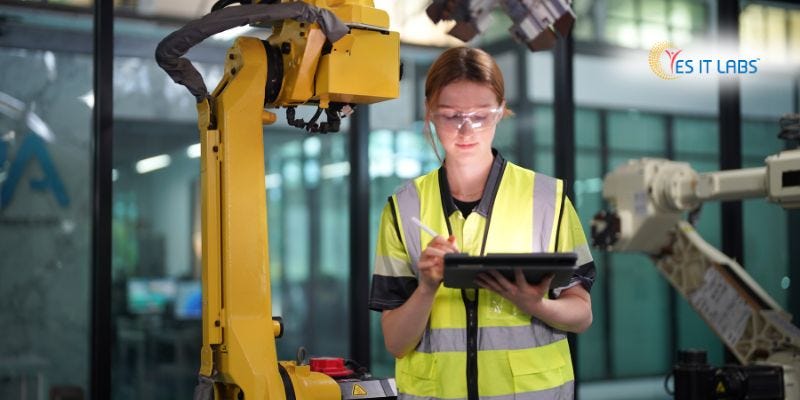
Robotics in manufacturing refers to the use of programmable machines such as industrial robots, collaborative robots, and AI driven systems to perform tasks like assembly, welding, packaging, inspection, and material handling.
These robots are typically integrated with advanced technologies such as:
- Artificial Intelligence (AI)
- Machine Vision
- Internet of Things (IoT)
- Digital Twins
Together, they create smart factories, which are a core part of Industry 4.0.
Why Robotics is Critical for Global Competitiveness
1. Increased Productivity and Efficiency
Robots can operate continuously without fatigue, which significantly improves production output.
- Industry 4.0 technologies can increase production by 10 to 15 percent and reduce costs by 5 to 7 percent
- AI powered robotics can improve quality by up to 30 percent while lowering operational costs
This allows manufacturers to produce more in less time, which is essential for global competition.
2. Cost Reduction and Profitability
Although robots require an upfront investment, long term savings are substantial.
- Automation can reduce production costs by up to 20 percent
- Robotics helps offset rising labor costs and workforce shortages
Lower costs allow businesses to offer competitive pricing while maintaining healthy profit margins.
3. Improved Quality and Precision
Robots reduce human error in repetitive tasks and deliver consistent results.
- Robotics enhances precision in processes such as welding, assembly, and inspection
- Better quality leads to fewer defects, stronger brand reputation, and higher export potential.
4. Faster Time to Market
Automation speeds up production cycles and minimizes delays.
- Smart factories use real time data and AI to optimize operations instantly
- Faster delivery is especially important in industries like electronics and automotive, where speed impacts market share.
5. Flexibility and Scalability
Modern robotic systems are designed to adapt to changing needs.
- Collaborative robots, also known as cobots, are increasingly used in flexible production lines
- Manufacturers can quickly adjust production volumes or switch product lines without major infrastructure changes.
The Role of Software in Modern Robotics
Behind every efficient robotic system is powerful software that connects machines, data, and operations. Businesses are increasingly investing in **Manufacturing App Development Services** to build customized platforms that manage robotics workflows, monitor performance, and optimize production in real time.
These applications help manufacturers gain better visibility, improve decision making, and ensure seamless coordination across automated environments.
Global Robotics Adoption: Key Statistics
The rapid growth of robotics highlights its role in global manufacturing:
- Around 542,000 industrial robots were installed globally in 2024
- Robot installations have more than doubled over the past decade
- Approximately 4.3 to 4.6 million robots are currently operating in factories worldwide
- Asia accounts for about 74 percent of global robot deployments
- China alone represents roughly 54 percent of total installations
Country Level Insights:
- China leads with the highest number of installations
- Japan, the United States, South Korea, and Germany are also major adopters
- South Korea has one of the highest robot densities, with around 1,000 robots per 10,000 workers
These figures clearly show that robotics adoption is closely linked to industrial leadership.
Integration and Connectivity in Smart Factories
For robotics to deliver maximum value, systems must communicate seamlessly with other enterprise tools such as ERP, supply chain platforms, and analytics systems. This is where **Third party API integration services** play a crucial role.
By enabling smooth data exchange between different systems, manufacturers can achieve real time insights, better coordination, and improved operational efficiency across the entire production lifecycle.
Robotics Trends Shaping the Future of Manufacturing
1. AI Powered Smart Robots
Robots are becoming more intelligent and capable of learning, adapting, and making decisions in real time.
2. Collaborative Robots
Cobots are designed to work alongside humans and improve productivity without fully replacing the workforce.
3. Autonomous Mobile Robots
These robots are used for internal logistics and material transport within factories, reducing manual handling.
4. Robotics as a Service
Subscription based robotics solutions are making automation more accessible to small and medium businesses.
5. Digital Twins and Simulation
Virtual models of production environments help manufacturers test and optimize processes before real world implementation.
Robotics in the United States: Driving Industrial Leadership
The United States continues to be a global leader in advanced manufacturing and robotics adoption. With increasing investments in automation and smart factories, US manufacturers are leveraging robotics to stay competitive in a rapidly evolving global market.
- The US ranks among the top countries for industrial robot installations globally
- Robotics adoption is accelerating across automotive, electronics, and logistics sectors
- Labor shortages and rising operational costs are key drivers of automation
Key Growth Drivers:
- Reshoring and nearshoring strategies to strengthen domestic manufacturing
- Government support for advanced manufacturing and innovation
- Increasing demand for high precision and high quality production
- Rapid adoption of Industry 4.0 technologies
The Role of AI in Advanced Manufacturing
Artificial intelligence is taking robotics to the next level by enabling predictive maintenance, intelligent automation, and real time decision making. Many enterprises are leveraging **Ai Software Development Services in USA** to build advanced AI driven systems that enhance robotic capabilities and drive innovation in manufacturing.
These AI powered solutions allow businesses to detect issues early, reduce downtime, and continuously optimize production processes.
Challenges in Adopting Robotics
Despite its advantages, robotics adoption involves certain challenges:
1. High Initial Investment
Small and medium businesses may find the upfront cost difficult to manage.
2. Skill Gap
There is a growing need for skilled professionals who can operate and maintain robotic systems.
3. Integration Complexity
Integrating robotics with existing systems can require significant technical expertise.
4. Cybersecurity Risks
Connected manufacturing systems can be vulnerable to cyber threats.
However, solutions such as Robotics as a Service and cloud based platforms are helping address these challenges.
Real World Impact: Robotics and Competitive Advantage
Companies that adopt robotics gain measurable advantages:
- Higher output with optimized resource usage
- Improved supply chain resilience
- Faster scalability in global markets
- Accelerated innovation cycles
Studies suggest that 95 percent of industrial businesses plan to introduce new automation within the next three years. By 2030, nearly half of manufacturers are expected to operate with highly automated processes.
This clearly shows that robotics is becoming a standard across industries.
The Future: Human and Robot Collaboration
The future of manufacturing is built on collaboration between humans and machines.
- Robots handle repetitive, hazardous, and precision driven tasks
- Humans focus on creativity, decision making, and complex problem solving
Even in advanced manufacturing environments, human involvement remains essential for system oversight and strategic direction.
Conclusion
Robotics in manufacturing plays a central role in achieving global competitiveness in today’s industrial landscape. It enables businesses to produce faster, reduce costs, and maintain consistent quality.
As automation continues to evolve, companies that invest in robotics today will be better positioned to lead in the future, strengthen their global presence, and build resilient operations.
Robotics is not just a technological upgrade. It is a strategic investment that defines long term success.
FAQs
1. Why is robotics important in manufacturing?
Robotics improves productivity, reduces costs, enhances quality, and enables faster production, all of which are critical for global competitiveness.
2. What industries benefit most from robotics?
Industries such as automotive, electronics, pharmaceuticals, food processing, and logistics benefit significantly from robotics.
3. Are robots replacing human workers?
Robots are not replacing humans. They are supporting human work by handling repetitive tasks while people focus on more complex responsibilities.
4. What is the future of robotics in manufacturing?
The future includes intelligent robots, collaborative systems, and fully connected smart factories.
5. Is robotics affordable for small businesses?
Yes, modern models such as Robotics as a Service make it more affordable for small businesses to adopt automation.
메타데이터
- post_id
- 3162f0cb112f
- slug
- robotics-in-manufacturing-the-key-to-global-competitiveness-3162f0cb112f
- url
- https://medium.com/@sabelacarson/robotics-in-manufacturing-the-key-to-global-competitiveness-3162f0cb112f
- canonical_url
- https://medium.com/@sabelacarson/robotics-in-manufacturing-the-key-to-global-competitiveness-3162f0cb112f
- author_url
- https://medium.com/@sabelacarson
- status
- ok
- fetched_at
- 2026-07-18 15:41:54