Trust Is The Bottleneck | FIIVE EYES | IFC-0 INTELLIGENCE
Allies will die for each other under a mutual defence treaty. They will not, as a rule, tell each other what they know in time to prevent…
Trust Is The Bottleneck | FIIVE EYES | IFC-0 INTELLIGENCE
Allies will die for each other under a mutual defence treaty. They will not, as a rule, tell each other what they know in time to prevent the reason dying became necessary. The gap between those two facts is where the next failure is already forming.
1946 Year the UKUSA Agreement founded what became Five Eyes — still, eight decades on, the deepest multilateral intelligence relationship in existence
32 NATO member states, each retaining sovereign classification and disclosure control over what it holds
Originator Control The doctrine governing nearly all formal intelligence sharing — a partner cannot redistribute what it receives without the source’s consent
Months Typical latency of formal multilateral disclosure channels, against threat networks that restructure in days
The alliance paradox
A mutual defence treaty is the deepest commitment one sovereign state can make to another: an agreement to treat an attack on the ally as an attack on oneself, and to respond accordingly, potentially at the cost of one’s own soldiers’ lives. Article 5 has been invoked once in NATO’s history, after the September 11 attacks, and every member honoured it.
Set beside that commitment, the reluctance of the same allies to share raw intelligence with each other in real time looks, on its face, almost irrational. States that will fight and die together will not, as a routine matter, tell each other everything they know about the threat they are jointly facing — not because they doubt the alliance, but because intelligence sharing is not the same kind of commitment as military commitment. It is not solidarity. It is capability revelation. And capability, once revealed, cannot be un-revealed.
This is not a failure of alliance management. It is a structural feature of how intelligence works, and it has been the quiet cause of some of the most consequential intelligence failures of the last quarter century.
What the architecture actually looks like
Formal intelligence sharing between allied states runs on a small number of governing doctrines, and nearly all multilateral cooperation — Five Eyes, NATO’s intelligence divisions, the Egmont Group’s financial intelligence network, INTERPOL’s notice system — operates within them rather than around them.
The most consequential is the third-party rule, more commonly called originator control: intelligence shared by one partner cannot be redistributed to a third party, or in some interpretations even acted upon beyond the specific use disclosed, without the originating agency’s consent. The rule exists for good reason — it protects sources, methods, and the relationships that produced the intelligence in the first place, and without it, states would share far less than they currently do, not more. But it means that even within an alliance built on decades of trust, intelligence does not flow. It is granted, case by case, request by request, often with the specific method of collection deliberately obscured even from the ally receiving the product.
Layered on top of originator control is classification architecture that differs meaningfully between allies. What one country classifies at a level shareable with a coalition partner, another classifies at a level restricted to its own nationals. Compartmentalisation — the practice of restricting access to intelligence even within one’s own government, on a strict need-to-know basis — exists for legitimate counterintelligence reasons, but it means that the analyst in Country A assessing a threat frequently cannot see what the analyst in Country B, an ally, already knows, even when both analysts would recognise, if they could compare notes, that they were looking at the same operation.
The rule that protects the source is the same rule that guarantees the analyst downstream never sees the whole picture. Both things are true at once. Neither is a mistake. That is what makes it hard to fix.
Where this has already cost lives
The most cited domestic case is the pre-9/11 “wall” between the CIA and FBI — a jurisdictional and legal barrier, not a multinational one, but built on the same underlying logic: intelligence collected for one purpose, under one set of legal authorities, could not be freely shared with the agency positioned to act on it, even inside a single government. The CIA held information, as early as January 2000, connecting future hijackers to al-Qaeda. It was not shared with the FBI in a form or a timeframe that allowed disruption. The 9/11 Commission identified this not as a single failure but as a structural one — a system engineered, for defensible legal and counterintelligence reasons, to make exactly this kind of gap likely.
The multinational version of the same problem is harder to see because it rarely produces a single dramatic post-mortem. It shows up instead as a pattern: a threat actor known to one allied service, travelling to or communicating with contacts in another allied state, where the receiving service’s awareness depends entirely on whether, and how completely, the first service chose to share what it knew — a choice shaped as much by originator-control caution and classification mismatch as by the actual severity of the threat. As our analysis of cross-border financing and jurisdictional fragmentation established, the same logic that lets adversarial networks exploit gaps between rival states also lets threats slip through gaps between allied ones. The border a threat actor crosses to defeat intelligence sharing does not have to be hostile. It only has to be a border.
The trust paradox, precisely stated
Deeper alliances do not automatically produce better intelligence fusion — they produce more intelligence worth protecting from each other. The closer the partnership, the more each service has riding on the other not learning how something was collected. Alliance depth and intelligence-sharing depth are not the same curve, and treating them as though they were is the recurring planning error.
Why this cannot be solved by asking allies to trust each other more
The standard prescription — deeper information-sharing agreements, more joint fusion cells, expanded liaison staff — treats the problem as a trust deficit that more diplomacy can close. It is not primarily a trust deficit. Trusted allies already share extensively; the limiting factor is structural, not emotional. Sharing raw intelligence means sharing collection method. Sharing collection method means a partner now knows what you can see and, by implication, what you cannot — information with value to that partner far beyond the specific threat under discussion. No amount of goodwill changes that calculus, because the calculus is correct. An ally that shares everything about how it collects intelligence has made itself strategically legible to a partner in a way that has consequences long after the immediate threat is resolved.
This is why bilateral and multilateral frameworks, however well-intentioned, tend to converge on narrow, case-specific disclosure rather than genuine fusion. Genuine fusion requires something else: a mechanism that can correlate what multiple allies separately know without requiring any of them to reveal to each other how they came to know it.
The architecture required
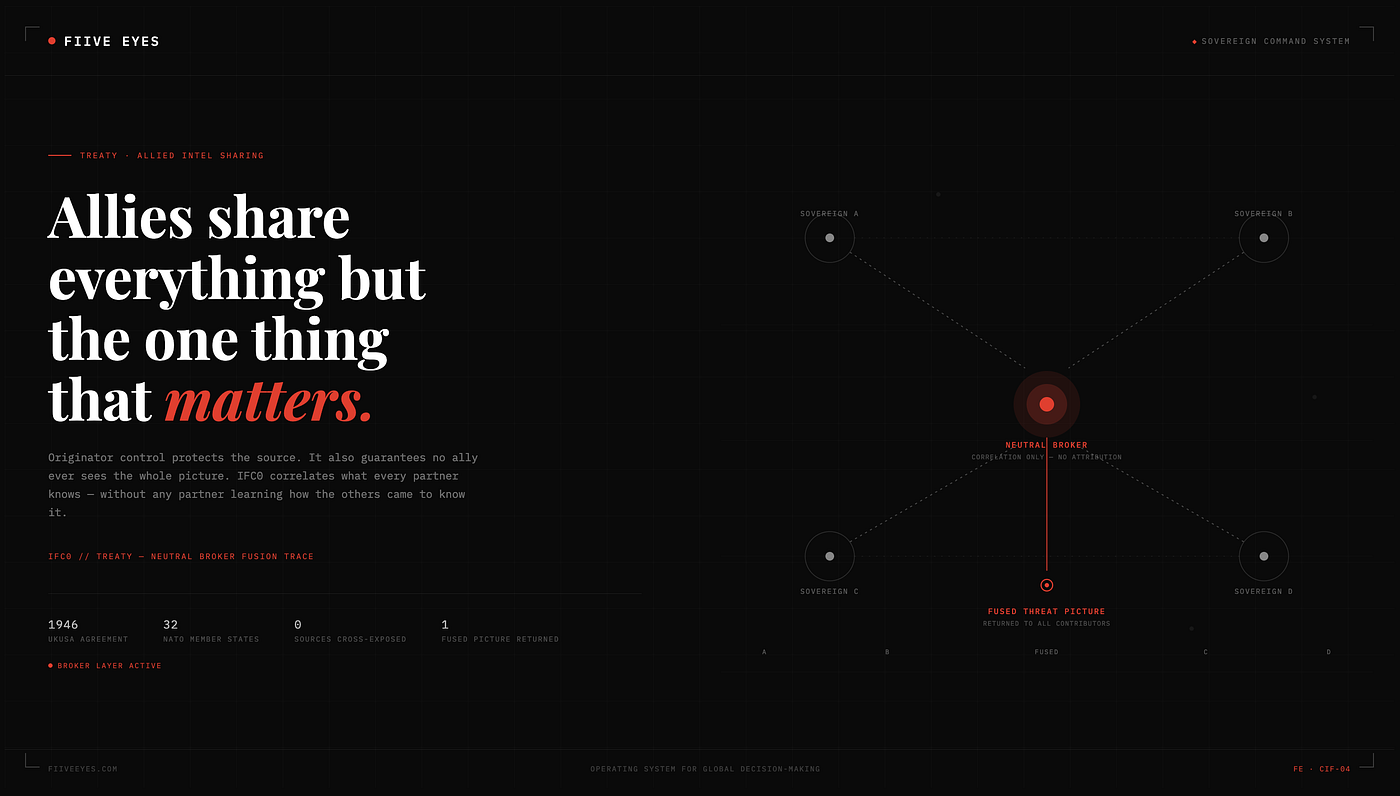
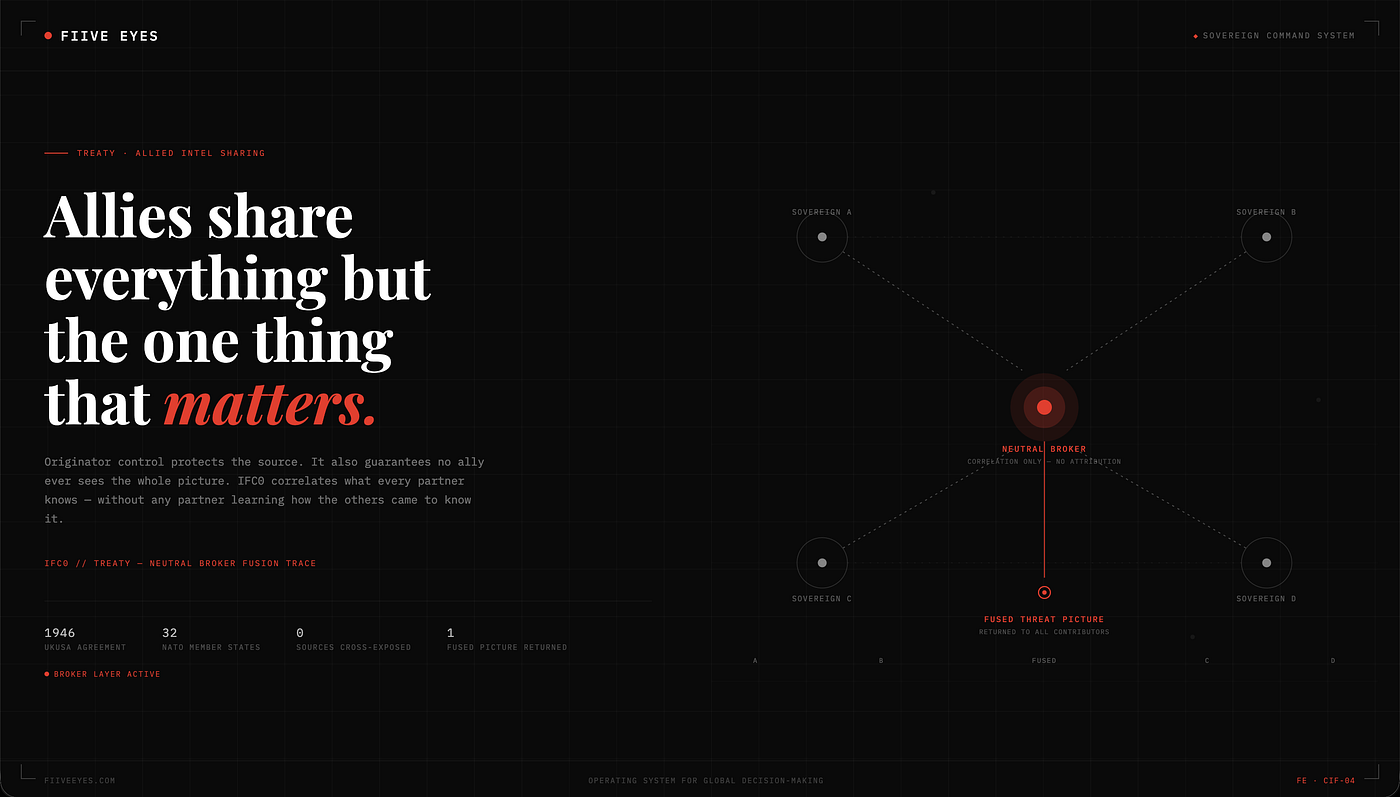
What the current model lacks is a neutral broker — an entity trusted enough by each sovereign contributor to receive intelligence in a form richer than a final product, but structurally incapable of exposing one ally’s sources or methods to another. This is a different function from a joint fusion cell staffed by seconded analysts from each member state, because seconded analysts still belong, in the final analysis, to their home service and its disclosure rules. A genuine neutral broker ingests, correlates, and redacts — surfacing the fused pattern (a name, a route, a financial link, a coordinated threat signature) to every contributing ally simultaneously, without any single ally learning what any other contributed to produce it.
That distinction — correlation without attribution — is the entire difference between an alliance that shares selectively, slowly, and defensively, and one that can actually see a threat network the way the network sees itself: as a single entity operating across all their borders at once. The technology to do this is not exotic. The institutional willingness to hand correlation authority to a broker outside any single sovereign chain of command is the harder part, and it is why so few genuine multilateral fusion architectures exist despite decades of allies agreeing, in principle, that they should.
IFC0 Intelligence Module — Intel Sharing
IFC0’s Treaty module positions the platform as a trusted, neutral intelligence broker for allied sovereigns — ingesting contributions from multiple national services under strict originator-control-compliant handling, correlating across them to surface fused threat patterns, and returning actionable intelligence to every contributing partner without exposing any partner’s sources or collection methods to the others. Built for alliance structures that need the picture a joint threat network produces, without requiring any single ally to reveal how it sees what it sees.
Allies do not fail each other because they do not care. They fail each other because the architecture asks them to choose, every time, between protecting a source and completing a picture — and a well-run intelligence service will protect the source almost every time. The fix is not to ask them to choose differently. It is to build the layer that means they never have to.
Fiive Eyes · IFC0 — Sovereign Intelligence Sharing Module From sky to soil. IFC0 sees the entire battlefield.
www.fiiveeyes.com
메타데이터
- post_id
- 31a8c50b925d
- slug
- trust-is-the-bottleneck-fiive-eyes-ifc-0-intelligence-31a8c50b925d
- url
- https://medium.com/@fiiveeyes/trust-is-the-bottleneck-fiive-eyes-ifc-0-intelligence-31a8c50b925d
- canonical_url
- https://medium.com/@fiiveeyes/trust-is-the-bottleneck-fiive-eyes-ifc-0-intelligence-31a8c50b925d
- author_url
- https://medium.com/@fiiveeyes
- status
- ok
- fetched_at
- 2026-07-17 03:50:05