The Relevance Gap: Why Enterprise Knowledge Fails Even When Documentation Exists
“Why are customers still contacting support when the answers already exist in the documentation?”
The Relevance Gap: Why Enterprise Knowledge Fails Even When Documentation Exists
“Why are customers still contacting support when the answers already exist in the documentation?”
Today, most enterprise content ecosystems are designed around repositories, workflows, and publishing pipelines, not around stakeholder consumption behavior.
But the issue is rarely content availability. The real issue is relevance.
Most enterprises ask this question after investing heavily in:
- AI-powered search
- self-service platforms
- enterprise knowledge systems
- RAG architectures
- and modern documentation portals
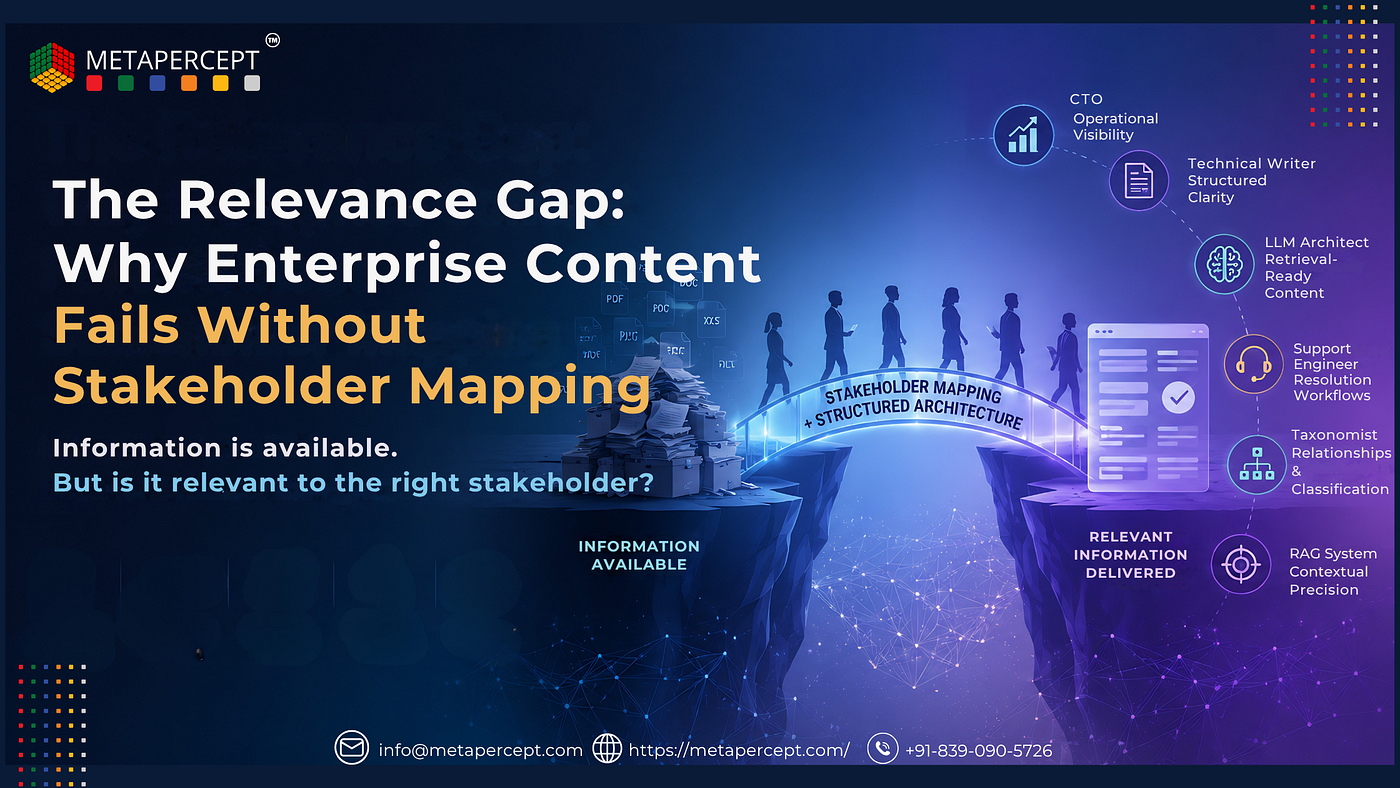
This creates what we call the Relevance Gap: The disconnect between available information and contextually usable knowledge. And this gap becomes even more dangerous in AI-driven environments. Because AI systems retrieve what exists, not necessarily what is meaningful.
The Real Enterprise Problem Isn’t Search
Organizations often assume poor retrieval is caused by weak search technology. Yet most enterprises still structure information as if every stakeholder consumes knowledge in the same way. But the problem begins much earlier.
When:
- A support engineer searches for resolution workflows.
- A CTO needs operational visibility.
- An LLM architect requires structured, retrieval-ready content.
- A technical writer focuses on clarity and reuse.
- A taxonomist thinks in semantic relationships.
This creates fragmented ecosystems where:
- information scales without governance
- repositories become disconnected
- terminology becomes inconsistent
- duplicate content increases
- and context slowly disappears
At scale, this becomes operationally expensive.
Why AI Is Exposing Weak Information Architecture
Modern enterprises are rapidly adopting:
- enterprise AI
- semantic search
- RAG systems
- hybrid retrieval models
- self-service ecosystems
But many organizations are feeding fragmented documentation directly into these systems.
- Disconnected markdown files.
- Static documentation portals.
- Unmanaged repositories.
- Broken taxonomies.
- Duplicate information.
Then expecting intelligent outcomes. AI does not repair poor information architecture. It amplifies it. Without structured relationships, metadata discipline, and stakeholder alignment, retrieval systems struggle to deliver contextual outputs.
Why Technical Writers Experience the Problem First
Technical writers often become the first team to feel the effects of poor stakeholder mapping.
They work across:
- engineering
- product
- support
- compliance
- customer success
But they rarely receive complete visibility into:
- stakeholder intent
- retrieval behavior
- user journeys
- taxonomy relationships
- downstream AI consumption
As a result, documentation becomes technically accurate but operationally fragmented. At smaller scales, this may remain hidden. At enterprise scale, it becomes impossible to manage efficiently.

Why Stakeholder Mapping Must Happen Early
Most organizations introduce stakeholder thinking after content begins scaling. That is usually too late. Before documentation workflows even begin, enterprises should define:
- Who needs the information?
- Why do they need it?
- How will they consume it?
- Which relationships matter?
- What retrieval behavior should exist?
This creates a scalable information architecture before fragmentation becomes Information Debt. Because structured knowledge ecosystems are not built through publishing alone. They are built through intentional information relationships.
The Future of Enterprise Content
The future of enterprise knowledge will not depend on how much content organizations create. It will depend on how intelligently information is structured for stakeholders, retrieval systems, and AI-driven environments.
Organizations that continue scaling content without stakeholder-aware architecture will continue scaling Information Debt. And AI will only expose those gaps faster.
Explore more: https://metapercept.com https://techconnect-space.co
InformationDebt #RelevanceGap #TechnicalWriting #EnterpriseAI #DITAXML #StakeholderMapping #ContentStrategy
메타데이터
- post_id
- 31b83ed2a84f
- slug
- the-relevance-gap-why-enterprise-knowledge-fails-even-when-documentation-exists-31b83ed2a84f
- url
- https://medium.com/@info-11696/the-relevance-gap-why-enterprise-knowledge-fails-even-when-documentation-exists-31b83ed2a84f
- canonical_url
- https://medium.com/@info-11696/the-relevance-gap-why-enterprise-knowledge-fails-even-when-documentation-exists-31b83ed2a84f
- author_url
- https://medium.com/@info-11696
- status
- ok
- fetched_at
- 2026-07-18 07:41:53