Proposal Writing and Defense: The Document That Actually Wins
How to Be a Great Pre-Sales Engineer | Chapter 9
Proposal Writing and Defense: The Document That Actually Wins
How to Be a Great Pre-Sales Engineer | Chapter 9
A 150-page proposal sat untouched for four minutes.
The evaluation committee read the executive summary. Two sentences generated discussion. The proposal landed in second place. Three weeks of architecture work, sizing calculations, reference lists, diagrams all invisible in the decision.
This is not rare. Research on enterprise procurement shows that decision-makers spend an average of eight minutes with a proposal. Most of that time is on the executive summary. The rest is on the price page.
Pre-sales engineers write technical sections because they know how to write technical sections. But the people making the decision are reading for business value, not technical depth. This chapter closes that gap.
What Is a Proposal, Really?
A proposal is the formal way one company tells another: “We can solve this problem together.”
It is not a technical document. It is a sales instrument.
That distinction changes how you write it. A technical document transfers information. A proposal persuades, builds trust, and manages risk.
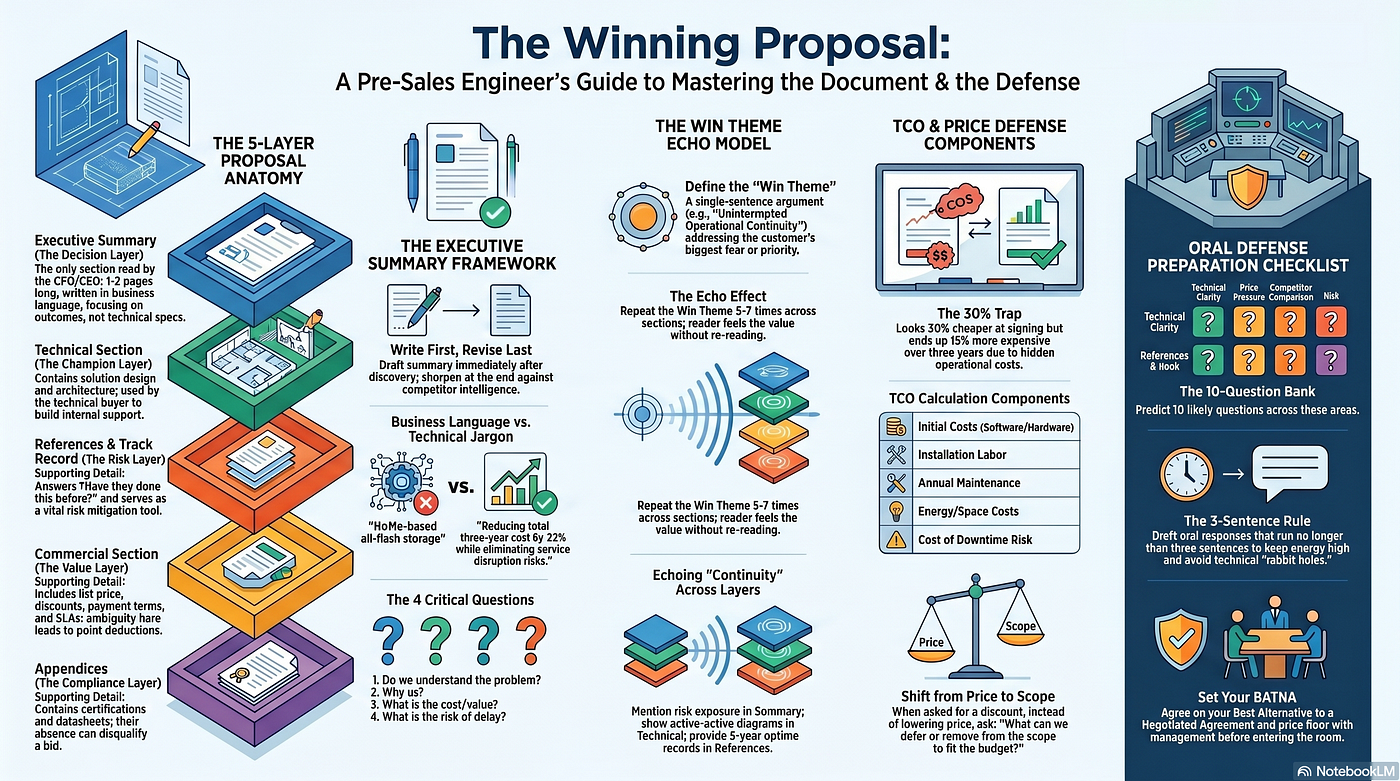
Five layers make up a complete proposal:
Layer 1: Executive Summary The only section decision-makers read. One to two pages. Written in the language of the CEO, not the IT director.
Layer 2: Technical Section Solution design, architecture, sizing, integration details. The technical buyer and IT director evaluate this section. This is where your champion builds internal support.
Layer 3: References and Track Record Similar-scale, same-sector references. Underweighted in most proposals. Serves as a risk mitigation tool answers the implicit question: “Have they done this before?”
Layer 4: Commercial Section List price, discount structure, payment terms, warranty, support and maintenance costs. Get the details right here. Ambiguity in the commercial section costs points.
Layer 5: Appendices Certifications, partner badges, datasheets, technical specification tables. Not read. But if missing, points are deducted.
Time and energy distribution is usually inverted: pre-sales spends most time on the technical section, but decision-makers spend most time on the executive summary. That misalignment is where deals are lost.
[embed]
Executive Summary: The Most Mishandled Section
Two classic mistakes define how executive summaries fail.
First: It is written last. Under deadline pressure, exhausted, the night before submission. It shows.
Second: It becomes a technical summary. “Our proposal includes an 8-node, active-active hyper-converged cluster with NVMe-based all-flash storage.” That sentence speaks to no one in the room who controls budget.
The right question is: Who reads this?
The CFO, the COO, or the general manager. Someone who does not know what NVMe means and does not need to. Someone who approves budget, absorbs risk, and cares about outcomes.
They want to know: Do we have a problem? Does this firm solve it? Why them, not the other vendor? What does it cost, and what is the return? What do we lose if we delay this decision?
Good executive summary: answers those five questions in two pages.
Bad sentence: “Our solution features an active-active cluster with RPO of zero and RTO of 15 minutes.”
Better sentence: “Your current infrastructure will be inadequate within 18 months. This solution eliminates the risk of service disruption while reducing total three-year cost by 22%.”
The second sentence translates technical reality into business language. Decision-makers note it. They skip the first.
Practical rule: Write the executive summary first, revise it last. First draft comes directly from discovery what the customer said, what was critical. Final revision is sharpened against evaluation criteria and competitor intelligence.
Win Themes: From Technical Specs to Business Value
A win theme is an argument that runs through the entire proposal. It is the single-sentence answer to “Why us?” It echoes in every section, in different forms.
Bad win theme: “With 20 years of experience and a strong technical team, we deliver the best solution.” Meaningless. Every competitor writes this. Zero impact in evaluation.
How to build a good win theme: Identify the customer’s biggest fear or most critical business priority. Show with specific metrics how your solution addresses it. Then echo that argument throughout every section of the proposal.
Example: The customer’s fear is service continuity. Any downtime means critical business loss.
Your win theme: “Uninterrupted operational continuity.”
In the executive summary: “Incidents in your current environment cause X hours of annual operational loss. Our solution eliminates that exposure.”
In the technical section: Active-active architecture diagram, RPO zero, RTO 15 minutes, clearly labeled.
In the references section: A reference account in the same sector with a five-year uptime record.
In the commercial section: SLA commitments, penalty clauses, support response time guarantees.
Whether the reader goes cover to cover or skips to the executive summary, the message is identical: this firm guarantees operational continuity.
A win theme should appear five to seven times in a proposal, in varied form. The reader should feel what they are choosing without needing to re-read.
Price Defense: It Is Not About Undercutting
The most common scenario in an oral defense: “The competitor came in 30% cheaper.”
Two options. Enter the price war almost always a losing position, because someone can always go lower. Or shift the conversation to TCO.
TCO: Total Cost of Ownership is the complete cost of the decision over time.
What TCO includes: initial license or hardware cost; installation and integration labor; annual support and maintenance; operational costs including management labor, energy, and physical space; cost of downtime risk per incident; migration and training costs. Sum that over three to five years.
The proposal that looks 30% cheaper at signing can be 15% more expensive over three years. That math needs to be in the room.
Practical tool: For every proposal, build a three-year TCO comparison table. Include your own numbers. Estimate the competitor’s column based on public data and market knowledge. Bring it to the oral defense. Let the CFO do the math.
Price defense in the room: When someone says “can you come down on price,” do not answer instantly. Instead: “I hear the budget constraint. Let’s review the scope together. What can we defer or remove to fit the budget?” That moves the conversation from price to scope. Scope negotiation is more controlled territory.
Set your BATNA before the meeting. How far can you reduce price? What cannot be removed without degrading the value proposition? Agree on those lines with your manager before the room fills.
The Three Layers
Junior: Meet the Deadline, Follow the Template
Use the template. Your company has one, or should have one. Do not try to redesign it. Understand how it works first.
Build a checklist. All appendices attached? Signature pages complete? Price table internally consistent? Technical specs mapped to spec requirements?
Executive summary gets skipped under deadline pressure. Do not skip it. Thirty minutes of executive summary writing will have more impact on the outcome than three extra hours in the technical section.
Mid-Level: Win the Deal
Own the win theme. Define it with your sales manager before writing begins. What is the customer’s single biggest priority? Make that the through-line.
Write the executive summary first. Technical section next. Commercial section after that. Then return to the executive summary and sharpen it.
Prepare for orals. Build a list of ten expected questions. Draft answers that run no longer than three sentences. Run a mock Q&A with your manager or sales director.
Build the TCO table. For your solution and for the estimated competitor position.
Senior: Shape the Outcome
Good senior pre-sales engineers know the evaluation criteria before the proposal is written.
What are the scoring weights? Is technical depth worth 40% or 20%? Does price dominate? Are references a tiebreaker or a primary factor? If you learned this in discovery, the proposal structure reflects those weights.
Design the proposal template for your firm. Eliminate the standardless process. Write guidance for each section. Teach the concept of win themes to the team.
Integrate competitor intelligence. Anticipate what the competitor will say. Address their likely arguments in your executive summary before anyone reads their proposal.
RFP Proposal Alchemist
The skill for this chapter: RFP Proposal Alchemist
[github.com/diabolikss-debug/rfp-proposal-alchemist](https://github.com/diabolikss-debug/rfp-proposal-alchemist)
Diabolikss.com AI Tool
Command: /proposal
What it does: Reads an RFP document or pasted specification text. Produces:
- Win theme options (3 alternatives, each with rationale)
- Executive summary template (customized to the customer’s sector and stated problem)
- Evaluation criteria alignment table (spec requirement mapped to technical feature mapped to business value)
- Price defense arguments (TCO framework, risk and value framing)
- Orals question bank (15 likely questions with recommended response structures)
Run /proposal before writing begins. The output is a roadmap, not a draft.
Proposals are won with the best argument, not the best technical content.
Technical content is necessary but not sufficient. An executive summary written in the decision-maker’s language, a win theme that echoes through every section, and a defensible price position will carry a good technical section to the win. The same technical section without those elements will land in second place.
At the junior level, focus on completeness. At mid-level, focus on winning. At senior level, focus on shaping the process before the proposal is written.
Chapter 10 covers POC, pilot, and demo management — the hands-on work that converts a proposal win into a signed contract.
메타데이터
- post_id
- 31c7fa4e2916
- slug
- proposal-writing-and-defense-the-document-that-actually-wins-31c7fa4e2916
- url
- https://medium.com/@diabolikss/proposal-writing-and-defense-the-document-that-actually-wins-31c7fa4e2916
- canonical_url
- https://medium.com/@diabolikss/proposal-writing-and-defense-the-document-that-actually-wins-31c7fa4e2916
- author_url
- https://medium.com/@diabolikss
- status
- ok
- fetched_at
- 2026-06-13 12:55:53