Dependent Origination as Universal Interdependence: From Early Buddhism to Systems Science
Introduction
Dependent Origination as Universal Interdependence: From Early Buddhism to Systems Science

Introduction
Few doctrines in Buddhism are as central — or as contested — as Dependent Origination (paṭicca-samuppāda). In the Theravāda tradition, it is most often identified with the twelve links (dvādasa nidānāni), a causal chain that explains the cycle of ignorance, craving, and rebirth. Mahāyāna Buddhism, however, expands the doctrine into a more sweeping vision: the interdependence of all phenomena.
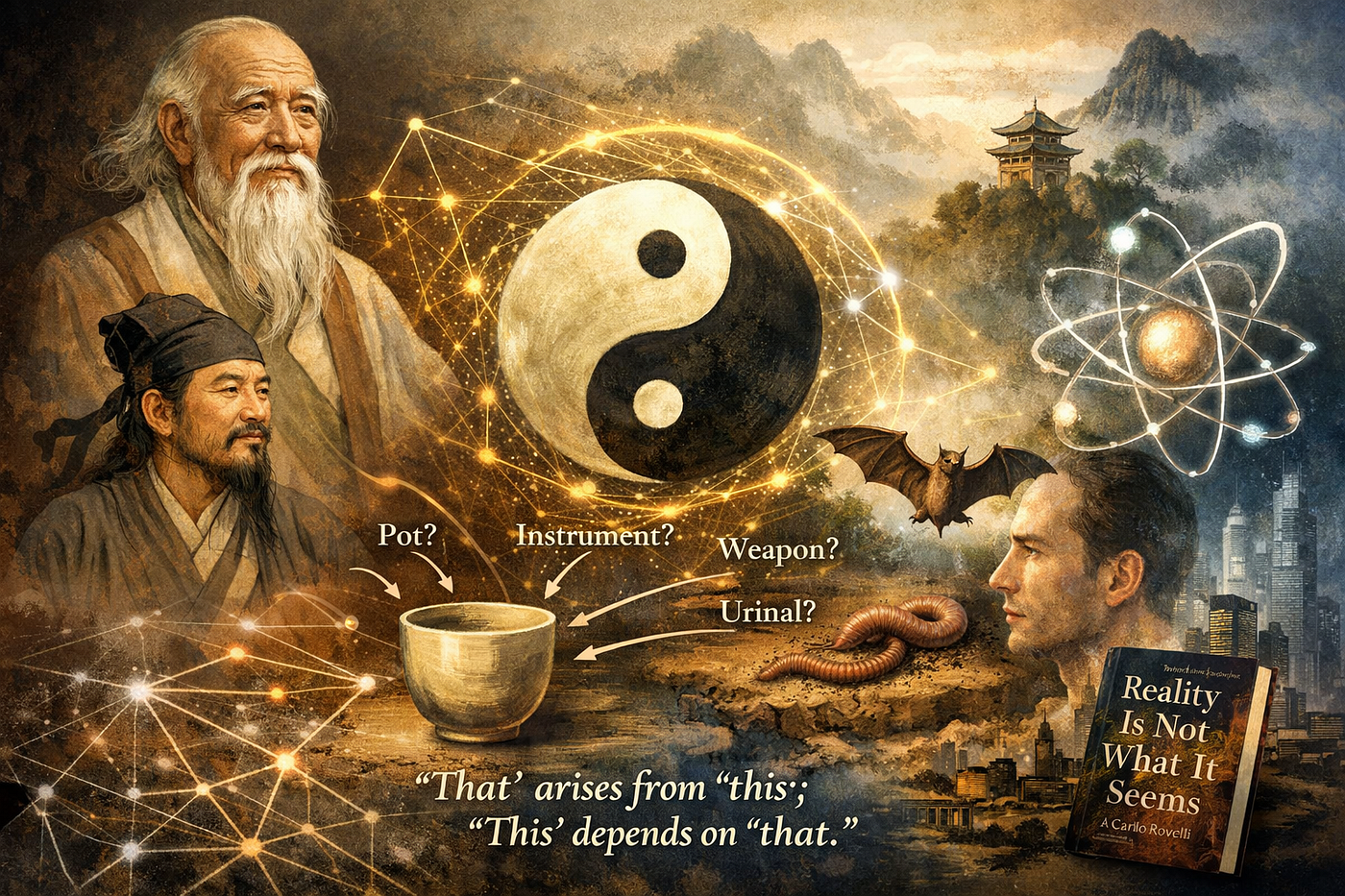
This essay argues that the broader Mahāyāna interpretation is actually closer to the Buddha’s original conception, as expressed in the earliest formula of This-That Conditionality (idappaccayatā):
When this is, that is. From the arising of this, that arises. When this is not, that is not. From the cessation of this, that ceases.
Far from being restricted to the psychology of rebirth, this principle applies to the whole of existence. Read in this way, Dependent Origination anticipates the relational worldview of modern systems science.
The Evolution of the Twelve Links
Historical scholarship has revealed that the twelve-link formula may not stem directly from the Buddha’s own teaching. Richard Gombrich observes:
The Buddha himself probably taught shorter chains of causal links, with fewer terms. The twelve-link formula was a later synthesis, combining two or more originally independent series.(What the Buddha Thought, 2009, p. 74)
K. R. Norman makes a similar point:
There is no reason to suppose that the list of twelve links was given in this form by the Buddha himself. The tendency of the tradition was to expand and systematize earlier, simpler formulations. (Norman, Pali Literature, 1983, p. 66)
And Erich Frauwallner goes further, showing how the twelve-link model is a composite:
This series is in fact a combination of two separate sequences, one dealing with the arising of suffering in this life, and the other extending the chain across lifetimes. Their joining together produced the composite twelvefold scheme. (The Philosophy of Buddhism, 1956, p. 181)
These scholarly perspectives converge: the twelve links reflect later systematization, not the Buddha’s earliest insight.
The Limits of the Twelve Links
Even apart from historical questions, the twelve-link model is insufficient to explain the full range of suffering. It focuses primarily on psychological and spiritual processes — craving, ignorance, attachment — while ignoring the broader physical and natural dimensions of causality.
- Global pandemics arise from viral mutations, ecological disruption, and global travel.
- Climate change results from industrial systems, fossil fuel use, and feedback loops in the Earth’s climate system.
- Geopolitical conflict today stems from resource competition, ideology, and global interdependence.
None of these can be meaningfully accounted for by the twelve-link formula. They require a more general model of interconnection and interdependence, one that embraces ecological, social, and systemic causality.
The Dalai Lama has repeatedly made this point in his own way. He emphasizes that interdependence is the defining reality of our age:
Today the reality is that we are all interdependent and have to co-exist on this small planet. Therefore, the only sensible and intelligent way to resolve differences and clashes of interest, whether between individuals or nations, is through dialogue. (Nobel Peace Prize Acceptance Speech, 1989)
And on the obsolescence of war:
The reality of our situation today is that we all depend on each other. Destruction of your neighbor or enemy is destruction of yourself. War is therefore completely out of date. (The Global Community and the Need for Universal Responsibility, 1992)
His remarks echo the ancient principle of This-That Conditionality: when one part of the system suffers, the whole suffers.
This-That Conditionality: The Earliest Core
The Buddha’s earliest formulation — imasmiṃ sati idaṃ hoti — is simple yet profound. It is not tied to rebirth, metaphysics, or cosmology. Instead, it articulates a relational ontology: all things arise in dependence on conditions and cease when conditions cease.
This principle:
- Explains suffering as conditioned, but also joy, knowledge, and liberation.
- Applies equally to psychological, physical, ecological, and social phenomena.
- Undermines the belief in any permanent, self-subsisting essence (ātman), replacing it with dynamic processes of interdependence.
Seen in this light, Dependent Origination is not a doctrine of rebirth alone but a universal law of conditionality.
Mahāyāna’s Return to the Root
If the Theravāda tradition tended to narrow Dependent Origination into the mechanics of rebirth, Mahāyāna thinkers recovered its philosophical breadth. Nāgārjuna distilled the essence of the teaching with his famous dictum:
Whatever is dependently arisen, that is empty.
For Nāgārjuna, emptiness (śūnyatā) does not mean nonexistence but the absence of independent essence. Things exist only through their relations. This is arguably closer to the Buddha’s original intent than the scholastic elaboration of twelve links.
A Systems Interpretation
Modern science — particularly systems theory, ecology, and cybernetics — confirms the Buddha’s intuition.
- Feedback loops show that causality is rarely linear; causes and effects circle back upon one another.
- Reciprocity and mutual dependence govern ecosystems, economies, and global climate systems.
- Emergence demonstrates how the whole is greater than the sum of its parts.
The Buddha’s insight that “this exists because that exists” aligns seamlessly with these systemic understandings. Instead of a universe of substances, he saw a universe of relations.
Conclusion
Dependent Origination began not as a twelve-step chain of rebirth but as a universal principle of conditionality: nothing exists independently. The scholarly analyses of Gombrich, Norman, and Frauwallner show that the twelve-link model is a later composite. More importantly, the twelve-link scheme is too narrow to account for the complex suffering of our age — pandemics, climate change, and war in a globally interconnected world.
The broader interpretation of Dependent Origination as universal interdependence provides a more adequate framework, one that aligns with both Mahāyāna philosophy and modern systems science. As the Dalai Lama reminds us, in today’s world war is obsolete, because harming others inevitably means harming ourselves.
The Buddha thus appears not only as a spiritual teacher but also as an early systems thinker, whose vision of radical interdependence remains urgently relevant. His teaching challenges us to recognize the web of conditions that sustain life and to act with the awareness that to heal one part of the system is to heal the whole.
메타데이터
- post_id
- 31fe424df0de
- slug
- dependent-origination-as-universal-interdependence-from-early-buddhism-to-systems-science-31fe424df0de
- url
- https://medium.com/@kleong54/dependent-origination-as-universal-interdependence-from-early-buddhism-to-systems-science-31fe424df0de
- canonical_url
- https://medium.com/@kleong54/dependent-origination-as-universal-interdependence-from-early-buddhism-to-systems-science-31fe424df0de
- author_url
- https://medium.com/@kleong54
- status
- ok
- fetched_at
- 2026-08-07 05:55:23