The Heat Knows Exactly How Much Your Life Is Worth
Across India, the air gets hotter the cheaper the body underneath it
The Heat Knows Exactly How Much Your Life Is Worth
Across India, the air gets hotter the cheaper the body underneath it
Across India, the air gets hotter the cheaper the body underneath it (Source)
On any single day of extreme heat in India this summer, roughly 3,400 people die who would otherwise have lived. Not from heat alone, exactly. From hearts that gave out a little early, from kidneys that quit, from the particular way a body surrenders when the air stops letting it cool. Stretch that single day into a five-day event and the count nears 30,000. The deaths arrive without a sound. No collapsed building, no wreckage for a camera, no name read on the news. The system files them under a clean accounting word, “excess,” and moves on.
Piyush Narang and Ashok Gadgil, two researchers at the India Energy and Climate Center at Berkeley, did the math because nobody else had bothered to do it at the level where people actually live and die, the district. They took mortality records from ten Indian cities and laid the pattern across the whole country. The government, for comparison, officially logs around 800 heat deaths a year. The researchers found that many in a single afternoon. What came back was not a map of temperature.
It was a map of money.
Five states, Uttar Pradesh, Bihar, Madhya Pradesh, Rajasthan, and Gujarat, account for 66 percent of the projected deaths in a five-day heatwave while producing only 29 percent of India’s GDP. The researchers gave the gap a number, 2.3 times, and a sentence that reads less like science than like a verdict: heat death is structurally concentrated in the states with the least economic output and the least money to protect anyone. The hundred most vulnerable districts hold about a third of India’s population and absorb 44 percent of the dead.
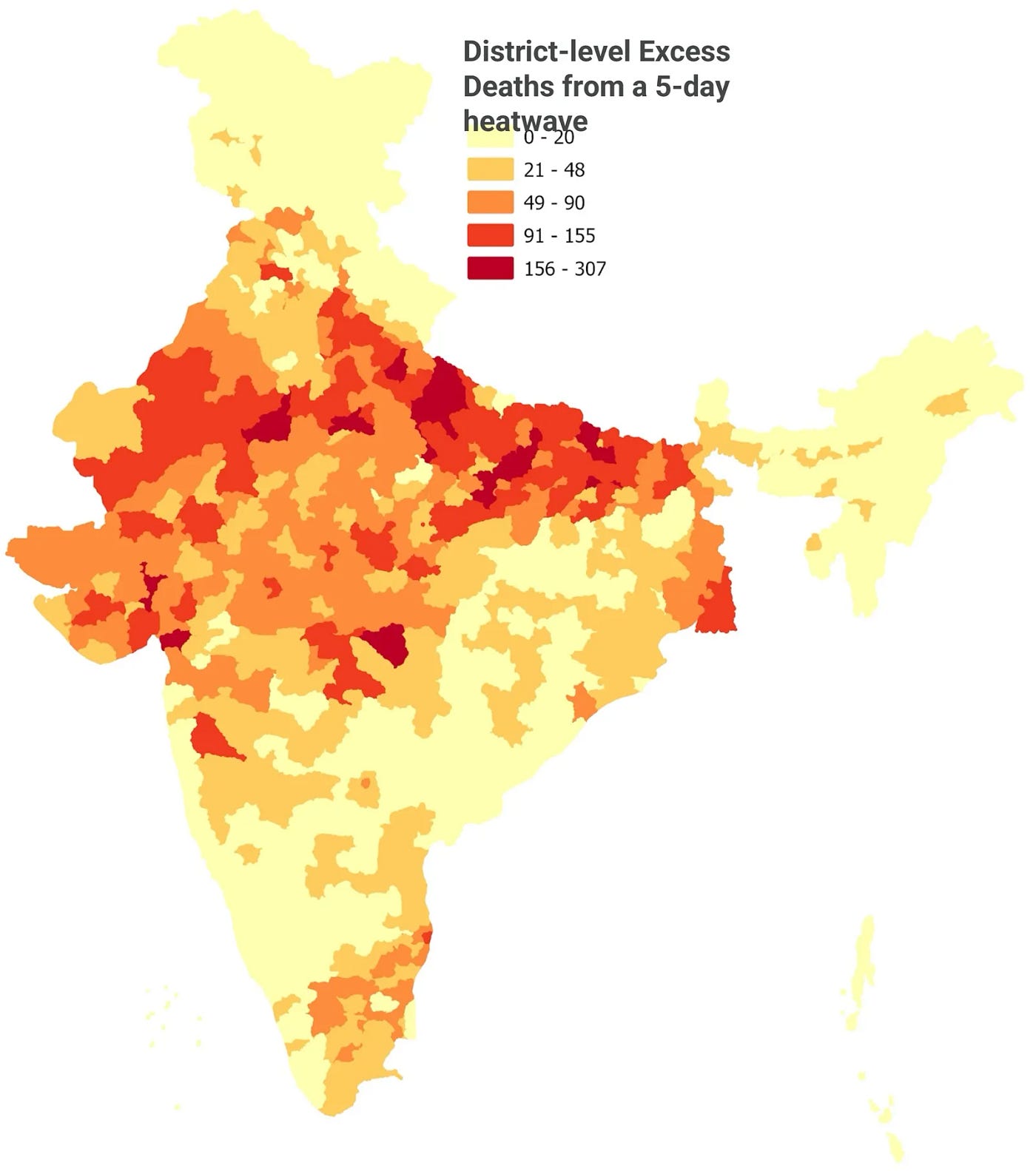
District-level distribution of excess deaths during a five-day heatwave (Source: Estimating heatwave-induced excess mortality in India’s districts)
The heat has done the actuarial work the market always does. It found the cheapest lives and gathered there.
Six Kilometers to a Sliver of Shade
To see what 8,100 projected deaths in a single state looks like before it becomes a number, go to Banda.
In May, this district in Uttar Pradesh held the top of an ugly national ranking for more than a week, the hottest place in the country, 47 to 48 degrees Celsius. By six in the morning the light already had the flat glare of afternoon, shadows shrinking before breakfast. The local meteorologist, Dinesh Sah, has watched this district hit 49 before. What unsettled him this time was the persistence, eight or nine days without a break. That part was new.
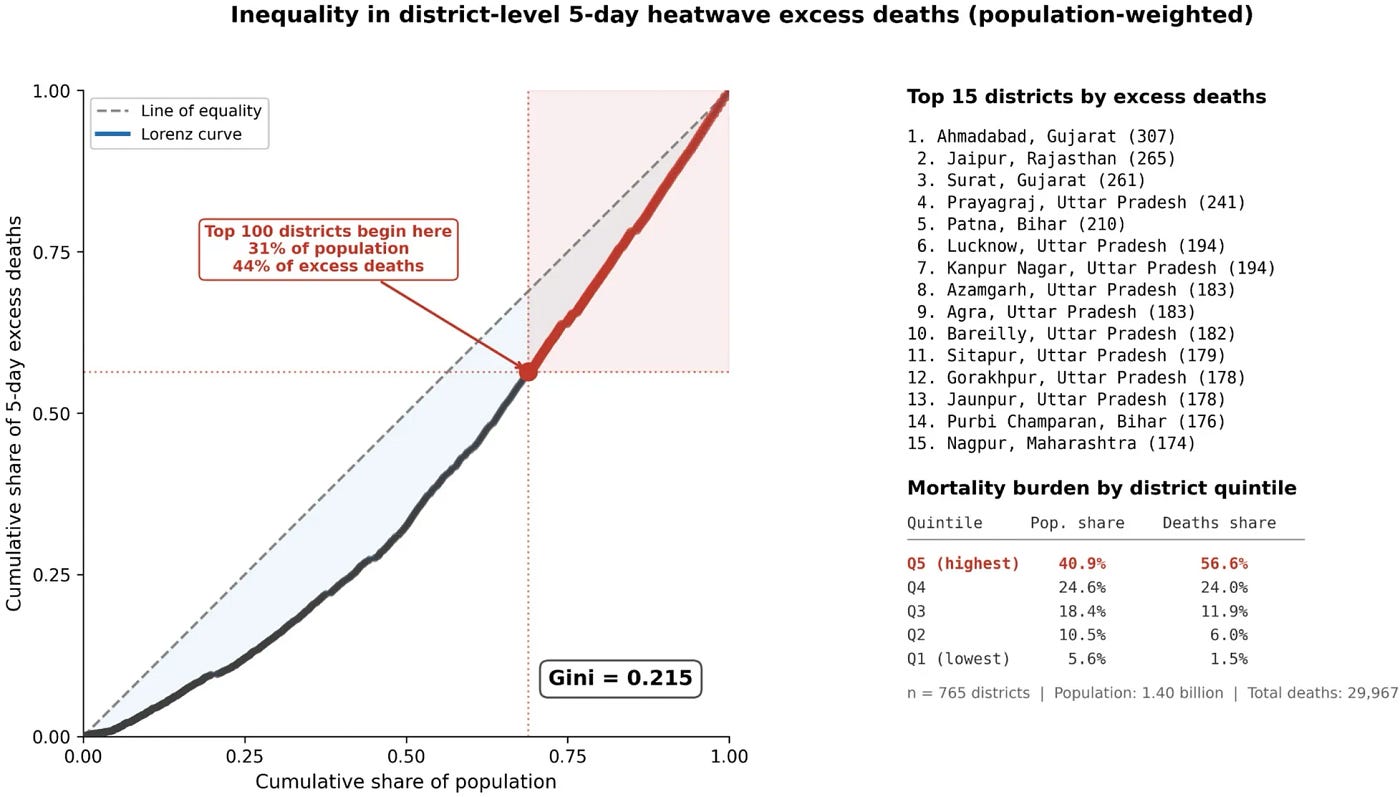
Population-weighted lorenz curve of district-level 5-day heatwave excess mortality across India (Source: Estimating heatwave-induced excess mortality in India’s districts)
The vegetable market thirty kilometers out at Atarra now empties by eight in the morning, the whole trading day compressed into the cool hours before the sun takes over. A tomato trader named Himanshu put it plainly at quarter past six, that it already felt like eight or nine o’clock. His produce spoils faster than he can sell it. The heat shortens the life of a box of tomatoes the way it shortens the working day, the way it shortens a person.
Around two in the afternoon one day last week, with the temperature at 46, three women repairing a highway crouched under a water tanker on a bridge over the Ken river, eating lunch in the strip of shade the chassis threw. One of them, Shanti Devi, walks six kilometers each way to the worksite and home again. Her lunch was bread with onion, salt, and pickle, because anything with vegetables would spoil by noon. Then she said the sentence that holds the entire argument of this piece, the one no economist or modeler could improve on.
“Poor people don’t have the luxury of worrying about the heat”
That is the 2.3 disproportion spoken in a human voice, on a bridge, at 46 degrees. Worrying about heat is a luxury. It requires an alternative. It requires somewhere cooler to be, work you can skip, a wage that survives a missed shift. Shanti Devi has none of those, so she has stopped spending energy on worry and spends all of it on walking.
The Word for This Is Not Resilience
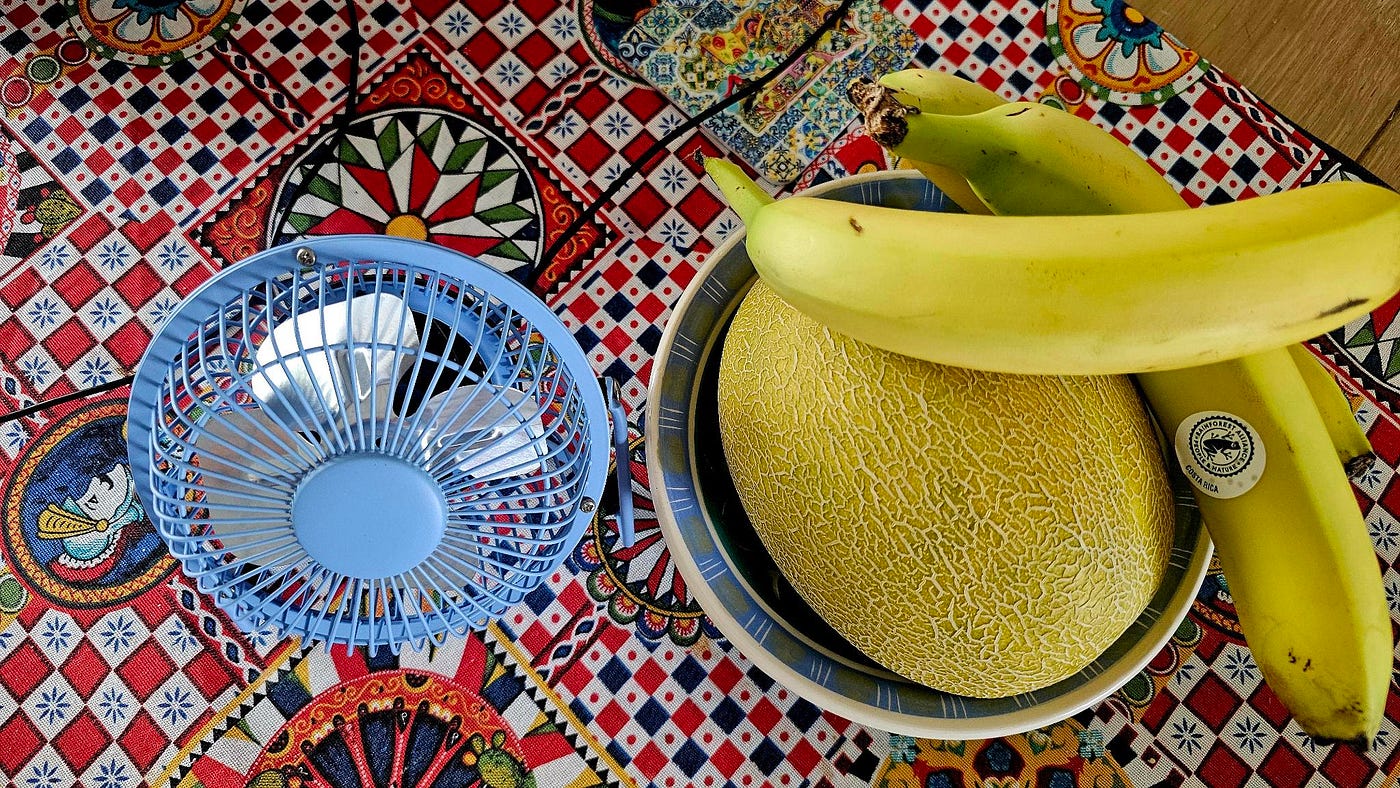
Read the dispatches from Banda and a strange admiration creeps in. Everyone has adapted. The mason Pappu Verma now works seven to noon, breaks through the worst of the day, then again four to seven, stretching eight hours of work across thirteen so the headaches and heat sickness don’t take the wages he earns. Otherwise, he said, the money would go to medicine. Rameshwar Yadav, sixty, tends buffaloes wrapped in heavy winter clothes and a shawl over his head in 46-degree air, because thick fabric slows the sun before it reaches the body. Chunubadi, eighty years old, sits beside a table fan held together with string that blows air dry and relentlessly hot. The sweat dries, she said, but the gusts are hard for an old body to bear. In eighty years she has never seen heat like this, and she is not sure she can endure it.
The reporters reach for the word resilience. The think tanks reach for adaptation. Banda has Heat Action Plans on paper the way most Indian cities do, plans that an assessment of dozens of them found largely unfunded and poorly targeted.
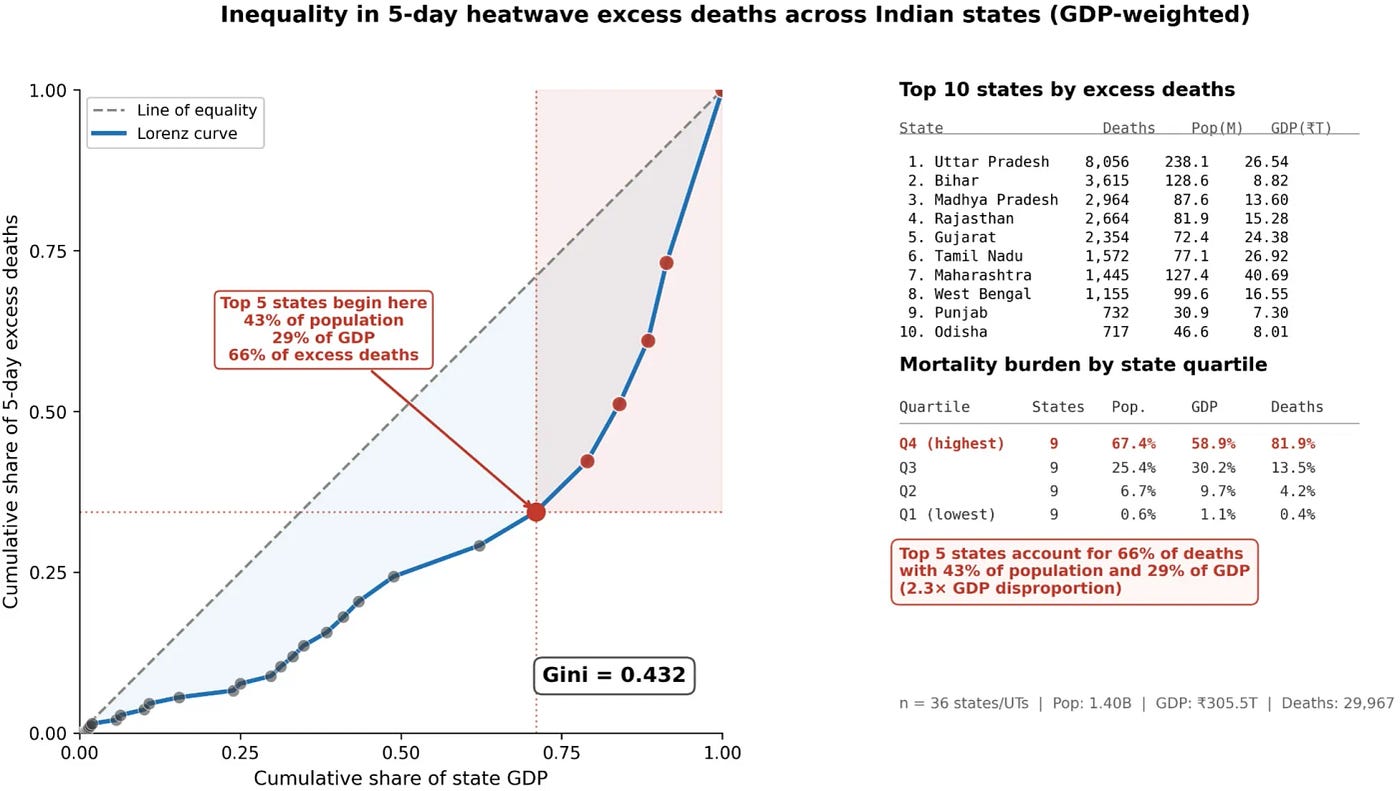
GDP-weighted lorenz curve of state-level 5-day heatwave excess mortality across India (Source: Estimating heatwave-induced excess mortality in India’s districts)
Look at what the adaptation actually costs. Pappu Verma surrenders four hours of his day and four of his evening so his body can wait out a sky that wants to kill it. Shanti Devi surrenders twelve kilometers of walking and the right to eat a vegetable. Chunubadi surrenders sleep. None of this buys relief. It buys one more season of labor before the body files for bankruptcy. A system that forces a population to rebuild its daily biology around not dying has not helped that population adapt. It has discovered exactly how much suffering it can extract before the worker stops producing, and set the dial there.
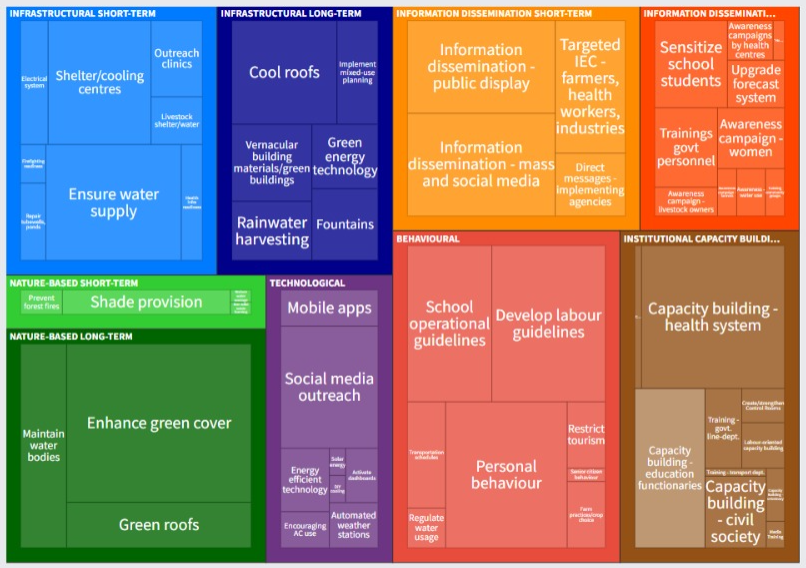
How Is India Adapting to Heatwaves? (Source)
Adaptation and relief are not the same thing. The people of Banda know the difference in their joints. The road workers sheltering under the tanker warned a visitor he would get heatstroke, then added that they were used to it. Used to it is not a coping strategy. It is the sound a body makes on the way to giving up.
The Ceiling Has No Appeal
Here is the part the resilience story cannot survive.
In a sealed laboratory in Australia, scientists ran a climate chamber experiment on a man named Owen. Thirty-one years old, an ultramarathon runner, heat-acclimated, hydrating as much as he wanted, wired to sensors that tracked his core temperature in real time. They set the box to 54 degrees at 26 percent humidity, conditions that put his body at the wet-bulb limit of 35 degrees, the point where sweat stops evaporating and the body stops being able to cool itself at all. If any human was built to outlast that room, it was him.
Source
After one hour his sweat poured uselessly. After two his muscles misfired and his coordination loosened. Somewhere past two and a half hours, with his core temperature racing toward 39, the alarms went off and a team pulled him out before his body finished the lesson. You can produce all the sweat you want, the lead researcher explained, but when none of it evaporates, even a heat-acclimated body simply maxes out.
Now hold the two rooms side by side and say nothing.
Owen had unlimited water, constant monitoring, and a team standing by to drag him out at the first alarm. He lasted two and a half hours. Shanti Devi has bread and onion and a strip of shade under a truck, six kilometers from home, paid by the day. The physics in her air is the same physics that broke an ultramarathoner. The difference is that nobody is monitoring her core temperature, no alarm will sound, and there is no team waiting to pull her out. She is the experiment that runs without consent and without an exit.
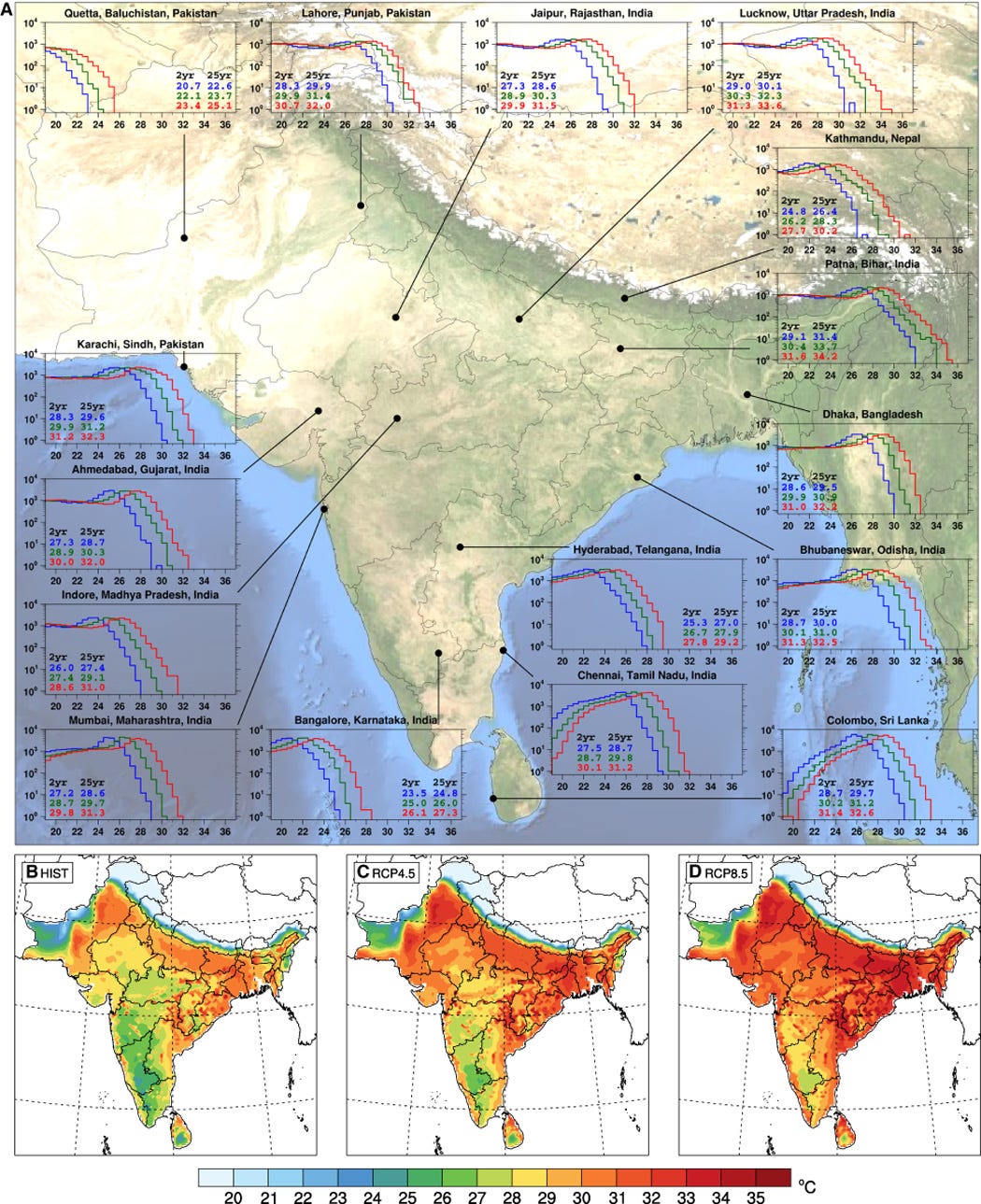
2 Histograms of daily maximum wet-bulb temperature, TWmax (°C), and maps of the ensemble averaged 30-year TWmax. (Source: Deadly heat waves projected in the densely populated agricultural regions of South Asia)
Across India people now face nearly twenty heatwave days a year each, about a third of them down to a warming climate. Heat erased the equivalent of 247 billion labor hours in a single year, most of it from the people working fields and building sites, and worldwide heat deaths have climbed 23 percent since the 1990s to roughly half a million a year. The chamber in Australia was a controlled demonstration of a ceiling that millions of bodies now press against in the open, on bridges and worksites and the walk home, with no door marked exit.
The Furnace Was Built on Purpose
None of this fell from the sky as weather.
Banda sits in a landscape that used to cool itself. The Ken river ran through it, and a living river moves heat the way sweat moves heat, by carrying it away. Then sand mining and falling groundwater stripped the river’s ability to cool the land around it, a pattern a review of river sand mining documents across India, where extraction drops water tables and dries the ground that once held moisture. The trees went the same way. A study at the local agricultural university found that nearly a sixth of the district’s dense forest cover vanished between 1991 and 2022, cleared for mining and farmland. Rivers run low and expose beds of sand and stone that soak up the sun and throw it back. Concrete replaced what grew.
The date matters. India opened its economy in 1991, and the urbanization that followed ran at an unusual speed, driven by migration and then the tech boom, less planning than improvisation. Cities filled in their lakes and paved their soil, and a place that loses its water and its trees stops being able to release the day’s heat at night. Concrete and asphalt hold it like a battery and radiate it back into the dark, so the heat island becomes a 24-hour condition instead of a daytime one. In Banda the overnight temperature now sits around 30, and the meteorologist Sah described the result in a line that should outlive him.
“It feels as if mornings and nights no longer exist.”
The farmer Prem Singh sees the cause clearly from inside it. The annual heat is nothing new and his crops need it. What worries him is the intensity, and he blames shrinking tree cover, the mining, the rising fossil-fuel use, and the spread of air-conditioning that cools the people who can afford it while pushing more heat onto the people who cannot. This, he said, has made life harder for the poor while the well-off have barely felt it.
[embed]
A farmer in Banda has identified the engine. The air-conditioner is a machine for moving heat out of one room and into someone else’s life, and the physics backs him up: waste heat vented by a city’s units raises outdoor night temperatures and drives the demand for still more cooling. Burn more to cool the few, and the street gets hotter for the many.
A Perfectly Efficient Instrument
Banda’s poorest do not have coolers. Eighteen-year-old Kranti Vishwakarma spends four or five hours a day fetching water for her household, and when the power cuts out in the afternoon, relief comes from the shade of a neem tree. We don’t have air conditioners, she said, so the neem trees play that role. A tree is the cooling infrastructure left to the people the heat kills first, and the trees are exactly what the last three decades cut down.
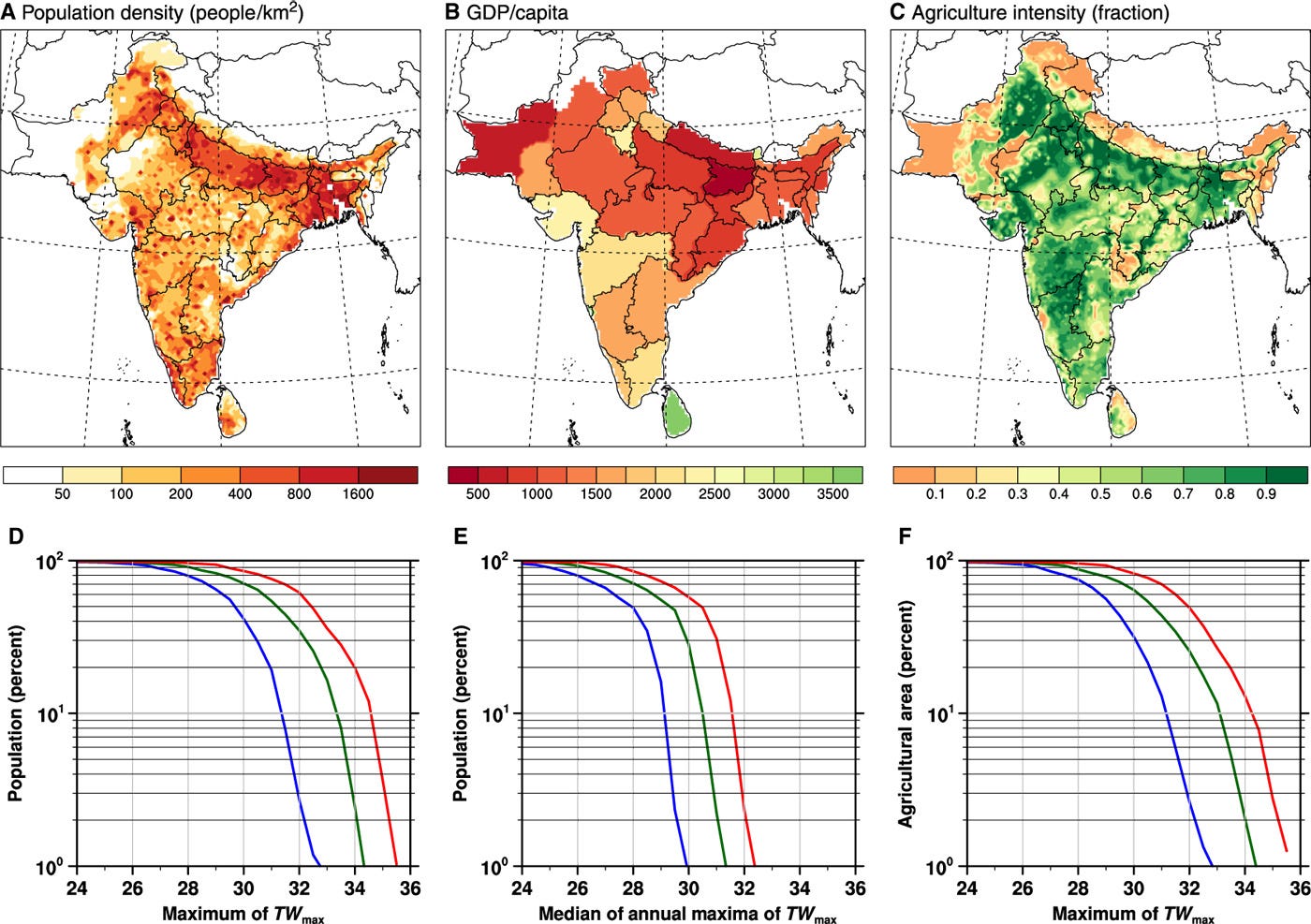
Vulnerability due to population density, poverty, and outdoor working conditions (Source: Deadly heat waves projected in the densely populated agricultural regions of South Asia)
So return to the number the Berkeley researchers built, and hear it now that Banda has filled it with faces. Uttar Pradesh, Bihar, Madhya Pradesh, Rajasthan, and Gujarat will absorb 66 percent of a heatwave’s dead while contributing 29 percent of the country’s wealth. The researchers turned it into a recommendation, that money for adaptation should follow the bodies rather than the population counts or the administrative convenience. None of this is bad luck of geography. The Indo-Gangetic plain that holds these states is one of the planet’s emerging hotspots for deadly humid heat, and it is also where the poorest live and work outdoors. Read without the academic register, the number says something the market has known all along and never had to admit.
The heat is a perfectly efficient instrument. It charges the highest price to the lives the economy has marked down the lowest, and it collects in the states that produced the least of the growth that built the furnace. Shanti Devi walks six kilometers each way to repair a road in 46-degree air, eats bread on a bridge, and tells a stranger that worrying about the heat is a luxury she cannot afford.
The numbers agrees with her. It has set her price, and it is the heat that comes to collect.
Thank you so much for reading! If you have any further comments, please contact me here!
메타데이터
- post_id
- 32077f6121da
- slug
- the-heat-knows-exactly-how-much-your-life-is-worth-32077f6121da
- url
- https://medium.com/southern-winds/the-heat-knows-exactly-how-much-your-life-is-worth-32077f6121da
- canonical_url
- https://medium.com/southern-winds/the-heat-knows-exactly-how-much-your-life-is-worth-32077f6121da
- author_url
- https://medium.com/@jamal.ghadi08
- status
- ok
- fetched_at
- 2026-06-12 18:14:10