There Is Money, but No Peace
The Most Expensive Trade I Ever Made
There Is Money, but No Peace
The Most Expensive Trade I Ever Made
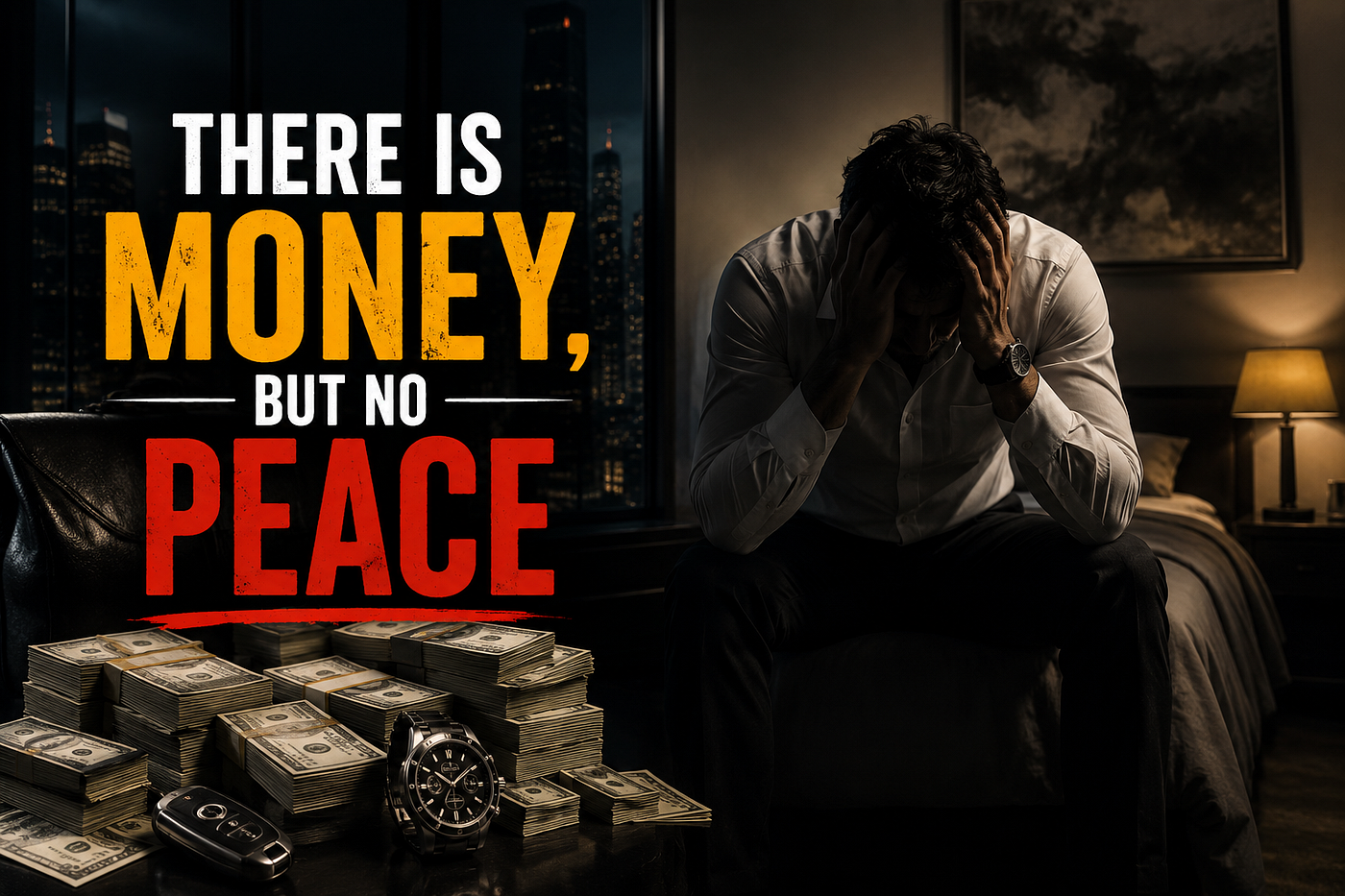
Money can’t buy peace
How chasing financial security quietly turned into a life I no longer wanted to live — and the uncomfortable question that changed everything.
The light from my laptop was the only thing illuminating the room.
It was 1:17 a.m.
A payment notification appeared on my phone. Another client had paid. The amount was large enough to make my younger self stare at the screen in disbelief.
I should have felt relieved.
Instead, my chest felt tight.
The strange part wasn’t the money. The strange part was that I had spent years believing this exact moment would solve everything.
The anxiety.
The uncertainty.
The restless feeling that life was happening somewhere else while I was preparing for it.
Yet there I was, earning more than I ever had, unable to remember the last day I felt genuinely calm.
Many people carry this private confusion.
They don’t talk about it because it sounds ungrateful.
How can someone complain when the bank account looks healthy?
How can someone admit they’re exhausted when they finally have what they once prayed for?
For a long time, I couldn’t answer those questions.
What I discovered wasn’t a productivity hack or a mindset trick.
It was something far quieter — and far more unsettling.
The possibility that money and peace are not traveling to the same destination.
Within six months of reaching a financial goal I had obsessed over for years, I developed a habit.
Every morning, before brushing my teeth, I checked my accounts.
Every night, before sleeping, I checked them again.
I wasn’t poor.
I wasn’t in danger.
Yet I behaved like someone standing on a frozen lake, convinced the ice would crack at any moment.
That realization cost me more than any financial mistake I’ve ever made.
Because I began to see that I hadn’t built wealth.
I had built dependence.
Why More Money Often Magnifies Existing Fear
We’re taught that financial success removes stress.
Sometimes it does.
But beyond a certain point, money becomes a spotlight.
Whatever fear already exists gets illuminated.
If insecurity lives inside someone, more income can create bigger insecurities.
If comparison lives inside someone, more success often expands the list of people they’re comparing themselves against.
I call this The Amplifier Effect.
Money rarely creates a new emotional reality.
It amplifies the one already there.
A business owner I once knew doubled his annual income.
His reward?
Twice as many sleepless nights.
Not because the business was failing.
Because now he had more to lose.
The mistake is assuming financial growth automatically produces emotional growth.
It doesn’t.
Those are separate projects.
Money can solve money problems. It cannot solve meaning problems.
Try this:
-
Write down three financial goals.
-
Next to each one, write the emotion you expect it to create.
-
Ask whether that emotion can be practiced before the goal arrives.
The trap is believing peace is waiting at the finish line.
Most finish lines simply move.
The Hidden Cost of Living in “Almost”
For years, my life operated on a single sentence.
“I’ll relax when…”
I’ll relax when revenue becomes predictable.
I’ll relax when the mortgage is smaller.
I’ll relax when investments grow.
I’ll relax when I feel secure.
The problem?
There is no natural ending to that sentence.
The human mind is remarkably talented at moving the target.
I call this The Horizon Debt.
It’s the debt created by borrowing happiness from the future.
The interest rate is paid in today’s peace.
One afternoon, I met an old friend for coffee.
He earned significantly less than many people I knew.
Yet he seemed lighter.
Present.
Available.
Halfway through the conversation, I asked him what his long-term financial goal was.
He laughed.
“I have goals,” he said. “I just don’t want them managing my mood.”
That sentence stayed with me for weeks.
A goal should direct your actions, not hold your happiness hostage.
The exercise here is simple:
- Identify one thing you’ve postponed enjoying.
- Ask whether it truly requires more money.
- Experiment with doing a smaller version of it this week.
Most people discover the obstacle wasn’t financial.
It was psychological.
There Is Money, but No Peace Because Achievement Became Identity
This is where things become uncomfortable.
Many successful people don’t merely earn money.
They become the person who earns money.
The distinction matters.
When identity fuses with achievement, rest begins to feel dangerous.
Slowing down feels irresponsible.
Stillness feels like failure.
Every quiet moment becomes a threat.
I call this The Achievement Costume.
Wear it long enough and eventually you forget what’s underneath.
A client once told me something that sounded absurd at first.
“If I stop working this hard, I don’t know who I am.”
He wasn’t talking about income.
He was talking about identity.
The deeper problem wasn’t financial dependence.
It was emotional dependence.
The moment your worth becomes measurable, peace becomes negotiable.
To loosen this grip:
- Spend one hour each week doing something that produces no income.
- Don’t post it.
- Don’t optimize it.
- Don’t turn it into a side hustle.
Protect one corner of life from monetization.
The landmine is obvious.
Many ambitious people immediately try to maximize their hobby.
Don’t.
The point is recovery, not expansion.
I Need to Be Honest About Something
I need to be honest about something.
A few months ago, after learning all of this, I caught myself refreshing revenue dashboards three times before breakfast.
Nothing had changed.
No emergency existed.
No decision depended on that information.
I was simply looking for reassurance.
The irony wasn’t lost on me.
I had spent years writing about peace while quietly negotiating with anxiety.
That’s when I realized peace isn’t a destination.
It’s a relationship.
And like every relationship, it requires maintenance.
I wrote this because I need to read it again myself.
The Peace Portfolio Nobody Talks About
Ask someone how diversified their investments are.
Many can answer immediately.
Ask how diversified their sources of meaning are.
Silence.
This is where the real work begins.
I call it the Peace Portfolio.
Most people invest everything into one account:
Work.
When work thrives, life feels good.
When work struggles, life collapses.
That’s not stability.
That’s concentration risk.
A healthy life spreads meaning across multiple domains:
- Relationships
- Health
- Curiosity
- Spiritual practice
- Creativity
- Service
- Community
The goal isn’t balance.
Balance is often unrealistic.
The goal is resilience.
When one area suffers, another can carry part of the load.
After reading the work of Viktor Frankl and later revisiting Man’s Search for Meaning, I realized something profound:
Human beings can survive extraordinary hardship when meaning remains intact.
Money helps.
Meaning sustains.
Engagement isn’t always a signal of interest; it’s often a signal of anxiety.
Edit your life the way great writers edit sentences: remove what impresses and keep what matters.
Most gurus sell complexity because simplicity doesn’t require a subscription.
Peace is not the reward for enough achievement. Peace is the foundation that makes achievement worth having.
For Those Who Skimmed With Good Reason
- Separate money problems from meaning problems.
- Beware of The Amplifier Effect: income magnifies existing emotional patterns.
- Stop borrowing happiness from future milestones through Horizon Debt.
- Build goals that guide actions, not moods.
- Protect parts of life from monetization.
- Diversify meaning the same way investors diversify assets.
- Treat peace as a practice, not a prize.
There is nothing wrong with wanting money.
Poverty is hard.
Financial stability matters.
Responsibility matters.
Ambition matters.
But somewhere along the way, many of us accidentally make a trade.
We exchange today’s peace for tomorrow’s security.
Then tomorrow arrives and asks for another payment.
The question that changed my life wasn’t “How much money do I need?”
It was:
“How much peace am I willing to sacrifice to get it?”
The answer turned out to be smaller than I expected.
If you’ve been chasing success and wondering why the finish line feels strangely empty, I write about the quiet, enduring way to build a life that feels rich on the inside too. You can find me here when you’re ready.
Tags
- Self Improvement
- Personal Finance
- Productivity
- Meaningful Living
- Inner Peace
메타데이터
- post_id
- 320e1956f0e6
- slug
- there-is-money-but-no-peace-320e1956f0e6
- url
- https://medium.com/@martin.joo.599/there-is-money-but-no-peace-320e1956f0e6
- canonical_url
- https://medium.com/@martin.joo.599/there-is-money-but-no-peace-320e1956f0e6
- author_url
- https://medium.com/@martin.joo.599
- status
- ok
- fetched_at
- 2026-06-09 15:37:30



