What FATs (Food Acceleration Teams) can do for Big Island food self-sufficiency
[I’m running for House District 4 (Puna) as the RESILIENCE candidate, focusing on local food, local power, affordable housing, and the JOBS…
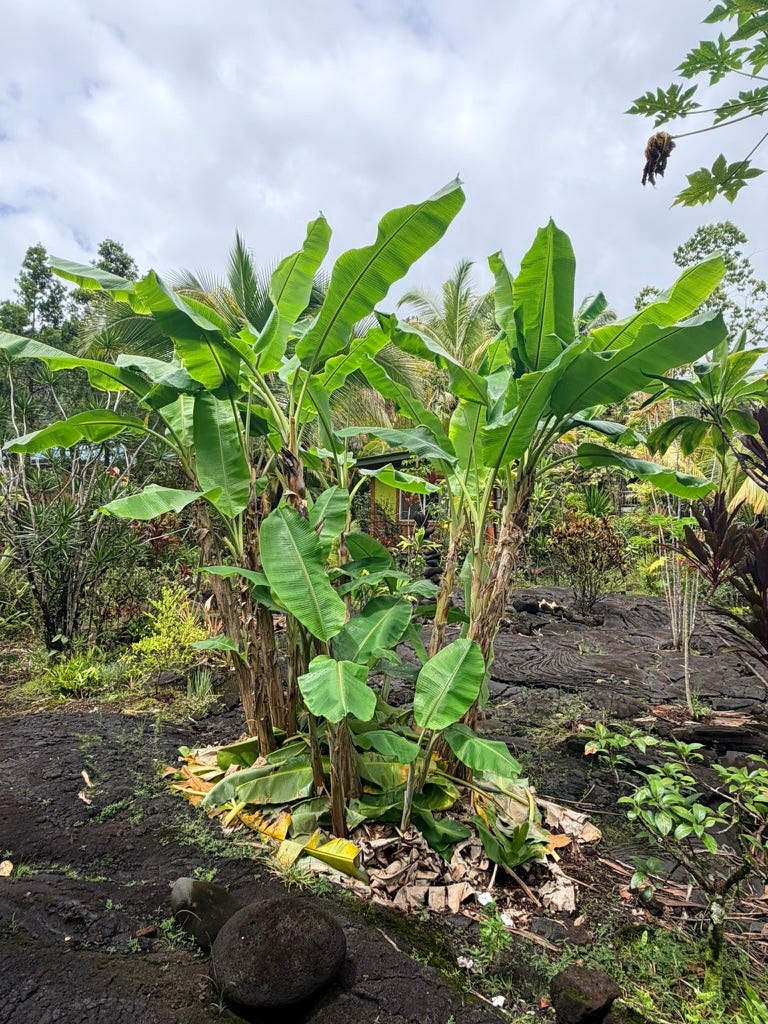
A dwarf banana patch in my garden (photo Tam Hunt)
What FATs (Food Acceleration Teams) can do for Big Island food self-sufficiency
[I’m running for House District 4 (Puna) as the RESILIENCE candidate, focusing on local food, local power, affordable housing, and the JOBS that all of these industries will bring]
I’ve written a lot lately about what we should grow on the Big Island and why — reviving the ahupuaʻa, planting food forests, leaning on tropical staples like ʻulu and ʻuala that already grow here beautifully.
But there’s a question we haven’t quite answered: how do we actually get all of this into the ground — at scale, growing, and fast enough to matter?
That’s the question my campaign manager Dean Yacalis and I have been chewing on, and we think we have at least the shape of an answer. We’re calling it a Food Acceleration Team — a FAT. (Yes, the acronym is on purpose, and yes, we think it’s a little funny for a food program. It also happens to be exactly the right word: this is about accelerating, getting fatter with good food.)
The gap nobody talks about
Here’s the uncomfortable truth about food self-sufficiency campaigns everywhere: almost everybody agrees with the goal, but almost nobody actually plants the food forest they envision for their backyard.
It’s not because people don’t care. It’s because the barriers between “good idea” and “plants in the ground” are real and stacked on top of each other. You don’t know which crops will thrive on your particular lot. You don’t have the seedlings. You’re not sure how to design the layers or where to put things. You don’t have a free weekend — or three — to do the hard initial work of creating soil, digging holes in lava, mulching, fertilizing, and getting a system established. And if you plant something and it struggles in year one, as most things do, you give up.
Each of those is a small barrier. Together they’re a wall. And that wall is why, decades into people talking about local food, the Big Island still imports 85 to 90 percent of what it eats.
A lot of the work I’ve proposed is aimed at lowering pieces of that wall — a propagation nursery so the plants exist, a microclimate GIS tool and a crop-and-market clearinghouse (Dean’s idea) so you know what to plant, the “Prep, Set & Forget” method so the system mostly runs itself once established. But knowledge and seedlings still leave the hardest part undone: somebody has to actually show up and do it.
That’s the FAT.
What a Food Acceleration Team actually is
A FAT is a small, trained, mobile crew that goes site by site and turns a bare yard — or parking strip, or schoolyard, or church lawn — into an established, productive food forest. Not a pamphlet. Not a workshop you have to find time for. A team that comes to you and gets it done.
As we’re sketching it, a FAT visit looks something like this:
First, assess the site — walk the land, check the GIS microclimate read for that exact address, look at sun, rain, slope, soil or lava, and water. Then design a food forest tailored to that spot: the right top-ten crops for that microclimate, stacked in layers, planned out in succession. Then source the plants from the nursery and the materials — mulch, compost, biochar — needed to build soil on raw ground. Then install it: plant the system, tie in catchment or irrigation, lay down the mulch, get it going. Then train whoever lives or works there on the simple maintenance — mostly pruning and harvesting. And then, crucially, follow up — come back over the two-to-three-year establishment window to prune, troubleshoot, and replace what didn’t take, so the thing actually succeeds instead of quietly dying in year one.
In other words, a FAT removes every barrier in that wall at once. You don’t need to know anything, own anything, or have any particular skill. You just need to say yes.
Everywhere, not just backyards
The vision Dean and I keep coming back to is that food forests shouldn’t live only in the yards of the already-motivated. They belong at every homestead, every business, every government building, every school and church and community center — and on the vacant lots, road verges, and idle parcels in between.
Picture it: county and state campuses ringed with breadfruit and banana instead of ornamental hedge. Hotels and restaurants growing a real share of what they serve. Schools where kids learn under the trees that feed their lunch. Churches whose grounds feed their congregations and neighbors. That’s not a fantasy — it’s just the ahupuaʻa logic applied to the modern built landscape, turning the whole island into a distributed, productive food forest. FATs are how you get there, one site at a time, faster than organic adoption ever would.
What the acceleration is worth
Why does the “acceleration” part matter so much? Because of time and participation — the two variables that decide whether any of this adds up.
An established Puna food forest can produce something like 500 to 1,500 pounds of food a year and can displace $2,000 to $3,000 of grocery spending per household. At even 25 percent participation across our district, that’s on the order of $6.3 million a year staying in the pockets of families in Hawaiʻi’s lowest-income district. (Those are planning estimates, and I always flag them as such.)
But notice the hinge in that sentence: participation. Twenty-five percent doesn’t happen on its own — left to individual initiative, adoption crawls, and the trees that take five to seven years to mature don’t even get planted until far too late. A deployment mechanism is what moves the participation number, and moves it now. A FAT that installs systems steadily, site after site, is how you compress what would otherwise be decades of slow, scattered adoption into a few years of real, visible change. The food forest you plant today feeds you in three years. The one you wait around to plant yourself feeds you in never.
A jobs program in disguise
There’s a part of this I find genuinely exciting beyond the food. Staffing FATs means good, local, hands-in-the-dirt jobs — exactly the kind of work that’s in short supply in Puna, and exactly the kind young people, veterans, and folks looking for a fresh start can step into and be proud of.
And here’s the part I like best: we don’t have to build that ladder from scratch, because Hawaiʻi Island already has most of the rungs. GoFarm Hawaiʻi — the beginning-farmer training program with a Hilo site, run through UH CTAHR in partnership with The Kohala Center — already moves people from a free “AgCurious” intro through hands-on farm training, business skills, and even incubation land, and has graduated hundreds of new growers across the state. GoFarm graduates are natural FAT crew members and crew leaders, and a FAT is a natural next step — or first paid job — for someone coming out of that pipeline. Hoʻōla Farms, which provides agricultural training and support specifically for veterans (and already partners with GoFarm), is another obvious fit, especially given how many veterans call Puna home — I’m one of them.
Layer in The Food Basket, the Hawaiʻi ʻUlu Cooperative, The Kohala Center, Kuaʻāina Ulu ʻAuamo, our community colleges, local nurseries and permaculture-design businesses, and Hawaiian practitioners, and you can already see the outline of a coalition that could stand a FAT up without anyone reinventing the wheel. Train on a crew, learn permaculture, syntropic, and Hawaiian agroforestry skills on real sites, and you come out ready to run your own farm, start a landscaping-into-food business, or lead a crew of your own. A FAT becomes a workforce engine as much as a food engine.
Who should run it — not the government
I’ll be straight that this is an idea Dean and I are actively developing, not a finished blueprint. But on one question we’ve grown pretty clear: a FAT probably should probably not be a government program.
I say that as someone running for office, and I mean it as a structural observation, not a cheap shot. Government does some things well — funding, setting standards, removing barriers — but standing up a nimble, hands-on field operation that has to adapt site by site and season by season is usually not one of them. New public programs tend to move slowly, accrete paperwork, and struggle to pivot when something isn’t working. A FAT lives or dies on speed and adaptability. That points toward a nonprofit or private-sector-led model — most likely a coalition of the groups above, organizations that already know how to hire fast, change course, and stay close to the ground.
That doesn’t mean government has no role. The right role for the State and County is as a funder and enabler, not an operator: seed the effort with grant-in-aid, channel USDA beginning-farmer and resilience dollars and philanthropy toward it — GoFarm itself runs on exactly this kind of public-private braid — and, just as importantly, clear the regulatory and zoning underbrush that makes it harder than it should be to grow and sell food in the first place. Empower the people doing the work; don’t try to direct them from a desk in Honolulu. That’s the approach I’d bring to this seat.
The questions that remain are the practical ones: how many crews, installing how many sites a year, to actually move the needle, and exactly how the funding braid comes together. We have working answers — but they’re working answers, and I’d rather say so than pretend otherwise. What I’m confident about is the logic. We have the method (PS&F), we’re building the knowledge tools (the nursery, the GIS tool, the clearinghouse), and the missing piece is simply a team whose whole job is to show up and plant. That’s the gap a FAT fills — and the people best placed to fill it are already here.
Where this fits
Regular readers know I think about food in two thrusts: how we thrive by ramping up local production, and how we survive in a pinch if the ships stop coming. FATs sit squarely in the first, but they strengthen the second too — every food forest a FAT plants is one more household that isn’t three days from empty shelves.
This is the next phase. We’ve spent a long time agreeing on the destination. A Food Acceleration Team is how we finally start driving.
I’d genuinely love your thoughts on this one — it’s early enough that your ideas can shape it. What would make you say yes to a FAT showing up at your place? What sites in Puna are crying out to be food forests? Tell me. And if this is the kind of practical, build-it-now thinking you want representing Puna, I’d be grateful for your support.
Let’s build back pono — and let’s plant while we’re at it.
메타데이터
- post_id
- 320eadce706c
- slug
- what-fats-food-acceleration-teams-can-do-for-big-island-food-self-sufficiency-320eadce706c
- url
- https://medium.com/@tamhunt/what-fats-food-acceleration-teams-can-do-for-big-island-food-self-sufficiency-320eadce706c
- canonical_url
- https://medium.com/@tamhunt/what-fats-food-acceleration-teams-can-do-for-big-island-food-self-sufficiency-320eadce706c
- author_url
- https://medium.com/@tamhunt
- status
- ok
- fetched_at
- 2026-06-16 19:09:56