Acting after the National Emergency Briefing
The image above is for one of several events that I’ve been involved in, mostly in Norwich, where I live.
Acting after the National Emergency Briefing
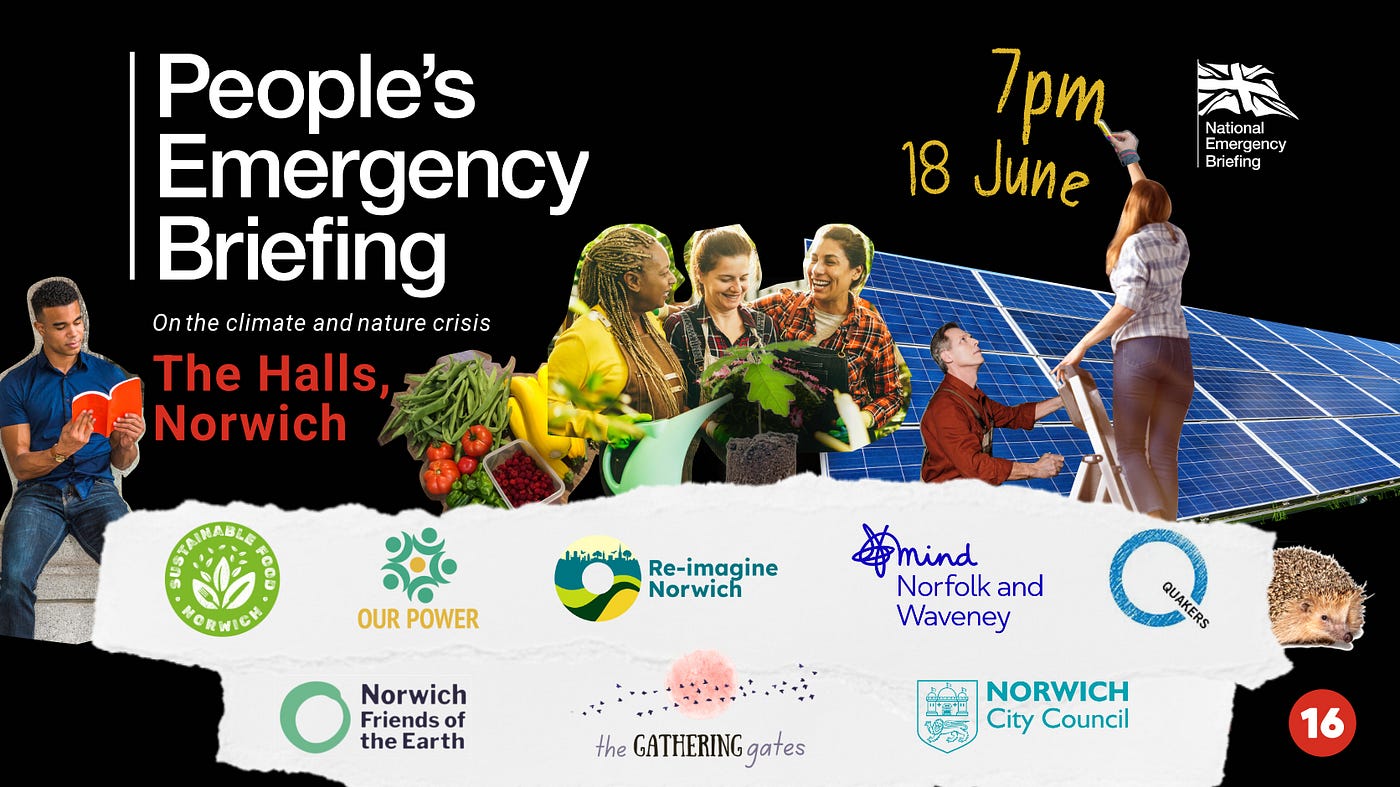
The image above is for one of several events that I’ve been involved in, mostly in Norwich, where I live.
This summer, hundreds of communities across the UK are discussing what to do about the climate and nature crisis after screenings of the People’s Emergency Briefing film.
What is that? In November 2025, Westminster Hall hosted a gathering of 1,200 invited politicians and leaders. Introduced by Chris Packham, ten experts over three hours presented the threats and solutions for the crisis. A shorter film version is now being rolled out in gatherings across the UK.
I’ve created a resource that interprets the Briefing materials to support its rollout via my networks. I’ve created some slides so that you can hold workshops alongside (or instead of) the film screening. I’ve also summarised all of the briefings and created a ‘synthesis of solutions’. I’ve added more information to help people understand the wider context and to share their ideas.
Below is my summary of the solutions most often mentioned by the experts, and some ideas on how you can help.
The experts made clear that the crisis increases risks of conflict, economic collapse and mass deaths. Its causes include the taking of resources from nature and people for the sake of corporate profit and power.
Former British Army officer, Lt Gen. Richard Nugee, summed up his talk with this: “What concerns me most is not any single crisis. It’s crises cascading together…food, health, infrastructure, migration, energy, extreme weather…all hitting at the same time, eroding trust in government by slow or failed responses…The biggest concern is that we’re facing the potential of an ungovernable state.”
The crisis is a severe matter of national and global security, and solutions require a response on the scale of tackling a world war, with far higher stakes than any war in history. This message feels overwhelming. Regret, apathy or blame are understandable responses, but not inevitable or helpful. By acting together, we can make a difference.
Based on the solutions the experts offered, here’s how we can support action. The big challenge is to accelerate action towards zero emissions by phasing out fossil-fuel technology and phasing in clean alternatives. However, cutting emissions is insufficient without also protecting people, places and livelihoods from inevitable climate impacts. The following measures allow for both mitigation and adaptation.
We can make landscapes more resilient. This means deploying nature to defend against floods and droughts by planting trees and increasing biodiversity.
You can help. Look at how places like Copenhagen and many Chinese cities are Sponge Cities. We can support our local politicians to pursue this idea.
We can make buildings adaptive and efficient. This involves retrofitting homes with insulation, heat pumps and grid upgrades, as well as zero-carbon new builds. It will help us cope with fossil fuel shortages and extremes of heat and cold.
You can help. Lobby MPs and councils to support these measures. Seek advice and grants for green heating and insulation, and ways to organise energy cooperatives with neighbours.
We need energy independence. This means supporting investment in highly efficient renewables and decentralised grid storage, and taking gas-powered stations into public control.
You can help. The UK has the highest offshore wind capacity in Europe, and the sector could employ 100,000 people by 2030. Put your efforts into ending fossil fuels rather than opposing renewable energy projects.
We can reduce fossil-fuelled transport. This requires deep cuts for aviation, as the sector cannot be decarbonised in time, and increasing active transport to reduce emissions, pollution and obesity.
You can help. Wars in Iran and Ukraine are making flights and car fuel more expensive, so by using public and active transport, you’ll make savings while helping create a cleaner, healthier environment.
We can create a healthier, greener food system. Plant-rich diets can be cheaper for consumers while reducing farming emissions by 60%, restoring biodiversity and soil quality, and providing health-related financial savings for the state.
You can help. Eat less meat and dairy, join a local farm share or veg box scheme, and reduce your food waste.
We can share knowledge about the root causes in our economic system, the future impacts on our lives, and the best available and affordable solutions. The more that knowledge spreads, the more that businesses, governments and citizens will make positive decisions.
You can help. Ask your MP to attend a Briefing event and to support a televised broadcast of it.
All these measures mean a shift in thinking. We have to treat nature as critical infrastructure, and recognise that all our livelihoods depend upon a living planet.
I’ll finish with words from the briefing of Professor Paul Behrens:
“We face a choice. We can continue with business as usual, watching our food system crumble, costs rise, and resilience erode. Or we can act now to improve our health, our environment, and our ability to roll with the punches of climate change. We will look back and wonder why we didn’t do it sooner.”
메타데이터
- post_id
- 3230b95825ab
- slug
- acting-after-the-national-emergency-briefing-3230b95825ab
- url
- https://medium.com/@bridgetmck/acting-after-the-national-emergency-briefing-3230b95825ab
- canonical_url
- https://medium.com/@bridgetmck/acting-after-the-national-emergency-briefing-3230b95825ab
- author_url
- https://medium.com/@bridgetmck
- status
- ok
- fetched_at
- 2026-06-14 11:28:49