Enterprise and Solution Architect Case: MVNO Integration in Digital Banking
In the dynamic intersection of fintech and telecommunications as of January 2026, digital banks are increasingly adopting Mobile Virtual…
Enterprise and Solution Architect Case: MVNO Integration in Digital Banking
In the dynamic intersection of fintech and telecommunications as of January 2026, digital banks are increasingly adopting Mobile Virtual Network Operator (MVNO) capabilities to deliver integrated financial and connectivity services. This convergence creates powerful super-apps where users handle banking, payments, investments, and mobile plans seamlessly in one interface.
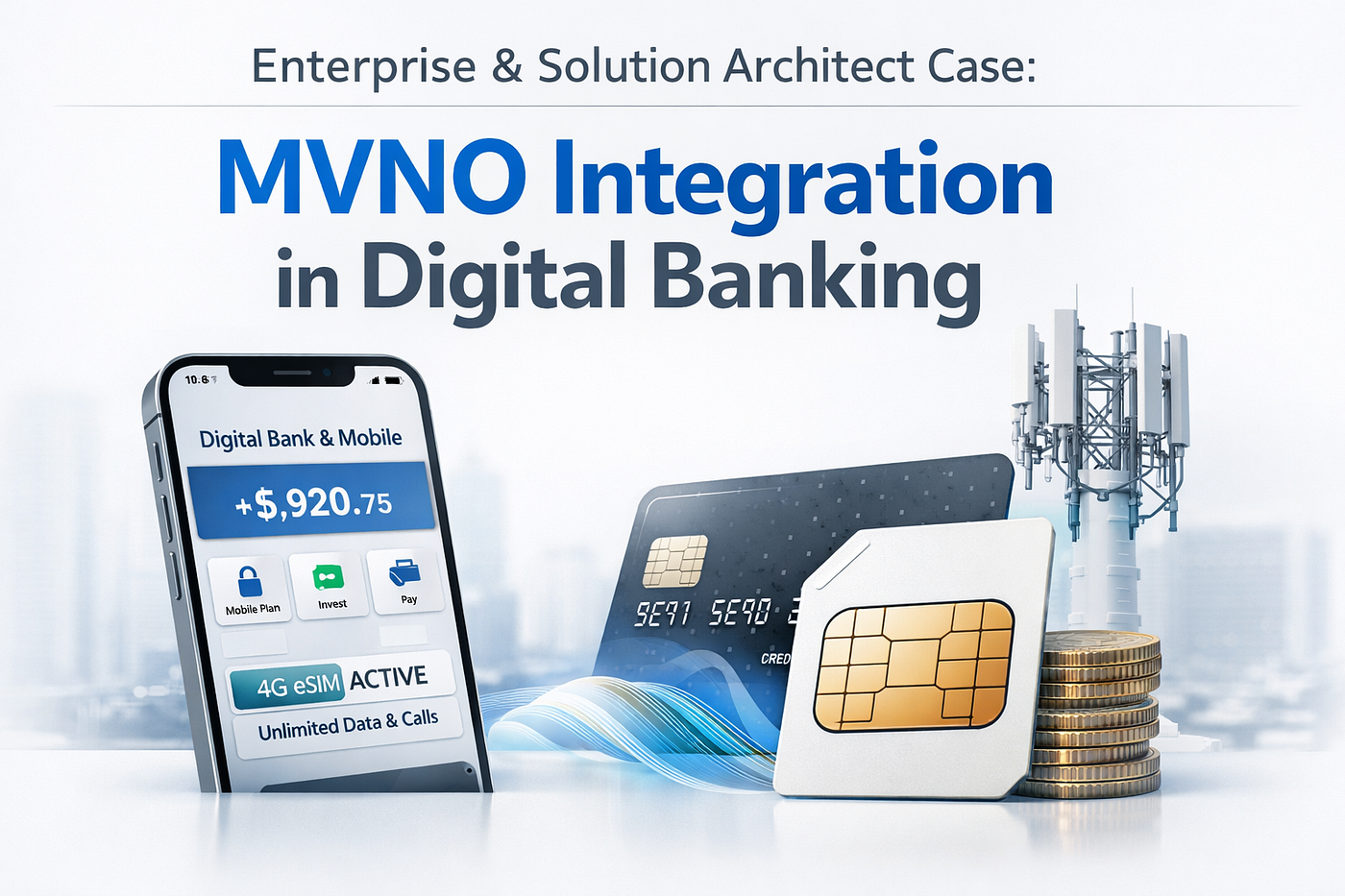
Prominent examples include Revolut’s full MVNO rollout in the UK and Germany (offering unlimited calls/texts/data with generous roaming), N26’s partnership with Vodafone in Germany for in-app SIM activation, and Nubank’s NuCel eSIM service in Brazil (emphasizing flexible, no-commitment plans tied to ecosystem rewards). These initiatives demonstrate how MVNO integration enhances user engagement in a high-competition environment where customer acquisition costs often exceed $1000–$1500 per user.
This article serves as an enterprise and solution architect case study, detailing the architectural patterns, integration strategies, best practices, and measurable efficiencies of MVNO embedding in digital banking platforms. We explore why this model excels in customer stickiness, regulatory compliance, and direct revenue generation, while providing actionable guidance for architects and CTOs. The discussion targets scalable, secure, compliant designs supporting tens of millions of users.
Strategic Rationale: Triple Value Proposition
MVNO integration delivers three synergistic benefits that justify the architectural investment:
- Customer Stickiness and Retention — Mobile connectivity becomes a daily-use “anchor” service, increasing app open rates and session duration. Bundling telecom with banking rewards (e.g., loyalty points for plan payments or free data for active credit card use) creates ecosystem lock-in. Industry data shows integrated MVNOs can reduce churn by 30–40%+ by extending user lifecycles through habitual engagement.
- Superior Compliance and Risk Management — Rich telecom metadata (usage patterns, location signals, device fingerprints) enriches financial fraud detection, credit scoring, and AML monitoring. This cross-domain data fusion strengthens PSD2/Open Banking compliance, enhances KYC/ongoing due diligence, and supports granular consent management under GDPR/eIDAS — often outperforming pure banking data sources.
- Direct and Recurring Revenue — Beyond transaction/interchange fees, MVNO adds subscription-based income from mobile plans, roaming add-ons, and value-added services (e.g., premium data bundles). Diversification reduces reliance on volatile fee-based models, with potential ARPU uplift from bundled offerings.
Best Practice Bullet Points for Realizing the Triple Value:
- Prioritize ecosystem lock-in by linking mobile perks directly to banking behavior (e.g., salary deposits unlock free data tiers) to maximize daily touchpoints and reduce switching incentives.
- Design unified consent and data governance frameworks that enable compliant cross-domain usage (telecom for fraud signals, banking for personalized offers) while maintaining strict segregation and auditability.
These elements form the core business case, turning MVNO from a cost center into a strategic differentiator.
Core Architectural Challenges and Mitigations
Bridging banking (regulated, batch-oriented) and telecom (real-time, event-heavy) domains poses significant hurdles:
- Real-time provisioning and charging vs. banking’s settlement cycles.
- Dual regulatory regimes (financial vs. telecom authorities).
- Scalability for millions of SIM activations and CDR (Call Detail Record) events.
- Security of converged sensitive data.
- Dependency on MNO/MVNE partners for network access.
Best practices mitigate these through modular, API-first, event-driven designs aligned with TM Forum ODA and GSMA standards.
Reference Architecture with Best Practices
Adopt a layered, cloud-native architecture:
- Frontend / Experience Layer — Unified React Native/Flutter app with seamless banking + telecom dashboard. In-app eSIM QR activation, usage visualization, and plan switching.
- Domain Services Layer — Separate bounded contexts for Banking (accounts, PSD2 payments) and Telecom (subscriber lifecycle, real-time charging). Shared microservices: Identity (OIDC), Customer 360°, Notification.
- Integration & Orchestration — API Gateway for external exposure; Kafka-based event bus for real-time flows (e.g., low-balance → auto-top-up trigger).
- Telecom Core — Light MVNO via MVNE (e.g., Circles, Spenza, or Lifecycle Software) for OSS/BSS, HLR/HSS emulation, convergent billing. Wholesale RAN from MNO (Vodafone, Deutsche Telekom).
- Data & Analytics — Hybrid: Redis/Cassandra for session data; lakehouse for enriched analytics feeding ML models.
- Security & Governance — Zero-trust, tokenization, differential privacy; segregated tenants for telecom metadata vs. financial records.
Best Practice Emphasis: Start with MVP — Launch eSIM-only data plans first (lower regulatory complexity), iterate to full voice/SMS/MVNO based on usage metrics.

Efficiency Gains: Quantifying the Triple Value
- Retention Impact — Bundled services drive 4–5× more frequent app usage; churn reduction of 30–40% observed in cases like Capitec Connect (South Africa) and projected for European players.
- Compliance Edge — Telecom signals improve fraud detection accuracy by 20–30% (behavioral anomalies); enable proactive AML via enriched profiles.
- Revenue Uplift — Recurring subscriptions add 5–15% to overall ARPU; SMS cost savings of 30–40% by in-house routing; cross-sell conversion rates rise due to daily engagement.
These efficiencies compound: higher LTV from retention funds better acquisition, stronger compliance reduces regulatory fines/risk provisions, and direct revenue diversifies income streams.
Security, Compliance, and Operational Best Practices
- Implement privacy-by-design: Granular consents, data minimization, anonymized analytics.
- Use event-driven fraud rules: Combine telecom events (e.g., unusual roaming) with banking triggers.
- Adopt agile but compliant DevOps: Separate pipelines for banking (heavy audits) vs. telecom (faster releases).
- Monitor telecom KPIs (CDR success, provisioning latency) alongside banking metrics in unified observability.
Partner with proven MVNEs offering banking-grade integrations to accelerate launch while ensuring resilience.
Future Outlook
By 2030, expect 5G SA integration for enterprise clients, AI-predicted top-ups based on salary inflows, and blockchain-enhanced identity. Challenges include vendor dependencies and energy costs for real-time systems, but the model’s defensibility — through unbreakable daily habits — positions MVNO-integrated banks as super-app leaders.
Risks to Avoid
- Poor UX fragmentation leading to churn.
- Compliance gaps from inadequate data segregation.
- Over-reliance on partners without fallback mechanisms.
MVNO integration represents a high-ROI architectural evolution for digital banks. When executed with best practices — light MVNO model, event-driven convergence, unified governance, and reward-linked bundling — it delivers exceptional efficiency in customer retention, compliance strength, and direct revenue generation. For architects in Frankfurt’s fintech hub, this convergence offers a blueprint for sustainable differentiation in 2026 and beyond.
메타데이터
- post_id
- 324bd5ebf480
- slug
- enterprise-and-solution-architect-case-mvno-integration-in-digital-banking-324bd5ebf480
- url
- https://medium.datadriveninvestor.com/enterprise-and-solution-architect-case-mvno-integration-in-digital-banking-324bd5ebf480
- canonical_url
- https://medium.datadriveninvestor.com/enterprise-and-solution-architect-case-mvno-integration-in-digital-banking-324bd5ebf480
- author_url
- https://medium.com/@1blnrequests
- status
- ok
- fetched_at
- 2026-06-20 20:29:01