Decoding Evolutionary Paths: Neighbor Joining (NJ) Method for Constructing Phylogenetic Trees
How species connected through evolution? Neighbor Joining-efficient method used to construct phylogenetic trees based on pairwise distance.
Decoding Evolutionary Paths: Neighbor Joining (NJ) Method for Constructing Phylogenetic Trees
The evolutionary relationships between different species are like unwinding threads that connects them over time. Constructing a phylogenetic tree is crucial for visualizing diversification and shared common ancestors. Among various methods, the Neighbor-Joining (NJ) method stands out for its efficiency and accuracy.
The NJ method constructs phylogenetic trees by using distance matrix to determine the closest evolutionary relationships among taxa. This method is applicable in generating both phylogenetic and phenetic trees. The evolutionary distance yields phylogenetic trees and trait-based similarities yields phenetic trees.
Let’s construct a phylogenetic tree with NJ method
It includes two essential stages: Initiation and Iteration.
- Initiation:
Begins with the distance matrix. Define a set of leaf nodes (T) and determine their count (L). These nodes represent the terminal ends of the tree and do not have any child node.
- Iteration:
Perform repeated calculations, updating relationships step-by-step, until the complete tree structure is derived.
Stage 1: Initiation
The distance matrix or starting matrix shows number of species and pairwise distance between them.
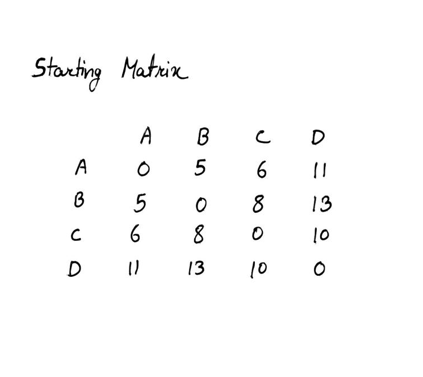
Starting matrix for constructing the phylogenetic tree using NJ method
From the above matrix,
Set of leaf nodes (T) = {A, B, C, D}
Number of leaf nodes (L) = 4
Stage 2: Iteration 1
Step 1: Calculate net divergence (r) of each node
The formula for calculating net divergence is —
r(i) = [1/(L-2)] * [d(ij) + d(ik) + d(il)]

i,j,k,l are the leaf nodes and L is the number of nodes
Using above formula, I calculated net divergence for each node in the starting matrix —
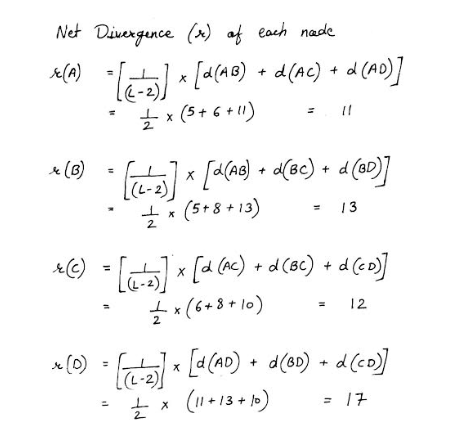
Net divergence calculations for each node
Step 2: Adjusting distance (D) for each node pair
Formula for adjusting distance foe each node pair —
D(ij) = d(ij) - [r(i) + r(j)]Using this formula, the adjusted distance for each node pair is —
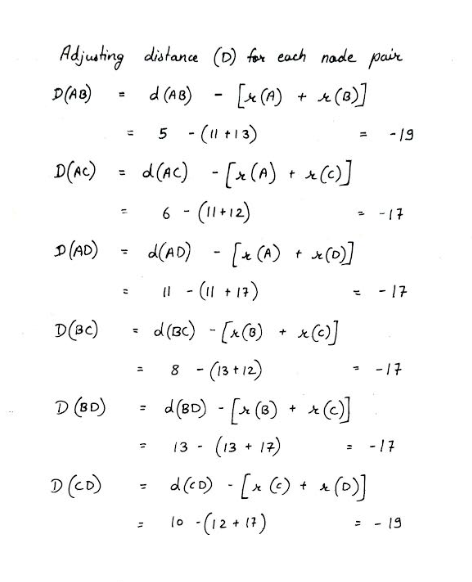
calculations for adjusting distance for each node pair
The pair of nodes with the smallest adjusted distance are neighbors. In this case there is tie between the pairs (AB) and (CD). Let’s consider pair (AB) for further calculations.
Step 3: Create a new node ‘Z’ that connects A and B.
Create a new node ‘Z’ which will be a parent node connecting child nodes A and B. To calculate the distance child to parent, the formula is
d(ik) = [d(ij) + r(i) + r(j)] / 2here, k is parent node and i and j are child nodes.
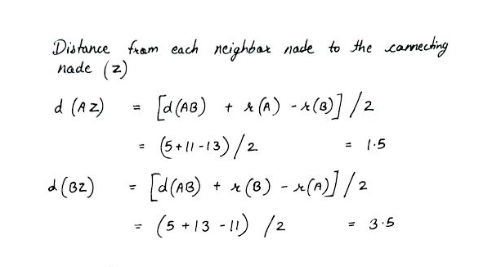
Distance calculations from each neighbor node to the connecting node
The above calculation denotes the distance between A and B from node ‘Z’. From this, the first two branches of the tree can be drawn as follows —
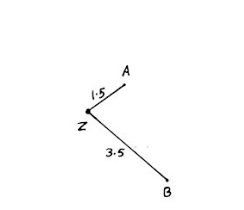
First two branches of the phylogenetic tree
Step 4: Reconstructing the distance matrix
The child nodes (A and B) are now replaced by node ‘Z’ which will change the distance matrix, but we will need to calculate the distance of remaining nodes from this new node.
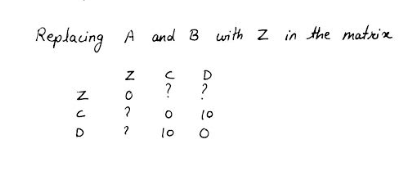
Reconstructing the distance matrix
Calculating the distance from new node to non-child nodes using the formula—
d(mk) = [d(im) + d(jm) - d(ij)] / 2here, m is non-child node.
Using the formula, the distance for non-child node to new node are —
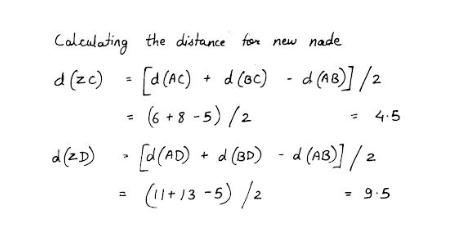
From this distance calculations, the updated matrix will be —
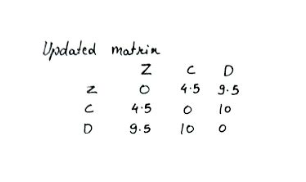
Iteration 2:
Step 5: Using the updated distance matrix, calculating net divergence (r) of each node.
Set of leaf nodes (T) = {Z, C, D}
Number of leaf nodes (L) = 3
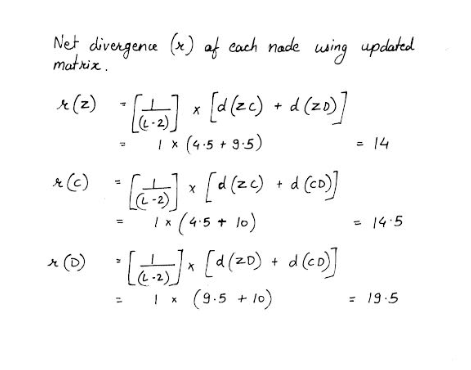
Net divergence of each node using updated distance matrix
Step 6: Adjusting distance (D) for each node pair
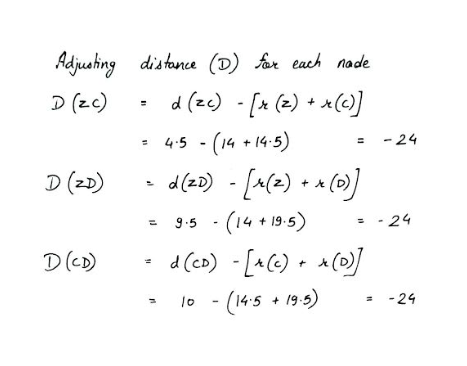
calculations for adjusting distance for each node
All of the pairs are tied for lowest adjusted distance, let’s select the first pair in the list (ZC).
Step 7: Define a new node (Y) that connects the neighbors Z and C.
Calculating distance from each neighbor node to the connecting new node (Y). Here Y is parent node and Z & C are child nodes.
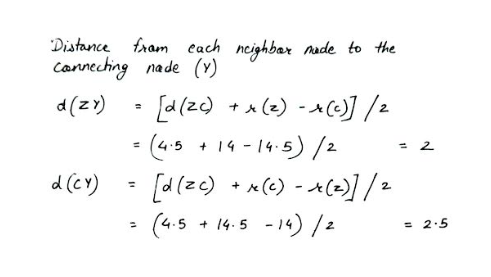
Calculations for parent to child node
From this distance, the phylogenetic tree will look like —
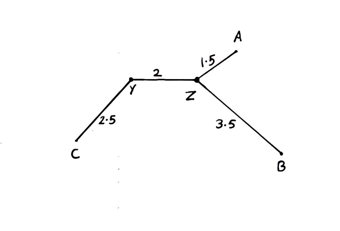
Step 8: Calculating remaining distance
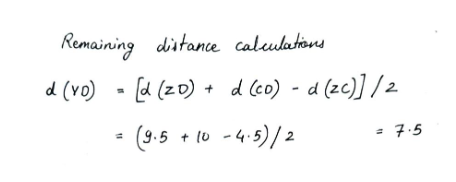
Calculation for remaining distances
The final phylogenetic tree derived from the calculations will look like following -
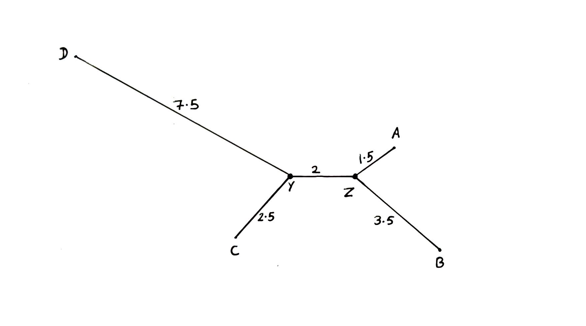
Final phylogenetic tree using NJ method
The NJ method is an effective approach for constructing phylogenetic trees. It does not assume any molecular clock of constant rate of evolution and can handle genetic as well as morphological data. By using an iterative clustering process based on distance matrix, it provides a reliable way to infer evolutionary relationships. The only drawback is it can cause loss of evolutionary signals as it reduces sequence data into pairwise distance.
메타데이터
- post_id
- 324fba11ebb3
- slug
- decoding-evolutionary-paths-neighbor-joining-nj-method-for-constructing-phylogenetic-trees-324fba11ebb3
- url
- https://medium.com/@monikammate/decoding-evolutionary-paths-neighbor-joining-nj-method-for-constructing-phylogenetic-trees-324fba11ebb3
- canonical_url
- https://medium.com/@monikammate/decoding-evolutionary-paths-neighbor-joining-nj-method-for-constructing-phylogenetic-trees-324fba11ebb3
- author_url
- https://medium.com/@monikammate
- status
- ok
- fetched_at
- 2026-06-09 15:37:30