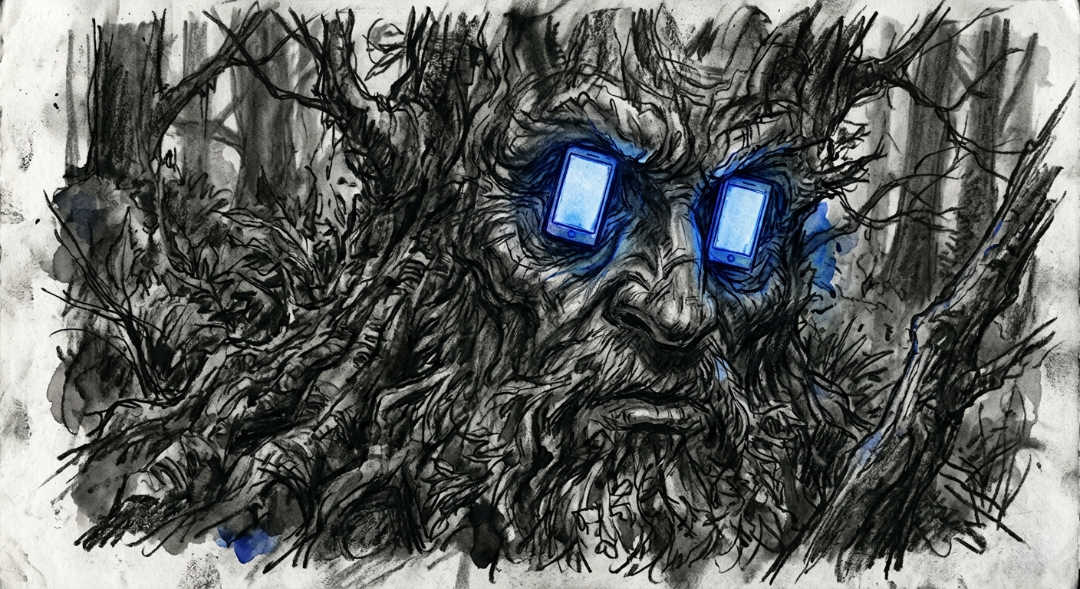
When Power Refuses to Hear Truth
Oppression, Moral Blindness, and the Responsibility of Conscience
When Power Refuses to Hear Truth
Oppression, Moral Blindness, and the Responsibility of Conscience
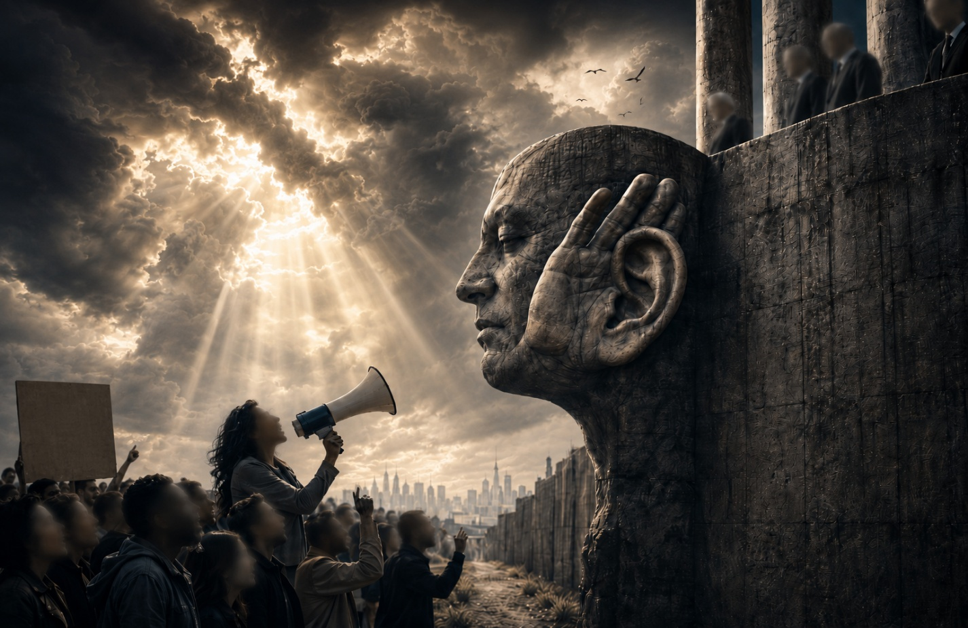
The image reflects the moral tension between power and truth, where voices from below confront structures that have learned to confuse silence with peace. (Photo illustration by the Author)
The Problem of Moral Hearing
Oppression is not sustained by force alone. It also depends on a failure of moral hearing. A person, institution, or society may hear complaints, protests, appeals, and testimonies, yet still refuse to understand what those voices reveal. This refusal is rarely simple. It may come from fear, pride, habit, political interest, social conditioning, or the desire to preserve an image of innocence. When truth threatens privilege or authority, the first response is often not reflection. It is defense.
The question of why power resists truth has occupied philosophers, theologians, political thinkers, and social critics for centuries. Plato warned that societies can mistake shadows for reality when they become accustomed to illusion. Aristotle understood justice as a condition of human flourishing, not merely a legal arrangement. Augustine examined the disordered loves that bend human beings toward domination. Immanuel Kant argued that human beings must never be treated merely as means to another person’s end.
W. E. B. Du Bois, Hannah Arendt, Frantz Fanon, Paulo Freire, and Michel Foucault each showed, in different ways, that oppression does not only control bodies. It also shapes perception, language, institutions, and moral imagination.
This article reflects on how oppression distorts conscience, how silence is mistaken for agreement, and why truth must be heard before justice can be pursued with integrity. The central concern is not simply that the oppressed are denied voice. It is that those who oppress often become unable, or unwilling, to hear truth without first translating it into threat.
Power and the Refusal to Listen
Power can serve justice when it is disciplined by humility, accountability, and respect for human dignity. Without those restraints, power becomes self-protective. It begins to interpret criticism as disloyalty and suffering as exaggeration. The person in power may still claim to value fairness, order, and peace, but those words become unreliable when they are used to avoid responsibility.
Plato’s allegory of the cave offers a useful image for this condition. In the cave, people mistake shadows for reality because shadows are all they have known. The danger is not only ignorance, but attachment to ignorance. Those who are accustomed to a certain arrangement may resist the truth because the truth requires them to reconsider the world that has made them comfortable. In oppressive systems, this attachment can become moral blindness. The powerful may believe they are defending reality when they are defending only the shadows that protect them.
Those who oppress others do not always see themselves as cruel. In many cases, they understand themselves as reasonable, necessary, or protective. They may believe they are preserving tradition, defending stability, or maintaining discipline. This is part of what makes oppression morally dangerous. It can hide behind language that sounds respectable. It can appear as procedure, policy, custom, or leadership. When the language of order is detached from justice, it becomes easier to excuse harm.
Hannah Arendt’s work on the “banality of evil” remains important here. Arendt did not suggest that evil is harmless or ordinary in its consequences. Rather, she showed how destructive systems can be carried forward by individuals who fail to think critically about their actions and responsibilities. Oppression often depends on this failure. People follow rules, repeat official language, and obey institutional routines without asking whether those routines violate human dignity.
When Order Is Mistaken for Justice
One of the most common mistakes in oppressive environments is the confusion of order with justice.
A society, organization, family, or institution may appear calm because those who are wounded have learned that speaking carries consequences. The absence of visible conflict should not be mistaken for moral health. There are places where peace is not the presence of justice, but the result of fear.
Aristotle’s understanding of justice helps clarify this distinction. For Aristotle, justice was not only about punishment or law. It was connected to right relationship, proportion, and the conditions that allow human beings to flourish. If an arrangement preserves calm while denying dignity, it may be orderly, but it is not just. Order becomes morally weak when it requires the injured to remain silent for the comfort of those in control.
Martin Luther King Jr. made a similar distinction when he criticized what he called a “negative peace,” which is the absence of tension, and contrasted it with a “positive peace,” which requires the presence of justice. His insight remains relevant because many oppressive systems present themselves as guardians of peace. They do not ask whether people are treated with dignity. They ask whether people are quiet.
This does not mean that every criticism is automatically correct or that every grievance should be accepted without examination. Truth requires discernment. Yet discernment is not dismissal. A serious moral response begins by asking what conditions gave rise to the complaint, who has been harmed, and whether the existing order has protected some people at the expense of others.
The Forms Oppression Can Take
Oppression may appear through direct violence, but it may also operate through less visible practices. It can emerge through exclusion, humiliation, unequal access, intimidation, inherited prejudice, selective enforcement, or the denial of voice. It can occur in public systems and private relationships. It can be embedded in institutions, but it can also be practiced through ordinary habits of speech, judgment, and avoidance.
Michel Foucault’s analysis of power is useful because it challenges the idea that power exists only in laws, rulers, or visible acts of force. Foucault argued that power also circulates through knowledge, discipline, institutions, and accepted norms. This helps explain why oppression can continue even when no single person appears to be issuing direct commands. A system can train people to accept certain categories, expectations, and hierarchies as natural.
Because oppression can become routine, those who participate in it may not experience themselves as oppressors. They may simply be following rules, repeating inherited assumptions, or benefiting from arrangements they did not create. Still, moral responsibility does not disappear because a harmful pattern is familiar. The fact that injustice has been normalized may make it harder to see, but it does not make it ethically neutral.
The deeper issue is not only whether one person intends harm. Intention matters, but harm can continue even when people describe themselves as well-meaning. A narrow focus on personal intention allows individuals and institutions to avoid examining consequences. A more honest approach asks whether dignity has been denied, whether voices have been suppressed, and whether some people are required to carry burdens others refuse to acknowledge.
How Oppression Distorts Conscience
Oppression changes the person who practices it. It teaches the conscience to look away. Over time, the pain of others becomes easier to explain, minimize, or blame on the victims themselves. The oppressed are no longer encountered as full moral subjects. They become problems to manage, threats to control, or interruptions to an established way of life.
Immanuel Kant’s moral philosophy is especially relevant here. Kant argued that human beings possess dignity and must never be treated merely as instruments for another person’s purposes. Oppression violates this principle because it reduces persons to functions. The worker becomes labor without voice. The citizen becomes a subject without agency. The poor become statistics. The stranger becomes a threat. The wounded become an inconvenience.
Frantz Fanon examined this moral distortion in the context of colonial domination. In his analysis, oppression does not simply take land, labor, or political power. It also imposes categories through which the oppressed are seen and through which they may begin to see themselves. The oppressor’s gaze becomes a form of violence because it denies the full humanity of the person being judged. Fanon helps us understand that oppression is not only material. It is psychological, symbolic, and relational.
This distortion is gradual. It may begin with indifference rather than hatred. A leader ignores a complaint because it is inconvenient. A community explains away mistreatment because change would be disruptive. An institution protects its reputation rather than confronting the harm done within it. Each act of avoidance makes the next one easier.
When conscience is trained by power rather than truth, language becomes unstable. Words such as fairness, loyalty, respect, and unity may still be used, but they no longer carry their full ethical meaning. Fairness may mean protecting the powerful from discomfort. Loyalty may mean silence. Respect may mean submission. Unity may mean the refusal to name harm. In this way, oppression does not only injure people. It also corrupts the moral vocabulary through which people understand themselves.
Silence and the Illusion of Agreement
Silence is often misread by those in authority. The powerful may interpret it as consent, satisfaction, or trust. Yet silence has many meanings. It may mean fear. It may mean exhaustion. It may mean that previous attempts to speak were punished or ignored. It may mean that people have calculated the cost of honesty and found it too high.
W. E. B. Du Bois’s idea of “double consciousness” offers one way to understand the burden placed on those who live under domination. Du Bois described the divided awareness produced when a person must see themselves through their own eyes and through the eyes of a society that misrecognizes them. In oppressive conditions, the wounded often learn not only how to speak, but when not to speak. They learn how to survive in spaces where truth can be costly.
This is especially important in environments where reputation, employment, status, or safety depends on pleasing those in control. In such spaces, people often learn to speak carefully, indirectly, or not at all. The result is a culture in which leaders receive filtered information and then confuse that filtered information with reality.
A serious commitment to truth requires attention to what is not being said. It requires leaders, communities, and institutions to ask whether people are genuinely free to speak. If honesty is costly only for the vulnerable, then the environment is not truthful. It is managed.
Truth from the Margins
Truth often reaches society through the voices of those whose suffering has been dismissed. This does not mean that every claim from the margins is complete or beyond critique. It means that the experience of those harmed by injustice contains knowledge that cannot be replaced by theories from a distance. A person who lives under exclusion understands dimensions of that exclusion that a beneficiary may never see unless they are willing to listen with humility.
Paulo Freire’s work in Pedagogy of the Oppressed is important because he understood oppression as a condition that denies people the opportunity to name their own world. For Freire, liberation requires dialogue, not paternalism. The oppressed are not objects of charity or passive recipients of instruction. They are subjects capable of reflection, speech, and transformation. This insight matters because oppressive power frequently claims to speak for those it refuses to hear.
The moral task is not to romanticize suffering. Suffering does not automatically make a person wise. Yet suffering can disclose realities that comfort conceals. Those who are protected by a system may see only its order, efficiency, or tradition. Those harmed by the same system may see its cost. To ignore their testimony is to choose a partial view of reality.
The voice of truth may come through grief, anger, resistance, or refusal. Its tone may not always be gentle. This can disturb those who believe truth should arrive in a form that preserves their comfort. Yet pain does not become false because it is expressed with intensity. When people have been ignored for a long time, their speech may carry the weight of accumulated injury. The ethical question is not whether their words make the powerful uncomfortable. The question is whether their words reveal a harm that must be addressed.
The Discipline of Self-Examination
To hear truth, one must practice self-examination. This is not guilt for its own sake. It is the disciplined willingness to ask difficult questions about one’s conduct, assumptions, and position. Have I ignored pain because acknowledging it would require change? Have I confused my comfort with peace? Have I treated criticism as disrespect because it challenged my authority? Have I benefited from arrangements I have not examined?
Socrates remains one of the most important figures for this kind of moral inquiry. His insistence that “the unexamined life is not worth living” was not a call for abstract reflection alone. It was a challenge to complacency. Socratic questioning exposes the weakness of inherited certainty. It asks people to examine whether their beliefs can survive honest scrutiny.
In the context of oppression, self-examination is difficult because it challenges the stories people tell about themselves. Most individuals and institutions prefer to imagine themselves as fair. That self-image can become a barrier to truth when it prevents honest confrontation with harm. Moral maturity requires the ability to hold two realities together: one may not intend injustice, and yet one may still participate in it.
Humility is essential here. A person who cannot be corrected cannot be trusted with power. A leader who cannot listen to pain cannot lead with integrity. A community that treats every criticism as an attack will eventually lose the ability to reform itself. Self-examination does not weaken moral authority. It is one of the conditions that makes moral authority credible.
The Misuse of Moral Language
Oppression often survives through distorted language. Words that should protect human dignity can be turned into instruments of silence. Calls for peace can be used to avoid justice. Appeals to unity can be used to suppress accountability. Demands for respect can be directed only toward the powerless, while the powerful excuse their own contempt.
George Orwell warned about the political misuse of language, especially when language is used to conceal violence, evade responsibility, or make injustice sound reasonable. Although Orwell wrote in a particular historical context, his warning applies broadly. When words are severed from truth, language becomes a tool of control.
This misuse of language shapes what people are allowed to notice. If a protest is called disorder, the injury that caused it may disappear from view. If a demand for accountability is called bitterness, the focus shifts from harm to the emotional state of the harmed. If the oppressed are described as ungrateful, difficult, or divisive, their moral claim is weakened before it is even considered.
A truthful society must be careful with its words. It must ask whether language clarifies reality or protects those who wish to avoid it. Moral language should not be used as decoration. It should lead to responsibility.
Truth, Accountability, and Repair
Truth is not merely exposure. It should lead toward accountability and, where possible, repair. Without accountability, truth can become a spectacle. People may publicly acknowledge harm while privately preserving the conditions that produced it. Without repair, apology becomes incomplete. It may comfort the speaker more than the wounded.
John Rawls’s theory of justice offers one way to think about fairness beyond personal preference. His idea of the “veil of ignorance” asks people to imagine social arrangements without knowing what position they would occupy within them. This thought experiment exposes the moral weakness of systems designed by those who assume they will remain among the protected. If a structure would appear unjust from the position of the vulnerable, then its defenders must explain why it should be accepted as fair.
Accountability does not always take the same form. In some cases, it requires confession and apology. In others, it requires institutional reform, restitution, changed leadership, policy revision, or a redistribution of voice and authority. The form depends on the nature of the harm. What matters is that truth must be allowed to change reality.
Repair also requires memory. Injustice is often repeated when communities rush too quickly toward closure. Those who suffer are asked to move on before the harm has been understood. This demand protects the comfort of others, not the dignity of the wounded. Genuine repair does not erase memory. It places memory in the service of moral transformation.
The Responsibility of Conscience
Conscience is not passive feeling. It is an active responsibility to notice, judge, and respond to what violates human dignity. Sympathy may feel sorrow for the oppressed, but conscience asks what must change. Sympathy may be temporary. Conscience requires commitment.
Augustine’s moral thought is helpful because he understood evil not merely as individual wrongdoing, but as a disordering of love and desire. When people love power, status, control, or reputation more than justice, their moral judgment becomes disordered. They may still speak the language of virtue, but their actions reveal what they truly protect.
This responsibility belongs not only to leaders or institutions, but also to ordinary people who witness harm. Silence in the presence of oppression is rarely neutral. It may be motivated by fear, caution, or fatigue, but it still has consequences. When injustice is left unchallenged, it gains room to organize itself as normal life.
The responsibility of conscience does not require reckless speech or simplistic judgment. It requires courage guided by wisdom. There are moments when truth must be spoken publicly, and there are moments when it must be pursued through careful action, patient reform, and protection of those at risk. What conscience cannot accept is comfort purchased at the price of another person’s dignity.
Why the Voice of Truth Matters
The voice of truth matters because oppression depends on distortion. It distorts how the powerful see themselves, how the wounded are described, and how society remembers what happened. Truth interrupts that distortion. It restores moral proportion. It reminds people that authority is not the same as righteousness and that silence is not the same as peace.
bell hooks wrote extensively about domination, love, education, and the possibility of transformation. Her work is valuable because she did not treat oppression only as a political structure. She also examined how domination enters relationships, classrooms, communities, and habits of thought. To resist oppression, then, is not only to oppose unjust systems. It is also to cultivate ways of seeing and relating that do not reproduce domination in ordinary life.
Those who refuse to hear truth may delay accountability, but delay is not resolution. Pain that is denied does not become harmless. It can return as mistrust, division, resentment, and institutional decay. A family, organization, community, or nation that refuses to examine its injuries will eventually be shaped by them.
The purpose of truth is not humiliation. Its purpose is moral clarity. It allows individuals and communities to name harm accurately so that justice can become possible. Without truth, reform becomes shallow. Without truth, reconciliation becomes performance. Without truth, power continues to defend itself while calling its defense peace.
Hearing Before Justice Is Lost
Oppression teaches the powerful to hear only what protects them. Truth asks them to hear what responsibility requires. That difference is the heart of the moral struggle. To hear truth is to become answerable to the pain of others. It is to allow conscience to interrupt self-justification. It is to recognize that dignity cannot depend on permission from those who hold power.
The philosophers and scholars considered here do not speak with one voice, yet they help illuminate a shared problem. Plato warns against illusion. Aristotle connects justice to human flourishing. Augustine examines the disorder of desire. Kant insists on human dignity. Du Bois reveals the burden of being misrecognized. Arendt exposes the danger of thoughtless participation in destructive systems. Fanon shows the psychological violence of domination. Freire insists that the oppressed must be heard as subjects, not objects. Foucault reveals how power circulates through institutions and knowledge. Rawls asks whether our idea of fairness survives when we no longer know where we stand.
Together, these thinkers remind us that oppression is never only a matter of external control. It is also a crisis of perception, conscience, language, and responsibility.
A just society cannot be built on the silence of the wounded. It must be built through listening, examination, accountability, and repair. Those who oppress may close their ears, but refusal does not make injustice righteous. Truth remains present in the lives of those who have suffered and in the conscience of those still willing to see.
The voice of truth is not always welcomed. It is not always comfortable. Yet without it, power becomes blind, peace becomes fragile, and moral language loses its meaning. To listen to truth is not merely to hear another person speak. It is to accept the responsibility that their suffering places before us.
Sources and Further Reading
Arendt, H. (1963). Eichmann in Jerusalem: A report on the banality of evil. Viking Press.
Aristotle. (1999). Nicomachean ethics (T. Irwin, Trans.; 2nd ed.). Hackett Publishing Company. (Original work published ca. 350 B.C.E.)
Augustine. (1998). The city of God against the pagans (R. W. Dyson, Ed. & Trans.). Cambridge University Press. (Original work published ca. 426 C.E.)
Du Bois, W. E. B. (1903). The souls of Black folk: Essays and sketches. A. C. McClurg & Co.
Fanon, F. (1963). The wretched of the earth (C. Farrington, Trans.). Grove Press. (Original work published 1961)
Foucault, M. (1977). Discipline and punish: The birth of the prison (A. Sheridan, Trans.). Pantheon Books. (Original work published 1975)
Freire, P. (1970). Pedagogy of the oppressed (M. B. Ramos, Trans.). Continuum. (Original work published 1968)
hooks, b. (1994). Teaching to transgress: Education as the practice of freedom. Routledge.
Kant, I. (2012). Groundwork of the metaphysics of morals (M. Gregor & J. Timmermann, Trans.; 2nd ed.). Cambridge University Press. (Original work published 1785)
King, M. L., Jr. (2018). Letter from Birmingham Jail. Penguin Classics. (Original work published 1963)
Orwell, G. (2013). Politics and the English language. Penguin Classics. (Original work published 1946)
Plato. (1997). Complete works (J. M. Cooper & D. S. Hutchinson, Eds.). Hackett Publishing Company.
Rawls, J. (1971). A theory of justice. Harvard University Press.
© 2026 Dr. Bekim Belica
메타데이터
- post_id
- 326cdce0a54d
- slug
- when-power-refuses-to-hear-truth-326cdce0a54d
- url
- https://medium.com/illumination-philosophy-and-metaphysics/when-power-refuses-to-hear-truth-326cdce0a54d
- canonical_url
- https://medium.com/illumination-philosophy-and-metaphysics/when-power-refuses-to-hear-truth-326cdce0a54d
- author_url
- https://medium.com/@drbekimbelica
- status
- ok
- fetched_at
- 2026-06-22 05:41:33